
Intro
The first hours after birth involve major physiological adjustments for both parent and baby. Skin-to-skin contact offers a gentle way to support this transition while creating space for closeness, observation, and early feeding.
Although the practice is simple, safe positioning and appropriate clinical supervision matter. Skin-to-skin can usually be adapted after vaginal or cesarean birth, during feeding, and at home, but medical priorities always come first.
Highlights
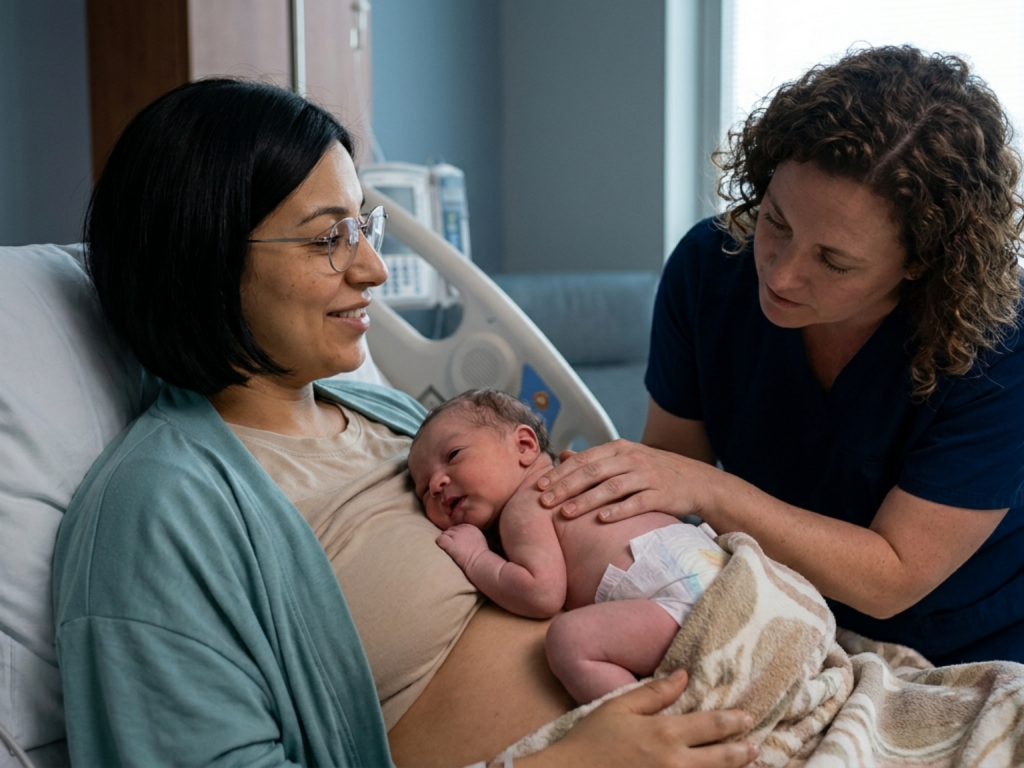
Skin-to-skin means placing a newborn directly against a caregiver’s bare chest, usually with the baby wearing only a diaper and covered by a warm blanket.
Early contact supports thermoregulation, cardiorespiratory adaptation, breastfeeding, and blood glucose stability.
The baby’s face must remain visible, with the head turned to one side and the airway unobstructed.
If immediate contact is interrupted for medical care, it can often begin later and still be valuable.
What skin-to-skin contact means
Skin-to-skin contact means placing a newborn, usually wearing only a diaper and sometimes a hat, prone against a parent’s bare chest. The baby and parent are then covered with a warm, dry blanket while the baby’s face remains visible. Immediately after birth, the birthing parent is generally the first choice when both parent and baby are clinically stable. A partner or another caregiver may also provide contact when needed.
This practice is sometimes called kangaroo care, although kangaroo mother care is a broader clinical intervention that includes prolonged skin-to-skin contact and support for exclusive breast milk feeding, particularly for preterm or low-birth-weight infants.
Newborn skin-to-skin care is not simply holding a clothed baby. Direct contact provides sensory and thermal input while allowing the newborn to hear a familiar heartbeat, smell the parent, and move toward the breast. Routine observations and many uncomplicated post-birth procedures can often occur without separating the baby, depending on local protocols and clinical circumstances.
When it begins and how long it continues
For a vigorous, stable newborn, skin-to-skin contact can begin immediately after birth, following rapid drying and an initial clinical assessment. The World Health Organization describes prolonged, uninterrupted contact as part of early essential newborn care. Many maternity teams aim to preserve this period for at least the first hour and through the first feeding cues, rather than ending it according to a rigid clock.
Uninterrupted skin-to-skin contact allows the newborn to progress through early behavioral states at an individual pace. Some babies remain quietly alert, while others rest, make small crawling movements, bring their hands to their mouth, or begin rooting. These behaviors should not be forced or rushed.
If resuscitation, surgery, significant maternal instability, or neonatal assessment makes immediate contact unsafe, treatment takes priority. This does not mean the opportunity has been lost. Skin-to-skin can begin as soon as the healthcare team confirms that both participants are stable. It can then be repeated during the postnatal stay and at home for as long as it feels comfortable and remains safely supervised.
Physiological benefits for the newborn
A newborn must rapidly transition from placental support to independent breathing, circulation, glucose regulation, and temperature control. The parent’s chest provides a warm microenvironment that can reduce heat loss through evaporation, convection, and radiation. This support for newborn temperature regulation is particularly relevant because newborns have a large surface-area-to-mass ratio and limited capacity to generate heat without increasing metabolic demand.
Skin-to-skin may also promote more stable respiratory and heart rates in healthy infants. Familiar sensory signals can reduce stress-related behavioral activation, while close observation makes subtle feeding cues easier to recognize. Evidence summarized by the World Health Organization indicates that early contact improves breastfeeding outcomes, including the likelihood of initiating and continuing breastfeeding.
Research also suggests a clinically meaningful role in blood glucose regulation. A systematic review indexed in PubMed found that skin-to-skin contact reduced neonatal hypoglycaemia compared with usual care, although certainty and protocols varied across studies. Contact may conserve energy by maintaining warmth and may facilitate earlier colostrum intake. Babies with established risk factors for hypoglycaemia still require the glucose monitoring and feeding plan recommended by their neonatal team; skin-to-skin does not replace indicated screening or treatment.
Feeding, bonding, and parental wellbeing
During quiet alert periods, a newborn may display first feeding cues such as hand-to-mouth movements, rooting, tongue movements, and searching with the head. Keeping the baby close helps parents notice these cues before crying, which is a late sign of hunger. When breastfeeding is planned, early contact may support self-attachment and the first feed, but some babies need positioning assistance or time to recover from birth.
Skin-to-skin contact is also associated with hormonal responses, including parental oxytocin release. Oxytocin contributes to uterine contraction, milk ejection, calm behavior, and social attachment. Bonding, however, is not a single event that must happen immediately. Parents may feel love, relief, uncertainty, numbness, or exhaustion after birth; all of these responses can occur without predicting the quality of the developing relationship.
Parents who formula-feed or use expressed milk can also offer skin-to-skin. Its thermal, sensory, and relational benefits are not dependent on feeding method. For families facing a difficult birth, separation, or feeding challenges, later periods of calm contact may provide a reassuring way to become familiar with the baby without creating pressure to achieve a particular emotional or feeding outcome.
Safe positioning and supervision
Safe skin-to-skin positioning protects the newborn’s airway while preserving direct chest contact. The baby should lie upright or diagonally across the adult’s chest, with the head turned to one side and the neck in a neutral or slightly extended position. The nose and mouth must remain uncovered, the chin should be away from the chest, and the shoulders and trunk should be supported. A blanket may cover the baby’s back but not the face.
The adult should be awake, responsive, and sufficiently upright to observe the baby. A staff member or alert support person should monitor the pair if the birthing parent is fatigued, sedated, unwell, or unable to see the baby clearly. Particular vigilance may be needed after opioid medication, general anesthesia, a complicated birth, or prolonged labor.
Skin-to-skin should not continue unattended if the caregiver is becoming drowsy. The baby should instead be placed supine in a separate, firm, flat sleep space that meets local safe-sleep guidance. Sofas, recliners, soft bedding, and adult beds create entrapment and suffocation hazards. Skin-to-skin is an awake, observed activity and is not a substitute for a safe newborn sleep environment.
Cesarean birth, prematurity, and temporary separation
Cesarean birth does not automatically exclude early contact. When the birthing parent is stable and the newborn does not need urgent intervention, operating-room skin-to-skin after cesarean may be possible with help from a midwife, nurse, or partner. Monitoring leads, intravenous lines, sterile fields, nausea, shaking, and arm movement must be considered. Staff may position the baby high on the chest and assign one person to watch the airway continuously.
If maternal anesthesia or surgical circumstances make this impractical, partner skin-to-skin may provide warmth and reassurance until the birthing parent is ready. Families can include cesarean birth preferences for skin-to-skin in a birth preferences document, while recognizing that the clinical plan may need to change quickly.
Preterm, low-birth-weight, or medically unstable babies may require specialist neonatal care. For stable infants, carefully supported contact can be incorporated around respiratory equipment, feeding tubes, or monitoring under neonatal guidance. The timing and duration should be individualized by the clinical team. When separation is unavoidable, parents may feel disappointed or distressed; requesting updates, photographs where permitted, early milk-expression support, and contact as soon as medically feasible can help preserve participation in care.
Continuing skin-to-skin after leaving hospital
Daily skin-to-skin at home can be used for comfort, feeding cues, or quiet connection. Choose a time when the caregiver is fully awake and not affected by alcohol, sedating medication, recreational drugs, or extreme fatigue. Sit in a stable, supported position, keep the baby’s airway visible, and have another adult nearby if there is any concern about drowsiness or mobility.
There is no universal required duration. Some families prefer brief periods, while others continue for an hour or longer. The baby’s temperature and behavioral cues should guide comfort: excessive sweating, hot skin, persistent agitation, pallor, or unusual lethargy warrant stopping and assessing the baby. Avoid overheating from heavy blankets or an excessively warm room.
Parents should not feel that they have failed if skin-to-skin is uncomfortable, emotionally difficult, or not possible. Alternatives such as responsive holding, talking, feeding, and making eye contact also support attachment. Ask a midwife, neonatal nurse, lactation professional, pediatric clinician, or obstetric team for individualized guidance if the baby was premature, has a medical condition, feeds poorly, or requires glucose or temperature monitoring.
When to stop and seek help
- Stop immediately if the baby’s face becomes covered, the chin drops onto the chest, or breathing appears obstructed.
- Call emergency services for absent or abnormal breathing, blue or grey coloration, marked limpness, or inability to wake the baby.
- Seek urgent clinical advice for persistent poor feeding, unusual lethargy, temperature instability, or repeated jitteriness.
- Do not continue skin-to-skin while sleeping or when the caregiver is significantly drowsy or sedated.
- Follow the neonatal team’s monitoring plan for babies at risk of hypoglycaemia, prematurity, infection, or respiratory difficulty.
Tools & Assistance
- Discuss skin-to-skin preferences with the maternity team before labor or a planned cesarean birth.
- Ask a midwife or neonatal nurse to demonstrate and check the baby’s airway position.
- Request lactation or infant-feeding support if feeding cues or attachment are difficult to interpret.
- Use local emergency services for breathing difficulty, abnormal color, profound lethargy, or unresponsiveness.
FAQ
Can a partner provide skin-to-skin contact?
Yes. An alert partner can provide skin-to-skin when the birthing parent is unavailable or later as part of routine care, provided the newborn is stable and safely positioned.
Does the baby need to breastfeed during skin-to-skin?
No. Feeding may occur naturally, but contact remains beneficial when breastfeeding is delayed, expressed milk is used, or the family formula-feeds.
Can skin-to-skin prevent neonatal hypoglycaemia?
It can reduce risk and support glucose stability, but it cannot guarantee prevention or replace clinically indicated glucose checks, feeding plans, glucose gel, or other treatment.
Is skin-to-skin safe if the parent falls asleep?
No. If the caregiver becomes drowsy, the baby should be moved to a separate, firm, flat sleep surface and placed on their back according to safe-sleep guidance.
Is it too late if skin-to-skin did not happen immediately?
No. Contact can begin later and be repeated whenever the baby and caregiver are stable, awake, and appropriately supported.
Sources
- World Health Organization — Early skin-to-skin contact for mothers and their healthy newborn infants
- PubMed — Skin-to-skin contact for the prevention of neonatal hypoglycaemia
- World Health Organization — Early Essential Newborn Care
Disclaimer
This article provides general medical information and is not a substitute for individualized advice. Consult your maternity or neonatal healthcare team about safe skin-to-skin care for your circumstances.

















Please log in to leave a comment.