
Intro
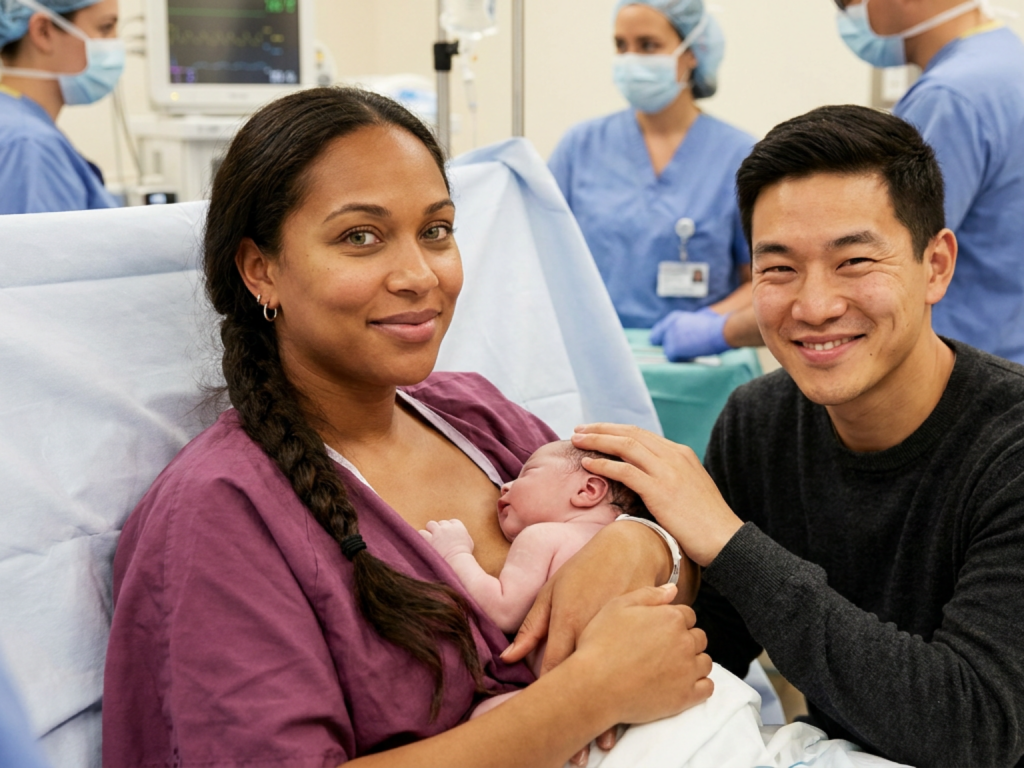
A cesarean birth is a surgical birth, but it can still include immediate warmth, closeness, and early feeding support. Skin-to-skin contact after C-section means placing the unclothed newborn, usually wearing only a diaper and hat if needed, directly against a parent’s bare chest while both are safely monitored.
For many families, the partner’s role becomes especially meaningful in the operating room and recovery area. A partner can help protect the birthing parent’s comfort, communicate preferences, support early feeding, and provide skin-to-skin if the birthing parent is not medically ready.
Highlights
Immediate skin-to-skin after cesarean can support thermoregulation, glucose stability, breastfeeding initiation, and bonding when mother and baby are clinically stable.
Operating-room skin-to-skin is possible in many planned and unplanned C-sections with coordinated anesthesia, surgical, midwifery, and neonatal care.
The partner can be an active part of the care plan by advocating, helping with positioning, observing the baby, and offering skin-to-skin if separation from the birthing parent is necessary.
Safety comes first: maternal alertness, sterile field protection, neonatal breathing, temperature, and staff access must guide timing and positioning.
Why skin-to-skin still matters after a surgical birth
A C-section can be medically necessary, planned, urgent, calm, frightening, empowering, or emotionally mixed. None of these experiences makes early contact less important. Skin-to-skin care is a physiologic intervention as well as an emotional one: it places the newborn in close contact with a warm, breathing, familiar body at the moment they are adapting from intrauterine to extrauterine life.
After birth, babies must regulate temperature, glucose, breathing, heart rate, and arousal state. Skin-to-skin contact after C-section can help reduce heat loss, support cardiorespiratory stability, and encourage early feeding behaviours such as rooting, licking, hand-to-mouth movements, and self-attachment. Scientific reviews also describe benefits for hypoglycaemia prevention, hypothermia prevention, breastfeeding facilitation, and early microbial exposure.
For the birthing parent, contact with the baby can stimulate oxytocin release. Oxytocin is involved in bonding, uterine tone, milk ejection, and calming responses. This does not mean every parent feels instant joy; anesthesia, pain, blood loss, nausea, fatigue, or birth trauma can affect the moment. Skin-to-skin is not a test of parental love. It is an option that can be offered gently, with consent, and adapted to the parent’s clinical and emotional state.
How immediate skin-to-skin can work in the operating room
In many maternity units, immediate or very early skin-to-skin after cesarean is organized through a defined protocol. If the newborn is vigorous and the birthing parent is stable, the surgeon or neonatal team may place the baby directly onto the parent’s upper chest while maintaining the sterile surgical field. Drapes may be lowered briefly or arranged so that contact can occur without compromising sterility. The baby is dried, assessed, and positioned so the airway remains visible.
The anesthesia team usually has a central role because the birthing parent’s arms, blood pressure cuff, intravenous lines, oxygen saturation probe, and monitoring cables may limit movement. A midwife, nurse, or partner may help hold the baby securely. Warm blankets are often placed over both parent and baby, while the baby’s face remains uncovered and observable. Staff continue monitoring maternal blood pressure, oxygenation, nausea, sedation level, and surgical progress.
Some units use a “gentle cesarean” or “family-centred cesarean” approach, but the exact steps vary. Families can ask in advance whether theatre skin-to-skin is routinely offered, whether delayed cord clamping is possible, whether routine newborn checks can be done on the parent’s chest, and what happens if the baby needs assessment at a warmer. If operating-room contact is not possible, recovery-room skin-to-skin can still be valuable and should not be viewed as a failure.
Breastfeeding, glucose, and newborn transition
Early contact is strongly linked with feeding behaviours. Evidence summaries report that birthing parents who received skin-to-skin after cesarean were more likely to breastfeed at one to four months and more likely to exclusively breastfeed. Babies who had skin-to-skin were also more likely to complete a successful first feed and had higher blood glucose levels in reported data. These findings are biologically plausible: close contact reduces stress, supports temperature regulation, and gives the baby access to the breast during a period of innate alertness.
Cesarean birth can sometimes be associated with delayed lactogenesis II, the onset of copious milk production, especially when there is maternal illness, significant blood loss, preterm birth, diabetes, obesity, or separation. Skin-to-skin does not guarantee breastfeeding after c-section will be easy, but it can improve the conditions for early milk transfer and infant organization. If direct latch is not possible, the same contact can support cue-based feeding, hand expression, and paced supplementation when medically indicated.
It is also important to protect the birthing parent’s body. Incision discomfort, uterine cramping, shoulder pain from referred gas, nausea, and limited mobility can make early feeding awkward. Pillows, rolled towels, a side-lying or laid-back position in recovery, and help keeping the baby away from the incision can make a significant difference. Lactation support is particularly useful if the baby is sleepy, premature, has low glucose, or needs additional monitoring.
The partner as advocate before and during birth
The partner’s role begins before the operation. A short, respectful birth preferences document can state that the family would like immediate skin-to-skin if clinically safe, minimal unnecessary separation, early feeding support, and partner skin-to-skin if the birthing parent is unavailable. This should be discussed with the obstetric, anesthesia, midwifery, and neonatal teams, especially for planned cesareans or pregnancies with known medical complexity.
During the birth, the partner can help by being a calm communicator rather than trying to control the clinical environment. Useful phrases include: “Is the baby stable enough for skin-to-skin?” “Can checks be done on the chest?” “If not now, when can we try?” and “Would partner skin-to-skin be appropriate while the birthing parent is being cared for?” These questions acknowledge that staff must prioritize safety while keeping family contact visible as a care goal.
The partner may also help notice the birthing parent’s needs. Some parents feel shaky, exposed, nauseated, itchy, overwhelmed, or frightened during surgery. A partner can ask whether they want the baby placed now, whether they need a pause, whether they want photos, or whether they would prefer the partner to hold the baby first. Consent matters, even in joyful moments. Respectful support means listening to the birthing parent rather than assuming what they “should” want.
Partner skin-to-skin when the birthing parent cannot do it immediately
When the birthing parent is under general anesthesia, heavily sedated, medically unstable, vomiting, shaking intensely, or undergoing urgent surgical management, immediate chest-to-chest contact may not be safe or comfortable. In those situations, partner skin-to-skin can be an excellent bridge. The baby can be placed upright against the partner’s bare chest, covered with warm blankets, with the head turned to one side and the airway visible.
Partner skin-to-skin is not “second best” in an emotional sense. It provides warmth, containment, familiar voices, and reduced separation while the birthing parent receives necessary care. It can also help the partner feel included after a birth that may otherwise feel highly medicalized. If the partner is anxious, staff can coach them: sit reclined, keep both hands supporting the baby, avoid covering the baby’s face, and call for help if the baby changes colour, becomes floppy, grunts, or seems difficult to rouse.
Once the birthing parent is ready, the baby can transition to their chest for continued contact and feeding support. The partner can then shift roles: arranging pillows, helping protect the incision, offering water if allowed, tracking feeding cues, and limiting unnecessary interruptions. In this way, partner skin-to-skin supports the whole sequence of bonding after cesarean birth rather than replacing the birthing parent’s experience.
Safety, monitoring, and when to adapt the plan
Skin-to-skin after cesarean should be supported, but it must be safe. The newborn’s nose and mouth need to remain visible, the neck should be slightly extended rather than flexed, and the chest should be observed for breathing. A baby who is very preterm, has respiratory distress, requires resuscitation, has significant congenital concerns, or needs urgent glucose or temperature management may require stabilization before prolonged contact.
Maternal factors also matter. Low blood pressure, excessive bleeding, reduced consciousness, severe pain, magnesium sulfate therapy, general anesthesia, or high opioid exposure can alter alertness and holding ability. In these cases, close staff supervision, partner assistance, or delayed contact may be safer. Safety planning is not a rejection of skin-to-skin; it is how the practice remains clinically responsible.
Families can ask for adaptations. If the operating room is too cold or crowded, contact may begin in recovery. If the parent cannot hold the baby securely, a staff member or partner can provide hands-on support. If feeding is delayed, hand expression, colostrum collection, or lactation review may be appropriate depending on the clinical situation. If the birth was traumatic, some parents prefer gradual contact. Emotional readiness is part of safe care too.
Planning practical details for recovery and the first day
The first 24 hours after a cesarean often involve frequent observations, pain assessment, uterine checks, bleeding checks, catheter care, mobility support, and newborn feeding. A partner can make skin-to-skin more achievable by handling logistics: keeping the call bell within reach, passing the baby safely, helping with blankets, noting feeding times, and reminding visitors that rest and bonding come first.
Clothing can help. A hospital gown that opens in front, a soft robe, or a button-front top allows easier access without tugging near the incision. The partner may also want a shirt that opens easily if partner skin-to-skin becomes useful. In recovery after c-section, the birthing parent should avoid twisting or sudden reaching; asking for help to lift and reposition the baby is appropriate, not a sign of weakness.
If breastfeeding is planned, early support with positioning is valuable. Football hold, side-lying, laid-back nursing, or a cross-cradle hold with incision protection may be considered with professional guidance. If bottle-feeding or combination-feeding, skin-to-skin still supports regulation and bonding; feeding method does not determine whether closeness is beneficial. The goal is not a perfect golden hour. The goal is responsive, safe, compassionate care for a recovering parent and a transitioning newborn.
When to seek immediate help
- Call staff immediately if the baby has blue or grey colouring, persistent grunting, pauses in breathing, marked floppiness, or poor responsiveness.
- Ask for urgent help if the birthing parent feels faint, confused, excessively sleepy, short of breath, or has heavy bleeding.
- Do not continue unsupported skin-to-skin if the parent is too sedated or weak to keep the baby’s airway visible.
- Seek clinical guidance for low temperature, low blood sugar concerns, poor feeding, prematurity, or respiratory distress.
- Contact the maternity team if pain, nausea, shaking, or emotional distress makes holding the baby feel unsafe or overwhelming.
Tools & Assistance
- Discuss skin-to-skin preferences with the obstetric and anesthesia team before the cesarean when possible.
- Ask whether your hospital has a family-centred cesarean or operating-room skin-to-skin protocol.
- Prepare a simple birth preferences note naming partner skin-to-skin as a backup plan.
- Request early lactation or infant-feeding support in recovery if feeding is difficult.
- Use the call bell for every transfer until the birthing parent can lift and reposition the baby safely.
FAQ
Can skin-to-skin happen during the C-section itself?
Often yes, if the baby is vigorous and the birthing parent is stable. The surgical, anesthesia, midwifery, and neonatal teams must be able to maintain sterility, monitoring, and airway safety.
Is partner skin-to-skin beneficial?
Yes. If the birthing parent cannot do skin-to-skin immediately, a partner can provide warmth, regulation, familiar voice, and bonding while the parent receives medical care.
What if my baby needs checks at the warmer first?
That may be necessary for safety. Ask when skin-to-skin can begin after stabilization; delayed contact in recovery can still be meaningful and helpful.
Does skin-to-skin only matter if I breastfeed?
No. Skin-to-skin supports temperature, breathing, glucose stability, calming, and bonding regardless of feeding method.
What if I do not feel ready to hold my baby right away?
That is valid. Surgery, anesthesia, pain, and emotions can be intense. Your partner or staff can support the baby until you are ready, and bonding can unfold over time.
Sources
- Evidence Based Birth — The Evidence for Skin to Skin Care after a Cesarean
- ScienceDirect — Immediate skin-to-skin contact after caesarean section
- East Lancashire Hospitals NHS Trust — Skin to Skin Caesarean Birth
Disclaimer
This article is for general educational purposes and is not a substitute for individualized medical advice. Always follow the guidance of your obstetric, anesthesia, neonatal, midwifery, or lactation care team.


















Please log in to leave a comment.