A–Z Glossary

co-regulation

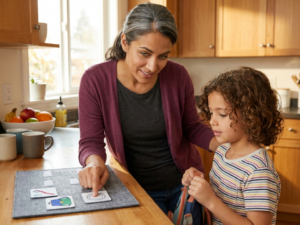
Caregiver support that helps a child calm, name feelings, breathe, move, or use sensory tools before self-regulating independently.

← Back to A–Z Glossary

Search results for: co-regulation

Can emotions shape baby personality

Can emotions shape baby personality

Temperament is not the same as personality When people say a baby has a “personality,” they often mean an early pattern of behavior: easy to soothe, highly alert, shy, intense, calm, or curious. In developmental medicine, this is usually called temperament. Temperament refers to an infant’s typical level of emotional reactivity, self-soothing, attention, activity, and […]

Why Newborns Cry When Put Down

Why Newborns Cry When Put Down

Why being held feels safer to a newborn For a newborn, being held provides a dense combination of familiar signals: body warmth, rhythmic movement, pressure against the caregiver’s body, a recognizable voice, and the sound of breathing or a heartbeat. These cues can reduce arousal and help organize the infant’s autonomic nervous system. A crib, […]

When babies show emotions

When babies show emotions

Emotional expression begins before language Newborns do not need words to communicate an internal state. Crying, facial tension, limb movements, changes in muscle tone, rooting, sucking, gaze aversion, and variations in vocal intensity all provide information. These behaviors are not perfectly specific. A cry may reflect hunger, pain, fatigue, temperature discomfort, a wet diaper, or […]

What babies learn in first 3 months

What babies learn in first 3 months

Learning Through the Senses In the first weeks, a baby’s brain is learning to organize a continuous stream of sensory input. Vision is clearest at close range, so a baby may study a caregiver’s face during feeding or cuddling. High-contrast patterns, slowly moving objects, and faces are often easier to notice than small or visually […]

Key transitions in baby development

Key transitions in baby development

From reflexes to regulation One of the earliest developmental transitions is the shift from reflex-dominated newborn behavior toward more organized regulation. In the first weeks, many movements are driven by primitive reflexes, flexor tone, startle responses, rooting, sucking, and brief alert periods. Over time, cortical control, sensory processing, and caregiver co-regulation help the baby spend […]

Small Skills That Often Appear Before Major Milestones

Small Skills That Often Appear Before Major Milestones

Milestones Are Built From Overlapping Skills A milestone is an observable functional achievement, such as sitting without support, taking an independent step, using a meaningful word, or responding consistently to a familiar request. It is helpful to remember that the visible event is usually the endpoint of several less obvious changes. The nervous system must […]

2 month baby routine example

2 month baby routine example

What a 2-month routine should accomplish At 2 months, the purpose of a routine is to create familiar patterns, not to make a baby conform to an adult timetable. A useful cycle is often feed, burp, diaper, brief interaction, and sleep, although the order may change. Some babies need to sleep immediately after feeding, while […]

Responsive parenting and routines

Responsive parenting and routines

What responsive parenting means Responsive parenting is a reciprocal process in which a caregiver notices a child’s signals, interprets them within context, and responds in a timely, appropriate, and emotionally available way. In infancy, signals may include crying, facial expressions, body movements, gaze, vocalizations, changes in muscle tone, and shifts in alertness. The same behavior […]

Coordinating Baby Care Between Parents and Caregivers

Coordinating Baby Care Between Parents and Caregivers

Start With Shared Priorities Coordination begins with a simple question: what must be consistent for this baby to be safe, well fed, rested, and emotionally supported? Parents may have strong preferences, and caregivers may bring professional experience or family wisdom. A useful care plan respects both while making the baby’s needs the central reference point. […]

How to soothe a crying baby

How to soothe a crying baby

Start with a calm check of basic needs Before trying multiple soothing techniques, pause and make a brief, structured check. A baby may be communicating hunger, a need for a diaper change, tiredness, temperature discomfort, or a wish for contact. Newborn feeding patterns can be frequent and variable; early hunger cues may include rooting, bringing […]

Calm Voice and Repetitive Sounds for Soothing

Calm Voice and Repetitive Sounds for Soothing

Why Predictable Sound Can Feel Settling Infants are developing the capacity to regulate arousal: the shift between alertness, distress, drowsiness, and sleep. In early life, this regulation is largely co-regulated, meaning that the baby relies on an adult’s responsive presence, touch, movement, feeding, and voice. A calm vocal pattern may contribute because it is socially […]

Self-soothing in babies explained

Self-soothing in babies explained

What self-soothing means in infancy Self-soothing is best understood as part of infant self-regulation: the gradual development of the capacity to modulate arousal, emotion, movement, and attention. A baby may lower arousal by sucking a hand, holding a comfort object when developmentally appropriate, looking away, flexing and relaxing the limbs, making repetitive sounds, or pausing […]

When babies learn to self-soothe

When babies learn to self-soothe

Self-soothing begins with co-regulation In infancy, self-soothing refers to a baby’s emerging ability to reduce arousal or return to a calmer state using their own behaviors. It may look like bringing a hand to the mouth, sucking, holding a comforting object when developmentally appropriate, making quiet vocal sounds, or briefly resettling after a normal night […]

Self-soothing myths explained

Self-soothing myths explained

What self-soothing actually means In everyday conversation, self-soothing can mean anything from sucking a hand to falling asleep without being held. In infant sleep research, it is usually narrower: the infant returns to sleep after a nighttime arousal without a parent intervening. This is not evidence that the baby has no needs, did not wake, […]

Evening crying in babies explained

Evening crying in babies explained

Why crying may peak in the evening Many babies have a predictable period of increased crying or fussiness toward the end of the day. The pattern may begin in the first weeks of life, become more noticeable during early infancy, and gradually improve as neurological maturation and sleep-wake organization progress. It can be exhausting because […]

Why baby cries more at night

Why baby cries more at night

Infant sleep makes night crying common Babies do not sleep like older children or adults. Their sleep is lighter, more fragmented, and organized into relatively short cycles. At the end of a cycle, a baby may stir, vocalize, open their eyes, or cry before returning to sleep. Waking between infant sleep cycles is therefore expected, […]

Baby reacting to sounds explained

Baby reacting to sounds explained

What babies actually do when they hear sound Babies are often described as if they are simply “hearing” a sound, but the observable behavior is usually more nuanced. A newborn may stop moving, blink, widen the eyes, change facial expression, suck more slowly, quiet, or orient the head and eyes toward the sound source. These […]

Why babies turn toward voices

Why babies turn toward voices

Newborns are biologically prepared to orient toward sound Babies do not arrive in the world as passive listeners. From the first days of life, the auditory system is already capable of detecting changes in the environment, and classic newborn studies show that infants orient toward sound by turning their heads. This is often described as […]

Baby recognizing parents behavior

Baby recognizing parents behavior

Recognition begins as multisensory learning When babies recognize caregivers, they are not relying on one single skill. Recognition is usually multisensory. A newborn may respond to a familiar voice, settle when held in a familiar way, orient toward a caregiver’s smell, or show feeding-related cues when placed close to the chest. These early responses are […]

Attachment behavior in babies

Attachment behavior in babies

What attachment behavior means Attachment behavior is the infant’s biologically rooted way of maintaining access to a familiar protective caregiver. In practice, it is not a single behavior but a flexible system: the baby may cry to summon help, quiet when held, track a caregiver with the eyes, reach, cling, crawl after the caregiver, or […]
Social Referencing: Reading a Parent’s Reaction

Social Referencing: Reading a Parent’s Reaction

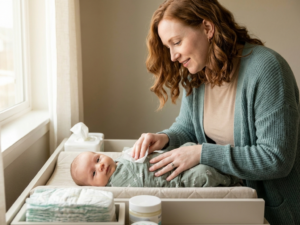
What Social Referencing Means Social referencing is the process by which an infant or young child uses another person’s emotional expression as information about how to interpret an ambiguous event. In practical terms, a baby notices a parent’s face, vocal tone, body tension, gaze direction, and timing of response, then uses those cues to help […]

Stranger anxiety in babies explained

Stranger anxiety in babies explained

What stranger anxiety is Stranger anxiety is an infant’s wary, avoidant, or distressed response to unfamiliar people. It may look like crying when someone new enters the room, turning away from a visiting relative, clinging tightly to a parent, refusing to be held by a babysitter, or watching a stranger with a still, serious expression. […]

Anticipating Familiar Songs and Games

Anticipating Familiar Songs and Games

What Anticipation Looks Like in Babies Anticipation in infancy is the ability to expect what is likely to happen next. In familiar songs and games, it may appear as widening eyes before a favorite sound, stillness before a repeated phrase, kicking before a bounce, smiling before a silly ending, or turning toward the caregiver at […]

Why babies get bored quickly

Why babies get bored quickly

Boredom in babies is often a learning signal Babies may appear to get bored quickly because their brains are designed to learn efficiently, not to remain politely engaged. An infant who looks away, arches, fusses, or drops a toy may be signaling that the stimulus has stopped being useful, has become too demanding, or is […]

Baby reaction to routine changes

Baby reaction to routine changes

Why routine changes can feel so big to babies Babies rely on repetition to make sense of the world. Feeding, sleeping, being held, and hearing familiar voices are all part of early pattern recognition, and those patterns help organize a baby’s developing nervous system. When a routine shifts, the baby may not understand the reason, […]

Why babies resist changes

Why babies resist changes

Attachment makes change feel risky For a baby, the world is still small and highly dependent on proximity to a trusted adult. The caregiver-baby relationship is not just about comfort; it is the infant’s main source of safety, co-regulation, and meaning. When that familiar person steps away, hands the baby to someone new, or changes […]

How babies adapt to new environments

How babies adapt to new environments

The first hours after birth: a major physiologic transition In utero, a fetus is buffered by a constant temperature, continuous nutrient delivery, and a relatively stable sensory environment. Birth ends that protected state abruptly. The newborn must begin thermoregulation, maintain euglycemia, coordinate breathing and circulation, and tolerate intermittent feeding while the autonomic nervous system is […]

Adjusting baby to new situations

Adjusting baby to new situations

Why new situations feel intense for babies A baby’s adjustment to change is shaped by rapid neurologic development, immature self-regulation, and complete dependence on caregivers for safety. Infants can detect patterns in voice, smell, touch, feeding, sleep timing, light, and movement long before they can understand explanations. When those patterns shift, the brain must update […]

Baby frustration behavior explained

Baby frustration behavior explained

What baby frustration means Baby frustration is a distress response that appears when an infant’s need, comfort, or goal is blocked. A hungry baby may cry because feeding has not begun. A tired baby may arch away from a caregiver because the nervous system is overloaded. A 9-month-old may yell when a toy rolls out […]

Why babies get frustrated easily

Why babies get frustrated easily

Frustration starts as communication For a baby, frustration is rarely a deliberate behavior. It is usually a signal. Newborns and young infants have a limited behavioral vocabulary: crying, facial grimacing, body stiffening, turning away, rooting, sucking, hand-to-mouth movements, arching, and changes in tone or color. These cues carry a lot of information, but they are […]

How babies express frustration

How babies express frustration

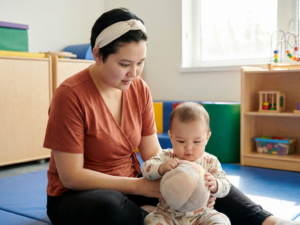
Frustration is communication, not misbehavior Frustration in infancy is best understood as an early affective response to a blocked goal or an overwhelming demand. The baby may want milk faster than it is arriving, reach for an object that remains out of range, become unable to settle after stimulation, or protest when a caregiver changes […]

Evening Care After a Long or Difficult Day

Evening Care After a Long or Difficult Day

Start With Essential Needs, Not a Perfect Routine After a long day, decision fatigue can make ordinary caregiving tasks feel complex. Begin with a short safety and comfort check. Consider whether the baby may need feeding, a clean diaper, temperature adjustment, burping, medication that has already been prescribed by a clinician, or a quieter environment. […]

Responsive caregiving

Responsive caregiving

What responsive caregiving means The World Health Organization describes responsive caregiving as the ability to notice, understand, and respond appropriately and promptly to a young child’s signals. Those signals include behavior, movements, vocalizations, facial expressions, and changes in state such as alertness, fatigue, hunger, discomfort, or overstimulation. The response is not merely practical. Its quality […]

Sensory play for babies

Sensory play for babies

What sensory play means in infancy Sensory play is any safe experience that lets a baby notice and respond to information from the body or environment. This includes the familiar senses of vision, hearing, smell, taste, and touch, as well as the vestibular system, which detects head movement and position, and proprioception for body awareness, […]

Developmental Play During Diaper Changes

Developmental Play During Diaper Changes

Why Diapering Can Be a Developmental Moment Diapering is a repeated, face-to-face caregiving interaction. Unlike a special activity that may happen occasionally, it occurs often enough for a baby to learn a recognizable sequence: the caregiver approaches, uses familiar words and touch, completes care, and helps the child return to play or rest. Predictable hygiene […]

Adapting activities to baby mood

Adapting activities to baby mood

Read the state before choosing the activity In early infancy, activity choice should begin with observation, not the clock or an idealized play plan. Babies cycle through sleep, drowsiness, quiet alertness, active alertness, fussiness, and crying. Quiet alertness, often marked by open eyes, relatively smooth movements, and attention to a face or voice, is commonly […]

How to balance activity and rest

How to balance activity and rest

What activity and rest mean in infancy In infancy, activity is broader than structured exercise. It includes spontaneous kicking, reaching, rolling, tummy time, changing position, looking at faces, vocal interaction, and exploring a safe environment. Carrying and daily care also provide movement and sensory input. As motor skills develop, active time may include supported sitting, […]

Understanding child behavior patterns

Understanding child behavior patterns

Behavior as developmental communication Child behavior is best understood as an observable output of a developing brain. Executive functions, including inhibitory control, working memory, cognitive flexibility, and planning, mature gradually from early childhood through adolescence. Emotional regulation also develops slowly and depends heavily on co-regulation: the adult’s ability to provide calm, predictable support while the […]

Common mistakes in social development

Common mistakes in social development

Why social mistakes are so common Children are still building the abilities needed for social life: attention, language, impulse control, emotion regulation, perspective-taking, and flexible thinking. In early life, social learning depends heavily on co-regulation before self-regulation, meaning an adult helps the child settle, name feelings, and stay organized before the child can manage those […]

Losing friends and coping kids

Losing friends and coping kids

Why friendship loss can hurt so much Children are not overreacting when a friendship ends badly. In peer relationships in child development, friendships are central practice for cooperation, identity, and emotional safety. A breakup can therefore feel like rejection of the self, not just the loss of a playmate or lunch partner. Children also have […]

Nonverbal communication children

Nonverbal communication children

What nonverbal communication means in childhood Nonverbal communication refers to the messages children send and receive without relying on spoken language alone. It includes eye contact, gaze shifts, facial expression, body orientation, posture, vocal quality, gestures such as pointing or showing, and the use of space and touch. In practice, these signals are often combined […]

Conflict resolution skills children

Conflict resolution skills children

Why conflict resolution matters in childhood Conflict is not proof that a child is disrespectful or that a family is failing. In childhood, disagreement is often a normal sign that a child wants autonomy, fairness, or control over a limited resource. The developmental task is to move from impulse-driven reactions toward teaching conflict resolution skills […]

How kids handle disagreements

How kids handle disagreements

Why disagreements are part of normal development Children are learning how to be separate people while still staying connected to others. That developmental task creates friction. A child may want the same toy, the same seat, the same turn, or the same attention as someone else, and the resulting disagreement is often a first lesson […]

Problem solving in relationships kids

Problem solving in relationships kids

What relationship problem solving means for children Problem solving in relationships is more than telling children to be nice. It means helping them move from emotion to action without ignoring either one. A child has to notice the conflict, label the feeling, consider the other person’s point of view, and choose a response that protects […]

Handling peer conflicts children

Handling peer conflicts children

Why peer conflict is a normal part of childhood Children do not build friendship skills in a straight line. They test boundaries, misread intentions, want the same toy, or feel hurt by a comment and react quickly. In this sense, peer conflict is part of learning how to negotiate membership in a group. Developmental research […]

Sibling relationships in children

Sibling relationships in children

Why sibling relationships matter Siblings often share the most consistent peer-like contact a child has at home. That makes the relationship an important setting for learning how to negotiate turns, read emotions, manage disappointment, and recover after conflict. In everyday life, siblings also influence each other’s routines, interests, language, and sense of belonging. Longitudinal research […]

Helping siblings get along and bonding

Helping siblings get along and bonding

Why sibling relationships can feel so intense Siblings are not simply other children in the home; they are daily relationship partners. They share parents, space, routines, and often attention. That combination makes sibling dynamics especially sensitive to perceived unfairness. A younger child may want to copy an older one, while the older child may feel […]

Helping children accept an apology while keeping healthy boundaries

Helping children accept an apology while keeping healthy boundaries

Why apology and boundaries are separate skills One of the most helpful ideas to give children is that accepting an apology does not mean giving up their right to safety or comfort. A child can listen, notice the other person’s words, and still decide, ‘I need space right now.’ That is not rude; it is […]

Cliques in childhood and how parents can support healthy choices

Cliques in childhood and how parents can support healthy choices

Why cliques can feel so intense in childhood Clique behavior often reflects normal developmental needs: children want belonging, identity, and status. In elementary and middle school years, social groups may become more organized, with unspoken rules about appearance, interests, or who is allowed into the group. For a child, this can feel all-consuming because peer […]

Family activities with children

Family activities with children

Why shared activities matter Family activities work best when they do more than occupy time. A shared game, walk, or kitchen task gives children repeated practice in turn-taking, joint attention, and communication. In developmental terms, these are building blocks for social learning and executive function, the set of skills used for planning, shifting attention, and […]

Common morning struggles and reducing stress children

Common morning struggles and reducing stress children

Why mornings can overwhelm children Children do not wake with adult-level planning skills already online. The prefrontal cortex, which supports working memory, sequencing, inhibition, and flexible problem-solving, is still developing throughout childhood and adolescence. A child who appears to be ignoring instructions may actually be struggling to hold several steps in mind: get dressed, eat, […]

Morning routine tips parents

Morning routine tips parents

Start with a small, predictable sequence Children generally manage mornings more easily when the order of events is stable. A routine acts as an external scaffold for executive function, the group of cognitive skills involved in working memory, inhibition, planning, and shifting attention. A systematic review of research on routines and child development found that […]

Common mistakes in child routines

Common mistakes in child routines

Treating routines as rigid rules One common mistake is confusing predictability with inflexibility. A routine should provide a reliable sequence, not require every event to occur at exactly the same minute. Children need repeated cues, but they also need opportunities to learn that plans can change safely. Insisting on perfect adherence may increase conflict when […]

Flexible vs strict routine children

Flexible vs strict routine children

What flexible and strict routines look like A flexible routine has recurring anchors but does not require every event to happen at an exact time or in an identical way. For example, a child may have a consistent bedtime sequence—washing, changing, reading, and settling—while the start time shifts slightly on weekends or after an appointment. […]

How parents manage child routines

How parents manage child routines

What a child routine is and why parents use one A routine is a repeated sequence of activities that generally occurs in a familiar order. It may include waking, using the toilet, dressing, eating breakfast, leaving for school, returning home, completing homework, playing, bathing, reading, and going to sleep. A schedule usually emphasizes clock times, […]

Parent role in daily structure

Parent role in daily structure

What the parent’s role really involves Children do not begin life with mature executive functions. Attention regulation, working memory, inhibitory control, time awareness, and flexible problem-solving develop gradually. Parents temporarily supply some of this external organization by deciding what needs to happen, sequencing activities, gathering materials, and providing reminders. This is not a failure of […]

Building independence through routine

Building independence through routine

Why routine supports independence A routine creates a predictable sequence: what happens first, what comes next, and what signals completion. This predictability reduces the cognitive load associated with planning and remembering multiple steps. Instead of repeatedly asking an adult what to do, a child can gradually internalise the sequence and initiate more of it independently. […]

Encouraging self management children

Encouraging self management children

Understanding self-management as a developmental process Self-management includes several related capacities: self-awareness, emotional regulation, planning, task initiation, monitoring, decision-making, communication, and problem-solving. These abilities rely partly on executive functions, which continue to mature throughout childhood and adolescence. A child may be highly independent in one area, such as choosing clothing, yet still need substantial support […]

Creating a weekday routine for children in two-household families

Creating a weekday routine for children in two-household families

Start with anchors, not identical households A useful routine begins with a small number of anchors: wake time, school or childcare, meals, homework or quiet time, personal care, connection with a caregiver, and bedtime. These anchors create temporal predictability, meaning the child can anticipate what usually happens next. The homes do not need to use […]

Preschool adaptation checklist

Preschool adaptation checklist

1. Begin with a realistic readiness review Preschool readiness is multidimensional. It includes emerging independence, communication, participation in group activities, emotional regulation, and the ability to recover from small frustrations. It does not require a child to be completely independent, consistently cheerful, or free from separation anxiety. A child may be ready for preschool while […]

Starting kindergarten experience and first day expectations

Starting kindergarten experience and first day expectations

Why the kindergarten transition matters Kindergarten often introduces a longer day, a larger peer group, more formal expectations, and a new balance between teacher-directed and child-directed activity. Children must learn where to put belongings, how to request help, when to use the bathroom, how to move between activities, and how to participate in a group. […]

Adjusting to kindergarten routine and social adaptation

Adjusting to kindergarten routine and social adaptation

Why kindergarten adjustment can feel demanding Kindergarten combines several developmental tasks that may previously have occurred separately. A child may need to wake earlier, dress within a time limit, travel to school, separate from a caregiver, attend to group directions, wait for turns, use classroom materials appropriately, manage toileting and meals more independently, and shift […]

Academic and social pressure children

Academic and social pressure children

What academic and social pressure mean for children Academic pressure refers to perceived demands to achieve particular grades, complete extensive work, gain admission to selective programs, or avoid failure. It may arise from school workload, testing systems, parental expectations, competition with classmates, or a child’s own perfectionistic standards. The Lancet Child & Adolescent Health has […]

Reducing pressure in school life

Reducing pressure in school life

Understanding school pressure as a biopsychosocial stressor School pressure is best understood as a biopsychosocial stressor: it affects biology, thoughts, emotions, behavior, family life, and social belonging. A child may look “lazy” or “unmotivated” when, in fact, their nervous system is overloaded. Stress activates the hypothalamic-pituitary-adrenal axis and sympathetic nervous system, increasing cortisol, heart rate, […]

Screen time and family dynamics

Screen time and family dynamics

Screen time as a family-system signal In clinical and developmental conversations, screen time is often discussed as if it belongs only to the child: how many hours, what content, what platform, and what limits. Those questions matter, but they can miss the broader family context. Screen use may also function as an index of family […]

Screens replacing real activities and solutions

Screens replacing real activities and solutions

The replacement problem For many children, screens begin as helpful tools: a cartoon during dinner preparation, a tablet for homework, a video call with relatives, or a game after school. The difficulty appears when screens stop being one activity among many and become the default replacement for nearly every pause in the day. In that […]