
Intro
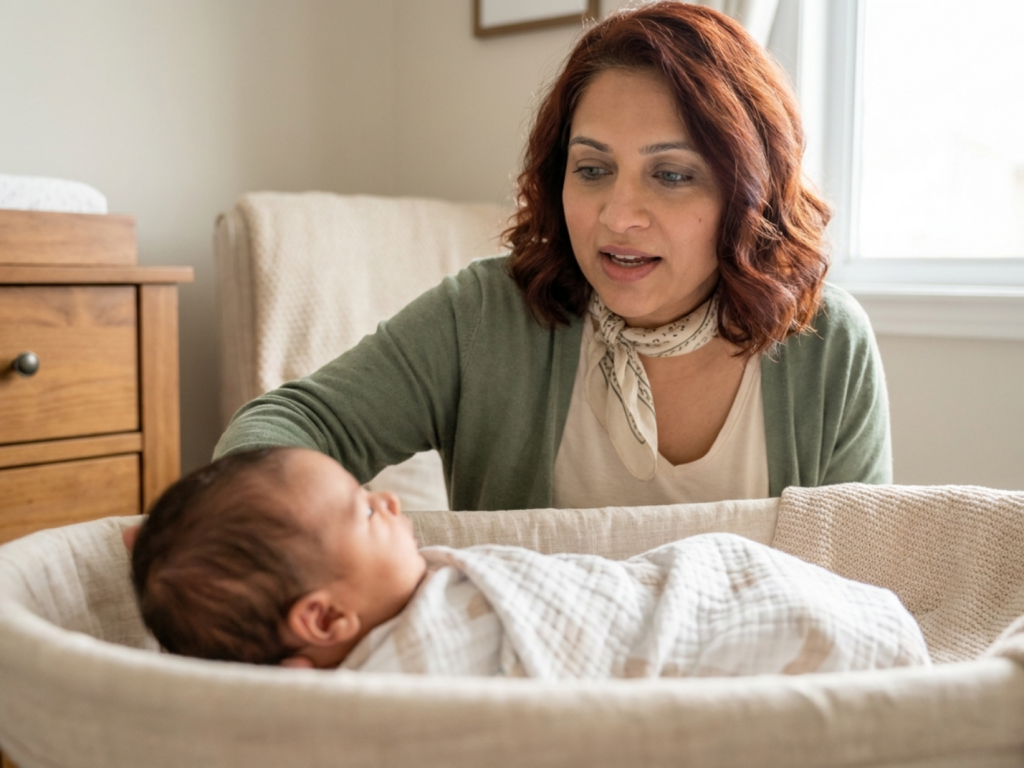
It can be reassuring, confusing, or both to watch a baby react to sounds. A sudden startle, a pause during feeding, a quieting at a familiar voice, or a brief turn toward a doorway can all reflect early auditory processing. In the first months of life, these responses are often subtle and state-dependent, because the auditory system is still maturing.
This article explains what normal sound reactions can look like, why they vary from one moment to the next, and when a hearing assessment is worth discussing with a healthcare professional. It also treats these responses as part of baby reactions as early communication, not just isolated reflexes.
Highlights
Newborns are active listeners. They can orient to sound, especially speech and other continuous auditory stimuli, even when the response is brief or delayed.
A baby may react differently to loud noises, voices, music, or background noise because arousal level, sleep state, and the type of sound all matter.
Typical early milestones include startling to sudden loud sounds, turning toward voices, and later searching for quieter sounds.
A single quiet response is not enough to diagnose a hearing problem, but persistent lack of reaction deserves medical review.
What babies actually do when they hear sound
Babies are often described as if they are simply “hearing” a sound, but the observable behavior is usually more nuanced. A newborn may stop moving, blink, widen the eyes, change facial expression, suck more slowly, quiet, or orient the head and eyes toward the sound source. These are meaningful behavioral responses, even when they are small.
Research in full-term newborns shows that babies can respond to speech, music, heartbeats, and environmental noise, although the auditory system is immature and the range of reactions is narrower than in older infants. Experimental work has also shown that newborns orient to sound, especially continuous auditory stimuli. That means the baby may be listening before the response is obvious to adults.
One practical implication is that you should not expect a dramatic turn every time. A baby who seems still may nevertheless be processing sound. Response timing, the intensity of the sound, and whether the baby is asleep, feeding, or already upset can all change what you see.
Typical sound reactions by age
Developmental checklists used in newborn hearing screening describe age-based patterns rather than a single yes-or-no milestone. In the earliest weeks, a baby may startle at sudden loud noises, quiet down to a human voice, or briefly pause when a sound begins. As listening matures, the baby may begin to turn eyes or head toward voices and other meaningful sounds.
By later infancy, many babies become more skillful at locating where a sound comes from. They may search for quieter sounds, notice a caregiver speaking from across the room, or shift attention toward a toy that makes a sound. These changes reflect both auditory development and broader attention skills.
- Early weeks: startle, blink, or quiet in response to loud or novel sounds.
- Early months: turn toward voices or familiar sounds.
- Later infancy: search for quiet sounds and localize sound sources more accurately.
Because this is gradual, the absence of one specific reaction on one day is usually less important than the overall pattern over time.
Why a baby may react strongly to one sound and ignore another
Not all sounds are processed the same way. A baby may respond quickly to a caregiver’s voice and barely notice a steady appliance hum, or react strongly to a vacuum cleaner and remain calm during music. Sound quality, volume, predictability, and emotional meaning all influence the response.
Familiar voices often carry the strongest effect because they are linked with feeding, comfort, and repeated exposure. This is why recognizing a caregiver’s voice can appear early and why many babies settle when they hear it. In contrast, sudden environmental noise may trigger a startle because it is unexpected rather than because it is harmful.
State matters as well. A sleepy baby may not orient clearly. A hungry baby may be less attentive. A baby who is already distressed may show a shortened or blocked response because they are coping with internal stress and sensory load at the same time. In those moments, the reaction may look more like turning away, crying, or arching than a neat head turn.
This variability is one reason clinicians interpret sound reactions in context instead of from a single observation.
How sound, comfort, and overstimulation overlap
Sound is not only information; it is also part of regulation. Many babies calm when they hear a familiar voice, rhythmic speech, soft singing, or a steady heartbeat-like rhythm. These inputs can support co-regulation, meaning the caregiver’s voice or rhythm helps the baby settle while the nervous system is still learning to organize itself.
At the same time, too much sound can be tiring. A busy room, overlapping voices, television noise, or frequent sudden sounds may contribute to baby overstimulation behavior. Some babies respond by crying, looking away, stiffening, or becoming harder to soothe. This does not automatically mean a hearing disorder. Often it means the baby is receiving more sensory input than they can comfortably process in that moment.
It can help to watch for patterns: does the baby settle after a quiet break, a dimmer room, or a familiar voice? Does the baby become more reactive after a noisy outing? These observations can be useful to discuss with a clinician if concerns persist.
When a hearing concern deserves follow-up
Most babies show some sound-related reaction over time, but not every concern should be dismissed as “they were just sleepy.” If a baby consistently does not startle at loud noises, does not seem to quiet or orient to voices, or loses previously seen responses, it is reasonable to arrange medical review. A passed newborn screen is reassuring, but it does not replace later developmental observation.
It is especially important to seek assessment if sound responses seem absent across different settings, or if there are concerns about speech, social engagement, or overall development later on. A clinician may review the newborn hearing screen result, examine the ears, and decide whether formal audiology testing is needed. In some babies, the issue is temporary fluid or congestion; in others, further evaluation clarifies the picture.
Prompt review is also sensible if you have a family history of childhood hearing loss, if your baby had neonatal intensive care exposure, or if the response pattern changes after an illness. The goal is not to alarm parents, but to avoid missing a hearing problem that could affect language access.
Ways to support listening and early language
You do not need special equipment to support sound awareness. Simple, repeated interactions are usually enough. Speak to your baby in a calm, rhythmic voice. Pause and wait for a response. Use short phrases, sing softly, and narrate everyday routines. These exchanges give the baby frequent chances to notice sound and to practice orienting toward a voice.
Try to balance stimulation. A baby who is learning to listen may do better in a quieter environment than in a room with multiple competing sounds. If a baby seems unsettled, lowering background noise can make it easier for them to focus on a familiar voice. If you suspect the baby is overwhelmed, a brief quiet break may help more than adding more stimulation.
Remember that babies vary. Some will turn immediately, others will seem to listen without making much movement, and others may respond only after repetition. What matters most is the longer trend: over time, is the baby showing increasing awareness of voices and sounds? If the answer is unclear, bringing that concern to a pediatric professional is appropriate.
Seek medical advice sooner if you notice:
- No startle or quieting response to loud sounds over time.
- No turning toward voices or familiar sounds as the baby grows.
- Loss of previously seen sound reactions.
- Concerns about speech, babbling, or general developmental progress.
- A failed newborn hearing screen or a known risk factor for hearing loss.
Tools & Assistance
- Your baby's newborn hearing screening record or discharge paperwork
- A pediatrician, family doctor, or health visitor appointment
- A referral to audiology or ENT if recommended by a clinician
- A quiet room for observing whether familiar voices settle your baby
FAQ
Is it normal for a baby not to react every time a sound occurs?
Yes. Reactions depend on sleep state, hunger, mood, and the kind of sound. Inconsistent response is common, especially in the newborn period.
Why does my baby respond more to my voice than to other sounds?
Familiar voices often carry stronger meaning for babies because they are repeated, soothing, and linked to care. That preference is a normal part of early listening.
Can loud noises be harmful if my baby startles?
A startle alone is not a sign of harm. It is a normal protective response to sudden noise. If you are worried about frequent loud exposure, discuss it with a clinician.
What should I do if my baby seems not to hear?
Bring the concern to a pediatric professional, even if the newborn hearing screen was normal. Hearing and development should be reviewed in context.
Sources
- PubMed — Hearing and behavioral responses to sound in full-term newborns
- PubMed — Newborn infants orient to sounds
- UK Government — Reacting to sounds checklist
Disclaimer
This article is for general information only and does not replace medical advice, diagnosis, or treatment. If you have concerns about your baby’s hearing or development, please consult a qualified healthcare professional.














Please log in to leave a comment.