
Intro
Babies enter a world that is dramatically different from the womb: cooler air, brighter light, irregular sounds, gravity, and far less continuous physical support. Adaptation is therefore not a single event but a gradual process that involves physiology, sensory processing, feeding, sleep regulation, and early learning. For many families, it can be reassuring to know that this adjustment is expected and that babies are built to respond to it.
At the same time, adaptation is not identical for every infant. Prematurity, illness, and individual temperament can shape how quickly a baby settles, feeds, sleeps, and tolerates stimulation. The goal is not to force a baby to adapt faster, but to understand the signals that support healthy adjustment and to recognize when extra clinical support is needed.
Highlights
Babies adapt through both body regulation and learning; their nervous system is actively calibrating to the environment.
The first hours after birth are a major transition, especially for temperature control, glucose stability, and breathing coordination.
A quieter, more predictable environment can help newborns, particularly preterm infants, maintain physiological stability.
Skin-to-skin contact and responsive caregiving support co-regulation, feeding cues, and early bonding.
Some infants adjust more quickly than others because temperament and environmental volatility influence how they learn.
The first hours after birth: a major physiologic transition
In utero, a fetus is buffered by a constant temperature, continuous nutrient delivery, and a relatively stable sensory environment. Birth ends that protected state abruptly. The newborn must begin thermoregulation, maintain euglycemia, coordinate breathing and circulation, and tolerate intermittent feeding while the autonomic nervous system is still immature. That is why the first hours after delivery are so important.
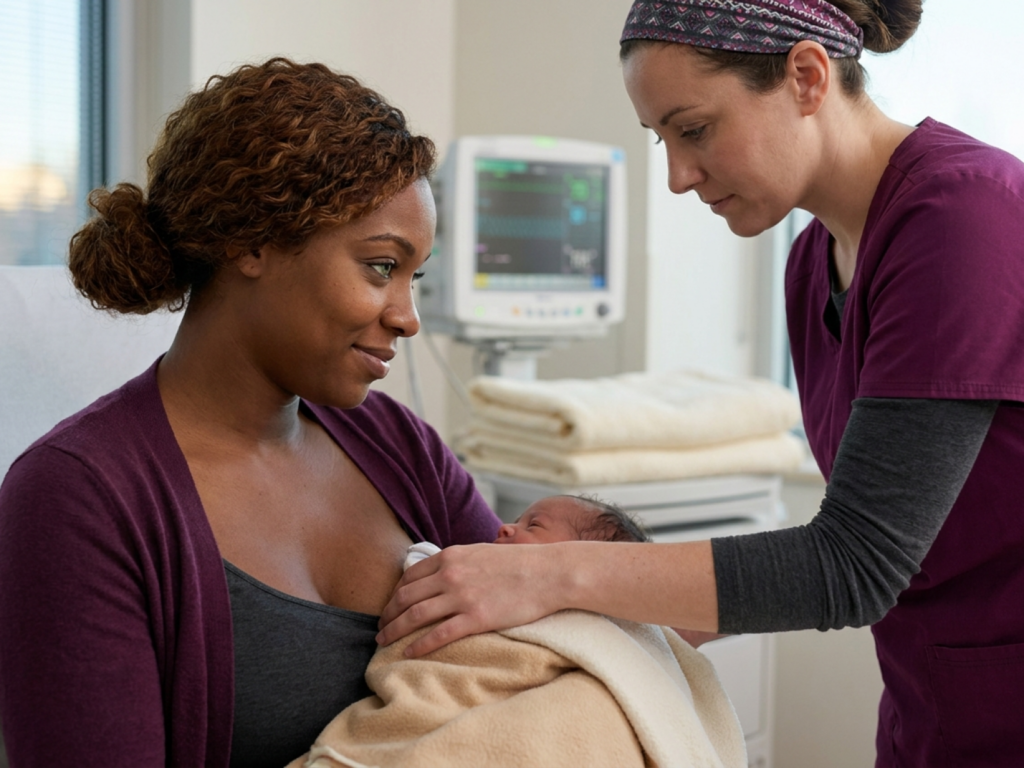
Immediate newborn care can strongly influence this transition. Evidence supports skin-to-skin contact, which helps reduce heat loss and supports more stable physiologic adaptation. It can also lower the risk of hypothermia and hypoglycemia, two common vulnerabilities in early newborn life. Beyond the metabolic benefits, skin-to-skin contact gives the infant a familiar tactile and vestibular experience: warmth, containment, rhythmic movement, and the caregiver’s scent and voice.
This is not simply a comfort measure. It is a biologically meaningful intervention that helps the infant conserve energy while the brain and body are adjusting to a new set of demands. For many newborns, especially those who are small or early-born, preserving stability in those first hours can shape the next steps of adaptation.
Why the nursery environment matters so much
Newborns do not process the environment with adult-level sensory filtering. Their auditory, visual, tactile, and autonomic systems are still maturing, so the same setting that feels ordinary to an adult can be highly activating for an infant. Bright light, frequent handling, noise, abrupt temperature shifts, and irregular sleep interruption can all increase stress and make it harder for a baby to settle.
Reviews of neonatal care emphasize that the physical and social nursery environment influences physiological stability and sensory development, especially in premature infants. Preterm babies are particularly sensitive because they have had less time for neurologic and respiratory maturation. They may fatigue more quickly, desaturate more easily, and show less efficient state regulation when stimulation is excessive or poorly timed.
That is why developmental care often focuses on reducing sensory load without eliminating stimulation entirely. Dimmer lighting, quieter routines, clustered caregiving, gentle touch, and protected sleep periods can help the baby maintain a more stable internal state. In practical terms, adaptation improves when the environment is predictable enough for the infant to process information without becoming overwhelmed.
Babies are active learners, not passive responders
One of the more interesting findings in infant research is that babies appear to adjust how they learn based on environmental volatility, meaning how stable or changeable their surroundings are. In a predictable context, an infant may benefit from repeated cues and slower updating. In a rapidly changing context, faster adaptation can be useful. This suggests that learning in infancy is not fixed; it is tuned to the structure of the environment.
This matters because some babies behave as if they need more repetition, more time to watch, or more time to settle before they can take in new information. Others may show less visible distress during transitions. These differences can reflect temperament and developmental stage rather than any problem. The important point is that babies are not simply absorbing everything around them in the same way. They are actively calibrating attention, arousal, and memory according to what the environment seems to demand.
For caregivers, that means adaptation is easier when changes are introduced gradually and when familiar cues are repeated. A baby who is moving to a new home, a different sleep space, or a different caregiving routine may do better when the most important cues stay consistent: feeding pattern, soothing strategies, lighting, and sleep timing when possible.
How caregivers help with co-regulation and social adaptation
Babies adapt most efficiently in relationship with a responsive adult. Responsive caregiving for infants means noticing early cues and matching the response to the baby’s state: hunger, sleepiness, discomfort, overstimulation, or the need for closeness. This is a central part of co-regulation, the process by which a caregiver helps the infant return toward a calmer physiologic baseline.
Examples include offering a feed when the baby shows early hunger cues, reducing stimulation when the baby averts gaze or becomes frantic, and using holding, rocking, swaddling when appropriate, or quiet vocal soothing to help the infant organize. Over time, repeated predictable responses support sleep-wake organization, feeding coordination, and early social communication. The baby begins to learn that signals have meaning and that the environment can be responded to in a reliable way.
Serve and return interactions are part of this process. When a baby looks, vocalizes, pauses, or settles in response to a caregiver’s face or voice, that back-and-forth builds a basic template for social understanding. It also helps the infant tolerate novelty because the adult becomes a stable reference point. For medically vulnerable babies, especially those in the NICU, this kind of relational support can be just as important as environmental modification.
When adaptation is harder than expected
Some babies need more support because the transition itself is more demanding. Prematurity, respiratory illness, difficult birth, low birth weight, maternal-infant separation, or frequent environmental disruption can all increase the burden on an infant’s immature regulatory systems. In these situations, slower adaptation is not a failure; it is often a sign that the baby needs a gentler pace, closer monitoring, or a more controlled setting.
Parents and clinicians should pay attention to patterns rather than isolated moments. A baby who is difficult to wake, feeds poorly across multiple attempts, has ongoing temperature instability, or seems to struggle with breathing may need evaluation. Persistent poor weight gain, weak tone, or marked irritability can also indicate that the infant is expending too much energy to maintain basic stability. None of these findings diagnose a condition on their own, but they do justify prompt medical review.
In neonatal and pediatric practice, the aim is to match support to the infant’s developmental capacity. That may include feeding guidance, environmental adjustments, or follow-up with a neonatology team. When adaptation is supported well, many babies settle into a more regular rhythm over time.
When to seek prompt medical attention
- A newborn who is hard to wake, unusually floppy, or unresponsive needs urgent assessment.
- Breathing pauses, grunting, chest retractions, or blue coloration are emergency warning signs.
- Poor feeding, repeated vomiting, or markedly fewer wet diapers can signal dehydration or illness.
- Temperature instability, especially a fever in a newborn, should be evaluated promptly.
- Premature or medically fragile babies may need earlier follow-up and individualized neonatal guidance.
Tools & Assistance
- Skin-to-skin contact during supervised awake periods, if your clinician says it is appropriate
- A quiet, dim sleep and feeding environment with reduced noise and frequent interruptions
- A simple feeding and diaper log to track intake, output, and patterns over time
- Your pediatrician, family doctor, or neonatology follow-up clinic for individualized guidance
FAQ
How long does it usually take a baby to adapt to a new environment?
There is no single timeline. Many healthy newborns begin to settle over days, but the pace varies with gestational age, medical status, and temperament.
Is fussiness always a sign that a baby is not adapting well?
No. Fussiness can reflect hunger, fatigue, overstimulation, discomfort, or normal temperament differences. Persistent or severe symptoms should be discussed with a clinician.
Why is skin-to-skin contact so often recommended?
It supports thermoregulation, helps protect against hypothermia and hypoglycemia, and can improve calming, feeding cues, and parent-infant bonding.
Are preterm babies more sensitive to new surroundings?
Often, yes. Their nervous system and physiologic regulation are less mature, so they may benefit from lower sensory load and closer developmental care.
Sources
- Science — Volatility-driven learning in human infants
- PubMed — Facilitating infant adaptation: the nursery environment
- PubMed — Influence of immediate newborn care on infant adaptation to the environment
Disclaimer
This article is for educational purposes only and is not a substitute for individualized medical advice, diagnosis, or treatment. If you are concerned about your baby’s breathing, feeding, temperature, or responsiveness, contact a qualified pediatric clinician promptly.
















Please log in to leave a comment.