
Intro
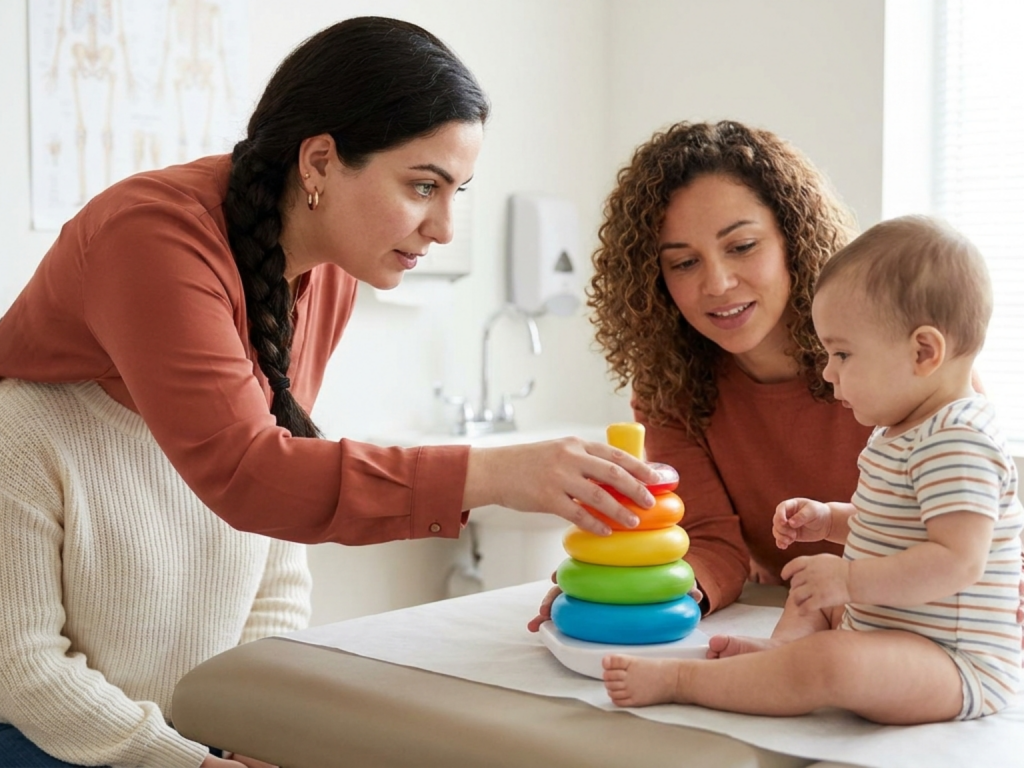
Baby development can feel both predictable and surprising: a newborn who once curled into flexion begins lifting the head, tracking faces, reaching intentionally, babbling, sitting, crawling, and eventually cruising or walking. These transitions are meaningful, but they are best understood as developmental windows rather than rigid deadlines.
For medically literate caregivers, the most useful approach is to observe multiple domains together: gross motor, fine motor, language, cognition, feeding, sleep-wake regulation, social engagement, and emotional co-regulation. A single late skill does not automatically mean a disorder, but persistent asymmetry, loss of skills, poor growth, feeding difficulty, or lack of social responsiveness deserves timely discussion with a pediatric clinician.
Highlights
Infant development progresses across overlapping domains, so one milestone should not be interpreted in isolation.
Motor transitions such as head control, sitting, crawling, standing, and walking usually occur across broad windows rather than on exact dates.
Social, sensory, language, and feeding transitions are as important as visible physical milestones.
Preterm infants are often interpreted using corrected age, especially during early infancy.
Caregivers should seek professional guidance for regression, persistent asymmetry, poor feeding, poor growth, or concerns about hearing, vision, tone, or interaction.
From reflexes to regulation
One of the earliest developmental transitions is the shift from reflex-dominated newborn behavior toward more organized regulation. In the first weeks, many movements are driven by primitive reflexes, flexor tone, startle responses, rooting, sucking, and brief alert periods. Over time, cortical control, sensory processing, and caregiver co-regulation help the baby spend longer periods calmly awake, visually engage with faces, and respond more predictably to feeding, holding, voice, and sleep cues.
This transition is not simply behavioral. It reflects maturation of the central nervous system, muscle tone, autonomic stability, and sensory integration. A newborn may have short cycles of wakefulness and frequent feeding because gastric capacity, circadian organization, and state regulation are still immature. As the infant matures, caregivers often notice more purposeful looking, smoother transitions between sleep and wakefulness, and clearer signals of hunger, fatigue, discomfort, and overstimulation.
Developmental surveillance in infancy works best when these early regulatory patterns are considered alongside growth, feeding, tone, hearing, vision, and social responsiveness. A baby who is fussy but feeding well, gaining weight, calming with support, and becoming more interactive may be following a normal maturation pattern. A baby who is persistently difficult to arouse, has weak feeding, poor weight gain, recurrent choking, markedly abnormal tone, or diminished response to sound or visual stimuli should be assessed promptly by a healthcare professional.
Head control, posture, and early movement
Physical development in babies becomes especially visible as antigravity control improves. In early infancy, the head is relatively large, neck and trunk muscles are immature, and the baby depends on external support. With maturation and supervised prone play, many infants gradually lift the head, turn it from side to side, bear weight through the forearms, bring hands toward the midline, and develop better postural stability.
Head control is a key transition because it supports later skills: visual exploration, reaching, rolling, sitting, feeding readiness, and safer interaction with the environment. Rolling often emerges as babies combine head turning, trunk rotation, hip movement, and motivation to reach. These skills do not always appear in a neat sequence. Some babies roll early but sit later; others dislike tummy time yet develop adequate sitting and reaching through repeated short, supported practice.
Caregivers can support infant motor development by offering awake, supervised floor time, alternating positions, limiting prolonged time in restrictive devices, and allowing the baby to move freely on a safe surface. The goal is not to train a milestone aggressively, but to create opportunities for the nervous and musculoskeletal systems to practice. Persistent head lag beyond the expected window, strong preference for turning only one way, marked asymmetry, very stiff or very floppy tone, or apparent pain with movement warrants clinical review.
Sitting, reaching, and hand control
The transition into sitting changes a baby’s access to the world. As trunk control improves, the hands become freer for reaching, transferring objects, banging, mouthing, and eventually using a more refined grasp. Sitting also expands visual perspective, social participation, and play complexity. A baby who can sit with support may first use the hands for balance, then gradually shift toward reaching outside the base of support and recovering posture.
Fine motor development is closely linked to cognition and sensory exploration. Reaching requires visual tracking, shoulder stability, hand opening, depth perception, and motor planning. Mouthing objects is developmentally typical because oral exploration provides rich sensory information. Over time, infants become better at coordinating both hands, passing objects between hands, inspecting textures, and anticipating what an object might do when dropped, shaken, or hidden.
Development differences between babies are common in this phase. One infant may be highly motivated by toys and reach early, while another may be more socially focused or cautious with movement. Corrected age for preterm babies is important when interpreting these skills, because a baby born several weeks early may be expected to follow a timeline closer to the due date than the birth date during early development. Medical input is useful if a baby consistently uses one hand much more than the other in early infancy, cannot bring hands together, shows poor visual tracking, or loses previously acquired hand skills.
Mobility and environmental exploration
Mobility is one of the most dramatic transitions in the first year. Babies may pivot, roll repeatedly, push backward, army crawl, rock on hands and knees, crawl, bottom-shuffle, pull to stand, cruise along furniture, stand briefly, or walk with assistance before walking independently. The World Health Organization’s motor milestone framework is useful because it emphasizes broad achievement windows for sitting, standing, crawling, and walking rather than a single correct age.
Not every infant crawls in the classic hands-and-knees pattern. Some develop alternative mobility strategies and still progress to walking. What matters clinically is the overall pattern: increasing strength, coordination, symmetry, curiosity, and ability to change position. Mobility also changes safety needs. Once an infant can roll or scoot, falls from beds, couches, and changing tables become more likely. When pulling to stand begins, unstable furniture, dangling cords, small objects, and hot liquids become newly relevant hazards.
Caregivers can support this transition with safe floor space, stable furniture for supported standing, barefoot practice when appropriate indoors, and close supervision. Walkers that allow rapid movement can increase injury risk and are generally discouraged in many pediatric safety discussions. Seek professional guidance if the baby shows persistent asymmetry, scissoring of the legs, inability to bear weight when expected, loss of mobility skills, or no progression in movement over time. The aim is not to force crawling or walking, but to notice whether the motor system is becoming more organized and functional.
Communication, cognition, and social engagement
Language development begins before recognizable words. Early communication includes crying, gaze, facial expression, body movement, cooing, squealing, laughter, and turn-taking with caregivers. Over time, babies become more intentional: they vocalize to continue interaction, look toward sounds, respond to familiar voices, imitate expressions or sounds, and use gestures such as reaching, showing, or waving. Babbling often becomes richer as oral-motor control, hearing, memory, and social motivation mature.
Cognitive transitions are equally important. Babies begin to anticipate routines, recognize familiar people, explore cause and effect, and develop early object permanence in infancy, meaning a growing understanding that people or objects continue to exist when not directly visible. This can coincide with separation protest or stranger wariness, which may feel like a regression but often reflects more advanced memory and social discrimination.
Responsive interaction with infants supports communication without requiring formal lessons. Talking during care routines, pausing for the baby’s response, reading simple books, singing, naming objects, and following the baby’s attention all strengthen language-relevant circuits. Concerns to raise with a clinician include lack of response to sound, limited eye contact or social smiling when expected, absence of vocal play, no gesture development, or loss of babbling or social engagement. Hearing assessment may be especially important when language progress seems delayed.
Feeding, sleep, and emotional transitions
Feeding transitions are developmental, not just nutritional. Early feeding depends on suck-swallow-breathe coordination, airway protection, endurance, and caregiver-infant synchrony. Later, readiness for complementary foods involves postural control, interest in food, diminishing tongue-thrust patterns, and the ability to manage textures safely. Gagging can occur as babies learn oral mapping, but recurrent choking, coughing with feeds, poor weight gain, persistent vomiting, or respiratory symptoms during feeding should be discussed with a healthcare professional.
Sleep also changes with neurodevelopment. Newborn sleep is distributed across day and night, while older infants often develop longer nighttime stretches and more predictable naps. Sleep transitions for babies can temporarily disrupt routines during growth, illness, travel, separation anxiety, or emerging motor skills. A baby practicing rolling or standing may wake more often because the new skill is neurologically salient and physically exciting.
Emotional development depends on co-regulation before self-regulation. Baby adaptability and temperament influence how intensely an infant reacts to novelty, noise, hunger, fatigue, or transitions. A sensitive baby may need slower pacing and more predictable cues; a highly active baby may need frequent movement opportunities. Caregivers do not need to eliminate distress, but repeated comforting, attuned responses teach the infant that stress can be noticed, tolerated, and resolved. Professional support is appropriate when crying is inconsolable, caregivers feel unsafe or overwhelmed, or feeding, sleep, and growth concerns cluster together.
Variation, surveillance, and when to seek help
Milestones are screening and surveillance tools, not pass-fail examinations. Evidence-based milestone ages can help clinicians identify children who may benefit from closer evaluation, but interpretation should account for gestational age, medical history, sensory status, neuromuscular findings, family context, and the baby’s trajectory over time. A baby who is progressing steadily across domains may simply be developing at an individual pace.
Still, some patterns deserve attention. Developmental regression is always important: losing words, social engagement, feeding ability, hand use, sitting, or mobility skills should prompt medical review. Other concerns include persistent asymmetry, abnormal muscle tone, poor visual fixation, limited response to sound, feeding difficulty, failure to thrive, seizures or seizure-like events, or a caregiver’s strong sense that something is not right. Early assessment does not label a child prematurely; it can identify hearing loss, vision problems, neuromotor issues, feeding disorders, or environmental supports that may improve outcomes.
Families should feel encouraged to bring observations, videos, growth records, and specific questions to well-child visits. Pediatricians, health visitors, developmental specialists, physical therapists, occupational therapists, speech-language pathologists, lactation consultants, and early intervention services for infants can all play roles depending on the concern. The most supportive approach combines reassurance about normal variation with a low threshold for asking for help when development appears stalled, asymmetric, or regressive.
Seek medical advice promptly if
- A baby loses previously acquired motor, language, feeding, or social skills.
- Feeding is weak, unsafe, painful, associated with choking, or accompanied by poor weight gain.
- There is persistent asymmetry, unusual stiffness, marked floppiness, or limited movement on one side.
- The baby does not respond to sound, track visually, or show expected social engagement.
- Caregivers feel overwhelmed, unsafe, or unable to soothe or feed the baby adequately.
Tools & Assistance
- Bring milestone questions to routine well-child visits.
- Use corrected age when discussing development in preterm infants.
- Record short videos of concerning movements, feeding episodes, or interactions for the clinician.
- Ask about early intervention services if development seems delayed or stalled.
- Use safe supervised floor time to support motor practice.
FAQ
Should I worry if my baby misses one milestone?
Not always. Milestones occur across broad windows, and one delayed skill may not be clinically significant. Discuss it with your pediatric clinician, especially if progress has stalled or other concerns are present.
Do all babies need to crawl before walking?
No. Many babies crawl, but some use other mobility patterns and still walk normally. Symmetry, strength, coordination, and steady progression matter more than one exact crawling style.
How should milestones be interpreted for a preterm baby?
Clinicians often use corrected age in early development, meaning age is adjusted based on the due date rather than the birth date. Your baby’s medical team can advise how long to apply this adjustment.
Can caregivers speed up development?
Caregivers can support development with responsive interaction, safe movement opportunities, reading, talking, and appropriate feeding support. Forcing skills before a baby is ready is not recommended.
When is regression concerning?
Regression is a reason to seek medical advice. Loss of motor skills, babbling, gestures, feeding ability, or social engagement should be reviewed by a healthcare professional.
Sources
- PubMed Central — Evidence-based milestone ages as a framework for developmental surveillance
- MedlinePlus — Infant - newborn development
- World Health Organization — Child growth standards
Disclaimer
This article is for general medical education and does not diagnose or treat any child. Always consult a qualified healthcare professional for concerns about your baby’s growth, feeding, behavior, or development.

















Please log in to leave a comment.