
Intro
Long before a child can describe preferences, worries, or joys in words, parents often notice patterns: one baby studies new faces quietly, another kicks with excitement at every interaction, and another needs a slow, calm approach before relaxing. These early patterns are usually better described as temperament rather than fixed personality. Temperament refers to biologically influenced tendencies in emotional reactivity, activity level, attention, and adaptability; personality develops gradually as temperament interacts with caregiving, health, relationships, culture, and life experiences.
Seeing early signs of individuality can be delightful, and sometimes confusing. A cautious baby is not necessarily anxious, and an intensely active baby is not necessarily difficult. The goal is not to label an infant, but to understand their cues and support healthy social-emotional development in infancy. When concerns are persistent, intense, or accompanied by delays in feeding, movement, communication, hearing, vision, or interaction, a pediatrician or child development professional can help distinguish normal variation from a possible medical or developmental issue.
Highlights
Early individuality is usually temperament, not a fixed adult personality. Babies can show patterns in reactivity, adaptability, attention, and mood from the first months of life.
Research suggests that some infant temperament traits, such as behavioral inhibition, can be associated with later personality and social outcomes, but they do not determine a child’s future.
Supportive caregiving matters. Sensitive responses, predictable routines, and respectful exposure to new experiences can help babies feel safe while gradually building confidence.
A baby who is quiet, intense, cautious, or easily overstimulated is not “bad” or “spoiled.” These traits often reflect nervous system sensitivity and the baby’s current developmental stage.
Temperament versus personality: why the distinction matters
Parents often use the word personality to describe a baby’s emerging style: cheerful, serious, sensitive, bold, calm, or determined. Medically and developmentally, however, it is more precise to call these early patterns temperament. Temperament is present very early and is influenced by biology, including genetic factors and nervous system reactivity. Personality is broader and develops over years as the child’s temperament interacts with family relationships, sleep, health, language, attachment, culture, and daily experiences.
This distinction is reassuring because it means early traits are meaningful but not destiny. A baby who startles easily may grow into a thoughtful child who benefits from preparation and reassurance. A baby who is highly active may later show curiosity, persistence, and strong motivation. The caregiving environment helps shape how early tendencies are expressed.
Several temperament dimensions are commonly discussed in infant development. These include emotional reactivity, meaning how strongly a baby responds to stimulation; adaptability, meaning how easily the baby adjusts to change; baseline mood; activity level; attention span; and early impulse regulation. In infancy, impulse control is very immature because the prefrontal cortex and related regulatory networks are still developing. Babies rely heavily on caregivers for co-regulation, the process by which an adult’s calm voice, touch, routine, and responsiveness help the infant’s nervous system settle.
Early signs you may notice in the first months
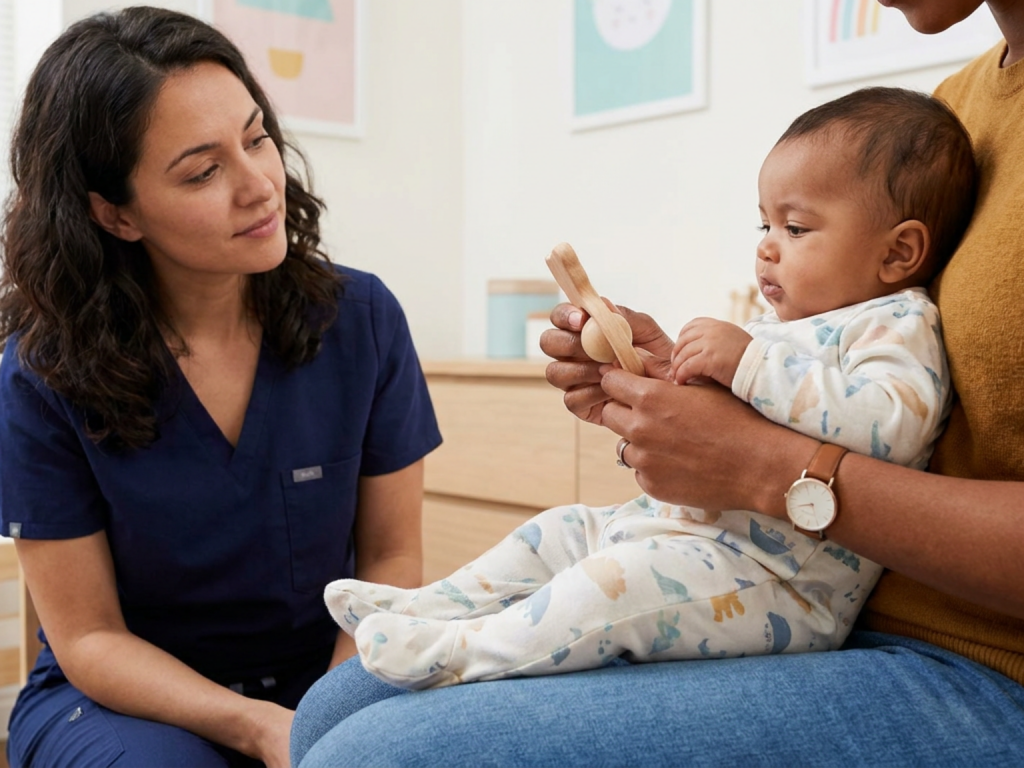
Early signs of temperament can appear in ordinary daily routines. Some babies are highly alert and seem to scan the room. Some settle quickly after feeding or cuddling, while others need rhythmic movement, dim light, or more time. Some babies smile readily at familiar faces, and others observe quietly before engaging. These patterns can be part of healthy development.
From around 4 to 7 months, many babies become more socially expressive. They may smile, laugh, reach for caregivers, respond differently to familiar and unfamiliar people, and show stronger preferences for certain games or routines. The American Academy of Pediatrics notes that babies in this age range may become more aware of people and surroundings, while some are more easily overwhelmed and need extra time to warm up.
- Reactivity: A baby may respond intensely to noise, light, hunger, or changes in position, or may remain relatively calm in the same situations.
- Adaptability: Some babies accept new caregivers, environments, or feeding routines gradually, while others adapt quickly.
- Approach or withdrawal: A baby may eagerly engage with new toys or faces, or may look away, become still, fuss, or cling before feeling comfortable.
- Soothability: Some babies calm with a brief cuddle; others need a longer sequence of feeding, rocking, swaddling when age-appropriate, quiet, or skin-to-skin contact.
- Rhythmicity: Sleep, feeding, and elimination patterns may be fairly predictable or more irregular, especially in the early months.
These observations are most useful when viewed as patterns over time, not single moments. A baby’s behavior can change with illness, teething, growth spurts, sleep deprivation, reflux symptoms, overstimulation, or disruptions in routine.
Behavioral inhibition and cautious babies
One well-studied temperament pattern is behavioral inhibition, a tendency to react to unfamiliar people, objects, or situations with caution, watchfulness, reduced movement, or distress. This is not a diagnosis. It is a temperament style that may be especially visible when a baby meets a new person, enters a busy environment, or encounters a novel toy.
National Institutes of Health reporting on longitudinal research has described how infant behavioral inhibition can predict later outcomes in some individuals. In that research, infants who showed more behavioral inhibition were more likely to have a reserved personality style and lower social functioning decades later. This is important because it shows that early temperament can be developmentally meaningful. At the same time, prediction is not certainty. Many cautious infants develop strong relationships, confidence, and social competence, especially when caregivers provide patient support without forcing rapid exposure.
A helpful approach is to think of cautious babies as needing a longer “warm-up runway.” Instead of handing the baby immediately to an unfamiliar adult, a caregiver might hold the baby while the new person speaks softly from a short distance. Instead of placing the baby in the middle of a noisy gathering, the caregiver might begin at the edge of the room and watch for cues. Respecting the baby’s threshold does not mean avoiding all novelty; it means introducing novelty in tolerable steps.
Highly reactive or easily overstimulated babies
Some babies have a low sensory threshold. They may fuss when lights are bright, noise is layered, clothing tags rub, or several people interact at once. They may arch, turn away, hiccup, yawn, splay their fingers, cry, or become suddenly quiet when overstimulated. These cues can be misunderstood as rejection or “fussiness,” but often they are signs that the baby’s nervous system needs less input.
Support begins with observation. Many babies regulate better when caregivers reduce competing stimuli: lower the volume, dim the room, pause face-to-face play, or offer a predictable calming routine. A baby who has been happily playing may still need a break before crying begins. Early recognition of disengagement cues can prevent escalation.
At the same time, persistent irritability deserves medical attention, especially if it is associated with feeding difficulty, poor weight gain, vomiting, abnormal muscle tone, breathing problems, fever, reduced responsiveness, or a sudden change from the baby’s usual pattern. Temperament can explain many differences, but it should not be used to dismiss signs of pain, illness, sensory impairment, or developmental delay.
Social engagement: smiles, eye contact, and communication style
Early social behavior is one of the most visible ways parents perceive personality. Some babies offer frequent smiles and vocalizations; others engage in shorter bursts and then look away. Looking away is often a healthy self-regulation strategy, not necessarily disinterest. Babies are still learning how to manage social stimulation.
Social engagement also overlaps with early communication milestones. Cooing, turn-taking sounds, facial imitation, shared attention, and responsiveness to a caregiver’s voice all contribute to relationship building. A baby who is temperamentally quiet may still communicate effectively through gaze, body movement, and subtle sounds. Conversely, a very vocal baby may use sound as a preferred way to seek interaction.
Parents should mention concerns to a pediatrician if a baby rarely responds to voices or sounds, does not visually track faces or objects as expected, loses previously acquired social behaviors, seems persistently floppy or unusually stiff, or shows little interest in interaction across multiple settings. Developmental screening questionnaires and, when appropriate, hearing or vision evaluation can help clarify whether a behavior reflects temperament, sensory access, or another developmental factor.
How caregiving shapes early personality development
Caregiving does not erase temperament, but it can strongly influence how safely and flexibly a baby learns to use their temperament. A sensitive caregiver notices cues, responds consistently, and adjusts expectations to the baby’s developmental stage. This does not require perfection. Babies benefit from repeated experiences of being understood, soothed, and gently guided.
For an intense baby, support may mean predictable routines and early calming before the baby becomes overwhelmed. For a cautious baby, it may mean slow introductions and reassurance. For a highly social baby, it may mean plenty of interaction balanced with rest. For a baby with irregular rhythms, it may mean flexible routines that gradually create structure without unrealistic pressure.
- Name the pattern without labeling the child: Try “You need a little time to watch first” rather than “You are shy.”
- Use co-regulation: Calm breathing, a steady voice, and predictable touch help the baby’s immature regulatory systems organize.
- Protect sleep: Overtired babies often look more reactive, withdrawn, or irritable than they do when rested.
- Offer graded exposure: New people, sounds, textures, and places can be introduced gradually, with breaks.
- Coordinate with caregivers: Share the baby’s cues with grandparents, childcare providers, and clinicians so responses are consistent.
Over time, these supportive patterns help babies build trust, emotional regulation, and curiosity. They also help parents feel less blamed and more skilled in responding to a baby whose style differs from what they expected.
When early signs should prompt extra support
Variation in infant temperament is broad. Still, parents should trust their observations when something feels persistently different or concerning. Seek professional guidance if social withdrawal, irritability, feeding problems, poor sleep, or unusual movements are intense, worsening, or interfering with daily care. It is also important to seek care for any developmental regression, such as loss of smiling, vocalizing, visual engagement, motor skills, or social responsiveness.
Concerns do not mean a baby will receive a diagnosis. Often, a pediatric visit provides reassurance, checks growth and neurologic signs, screens hearing or vision, and reviews feeding, sleep, and family stress. If needed, the clinician may suggest early intervention referral for babies, infant mental health support, lactation or feeding evaluation, physical or occupational therapy, or developmental pediatrics consultation.
Parents also deserve support. Caring for a baby who cries intensely, sleeps unpredictably, or resists soothing can be emotionally exhausting. Postpartum depression, anxiety, traumatic birth experiences, and lack of sleep can make it harder to read infant cues. Asking for help is a protective step for both parent and baby.
When to contact a healthcare professional
- A baby loses previously acquired social, motor, feeding, or communication skills.
- Persistent inconsolable crying occurs with fever, poor feeding, vomiting, breathing difficulty, or reduced alertness.
- A baby rarely responds to sound, voices, faces, or visual movement across multiple situations.
- There are concerns about poor weight gain, feeding difficulty, abnormal muscle tone, or unusual movements.
- Caregiver exhaustion, depression, anxiety, or fear of harming the baby is present and urgent support is needed.
Tools & Assistance
- Keep a brief temperament and cue diary for sleep, feeding, social reactions, and soothing strategies.
- Discuss persistent concerns during well-child visits and bring videos of behaviors that are hard to describe.
- Use developmental screening questionnaires recommended by your pediatric practice.
- Ask about early intervention services if developmental or sensory concerns affect daily functioning.
- Create a calm routine with predictable transitions, lower stimulation, and responsive caregiving.
FAQ
Can you really see personality in a baby?
You can often see temperament patterns, such as reactivity, adaptability, and sociability. Personality is still developing and will be shaped by maturation, relationships, health, and environment.
Is a cautious baby likely to stay shy?
Not necessarily. Some cautious infants remain more reserved, and research links behavioral inhibition with later social patterns in some people, but supportive caregiving and gradual exposure can help confidence grow.
Is intense crying always temperament?
No. Some babies are more reactive, but persistent or severe crying should be discussed with a clinician, especially if accompanied by feeding problems, fever, vomiting, poor weight gain, or changes in alertness.
Should parents try to change a baby’s temperament?
The goal is not to change who the baby is. The goal is to understand cues, reduce unnecessary stress, and gently support regulation, exploration, and secure relationships.
Do early temperament signs mean a child will have a mental health condition?
No single infant behavior predicts a diagnosis. Temperament can influence risk and resilience, but development depends on many factors. Persistent concerns are best reviewed with a pediatric or developmental professional.
Sources
- National Institutes of Health — Infant behavioral inhibition predicts personality and social outcomes three decades later
- American Academy of Pediatrics — Emotional and Social Development: 4 to 7 Months
- Naître et grandir — Where does your baby's personality come from?
Disclaimer
This article is for general educational information and is not a diagnosis or treatment plan. Consult a pediatrician or qualified healthcare professional for concerns about your baby’s behavior, development, feeding, or health.














Please log in to leave a comment.