
Intro
For many people trying to conceive, hearing that a uterine polyp is present can immediately raise the question: could this be interfering with implantation? Endometrial polyps are usually benign overgrowths of the uterine lining, but their location inside the cavity means they can matter for fertility in ways that are not always obvious from symptoms alone.
The relationship is not absolute. Some people with polyps conceive without difficulty, while others experience delayed conception, recurrent implantation failure, or unexplained bleeding. The key point is that implantation depends on both a healthy embryo and a receptive endometrium, and a polyp can affect that balance mechanically and biologically. This article explains what is known, what remains uncertain, and when it is reasonable to discuss evaluation or treatment with a clinician.
Highlights
Endometrial polyps are usually benign, but their position in the uterine cavity can influence fertility and implantation.
Research suggests polyps may reduce endometrial receptivity through local inflammation, altered gene expression, and physical distortion of the cavity.
Bleeding patterns can be confusing: polyp-related spotting may overlap with the timing people associate with implantation.
Hysteroscopy is often the most direct way to confirm a polyp and, when appropriate, remove it.
Whether removal helps depends on the whole fertility picture, not just the presence of a polyp.
What endometrial polyps are
Endometrial polyps are focal overgrowths of the uterine lining. They are often discovered incidentally during an infertility workup or when a person is being evaluated for abnormal uterine bleeding. Many are small and asymptomatic, and many are discovered only because imaging happens to look closely at the uterine cavity.
For fertility, the most important feature is not simply that a polyp exists, but where it is located. Implantation requires a coordinated interaction between the embryo and the endometrium, so a lesion inside the cavity can matter even if it does not cause pain. A polyp near the fundus or at the site where an embryo would attach may be more disruptive than one that is less strategically placed.
It also helps to remember that the endometrium is dynamic, not a static surface. Every cycle, it prepares for the implantation window. Anything that changes the cavity contour or the local tissue environment can potentially affect that preparation.
How polyps may affect implantation
The best-supported explanation is that polyps can interfere with implantation in more than one way. First, they may create a space-occupying effect: the embryo may have less room to appose and attach to the lining in the usual way. Second, they may change the local endometrial environment by promoting inflammation or altering the expression of genes involved in receptivity.
That biologic idea is consistent with studies showing reduced HOXA10 and HOXA11 expression in endometrium with polyps. These genes are associated with endometrial receptivity in early pregnancy, so lower expression provides one plausible mechanism for why implantation can be less efficient in some patients. In addition, review articles have described altered cytokine signaling and a less favorable local milieu, which may further reduce the odds that the embryo will implant successfully.
This does not mean every polyp will block pregnancy. It does mean that when clinicians discuss endometrial receptivity and implantation, a polyp is more than a passive incidental finding. It may be one of several factors that shape how well the uterus supports the embryo.
Symptoms and clues that can overlap with early pregnancy signs
Polyps often cause no symptoms, but they can also show up as irregular bleeding, spotting between periods, prolonged menses, or bleeding after sex. In some people, the first clue is not bleeding at all but repeated difficulty conceiving or repeated loss after very early pregnancy tests.
That can make interpretation emotionally difficult. Bleeding in the luteal phase may be blamed on a failed cycle, while a small amount of spotting may be mistaken for implantation bleeding. In reality, implantation bleeding versus period spotting can be hard to distinguish clinically, and a polyp is one reason the picture may be unclear. Timing alone is not enough to identify the cause.
Because the symptoms are nonspecific, clinicians think broadly. Fibroids, chronic endometritis, ovulatory dysfunction, cervical causes, and embryo-related factors can all contribute to bleeding or subfertility. A polyp may be part of the story, but it is rarely wise to assume it is the only explanation.
How clinicians evaluate the uterine cavity
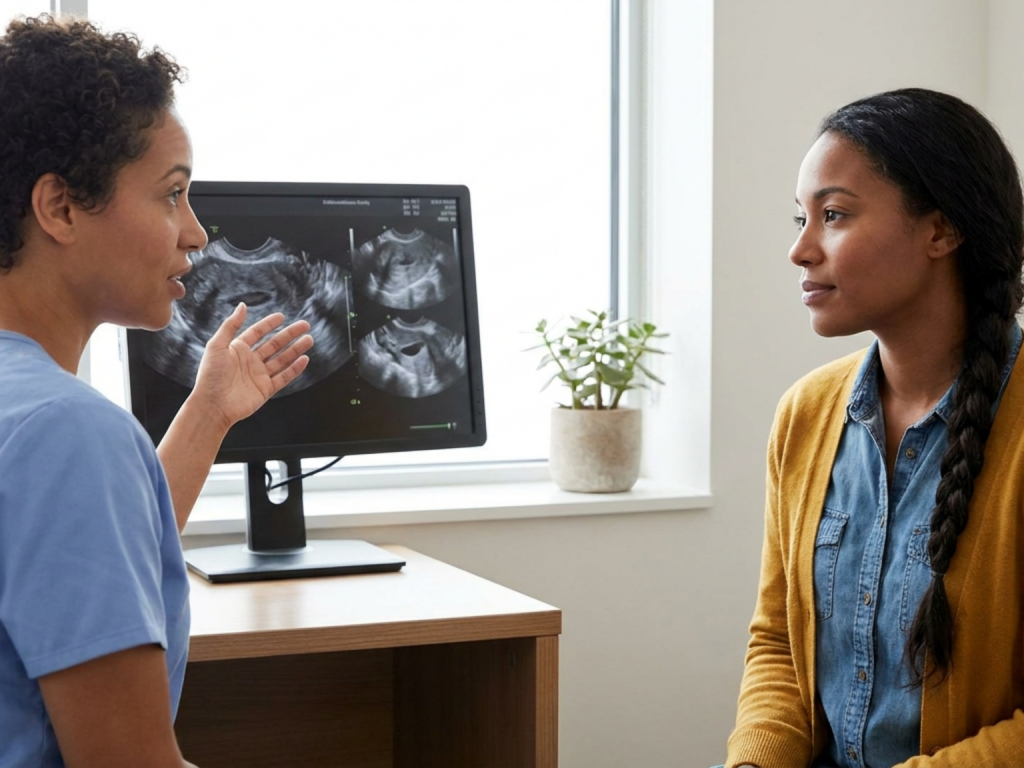
Evaluation usually starts with a careful history and transvaginal ultrasound. Ultrasound can detect many polyps, but small lesions may be missed, and the test may not always show how much the cavity is distorted. If the result is uncertain or if fertility planning depends on a clearer view, saline infusion sonohysterography can outline the cavity more precisely.
Hysteroscopy is the most direct method because it lets the clinician inspect the inside of the uterus in real time. If a polyp is seen, it can often be removed during the same procedure. That makes hysteroscopy especially useful when there is recurrent implantation failure after IVF, unexplained infertility, or repeated bleeding that has not been clarified by imaging alone.
For some patients, a broader evaluation is also appropriate. When there has been repeated loss, a uterine cavity assessment after miscarriage may be discussed alongside hormonal testing, tubal assessment, semen analysis, or review of embryo factors. A good evaluation looks for the full pattern, not just one lesion.
Treatment considerations and fertility planning
Hysteroscopic polypectomy is commonly considered when a polyp is causing bleeding or when the fertility setting makes cavity optimization important. Review-level evidence suggests that removing a polyp can improve pregnancy outcomes in some subfertility contexts, but the magnitude of benefit varies. Age, polyp size, number of polyps, other uterine findings, and the presence of male factor or ovulatory factor infertility all influence the decision.
In IVF, a polyp may be considered when there is failed implantation after embryo transfer, especially if the cavity has not been recently assessed. Some clinicians favor removal before another transfer because even a small lesion may affect the uterine surface. Others may individualize the plan if the polyp is tiny, asymptomatic, or difficult to interpret on imaging. There is no single rule that fits every patient.
Pathology after removal is important because it confirms the diagnosis and can exclude uncommon atypia. If symptoms continue after a polyp has been removed, further review is reasonable rather than assuming the problem is solved. The goal is not just to remove tissue, but to improve the chance of a healthy, receptive uterus for the next cycle.
Living with uncertainty while trying to conceive
A polyp diagnosis can feel discouraging, especially when you have already invested a lot of hope in conception. It may help to remember that a polyp is a structural issue, not a reflection of anything you did or did not do. Fertility care often involves many moving parts, and one abnormality rarely explains everything by itself.
If you are preparing for a consultation, useful questions include whether the polyp is likely to affect implantation, whether hysteroscopy is recommended, how the team would time treatment relative to conception attempts, and whether other causes of infertility should be reviewed at the same time. If you have had multiple losses or cycles without success, asking how the clinician weighs endometrial receptivity and implantation against embryo and hormone factors can make the discussion more concrete.
Support matters too. Many people find that having a clear plan, even if it includes waiting for a procedure or repeat imaging, reduces uncertainty. The aim is not to rush to a conclusion, but to make the next step evidence-based and personally appropriate.
Seek prompt medical review if you have:
- Heavy bleeding, dizziness, fainting, or signs of anemia.
- Severe pelvic pain, fever, or foul-smelling discharge.
- Positive pregnancy test with bleeding or one-sided pain.
- Repeated implantation failure or recurrent loss that has not been evaluated.
Tools & Assistance
- Gynecologist or reproductive endocrinologist consultation
- Transvaginal ultrasound or saline infusion sonohysterography
- Diagnostic and operative hysteroscopy
- Pathology review after polyp removal
FAQ
Can a polyp stop implantation completely?
Sometimes it can interfere with the uterine environment or cavity shape, but not every polyp prevents pregnancy.
Do all polyps need to be removed before trying to conceive?
No. The decision depends on symptoms, size, location, recurrence, IVF plans, and your broader fertility picture.
Can polyp-related spotting be confused with implantation bleeding?
Yes. The timing and amount of bleeding can overlap, so spotting alone cannot reliably tell you the cause.
Is hysteroscopy the most accurate way to confirm a polyp?
Yes, hysteroscopy is the most direct way to look inside the uterus and can often treat the polyp at the same time.
Sources
- PubMed Central / National Library of Medicine — Endometrial polyps: Pathogenesis, sequelae and treatment
- PubMed Central / National Library of Medicine — Endometrial Polyps and Subfertility
- PubMed Central / National Library of Medicine — ENDOMETRIAL POLYPS AFFECT UTERINE RECEPTIVITY
Disclaimer
This article is for informational purposes only and does not replace individualized medical advice, diagnosis, or treatment from a qualified healthcare professional.
















Please log in to leave a comment.