A–Z Glossary

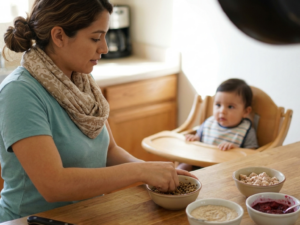
Responsive feeding

A feeding approach that notices a child’s cues, offers food consistently, and lets the child decide how much to eat.

← Back to A–Z Glossary

Search results for: Responsive feeding

When to start breastfeeding and first latch

When to start breastfeeding and first latch

When should breastfeeding begin? When a newborn is breathing effectively, maintaining an appropriate temperature, and does not require urgent medical intervention, breastfeeding should usually be initiated within the first hour after birth. The World Health Organization recommends early initiation and emphasizes immediate, uninterrupted skin-to-skin contact when possible. This period is sometimes called the first hour […]

How unpredictable newborn routine is

How unpredictable newborn routine is

Why newborn routines change so quickly During the neonatal period, routine is shaped by physiology rather than by a stable internal clock. A newborn’s stomach is small, feeding skills are still developing, and the infant may need repeated opportunities to feed over a 24-hour period. Basic care also generates frequent interruptions: diapers need changing, the […]

Hunger or Discomfort: Why a Newborn Wakes Up

Hunger or Discomfort: Why a Newborn Wakes Up

Why Newborns Wake So Often Newborn sleep is organized differently from adult sleep. Infants move through relatively short sleep periods and spend substantial time in active sleep, a state that may include facial movements, irregular breathing, brief vocalizations, and limb activity. These behaviors can look like waking even when the baby is not fully awake. […]

How parents adjust first weeks with newborn

How parents adjust first weeks with newborn

Expect a flexible rhythm rather than a fixed routine During the first weeks, many newborns do not follow a stable day-night schedule. Their sleep-wake cycles are shaped by immature circadian regulation, small gastric capacity, and frequent nutritional needs. A typical sequence may be feeding, burping, a diaper change, a short period of quiet alertness, settling, […]

Skin-to-skin after coming home

Skin-to-skin after coming home

What skin-to-skin means at home Skin-to-skin contact, also called kangaroo care, involves placing a diapered newborn upright against an adult’s bare chest. The baby’s chest rests against the caregiver’s chest, while the head is positioned to one side. A blanket can cover the baby’s back and the adult’s shoulders, but it should not cover the […]

What are baby growth spurts

What are baby growth spurts

What a baby growth spurt means A baby growth spurt is a relatively short interval of accelerated physical growth. The change may involve body weight, length, or head circumference, and the timing can vary substantially between infants. A spurt is best understood as part of a broader growth pattern rather than as an event that […]

How often to feed a baby 0 to 12 months

How often to feed a baby 0 to 12 months

What determines feeding frequency? Feeding frequency is influenced by the infant’s age, stomach capacity, feeding method, milk transfer or intake, sleep-wake pattern, and rate of growth. Newborn stomach capacity is small, so frequent feeds are physiologically expected. As the infant matures, feeds usually become more efficient and may become less frequent, although temporary increases are […]

Baby feeding cues explained

Baby feeding cues explained

What feeding cues are and why they matter Feeding cues are observable behavioral and physiologic signals that may indicate a baby wants to feed, is preparing to feed, or is becoming satisfied. They are part of an infant’s communication repertoire, not a rigid schedule. A baby may signal hunger through movements, facial expressions, vocalizations, or […]

Early hunger cues vs late hunger cues

Early hunger cues vs late hunger cues

What hunger cues mean Hunger cues are observable behaviors that may indicate a baby is becoming ready to feed. They reflect a changing internal state, including appetite, arousal, and readiness to coordinate sucking, swallowing, and breathing. They are not a precise measurement of how much milk a baby needs, and a single behavior does not […]

Feeding on demand vs schedule

Feeding on demand vs schedule

What feeding on demand means Feeding on demand, also called cue-based or responsive feeding, means offering breast milk or infant formula when the baby shows signs of hunger rather than waiting for a predetermined interval. The parent observes the infant’s behavioral state and responds to early cues. These may include stirring, hand-to-mouth movements, rooting, lip […]

How to bottle feed a baby correctly

How to bottle feed a baby correctly

Prepare before offering the bottle Begin by choosing a quiet moment and making sure you can remain with the baby throughout the feed. Have the bottle ready according to the instructions for the specific milk being offered. When using infant formula, follow the product label and the preparation guidance provided by your healthcare professional or […]

Paced bottle feeding explained

Paced bottle feeding explained

What paced bottle feeding means Paced bottle feeding is a method of offering milk that allows the infant to regulate the rhythm of the feed. The baby is held relatively upright, the bottle is kept almost horizontal rather than tipped steeply downward, and the caregiver periodically lowers or removes the bottle to create a pause. […]

How to hold baby during bottle feeding

How to hold baby during bottle feeding

Start with a supported, semi-upright position Sit in a stable chair or other comfortable place where your back and arms are supported. Bring your baby close to your chest and place the baby’s head in the bend of your elbow or slightly higher along your forearm. The baby’s trunk should be tilted upward rather than […]

Bottle Refusal in Breastfed Babies

Bottle Refusal in Breastfed Babies

What Bottle Refusal Looks Like Bottle refusal ranges from mild hesitation to complete rejection. A baby may latch briefly and then pull away, gag, cough, become distressed, or refuse to coordinate sucking, swallowing, and breathing. Some babies accept a bottle only from one caregiver, in one position, or when drowsy. Others reject every teat but […]

Why baby suddenly eats more or less

Why baby suddenly eats more or less

Appetite is not perfectly consistent in infancy Infants do not consume an identical amount at every feeding. Appetite is influenced by sleep, alertness, gastric emptying, activity, temperature, recent intake, and the timing of the previous feed. A baby may take a large feed in the morning, snack intermittently later, and then feed more frequently overnight. […]

Distracted Feeding During the First Year

Distracted Feeding During the First Year

What Distracted Feeding Can Look Like Distracted feeding refers to a baby shifting attention away from feeding toward environmental or internal stimuli. During breastfeeding, a baby may latch, suck briefly, then unlatch to look at a voice, door, screen, pet, or movement nearby. During bottle-feeding, the baby may stop sucking, turn the head, push the […]

Feeding regression in babies explained

Feeding regression in babies explained

What feeding regression means There is no single clinical definition of feeding regression. In everyday use, it means a backward shift from a baby’s previous feeding pattern. The change may affect breastfeeding, bottle-feeding, complementary foods, or several domains at once. A baby who fed efficiently may begin taking much longer, fall asleep before completing a […]

First foods for baby in the US

First foods for baby in the US

When babies are ready to start complementary foods Federal guidance and American Academy of Pediatrics guidance generally support beginning complementary foods around 6 months. Foods should not be introduced before 4 months unless specifically directed by a qualified healthcare professional. The appropriate timing is based on maturation of oral-motor skills and postural control, not simply […]

Best first foods for babies

Best first foods for babies

When babies are ready for first foods Most infants begin complementary foods at approximately 6 months. Age alone is not enough: readiness reflects neuromuscular control and oral-motor skills. A baby who is ready can usually sit upright with support and maintain stable head and neck control. The infant should also show interest in food, open […]

What foods to introduce first

What foods to introduce first

Start with readiness, not a rigid food order Most public health guidance places the start of complementary feeding at about 6 months, when breast milk or infant formula is supplemented with other foods. Age alone is not enough. Look for several signs of developmental readiness for solids: the baby can sit upright with good head […]

Introducing Mild Herbs and Flavors to Baby Food

Introducing Mild Herbs and Flavors to Baby Food

When Mild Flavors Can Be Introduced Many babies are developmentally ready for complementary foods at around 6 months, although readiness varies and should be discussed with a health visitor, pediatrician, or other qualified healthcare professional when there is uncertainty. Readiness commonly includes being able to sit with support and maintain head control, coordinate bringing food […]

Added Sugar and Salt in Foods for Babies

Added Sugar and Salt in Foods for Babies

What Counts as Added Sugar and Salt? Added sugar is sugar incorporated into a food or drink during processing, preparation, or cooking. It includes ingredients such as table sugar, syrups, molasses, glucose, fructose, and concentrated sweeteners used to make a product taste sweeter. It is distinct from the naturally occurring sugar in whole fruit, vegetables, […]

Vegetarian Feeding During the First Year

Vegetarian Feeding During the First Year

Build the first year around breast milk or formula For most infants, breast milk or iron-fortified infant formula supplies the majority of energy and nutrients during the first year. Guidance for vegetarian and vegan babies generally supports exclusive breast milk or infant formula for approximately the first 6 months when feasible and appropriate, followed by […]

Balanced Meals for Babies Without Meat

Balanced Meals for Babies Without Meat

Start With the Nutrients Babies Need Most After about 6 months, infants need increasing amounts of nutrients that may be difficult to obtain from a limited or poorly planned vegetarian diet. Iron is a central concern because infant iron stores begin to decline during this period. Iron supports hemoglobin production, oxygen transport, neurodevelopment, and cellular […]
Purees vs baby-led weaning explained

Purees vs baby-led weaning explained

What the two approaches mean Traditional spoon-feeding generally introduces complementary foods as smooth or finely mashed purées. An adult offers small amounts on a spoon, observes the baby’s cues, and gradually increases texture and variety. Purées may be homemade or commercially prepared, provided that foods are prepared safely and products are suitable for the baby’s […]

Balancing milk and solid food

Balancing milk and solid food

Milk and solids have complementary roles Complementary feeding refers to foods given in addition to breast milk or infant formula when milk alone no longer meets all nutritional needs. The word complementary is important: early solid foods supplement milk rather than immediately replacing it. Breast milk or properly prepared infant formula continues to provide substantial […]

Snacks for babies introduction

Snacks for babies introduction

When can babies start having snacks? Solid foods are generally introduced at about 6 months, when a baby shows developmental readiness. Relevant signs include sitting with support and maintaining head and neck control, opening the mouth for food, bringing objects to the mouth, and swallowing food rather than consistently pushing it out with the tongue. […]

Family Meals With a Baby Under One

Family Meals With a Baby Under One

Start With Readiness, Not the Calendar Alone Public-health guidance generally recommends introducing complementary foods at about 6 months. Age matters because the gastrointestinal, neuromuscular, and oral-motor systems are maturing, but readiness is not determined by a date alone. A baby should be able to hold their head and neck steady, sit with support in an […]

How to prepare baby food at home

How to prepare baby food at home

Start with developmental readiness Readiness for complementary foods is based on developmental abilities rather than age alone. Many infants are ready at approximately six months, but a healthcare professional can help interpret the signs for an individual baby. Relevant signs include being able to sit with stable head control, coordinating the eyes, hands, and mouth, […]

Store-bought vs homemade baby food

Store-bought vs homemade baby food

What complementary foods need to provide Complementary foods are introduced alongside breast milk or infant formula when a baby shows developmental readiness, commonly around 6 months, although timing should be individualized. Readiness includes being able to sit with support, maintaining head and neck control, showing interest in food, and moving food toward the back of […]

When babies start self-feeding

When babies start self-feeding

When self-feeding usually begins Most babies start experimenting with self-feeding at approximately 6 months, which commonly coincides with the beginning of complementary feeding. Age alone, however, is not enough to establish readiness. The Centers for Disease Control and Prevention advises against introducing solid foods before 4 months, while public-health guidance from the NHS generally describes […]

How to encourage self-feeding

How to encourage self-feeding

Understand what self-feeding involves Self-feeding includes more than picking up food. It requires postural stability, visual attention, hand-to-mouth coordination, graded grasp, oral-motor control, and the ability to manage different textures. Early attempts may involve raking food toward the palm, dropping pieces, mouthing objects, or using the whole hand. With practice, many children develop a pincer […]

When Baby Is Ready for a Spoon

When Baby Is Ready for a Spoon

What “Ready for a Spoon” Really Means Readiness for a spoon has two related but distinct meanings. A baby may be ready to accept complementary food from a caregiver’s spoon, or ready to participate actively by grasping and guiding a spoon toward the mouth. The first skill generally develops earlier. The Centers for Disease Control […]

Using spoon vs hands for feeding

Using spoon vs hands for feeding

What the two approaches involve Spoon-feeding usually involves a caregiver placing purées, mashed foods, or soft meals onto a spoon and bringing it to the baby’s mouth. The caregiver controls much of the timing and may be able to offer a predictable amount of food. This can be useful when introducing iron-rich foods, smooth textures, […]

Baby refuses solid food what to do

Baby refuses solid food what to do

Why a baby may refuse solid food Refusal does not automatically mean that something is wrong. Solids are a developmental transition from a familiar, liquid feeding pattern to a complex sensory and motor task. A baby must coordinate posture, lip closure, tongue movement, chewing or mashing, and swallowing while also processing unfamiliar tastes and textures. […]

Repeated Food Exposure After Baby Refuses a Food

Repeated Food Exposure After Baby Refuses a Food

A refusal is information, not a final decision Infant food acceptance is influenced by more than flavor. Babies are learning how to manage new oral sensations, coordinate chewing or gum-based mashing, move food through the mouth, and swallow. A food that seems simple to an adult may be difficult because it is fibrous, sticky, grainy, […]

Iron-Rich First Foods for Babies

Iron-Rich First Foods for Babies

Why Iron Matters When Solids Begin Iron is required for hemoglobin synthesis, oxygen transport, cellular energy production, and neurodevelopment. Infants are born with iron stores accumulated during pregnancy, but those stores gradually become less sufficient during the second half of the first year. This is one reason complementary foods are commonly introduced at approximately 6 […]

Why baby wakes up at night

Why baby wakes up at night

Night waking is often normal in infancy Babies are not born with a fully mature circadian rhythm, the internal timing system that helps coordinate sleep and wakefulness across a 24-hour day. In the early weeks, many infants cannot reliably distinguish day from night. Their sleep is distributed across multiple periods, and nighttime may look very […]

1 month baby routine example

1 month baby routine example

What a 1-month-old routine is really like At 1 month, a baby’s schedule is usually feeding-driven. Most newborns need approximately 8 to 12 feedings per 24 hours, often spaced about every 2 to 3 hours, although the interval can be shorter or longer at particular times. Some babies feed in clusters, especially during parts of […]

2 month baby routine example

2 month baby routine example

What a 2-month routine should accomplish At 2 months, the purpose of a routine is to create familiar patterns, not to make a baby conform to an adult timetable. A useful cycle is often feed, burp, diaper, brief interaction, and sleep, although the order may change. Some babies need to sleep immediately after feeding, while […]

3 month baby routine example

3 month baby routine example

What a 3-month routine can realistically look like At this age, infants commonly move through repeated cycles of feeding, brief interaction, and sleep. Sleep may still occur in several short sessions, and longer, more consolidated nighttime sleep often develops gradually rather than suddenly. Research on infant and toddler sleep patterns supports keeping expectations flexible during […]

4 month baby routine example

4 month baby routine example

What a 4-month routine should include A useful 4-month routine usually contains the same broad sequence throughout the day: feeding, brief interaction or play, diapering and care, sleep, and another feed after waking. This pattern creates predictability without requiring your baby to sleep or eat at exactly the same times every day. A feeding-led routine […]

5 month baby daily routine

5 month baby daily routine

Build a flexible daily rhythm A practical 5-month routine usually follows a repeating pattern: waking and feeding, a period of interaction, then sleep when tiredness cues appear. The exact timing can vary from day to day. Some babies take longer naps, while others sleep briefly and need several opportunities to rest. A routine is successful […]

How to structure baby day

How to structure baby day

Start with a rhythm, not a rigid schedule A young baby’s day is best understood as a repeating sequence rather than a fixed timetable: wake, feed, have a period of interaction or movement, receive routine care, and sleep again. The length and order of these periods will vary. In the early weeks, feeding and settling […]

On-demand vs scheduled routine

On-demand vs scheduled routine

What the two approaches mean An on-demand routine follows the baby’s signals. Feeding may occur when early hunger cues appear, sleep may be offered when the infant shows fatigue, and soothing or interaction may be adjusted according to arousal and comfort. Early cues are generally easier to respond to than late cues: a hungry baby […]

Pros and cons of baby schedules

Pros and cons of baby schedules

Schedule, routine, and responsiveness A schedule usually means activities are planned at approximately specified clock times. A routine is broader: it is a predictable sequence, such as feeding, diapering, dimming the lights, reading, and settling for sleep, without requiring that every event happen at exactly the same time. Responsiveness means adjusting care according to the […]

Should babies follow strict schedule

Should babies follow strict schedule

Why strict schedules often do not fit infant biology Newborns do not arrive with a mature circadian rhythm, the internal timing system that helps coordinate sleep and wakefulness across a 24-hour day. In the early weeks, sleep is distributed across day and night, and waking is strongly influenced by hunger, discomfort, temperature, need for contact, […]

Responsive parenting and routines

Responsive parenting and routines

What responsive parenting means Responsive parenting is a reciprocal process in which a caregiver notices a child’s signals, interprets them within context, and responds in a timely, appropriate, and emotionally available way. In infancy, signals may include crying, facial expressions, body movements, gaze, vocalizations, changes in muscle tone, and shifts in alertness. The same behavior […]

Baby Schedule Changes After Starting Solids

Baby Schedule Changes After Starting Solids

Why the Schedule Changes Before solids, many babies move through a relatively simple cycle of milk feeding, wake time, and sleep. Adding complementary foods introduces another activity that requires preparation, positioning, supervision, and cleanup. A meal that takes only a few minutes for an experienced eater may initially take much longer because the baby is […]

How parents manage baby schedules

How parents manage baby schedules

Start with biology rather than the clock In the early weeks, babies do not reliably distinguish day from night. Their sleep is distributed across multiple periods, and frequent waking is often biologically appropriate because breast milk or formula is consumed in relatively small volumes. A newborn schedule is therefore commonly organized around feeding cues, diaper […]

Working parents and baby routine

Working parents and baby routine

What a workable baby routine means A workable routine is a recurring pattern of care, not a demand that every event occur at exactly the same time. In early infancy, feeding may be frequent and irregular, night waking is common, and circadian rhythm development is still immature. A newborn may therefore need a cue-based routine […]

Baby Routine for Families With Irregular Work Hours

Baby Routine for Families With Irregular Work Hours

Start With Anchors, Not a Perfect Schedule Infants do not follow adult time management. In the first months, circadian rhythm is still developing, sleep is distributed across day and night, and feeding needs may be frequent. Even older babies can have variable nap duration, changing wake periods, teething discomfort, or increased night waking. A routine […]

Weekday vs Weekend Baby Routines

Weekday vs Weekend Baby Routines

Routine Means Predictability, Not Precision For an infant, a routine is best understood as a pattern of repeated events rather than a strict timetable. Babies gradually develop circadian rhythm, the internal 24-hour biological timing system that helps organize sleep and wakefulness. In the newborn period, this system is immature, and frequent feeding, variable sleep duration, […]

Baby Routine With Older Siblings at Home

Baby Routine With Older Siblings at Home

Build a Flexible Family Rhythm In early infancy, a routine is better understood as a repeating sequence than as a strict timetable. The baby may feed responsively, sleep for variable intervals, and require frequent soothing. A practical family rhythm can therefore be organized around anchor points that are relatively stable: waking, school or childcare departure, […]

Why strict routines can fail

Why strict routines can fail

A routine is a pattern, not a contract A routine is a recurring sequence of experiences: a baby wakes, feeds, interacts, rests, and receives care in a broadly familiar order. This pattern can provide anticipatory cues and reduce uncertainty. A strict routine, by contrast, often depends on predetermined times, fixed intervals, or rules that must […]

Best ways to calm a crying baby

Best ways to calm a crying baby

Begin with a calm, systematic check Before attempting several techniques at once, pause and assess the most likely needs. Crying may signal hunger, a wet or soiled nappy, discomfort from clothing or temperature, tiredness, or a need for closeness. Check whether the baby is positioned comfortably, whether fingers or toes are caught in clothing, and […]

Dropping Objects Repeatedly From the High Chair

Dropping Objects Repeatedly From the High Chair

Why Repeated Dropping Happens From an adult perspective, dropping the same spoon ten times may look inefficient or intentionally provocative. From a baby’s perspective, it can be a compact science experiment. Infants learn through sensorimotor exploration: they act on objects, watch what happens, and repeat the action to test whether the outcome is predictable. Dropping […]

Loss of appetite baby causes

Loss of appetite baby causes

Understanding Appetite Changes In Babies Loss of appetite in a baby rarely has a single obvious meaning. A newborn, a six-month-old starting solids, and a nearly one-year-old exploring the room all express hunger and fullness differently. A useful first step is to ask whether the baby is truly taking much less overall, or whether the […]

Mixing Medicine With Milk or Food: What Parents Should Know

Mixing Medicine With Milk or Food: What Parents Should Know

Why food can change how a medicine behaves Mixing a medicine with milk or food is not just a taste issue. It can change the drug’s bioavailability, meaning the amount that actually reaches the bloodstream. Some medicines bind to components in food, some are absorbed more slowly, and some become less stable once blended into […]

How fast babies grow in first year

How fast babies grow in first year

The pace of growth during the first year Infancy is the period of fastest postnatal growth after the newborn phase. In general, babies gain weight and length most quickly during the first several months, then the rate gradually slows as the year progresses. This deceleration is normal physiology rather than evidence that growth has stopped. […]

Weight gain 3 to 6 months baby

Weight gain 3 to 6 months baby

What weight gain is typical from 3 to 6 months? There is no single weight that every 3- to 6-month-old baby should reach. Infants begin this period at different weights, lengths, and percentiles, and healthy babies can follow many different growth patterns. The clinically useful question is usually whether the baby is gaining weight along […]

When growth spurts happen first year

When growth spurts happen first year

What a first-year growth spurt means A growth spurt is a relatively short period of accelerated physical growth. An infant may need more energy and fluids during this interval, which can lead to observable changes in feeding and sleep. The phrase is commonly used by caregivers to describe a cluster of behaviors, but it is […]

How growth spurts affect weight

How growth spurts affect weight

What happens to weight during a growth spurt? During a growth spurt, the body increases its production of new tissue. In a baby, this may include muscle, bone, fat stores, organs, and blood volume. These processes require energy and nutrients, so some infants show a temporary increase in appetite or feeding frequency. A baby may […]

Growth spurts and appetite changes

Growth spurts and appetite changes

What happens during a growth spurt A growth spurt is a period when an infant’s body is growing more rapidly than usual. The change may involve weight, length, head circumference, or a combination of these measures. Growth is not perfectly linear: babies commonly alternate between periods of relatively rapid gain and periods in which measurable […]

Growth After Illness or Feeding Difficulties

Growth After Illness or Feeding Difficulties

Why Illness or Feeding Problems Can Slow Growth Infant growth depends on a sustained balance between energy intake, nutrient absorption, metabolic demand, and the energy required for movement and recovery. Acute illness can disturb several of these factors at once. A baby with fever, respiratory disease, infection, pain, or gastrointestinal symptoms may feed less frequently […]

Why baby is not gaining weight

Why baby is not gaining weight

What slow weight gain means Babies do not gain weight in a perfectly linear pattern. Short periods of slower gain can occur during minor illness, developmental transitions, or changes in feeding. The clinically relevant question is whether the baby is following an individual growth trajectory and maintaining proportional growth over time. Clinicians commonly assess weight-for-age, […]

Growth comparison feeding types

Growth comparison feeding types

What feeding type can and cannot explain Feeding type is associated with population-level differences in infant growth, but it is only one part of the explanation. Human milk composition changes over time and varies across feeds, while standard infant formulas provide a relatively consistent nutrient composition. Babies also differ in appetite regulation, feeding efficiency, sleep, […]

Growth During the Transition to Solid Foods

Growth During the Transition to Solid Foods

Why the Transition Matters for Growth Complementary feeding begins when breast milk or infant formula alone no longer fully meets an infant’s evolving nutritional requirements, while milk remains an important part of the diet. The World Health Organization identifies the period from 6 to 24 months as especially important because children undergo rapid growth and […]

Basic baby care for new parents

Basic baby care for new parents

Feeding and hydration Newborns commonly feed often because their stomach capacity is small and growth is rapid. Whether your baby receives breast milk, formula, or both, look for early newborn feeding cues such as stirring, bringing hands to the mouth, rooting, or making sucking movements. Crying is a later cue and can make feeding more […]

Early baby care essentials

Early baby care essentials

Supporting the newborn transition Immediately after birth, the priorities are effective breathing, thermal stability, skin-to-skin contact, and timely feeding. Drying the baby thoroughly and placing the infant skin-to-skin with a parent helps reduce heat loss and supports cardiorespiratory adaptation. A hat or additional covering may be used when clinically appropriate, while the baby’s face remains […]

Responsive caregiving

Responsive caregiving

What responsive caregiving means The World Health Organization describes responsive caregiving as the ability to notice, understand, and respond appropriately and promptly to a young child’s signals. Those signals include behavior, movements, vocalizations, facial expressions, and changes in state such as alertness, fatigue, hunger, discomfort, or overstimulation. The response is not merely practical. Its quality […]

Managing baby needs on the go

Managing baby needs on the go

Start with a realistic outing plan Managing baby needs on the go begins before you leave. Consider the destination, travel time, access to clean water and changing facilities, weather, likely crowding, and how quickly you could return home. For a first outing after a difficult night, a brief walk or one-stop errand may be more […]

How parents manage baby care daily

How parents manage baby care daily

Building the daily care cycle Most families manage baby care through repeating cycles rather than a strict schedule. A typical sequence may include waking, feeding, burping or holding upright when appropriate, diaper care, brief interaction, and sleep. The order can change according to the baby’s signals. During the early weeks, the newborn schedule is feeding-led […]

Baby Care When One Parent Is Home Alone

Baby Care When One Parent Is Home Alone

Prepare the Environment Before You Are Alone Preparation is most useful when it reduces the number of times you must leave the baby or make a complex decision. Choose a primary care area where you can safely place the baby while using both hands. Depending on developmental stage, this may be a crib, bassinet, play […]

Planning daily baby care

Planning daily baby care

Build a flexible daily rhythm Begin with essential tasks rather than fixed clock times. For many newborns, the most useful framework is a repeating sequence: observe the baby, feed responsively, change the diaper, provide brief interaction if the baby is alert, and return the baby to a safe sleep space when sleepy. This approach accommodates […]

Teething and feeding changes

Teething and feeding changes

Why tooth eruption can alter feeding Primary tooth eruption can produce localized gum tenderness, swelling, increased drooling, irritability, and disrupted sleep. These effects can change feeding behavior because sucking and chewing place pressure on the gums. A baby may start a feed eagerly, then pull away once discomfort increases. Others may repeatedly latch and unlatch, […]

Why baby refuses food during teething

Why baby refuses food during teething

How teething can make feeding uncomfortable Teeth emerge by moving through gum tissue, a process that can produce localized gum tenderness, pressure, and mild inflammation. A baby may respond by rubbing the gums, drooling, biting, becoming more irritable, or refusing food. MedlinePlus includes refusing food among common signs associated with teething. The behavior is understandable: […]

Spoon Refusal Caused by Sore Gums

Spoon Refusal Caused by Sore Gums

Why sore gums can lead to spoon refusal Teething is a normal developmental event, but the local gum inflammation and pressure associated with an erupting tooth can be uncomfortable. A spoon touches tissues that may already be tender, swollen, itchy, or sensitive to pressure. Some babies respond by turning their head away, pushing the spoon […]

Adapting activities to baby mood

Adapting activities to baby mood

Read the state before choosing the activity In early infancy, activity choice should begin with observation, not the clock or an idealized play plan. Babies cycle through sleep, drowsiness, quiet alertness, active alertness, fussiness, and crying. Quiet alertness, often marked by open eyes, relatively smooth movements, and attention to a face or voice, is commonly […]

Essential baby products first year

Essential baby products first year

Start with a safe sleep setup Sleep equipment deserves the highest priority because infants spend many hours asleep and cannot reliably reposition themselves. Choose a crib, bassinet, portable crib, or play yard that complies with current consumer safety requirements and has a firm, flat, noninclined mattress designed for that product. The sleep surface should fit […]

Baby gear checklist for new parents

Baby gear checklist for new parents

Start with a needs-based checklist Newborn shopping can become overwhelming because product lists often mix true essentials with convenience items. Begin by mapping the first two to four weeks at home: where the baby will sleep, how you expect to feed them, how you will manage diaper changes, and how you will travel to appointments. […]

What you really need for a baby

What you really need for a baby

Start with needs, not a shopping list Newborn care is repetitive and close-range: feed, change, settle, observe, and rest when possible. The basic needs are nutrition, a safe place to sleep, protection from overheating or chilling, clean diapers, gentle hygiene, and reliable caregiving. Most families can begin with a deliberately short list and add items […]

Best feeding products for babies

Best feeding products for babies

Start with function, safety, and your baby's stage The best feeding products are those that fit a real feeding method and a baby’s current developmental abilities. Before buying a large set, identify whether you are primarily breastfeeding, formula feeding, expressing milk, combination feeding, beginning solids, or doing several of these at once. A small number […]

Bottle types and differences

Bottle types and differences

Why bottle design matters A baby bottle is a feeding system rather than an isolated container. Its body, collar, nipple, valve, cap, and sometimes venting components work together to deliver milk. Small differences in geometry can affect preparation, grip, visibility of the milk, cleaning time, and the ease with which a caregiver maintains a consistent […]

Common feeding gear mistakes

Common feeding gear mistakes

Treating feeding gear as a substitute for supervision One of the most consequential mistakes is using equipment to keep a baby feeding without an attentive adult present. Bottle propping, in which a bottle is wedged against a pillow, blanket, or another object, prevents the caregiver from responding promptly if the infant coughs, chokes, vomits, becomes […]

Food insecurity and how it can affect children’s eating behavior

Food insecurity and how it can affect children’s eating behavior

What food insecurity means for a child Food insecurity is not the same as a child simply being hungry before dinner. It refers to ongoing or repeated uncertainty about food access. A family may have enough food some days and not enough on others, or they may have calories available but not a stable, varied, […]