A–Z Glossary

Developmental regression

Regression is a temporary return to younger behaviors, such as clinginess or acting younger, during distress or major change.

← Back to A–Z Glossary

Search results for: Developmental regression

What affects baby development

What affects baby development

Prenatal biology and fetal growth Development is affected by conditions that exist before a baby is born. Genetic factors contribute to physical characteristics, metabolism, neurological maturation, and susceptibility to some medical conditions, but genes do not operate in isolation. Fetal growth reflects interactions among maternal size, nutrient availability, endocrine signals, growth factors, and placental function. […]

How babies learn to move

How babies learn to move

Movement begins with the nervous system and the senses Newborn movement is strongly influenced by the nervous system’s early organization. Primitive reflexes, such as the rooting, grasp, and stepping reflexes, are automatic responses that support early survival and provide the groundwork for later voluntary control. A newborn does not yet plan a reach or deliberately […]

Balance Development Before Standing and Walking

Balance Development Before Standing and Walking

Balance Begins Before Upright Postures Balance control develops long before a baby pulls to stand. During early infancy, the developing brain and spinal cord gradually learn to coordinate head position, trunk stability, and limb movement against gravity. Tummy time and varied floor positions provide opportunities to strengthen the cervical, thoracic, and abdominal musculature while helping […]

Why babies develop at different speeds

Why babies develop at different speeds

Development is not a fixed-speed process Human development does not advance at a constant rate. Neurodevelopment involves rapidly changing networks in the brain and nervous system, and the pace of change can vary within the same child as well as between children. Periods of rapid acquisition may be followed by quieter intervals in which the […]

Role of environment in development

Role of environment in development

Development begins before birth The developmental environment begins during pregnancy. The fetus is exposed to maternal nutrition, stress physiology, medications and substances, infections, air pollution, and other aspects of the surrounding environment through complex biological pathways. These influences do not determine a child’s future in a simple or predictable way, but they can alter developmental […]

Talking to baby for development

Talking to baby for development

Why talking supports early development During the first three years, the nervous system is highly responsive to language input. Babies are learning to discriminate speech sounds, recognize familiar voices, detect patterns in syllables, and associate spoken labels with people, objects, actions, and emotional states. This learning begins before a child can produce recognizable words. Research […]

When babies smile by month

When babies smile by month

What counts as a baby's first smile? In the first weeks of life, caregivers often notice a fleeting smile while a baby is asleep, drowsy, passing stool, or settling after a feed. These early expressions are commonly described as reflex smiles. They are normal, but they do not necessarily indicate that the baby is responding […]

First Gestures Before Spoken Words

First Gestures Before Spoken Words

Why Gestures Come Before Words Spoken language requires several capacities to coordinate: auditory perception, comprehension, symbolic representation, respiratory and vocal control, and precise oral-motor sequencing. Gestures draw heavily on visual attention, body movement, and social learning, so they may become meaningful before speech is physically and cognitively ready. A baby may understand a request or […]

How to track baby milestones monthly

How to track baby milestones monthly

Start with an age-appropriate framework Begin with a milestone checklist designed for your baby’s current age. The CDC’s Learn the Signs. Act Early. resources organize milestones by age and provide checklists that families can review and discuss with clinicians. Cleveland Clinic also describes common month-by-month patterns across motor, language, social-emotional, and cognitive domains. These sources […]

Developmental Progress Between Monthly Checkups

Developmental Progress Between Monthly Checkups

Development Is Observed Continuously, Not Only in the Clinic A checkup provides a structured snapshot of a baby’s health and behavior, but a brief office encounter cannot capture every skill or context. A baby may be tired, hungry, unfamiliar with the examination room, or less socially engaged than at home. For that reason, clinicians use […]

Why milestone timing varies

Why milestone timing varies

Milestones are reference points, not deadlines Developmental milestones are specific behaviors or skills that many children can do by a certain age. They may involve gross motor abilities, such as rolling or sitting; fine motor abilities, such as reaching and transferring an object; language and communication, such as babbling or using gestures; cognitive skills, such […]

Early vs late milestones explained

Early vs late milestones explained

What early and late milestones actually mean Milestones describe functional abilities in several domains: gross motor skills, fine motor skills, language and communication, cognitive or problem-solving abilities, and social-emotional interaction. Examples include holding the head steady, reaching for an object, responding to sounds, smiling socially, making consonant sounds, or moving from one position to another. […]

What if baby skips milestones

What if baby skips milestones

What it means to skip a milestone Parents often use “skip” to describe several different patterns. A baby may acquire a skill later than expected, develop it in an unusual sequence, or appear to move directly to a more advanced skill without a caregiver noticing the earlier one. For example, some infants do not spend […]

Most important milestones first year

Most important milestones first year

How to interpret milestones during the first year Development is continuous rather than divided into perfectly discrete stages. Milestone ages describe when a skill is commonly observed in a population, but they do not predict the exact date for an individual child. A baby may acquire a fine motor skill before a gross motor skill, […]

Key transitions in baby development

Key transitions in baby development

From reflexes to regulation One of the earliest developmental transitions is the shift from reflex-dominated newborn behavior toward more organized regulation. In the first weeks, many movements are driven by primitive reflexes, flexor tone, startle responses, rooting, sucking, and brief alert periods. Over time, cortical control, sensory processing, and caregiver co-regulation help the baby spend […]

Small Skills That Often Appear Before Major Milestones

Small Skills That Often Appear Before Major Milestones

Milestones Are Built From Overlapping Skills A milestone is an observable functional achievement, such as sitting without support, taking an independent step, using a meaningful word, or responding consistently to a familiar request. It is helpful to remember that the visible event is usually the endpoint of several less obvious changes. The nervous system must […]

Why babies move constantly

Why babies move constantly

Movement begins before birth A baby who seems to wiggle constantly is often continuing a pattern that began in the uterus. Fetal movement is not a late add-on to development; it is one of the earliest visible expressions of an active nervous system. Long before purposeful reaching or crawling, the fetus practices whole-body stretches, isolated […]

Baby recognizing parents behavior

Baby recognizing parents behavior

Recognition begins as multisensory learning When babies recognize caregivers, they are not relying on one single skill. Recognition is usually multisensory. A newborn may respond to a familiar voice, settle when held in a familiar way, orient toward a caregiver’s smell, or show feeding-related cues when placed close to the chest. These early responses are […]

Looking Back at a Caregiver While Exploring

Looking Back at a Caregiver While Exploring

What the Look Back Can Mean A baby who pauses, turns, and looks back is often doing more than simply orienting visually. This behavior can be part of early social communication. In developmental terms, it may show that the child is using the caregiver as a secure base: a familiar person whose presence helps the […]

Stranger anxiety in babies explained

Stranger anxiety in babies explained

What stranger anxiety is Stranger anxiety is an infant’s wary, avoidant, or distressed response to unfamiliar people. It may look like crying when someone new enters the room, turning away from a visiting relative, clinging tightly to a parent, refusing to be held by a babysitter, or watching a stranger with a still, serious expression. […]

Baby attention span explained

Baby attention span explained

What baby attention span really means In infancy, attention span is not the same as the adult ability to concentrate on a task for a sustained period. It is closer to a set of early neurodevelopmental skills: orienting toward a stimulus, maintaining alertness, filtering competing sensory input, shifting gaze when something new appears, and disengaging […]

Object fascination in babies

Object fascination in babies

Why objects are so compelling For a baby, an object is not just a thing; it is a compact experiment. A rattle may be bright, graspable, noisy, cool against the gums, and different when shaken, dropped, or rolled. This combination of sensory feedback makes objects powerful tools for learning. Infants are drawn to contrast, movement, […]

Dropping Objects Repeatedly From the High Chair

Dropping Objects Repeatedly From the High Chair

Why Repeated Dropping Happens From an adult perspective, dropping the same spoon ten times may look inefficient or intentionally provocative. From a baby’s perspective, it can be a compact science experiment. Infants learn through sensorimotor exploration: they act on objects, watch what happens, and repeat the action to test whether the outcome is predictable. Dropping […]

Banging Objects Together During Exploration

Banging Objects Together During Exploration

Why Banging Is Meaningful Banging objects together during infancy is often a normal expression of sensorimotor exploration. A baby is not only making noise; they are gathering information through vision, touch, proprioception, hearing, and movement. Each strike gives rapid feedback: the object feels hard or soft, the sound is sharp or muted, the surface resists […]

Calm vs active baby behavior

Calm vs active baby behavior

What calm and active behavior can mean A calm baby is often described as easy to soothe, observant, steady during transitions, and able to spend short periods in quiet alertness. Quiet alertness is a wakeful state in which the infant has open eyes, relatively smooth movements, and good availability for face-to-face interaction. A calm baby […]

Clinginess After Illness or a Major Routine Change

Clinginess After Illness or a Major Routine Change

Why illness or a schedule change can make babies clingier Babies are highly dependent on external regulation. They do not yet have mature circadian timing, emotional self-soothing skills, or the ability to understand that a parent will return after a separation. When illness interrupts sleep, feeding, breathing comfort, or usual caregiver contact, the baby’s stress […]

Baby frustration behavior explained

Baby frustration behavior explained

What baby frustration means Baby frustration is a distress response that appears when an infant’s need, comfort, or goal is blocked. A hungry baby may cry because feeding has not begun. A tired baby may arch away from a caregiver because the nervous system is overloaded. A 9-month-old may yell when a toy rolls out […]

Behavior during travel or change

Behavior during travel or change

Why change affects baby behavior Infant behavior is tightly connected to regulation: sleep-wake timing, hunger and satiety cues, sensory processing, vestibular input, temperature, light exposure, and caregiver responsiveness. During travel or household change, several of these systems shift at the same time. A baby may nap in motion, feed at unusual intervals, hear unfamiliar sounds, […]

Baby behavior changes and illness signs

Baby behavior changes and illness signs

Why behavior often changes first In infants, behavior is often an early clinical signal because babies cannot localize pain or describe symptoms. A baby may respond to infection, dehydration, respiratory distress, pain, or neurologic irritation by changing state regulation: becoming more difficult to wake, sleeping through feeds, crying weakly, refusing feeds, or seeming unusually irritable. […]

Caring for Baby With Older Children Around

Caring for Baby With Older Children Around

Prepare Siblings for a Changing Family Rhythm Older children often experience a new baby as both an exciting family event and a disruption. Their routines, access to caregivers, noise level at home, and expectations about independence may all change at once. Regression, clinginess, irritability, or renewed interest in baby behavior can be understandable adjustment responses […]

When babies transfer objects from hand to hand

When babies transfer objects from hand to hand

What hand-to-hand transfer means Hand-to-hand transfer occurs when a baby moves an object held in one hand into the other hand. The transfer may happen directly across the midline, or the baby may briefly bring the object to the mouth, chest, or lap before the opposite hand takes hold. Early attempts can look awkward: the […]

When to Lower the Crib Mattress as Baby Starts Sitting and Standing

When to Lower the Crib Mattress as Baby Starts Sitting and Standing

The Short Answer: Lower Before the Skill Is Fully Mastered The most practical rule is to lower the crib mattress before your baby can use the crib rail as leverage. The American Academy of Pediatrics advises lowering the mattress before a baby can sit and setting it at the lowest position before the child learns […]

Best activities for babies 0 to 12 months

Best activities for babies 0 to 12 months

Principles for choosing infant activities Babies do not need expensive equipment or a tightly scheduled curriculum. They benefit from a predictable environment, warm social contact, and opportunities to initiate movement and interaction. Choose activities that match the baby’s current state: an alert baby may enjoy face-to-face play, while a fatigued baby may need quiet holding […]

Activities for 3 to 6 month babies

Activities for 3 to 6 month babies

Start with responsive, supervised floor play Floor play is the foundation for many activities in this age range because it allows an infant to move freely and practise against a stable surface. Choose a clean, firm play mat on the floor rather than a bed, sofa, or raised surface. Place your baby on their back […]

Supported Sitting Play Ideas

Supported Sitting Play Ideas

What Supported Sitting Is Meant to Build Supported sitting is a play position in which a caregiver, their legs, or a stable surface provides enough contact to help a baby stay upright while awake and supervised. It is different from placing a baby in a device and expecting them to maintain a posture they cannot […]

Water Play for Sensory Exploration

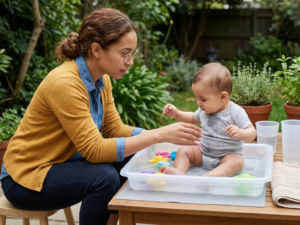
Water Play for Sensory Exploration

Why Water Is a Rich Sensory Medium Water is unusually responsive to a baby’s actions. A hand moving through it produces resistance, ripples, sound, droplets, and visible motion at the same time. This gives infants repeated opportunities to notice a basic cause-and-effect relationship: a reach, kick, squeeze, or splash changes what they see and hear. […]
Reading to baby benefits

Reading to baby benefits

How reading supports early language development In the first year, babies are building perceptual and neural foundations for communication. They are learning to distinguish speech sounds, recognize familiar voices, notice stress and intonation, and connect repeated sounds with people, objects, and routines. Reading aloud provides a concentrated stream of language that is usually more varied […]

Peekaboo Games for Object Permanence

Peekaboo Games for Object Permanence

What Object Permanence Means in Infancy Object permanence is the developing understanding that a person or object remains present even when it cannot currently be seen. A young infant may attend mainly to what is immediately visible. With maturation and repeated experiences, the baby increasingly expects a hidden toy, caregiver, or sound source to continue […]

Skill loss in children: when regression needs attention

Skill loss in children: when regression needs attention

What developmental regression means Developmental regression is the loss of a previously acquired ability. The lost ability may involve expressive or receptive language, social communication, play, gross or fine motor function, feeding, toileting, sleep-related independence, or other activities of daily living. A child who once used several meaningful words and then stops using them, or […]

Common mistakes in social development

Common mistakes in social development

Why social mistakes are so common Children are still building the abilities needed for social life: attention, language, impulse control, emotion regulation, perspective-taking, and flexible thinking. In early life, social learning depends heavily on co-regulation before self-regulation, meaning an adult helps the child settle, name feelings, and stay organized before the child can manage those […]

Common sibling conflicts explained

Common sibling conflicts explained

Why sibling conflict is so common Siblings live in close proximity, compete for time and attention, and often have uneven power depending on age, size, language skills, and impulse control. That combination makes conflict almost inevitable. A preschooler may not yet have the inhibitory control to wait, share, or tolerate frustration. An older child may […]

Sibling rivalry children explained

Sibling rivalry children explained

What sibling rivalry usually means Sibling rivalry is not a diagnosis. It is a relational pattern in which children compete, protest, test limits, or escalate to secure attention, status, or control within the family system. Academic reviews of sibling relationships describe a blend of warmth, conflict, power, and rivalry, and most families see all of […]

Chores and responsibility habits children

Chores and responsibility habits children

Why chores support responsibility Chores give children repeated opportunities to connect effort with a visible outcome. Putting laundry in a basket, feeding a pet with supervision, or clearing a plate teaches that actions affect other people and the shared environment. Over time, these experiences can strengthen self-efficacy, meaning the child’s belief that they can manage […]

Common routine problems children

Common routine problems children

Recognizing child routine challenges Child routine challenges can occur at any age, although the form they take changes with development. Preschool children may protest transitions, insist on a particular sequence, or become overwhelmed when a preferred activity ends. School-age children may forget steps, lose materials, delay homework, or become emotionally dysregulated when asked to shift […]

Common mistakes in child routines

Common mistakes in child routines

Treating routines as rigid rules One common mistake is confusing predictability with inflexibility. A routine should provide a reliable sequence, not require every event to occur at exactly the same minute. Children need repeated cues, but they also need opportunities to learn that plans can change safely. Insisting on perfect adherence may increase conflict when […]

Too strict vs too flexible routines children

Too strict vs too flexible routines children

What a healthy routine is designed to do A routine is a repeated pattern that organizes important parts of the day, such as waking, meals, school or childcare, hygiene, play, family connection, and sleep. It differs from a rigid schedule because it emphasizes sequence and dependable expectations rather than exact timing at every moment. For […]

Flexible vs strict routine children

Flexible vs strict routine children

What flexible and strict routines look like A flexible routine has recurring anchors but does not require every event to happen at an exact time or in an identical way. For example, a child may have a consistent bedtime sequence—washing, changing, reading, and settling—while the start time shifts slightly on weekends or after an appointment. […]

Helping children follow routines and adjusting with age

Helping children follow routines and adjusting with age

Why routines help children develop A routine is a repeated sequence that organizes activities and expectations. It may be highly predictable, such as brushing teeth before bed, or loosely structured, such as completing homework sometime after school and before leisure. Research synthesized in a systematic review suggests that family routines become more differentiated and structured […]

Fixing routine problems

Fixing routine problems

What counts as a routine problem? A routine problem occurs when a child repeatedly struggles with a familiar sequence that should be manageable with their current skills and support. Examples include forgetting steps in tooth-brushing, becoming stuck while dressing, refusing to leave for school, or needing prolonged adult prompting to begin homework. The problem may […]

Rebuilding family routines after moving to a new home

Rebuilding family routines after moving to a new home

Understand why a move can unsettle children A move changes more than an address. Children may lose familiar sensory cues, neighborhood landmarks, classmates, caregivers, play spaces, and expectations about what happens next. Even when the move is positive, the transition can increase cognitive load: a child must learn new routes, room layouts, household rules, and […]

Teaching responsibility and daily tasks children

Teaching responsibility and daily tasks children

Why daily tasks matter for children Household tasks provide a natural context for learning responsibility. Putting toys away, placing laundry in a hamper, feeding a pet under supervision, preparing a school bag, or helping clear the table teaches that shared environments require shared contributions. The goal is not simply productivity. Children are learning that actions […]

Preschool adaptation checklist

Preschool adaptation checklist

1. Begin with a realistic readiness review Preschool readiness is multidimensional. It includes emerging independence, communication, participation in group activities, emotional regulation, and the ability to recover from small frustrations. It does not require a child to be completely independent, consistently cheerful, or free from separation anxiety. A child may be ready for preschool while […]

Screen myths vs facts

Screen myths vs facts

Myth 1: All screen time affects children in the same way The fact is that “screen time” is a broad, often poorly defined category. Research may group together television, tablets, video games, smartphones, schoolwork, video chatting, and background media, even though these exposures differ in cognitive load, social context, pacing, interactivity, and emotional intensity. This […]

Common challenges raising children and parenting struggles

Common challenges raising children and parenting struggles

Parenting stress is real, and it can become a cycle One of the most common parenting struggles is the feeling that the demands never stop. Feeding, bathing, sleep, school communication, emotional coaching, safety monitoring, finances, and work obligations may overlap until a parent’s nervous system feels constantly activated. This chronic activation can look like irritability, […]

What parents struggle with most kids and how problems change with age

What parents struggle with most kids and how problems change with age

Why parenting struggles change with age Parents often expect that caregiving will become steadily easier as children become more independent. In reality, the burden usually changes shape. Infancy is physically demanding because the adult nervous system is constantly recruited for feeding, settling, sleep protection, and safety monitoring. Preschool years add mobility, language growth, toileting, and […]

Understanding parenting challenges

Understanding parenting challenges

Why parenting feels difficult even in loving families Parenting asks adults to regulate themselves while helping another person learn regulation. This is demanding because children are neurologically immature: the prefrontal cortical networks involved in impulse control, planning, emotional modulation, and flexible problem solving develop gradually across childhood and adolescence. A toddler who melts down at […]

Child inconsistent habits problem

Child inconsistent habits problem

Understanding inconsistent habits in children A child inconsistent habits problem usually means that everyday behaviors are unreliable across days or settings. A child may brush teeth independently one night and refuse the next, fall asleep easily during the week but stay awake for hours on weekends, or complete homework after school only when a caregiver […]

Routine problems solutions children

Routine problems solutions children

Understanding why routines break down Routine problems in childhood are rarely just a matter of willpower. A routine asks a child to remember steps, stop a preferred activity, shift attention, tolerate sensory experiences, manage frustration, and often do all of this quickly. These are executive-function demands: planning, sequencing, inhibition, working memory, and cognitive flexibility. Younger […]

Myths about difficult children and parenting struggles

Myths about difficult children and parenting struggles

Myth 1: Difficult behavior means a child is bad Calling a child “bad” compresses a complex developmental picture into a moral judgment. Children’s behavior is shaped by temperament, maturation, nervous system regulation, learning history, family stress, sleep, hunger, sensory processing, language ability, and social context. A child who melts down during transitions, refuses a demand, […]

When problems are normal children

When problems are normal children

Normal does not mean easy Many childhood “problems” are normal because childhood itself is an active period of neurological, emotional, and social construction. A toddler who says “no” repeatedly is not simply being difficult; they are discovering agency before they have mature inhibition. A preschooler who melts down when a plan changes may not be […]

Child struggles with change

Child struggles with change

Why change can feel so big to a child Change requires a child to stop one mental set and shift to another. That sounds simple, but neurologically it depends on executive function: working memory, cognitive flexibility, inhibitory control, time awareness, emotional regulation, and planning. These skills mature gradually across childhood and adolescence. A toddler may […]

Parenting challenges everyday life

Parenting challenges everyday life

Why ordinary parenting can feel so hard Parenting stress is the distress that arises when the demands of caregiving feel greater than a parent’s perceived resources. This does not mean a parent is failing. It means the nervous system is responding to sustained responsibility, frequent interruption, and limited recovery time. Modern caregivers often manage child […]

How to support child in difficult situations

How to support child in difficult situations

Start by regulating yourself In difficult situations, children scan caregivers for cues about danger. This is not manipulation or weakness; it reflects normal neurobiology. A child’s limbic system, especially under stress, is highly responsive to adult tone of voice, facial expression, posture, and predictability. If the adult appears panicked, dismissive, or explosive, the child’s arousal […]