
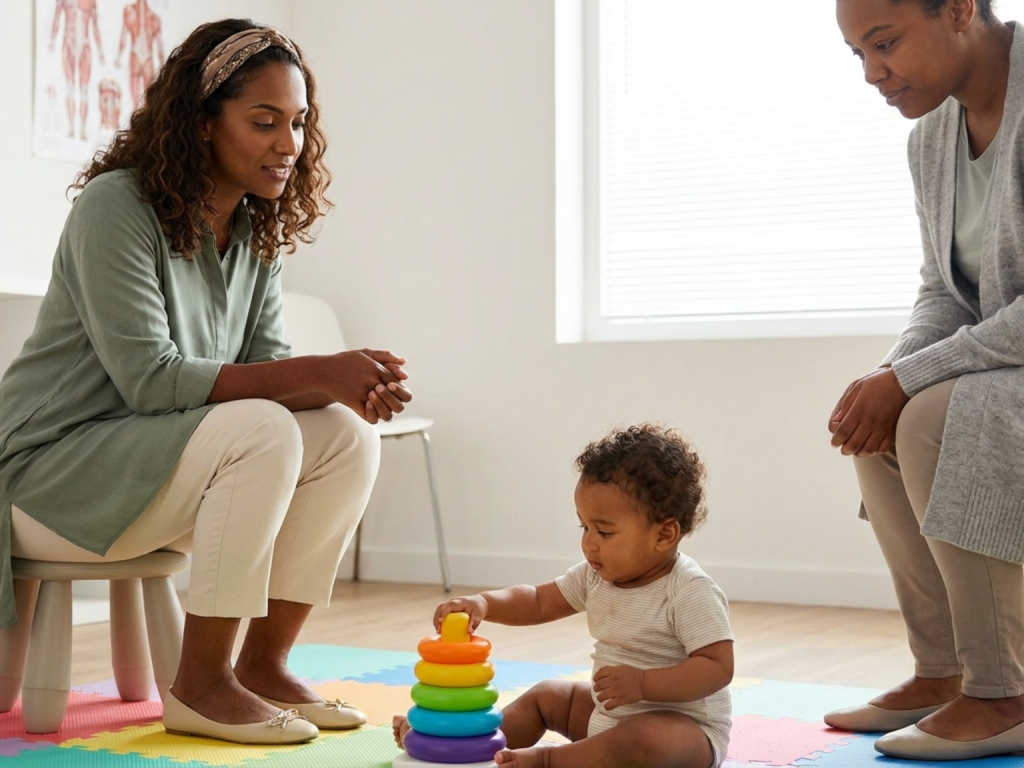
Intro
The first year brings rapid changes in movement, communication, cognition, feeding, and social connection. A newborn who relies almost entirely on reflexes may, by 12 months, sit independently, move across the floor, use gestures, understand familiar words, and participate actively in social routines.
Milestones are useful reference points, not rigid deadlines. Babies develop at different rates, and skills may emerge in a different order. Prematurity, medical conditions, temperament, opportunities for movement, and cultural practices can all influence timing. The goal is to observe patterns over time, share questions with a healthcare professional, and seek assessment when a concern persists.
Highlights
First-year milestones span motor, language, cognitive, and social-emotional domains; no single skill defines a baby's overall development.
Many babies progress from head control and purposeful grasping to sitting, pulling to stand, cruising, and possibly taking independent steps.
Babbling, gestures, shared attention, imitation, and responding to familiar voices are meaningful early communication achievements.
A missed milestone, loss of a previously acquired skill, or persistent asymmetry deserves timely discussion with a pediatric clinician.
How to interpret milestones during the first year
Development is continuous rather than divided into perfectly discrete stages. Milestone ages describe when a skill is commonly observed in a population, but they do not predict the exact date for an individual child. A baby may acquire a fine motor skill before a gross motor skill, or may concentrate on mobility for a period while expressive language develops more gradually.
Clinicians consider several dimensions together: whether a skill is emerging, whether it is becoming more consistent, whether the baby uses both sides of the body, and whether social engagement is progressing. Developmental surveillance is an ongoing process that combines caregiver observations, clinical examination, and standardized screening when indicated. A single observation is less informative than the trajectory across visits.
For babies born preterm, clinicians may use corrected age during early developmental assessment. Corrected age accounts for the weeks of gestation before 40 weeks and can provide a more appropriate comparison during the first months. Ask the child’s clinician how corrected age should be applied and when chronological age becomes the primary reference.
Birth to 3 months: regulation, connection, and early control
In the newborn period, movement is largely reflexive, and the nervous system is still developing the postural control needed for purposeful activity. During the first three months, many infants become more alert and better able to regulate attention. They may briefly follow a face or object with their eyes, quiet in response to a familiar voice, and show an emerging social smile.
Head control develops gradually. With supervised tummy time while awake, a young infant may lift the head briefly, then raise the chest using the forearms. This activity strengthens the neck, shoulder, and trunk muscles needed for later rolling, reaching, and sitting. It should occur on a firm, clear surface with an attentive adult nearby; sleep should follow current safe-sleep guidance.
Early communication includes crying with different patterns, cooing, changes in facial expression, and increased responsiveness to human voices. Caregivers can support this period by speaking slowly, pausing for the infant’s response, mirroring sounds, and using face-to-face interaction. These exchanges help build turn-taking before recognizable words appear.
4 to 6 months: purposeful movement and emerging exploration
By the middle of the first year, many babies demonstrate more stable head and trunk control. Rolling may develop in either direction and may not appear as a single predictable event. When placed on the floor, an infant may push up on extended arms, pivot, reach for a toy, and bring objects to the mouth for sensory exploration. Some babies begin to sit with support and later maintain a seated position briefly without assistance.
Fine motor development becomes increasingly intentional. The infant may reach accurately, grasp a toy, transfer it from one hand to the other, and rake small items toward the body using the fingers. These actions reflect improving visual-motor integration and hand strength. Choking hazards remain a serious concern, so objects should be too large to fit entirely in the mouth and should be selected according to current safety recommendations.
Babbling often becomes more varied, with repeated consonant-like sounds and vocal play. Many infants laugh, recognize familiar people, and show interest in their reflection. Responsive interaction remains central: follow the baby’s gaze, name objects, imitate vocalizations, and allow pauses so the child can initiate or respond.
7 to 9 months: sitting, mobility, and shared attention
Between seven and nine months, many infants sit steadily and use their hands while seated to manipulate toys. Some begin crawling on the hands and knees, while others move by rolling, scooting, commando crawling, or transitioning directly to pulling up. The specific method is less important than the broader pattern of increasing purposeful mobility, postural control, and ability to change position.
Babies may reach for objects with greater precision and begin using a thumb-and-finger grasp for larger pieces of food or toys. They may look for a dropped object, uncover a partially hidden item, and explore cause and effect by shaking, banging, or dropping objects repeatedly. These behaviors are early cognitive experiments rather than misbehavior.
Communication becomes more socially directed. A baby may respond to their name, recognize familiar words, use varied babbling, imitate sounds, and participate in reciprocal games such as peekaboo. Joint attention begins to emerge when the baby alternates gaze between a person and an object or follows another person’s pointing. Caregivers can strengthen these skills by labeling what the baby notices and sharing simple routines such as songs, books, and turn-taking games.
10 to 12 months: purposeful communication and standing skills
Near the first birthday, many babies pull to stand, lower themselves with increasing control, and cruise while holding furniture. Some take independent steps, but walking by 12 months is not required for healthy development. A baby who is not yet walking may still show strong progress through crawling, transitioning between positions, bearing weight through the legs, and moving toward desired objects. Footwear is generally unnecessary indoors while a baby is learning balance, unless a clinician recommends otherwise.
Fine motor skills may include picking up small objects between the thumb and index finger, releasing items intentionally, pointing, waving, clapping, and placing objects into a container. Gestures are important communication, especially when spoken vocabulary is still limited. Many babies understand familiar words such as a person’s name, a routine command, or the word no, although understanding is not the same as consistently following an instruction.
Socially, a one-year-old may seek a caregiver for reassurance, imitate simple actions, show a preferred toy, and engage in back-and-forth interaction. Separation reactions and wariness around unfamiliar people can occur as attachment and memory mature. At this stage, the Centers for Disease Control and Prevention describes milestones across social-emotional, language, cognitive, and movement domains, making it useful to assess the whole child rather than focusing only on walking or talking.
Supporting development through everyday care
Babies learn through ordinary interactions, not only structured activities. Provide frequent opportunities for supervised floor play, reaching, rolling, and changing position. Keep the environment physically safe as mobility increases: secure furniture, block stair access, remove small objects, and keep hot liquids, medications, cords, and choking hazards out of reach. A responsive caregiver can offer a toy slightly beyond easy reach, then allow time for the baby to attempt the movement without forcing it.
Language support is similarly practical. Talk during feeding, bathing, dressing, and walks. Describe what the baby is seeing and doing, read sturdy books, sing repetitive songs, and respond to gestures and vocalizations as meaningful communication. Avoid testing the baby repeatedly or comparing them with siblings and peers. Warm, contingent responses help build the foundations of communication, emotional regulation, and secure attachment.
Feeding readiness and developmental milestones overlap but are not identical. Introduction of complementary foods should follow guidance from the child’s healthcare professional and should account for developmental readiness, safe texture, allergy considerations, and continued breast milk or formula needs. Never place food or objects in a baby’s mouth to accelerate a skill.
When to discuss a developmental concern
Contact the child’s healthcare professional when a baby is not progressing, shows a marked difference between the two sides of the body, seems unusually stiff or floppy, has persistent difficulty using the hands, or does not respond to voices or social interaction as expected. Regression, meaning the loss of a skill that was previously acquired, is especially important to report promptly. A clinician may perform a focused neurologic and developmental examination, review hearing and vision, assess feeding and growth, and use a validated screening instrument.
Concerns do not automatically indicate a diagnosis. They do indicate that more information may be useful. Early intervention services, physical or occupational therapy, speech-language assessment, audiology, or other specialists may be recommended based on the pattern of findings and local services. Evaluation is most helpful when caregivers bring concrete examples, videos when appropriate, questions about corrected age, and a record of skills that are present, emerging, or absent.
Trust your observations. Caregivers often notice subtle changes in movement, responsiveness, or interaction before a routine visit. If a concern feels significant, it is reasonable to contact the pediatric office rather than waiting for the next scheduled appointment. Seek urgent medical care for acute symptoms such as breathing difficulty, seizure-like activity, severe lethargy, or sudden loss of function.
When to seek medical advice
- Report any loss of previously acquired developmental skills promptly.
- Discuss persistent marked asymmetry, unusual stiffness, or pronounced floppiness with a clinician.
- Ask for assessment if the baby does not respond to sound, visual interaction, or familiar people as expected.
- Seek urgent care for breathing difficulty, seizure-like activity, severe lethargy, or sudden functional change.
Tools & Assistance
- Keep a dated record of new skills, concerns, and questions for routine pediatric visits.
- Use the CDC milestone checklist as a discussion aid rather than as a diagnostic test.
- Arrange regular well-child visits with growth, neurologic, hearing, vision, and developmental review.
- Contact local early intervention services when a healthcare professional recommends developmental evaluation.
- Record brief videos of concerning movements or interactions for review by the child's clinician when appropriate.
FAQ
Should my baby be walking by the first birthday?
Not necessarily. Some babies walk independently near 12 months, while others walk later. Progress in posture, transitions, weight-bearing, crawling or other mobility, and purposeful exploration provides important context.
Is crawling required before walking?
No. Babies use different mobility patterns, and some crawl briefly or skip hands-and-knees crawling. Persistent asymmetry, difficulty bearing weight, or lack of motor progress should be discussed with a healthcare professional.
How many words should a one-year-old say?
Spoken vocabulary varies considerably. Gestures, pointing, babbling, responding to familiar words, shared attention, and social reciprocity are also meaningful communication milestones.
What if my baby was born premature?
Development is often interpreted using corrected age during early infancy. Ask the pediatric clinician how to calculate and apply corrected age and whether additional developmental surveillance is appropriate.
Can I identify a developmental disorder from a milestone checklist?
No. Checklists support observation and conversations with clinicians but cannot diagnose a condition. A professional evaluation is needed when concerns persist or skills are lost.
Sources
- Centers for Disease Control and Prevention — Milestones by 1 Year | Learn the Signs. Act Early.
- National Center for Biotechnology Information, National Institutes of Health — Child Development - StatPearls - NCBI Bookshelf
- PubMed Central — Evidence-based milestone ages as a framework for developmental surveillance
Disclaimer
This article provides general educational information and is not a diagnosis or a substitute for individualized medical advice. Consult your baby's healthcare professional about developmental concerns or urgent symptoms.















Please log in to leave a comment.