
Intro
Choosing toys can feel surprisingly high-stakes. Many caregivers want toys that delight a child while also supporting language, attention, problem-solving, motor skills, and emotional regulation. At the same time, toy packaging often blurs the line between genuine learning support and entertainment designed mainly to capture attention.
Highlights
Educational value depends less on labels and more on how a toy supports active, meaningful, socially interactive play.
Bright lights, rapid sounds, screens, and constant rewards can compete with a child’s attention and may increase overstimulation in some children.
Open-ended, caregiver-supported play often gives children more room to practice language, executive function, creativity, and self-regulation.
Children differ: temperament, neurodevelopmental profile, sleep, illness, and stress can all change how much stimulation feels comfortable.
What makes a toy educational rather than just entertaining
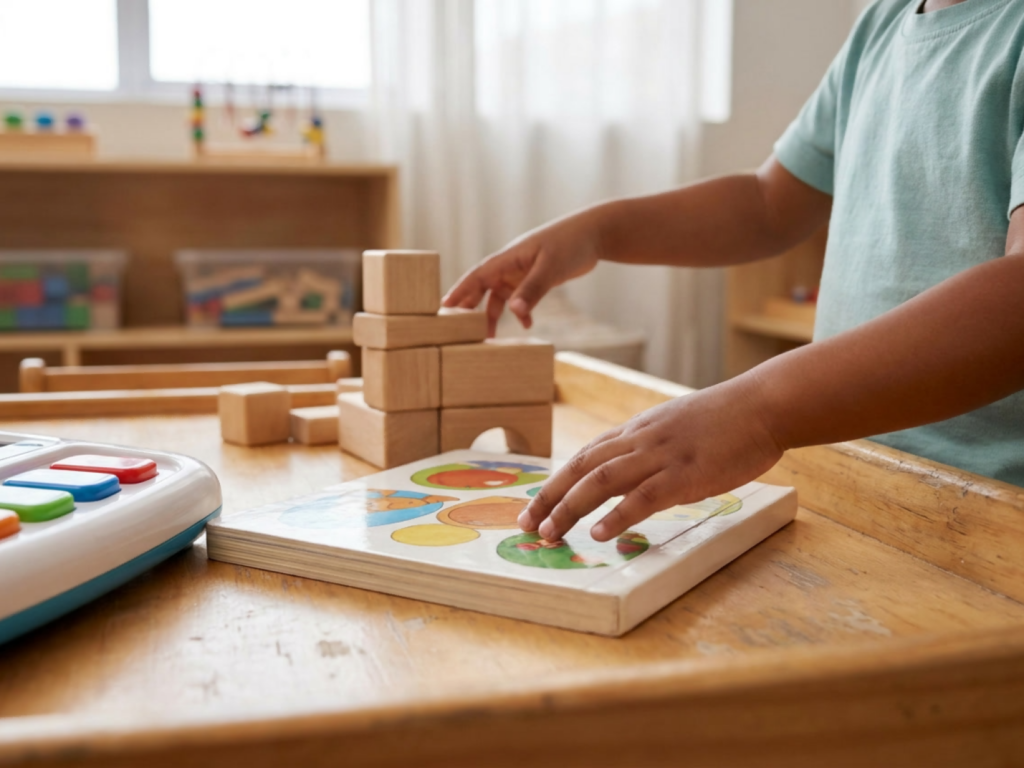
A toy is not educational simply because it says so on the box. In child development, learning is strongest when play is active, meaningful, socially interactive, and not dominated by irrelevant distractions. A child who stacks blocks, narrates a pretend meal, sorts shells by size, or takes turns in a simple game is practicing attention, motor planning, symbolic thought, language, and social cognition. The adult’s role matters: language-rich play interactions can turn an ordinary object into a learning tool through naming, waiting, expanding the child’s words, and sharing delight.
Entertainment toys are not automatically harmful. Joy, humor, music, and novelty all have a place in childhood. The concern is whether the toy does most of the work while the child passively watches, presses buttons, or is pulled from one sensory cue to the next. A toy that continuously flashes, talks, sings, and rewards every touch may keep a child busy, but it may leave less space for initiation, problem-solving, frustration tolerance, and conversation.
Marketing can be especially confusing for infants, toddlers, and preschoolers. Products may promise early reading, advanced vocabulary, or accelerated cognition without strong evidence that the product itself causes these gains. A more useful question is: What does my child do with this toy? If the answer includes exploring, imagining, communicating, moving, negotiating, or persisting, the toy is more likely to support development than one that mainly captures attention.
How overstimulation happens in play
Overstimulation occurs when sensory, cognitive, or emotional input exceeds a child’s current capacity to process and regulate it. This is not a diagnosis; it is a functional state. The nervous system receives input through multiple channels: visual, auditory, tactile, vestibular, proprioceptive, social, and interoceptive. A multisensory toy can be helpful when it coordinates these inputs toward a clear goal, such as matching a sound to an action or using texture to guide fine-motor exploration. It can become overwhelming when many channels compete at once.
Young children have immature executive function networks. Skills such as inhibitory control, attentional shifting, working memory, and emotional regulation develop gradually and are strongly influenced by sleep, hunger, illness, stress, and caregiver support. Rapid lights, loud music, unpredictable sounds, and fast reward loops can increase arousal. For some children, that arousal looks like excitement; for others it becomes irritability, impulsivity, avoidance, crying, aggression, or shutting down.
Electronic toy overstimulation is often most noticeable when the toy drives the pace. If every button triggers a new sound before the child has time to think, the child may learn to seek more stimulation rather than sustain attention. This does not mean families must avoid all electronic toys. It means the sensory load should match the child’s age, temperament, and context, and adults should feel free to turn off sound, remove batteries, shorten sessions, or offer calmer alternatives.
Educational media, screens, and the limits of passive learning
Screens and app-connected toys deserve separate caution because they combine entertainment design with educational claims. Some programs and apps are carefully designed, slow-paced, and age-appropriate. Others use frequent scene changes, reward sounds, autoplay, and gamified prompts that may hold attention without supporting deep learning. For preschoolers, high-quality programming for preschoolers is most beneficial when an adult helps connect what is seen on screen to real-world language, play, and routines.
Preschool screen time limits are not only about minutes. They are also about timing, content, context, and displacement. A short shared video after lunch is different from a loud interactive toy during bedtime, meals, or independent play. Background television and child attention can be a concern because children may repeatedly orient to the screen even when they are trying to play with other objects. This fragmented attention can reduce sustained exploration and caregiver-child conversation.
For babies and toddlers, the evidence for many learning-oriented media products remains limited compared with the evidence for responsive human interaction. A child learns words not just by hearing labels, but by watching gaze, gestures, turn-taking, emotional tone, and shared reference. If a product replaces those interactions rather than supporting them, its educational value is weaker. Caregivers do not need perfection; they need realistic routines that preserve sleep, movement, conversation, and unstructured play.
What to look for in a balanced toy environment
A balanced play space does not need to be expensive or sparse. It should offer a mix of open-ended toys, pretend-play items, movement opportunities, books, art materials, and a few cause-and-effect toys that do not dominate the room. Open-ended toys for preschoolers include blocks, dolls or figures, animal sets, play kitchens, simple vehicles, scarves, puzzles, and materials that can be used in more than one way. These invite flexible thinking and social problem solving through play.
Consider the sensory profile of the whole environment, not just one toy. A musical toy may be fine in a quiet room after a nap, but too much in a crowded room with television, siblings, bright lighting, and a tired child. Toy rotation can help: keeping fewer items available at once often reduces visual clutter and increases sustained engagement. It also makes old toys feel new without adding more stimulation.
Safety and developmental fit still come first. Age-appropriate toys for toddlers should avoid choking hazards, high-powered magnets, button batteries, and cords or small parts that can break off. Sound volume matters because some toys can be surprisingly loud near a child’s ear. If a child has developmental delays, sensory processing differences, autism, ADHD traits, hearing differences, vision impairment, or motor challenges, adapted toys for developmental needs may be useful, but selection is best individualized with professional input.
Signs a child may be overstimulated
Overstimulation can be easy to misread as misbehavior. A child may throw a toy not because they are defiant, but because the noise, frustration, or rapid pace has exceeded their coping capacity. Common signs include covering ears, squinting, turning away, fleeing, clinging, crying, pushing objects away, becoming unusually hyperactive, or suddenly losing interest. Some children become dysregulated later, after the toy is removed, because their arousal level remains high.
Look for patterns rather than isolated moments. Does the child become irritable after specific toys, certain rooms, long shopping trips, birthday parties, or screen-heavy afternoons? Do transitions worsen after fast-paced media? Does sleep become harder after evening electronic play? These observations can guide small environmental changes. A simple log of toy, time of day, sleep, hunger, and behavior may help families discuss concerns with a pediatric clinician or occupational therapist.
Immediate support usually means reducing input and increasing predictability. Turn off sound, dim lights, move to a quieter area, offer water or a snack if appropriate, and use a calm voice. Some children benefit from deep-pressure hugs, heavy work such as carrying books, or quiet sensory play, but preferences vary. Avoid forcing a child to continue with a toy marketed as educational if their body is clearly signaling distress.
Practical toy-choice strategies for families
A helpful rule is to choose toys that leave room for the child to lead. Before buying, ask: Can this be used in several ways? Does it invite talking, pretending, building, drawing, sorting, moving, or cooperating? Can the volume be controlled or turned off? Does it work without constant adult setup? Does it match my child’s current developmental skills while offering a gentle next step?
It is also reasonable to separate entertainment from learning. A flashing musical toy can be a short, joyful activity, while blocks, books, pretend-play items, outdoor movement, and art provide deeper developmental practice. This removes guilt: not every toy must teach. Children also need laughter, repetition, comfort, and downtime. The risk rises when highly stimulating toys crowd out sleep, caregiver interaction, physical activity, independent free play, and face-to-face social learning.
For birthdays and holidays, caregivers can request fewer, better-matched items rather than many noisy novelty toys. Libraries, toy swaps, and borrowing from friends can help families test what fits before buying. If a child strongly seeks sensory input, do not assume that more lights and noise are the answer. A professional may suggest safer sensory strategies, movement breaks, or environmental adjustments. If a child consistently struggles with ordinary play settings, feeding, sleep, transitions, or social engagement, consult a pediatrician or qualified developmental specialist for individualized assessment.
When to be cautious
- Seek urgent care if a child swallows or may have swallowed a button battery, magnet, or small hazardous part.
- Ask a clinician about repeated extreme distress, shutdowns, aggression, or sleep disruption linked to sensory input.
- Avoid very loud toys near the ear; repeated high-volume exposure can be risky for hearing.
- Do not rely on a toy or app to diagnose, treat, or remediate developmental concerns.
- Stop using any toy that breaks, overheats, has loose parts, or has been recalled.
Tools & Assistance
- Create a simple toy rotation bin with quiet, active, pretend, and sensory options.
- Use a one-week play log to track overstimulation patterns, sleep, and transitions.
- Check toy recall databases and inspect batteries, magnets, cords, and small parts.
- Discuss persistent sensory or developmental concerns with a pediatrician, occupational therapist, or developmental specialist.
FAQ
Are educational toys better than entertainment toys?
Not always. A simple toy used in responsive, social play may be more educational than a complex product with lights and sounds.
Should I avoid all electronic toys?
No. Many families use them occasionally. Choose controllable volume, slower pacing, and short sessions, and balance them with open-ended play and human interaction.
How can I tell if a toy is overstimulating my child?
Watch for covering ears, turning away, irritability, frantic activity, crying, avoidance, or worse transitions after use. Patterns matter more than one difficult moment.
Can overstimulation mean my child has autism or ADHD?
Sensory sensitivity can occur for many reasons and does not by itself diagnose any condition. If concerns are persistent or impair daily life, consult a qualified clinician.
Sources
- NIH / PubMed Central — Brain Training for Kids: Adding a Human Touch
- Frontiers in Education — Beyond play: a comparative study of multi-sensory and traditional toys in child education
- Kaiser Family Foundation — A Teacher in the Living Room? Educational Media for Babies, Toddlers, and Preschoolers
Disclaimer
This article is for general educational purposes and does not replace medical, developmental, or mental health advice. Consult a qualified healthcare professional for concerns about your child’s behavior, sensory responses, sleep, hearing, or development.














Please log in to leave a comment.