
Intro
At 9 months, parenting often feels less like caring for a mostly stationary infant and more like supporting an active, communicative explorer. Your baby may sit independently, crawl or move in another way, pull to stand, babble, respond to familiar people, and investigate nearly everything within reach. These developments can bring delight, but they also require substantial changes in supervision, home safety, feeding, sleep, and emotional support.
There is considerable normal variation in the timing and sequence of infant skills. The goal is not to make every day match a milestone checklist. It is to notice your baby’s emerging abilities, respond to their cues, and discuss questions with a pediatrician or other qualified healthcare professional when something concerns you.
Highlights
Mobility and curiosity increase the need for active supervision and a systematic safety review.
Feeding becomes more participatory as complementary foods expand, while breast milk or formula remains an important source of nutrition.
Separation anxiety and stranger wariness may intensify because babies are developing stronger recognition and memory for familiar caregivers.
Sleep may become more predictable for some families, but developmental changes, illness, teething, and temperament can still cause disruptions.
Responsive interaction, floor play, language exposure, and consistent routines support learning without requiring formal teaching.
Your baby becomes an active participant
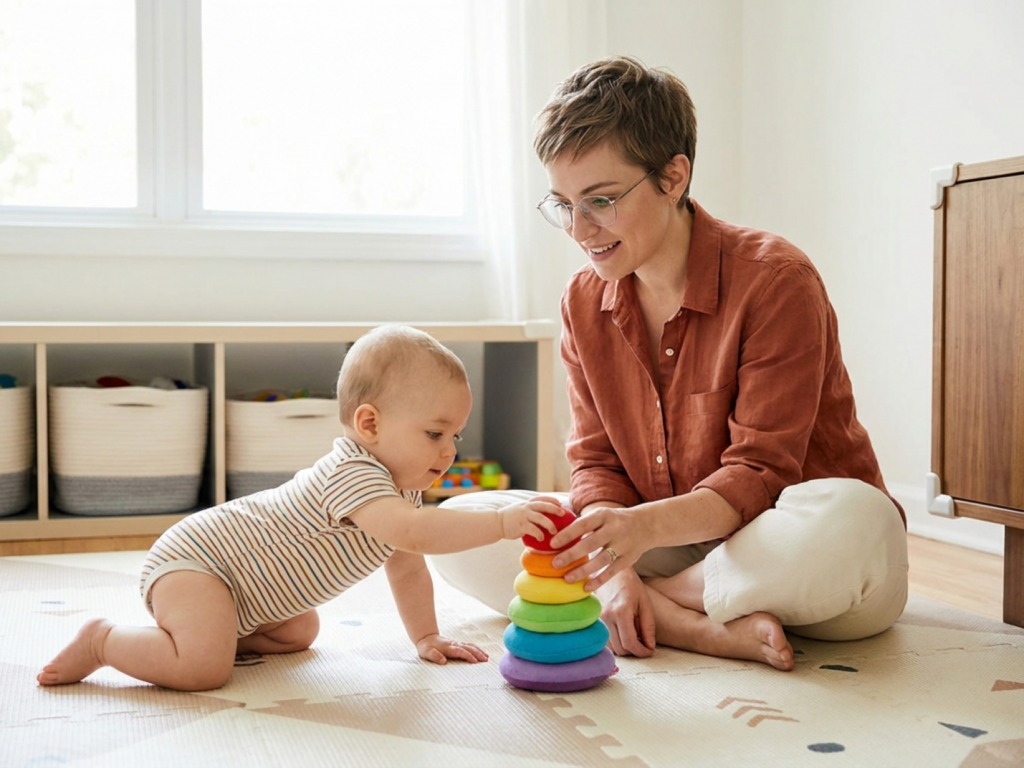
One of the most noticeable changes after 9 months is the shift from passive care to reciprocal interaction. Many babies are more physically capable of sitting steadily, changing position, reaching accurately, transferring objects between hands, crawling, scooting, or pulling themselves to stand. Some skip crawling and use another effective method of moving. The sequence matters less than the broader pattern of gaining skills and engaging with the environment.
These abilities change ordinary tasks. A diaper change may involve rolling, pivoting, or trying to escape. Dressing may require distraction and a calm, efficient routine. Carrying your baby becomes less central than creating safe opportunities for floor-based movement. Place appealing, age-appropriate objects within reach, allow supervised exploration, and let your baby practice moving between positions rather than positioning them constantly.
Review the 9-month developmental milestones described by trusted public-health and pediatric sources, but interpret them as population-based guides rather than a pass-or-fail examination. Prematurity, medical history, temperament, and individual variation can all affect timing.
Communication becomes more intentional
At this stage, sounds and gestures often become more socially directed. Your baby may babble with repeated consonants, vary pitch, imitate sounds, turn toward voices, respond to their name, raise their arms to be picked up, or use facial expressions to communicate interest and displeasure. They may also pause to listen and then vocalize in what feels like a conversation.
Parenting changes because everyday caregiving becomes an opportunity for language development. Narrate what you are doing during feeding, bathing, and dressing. Name familiar people and objects, respond to babbling as meaningful communication, imitate your baby’s sounds, and share books with simple pictures. These interactions do not need to be elaborate. Consistent back-and-forth exchanges help build attention, social communication, and early language pathways.
It is also normal for a baby to communicate more through movement, gaze, or gesture than through recognizable words. Avoid comparing one infant’s vocal repertoire with another’s. If your baby rarely responds to sound or voices, does not seem to notice social interaction, or loses a skill they previously had, raise the concern promptly with a healthcare professional.
Separation and exploration can coexist
Many babies around 9 months show stronger preferences for familiar caregivers and may become upset when a parent leaves or an unfamiliar person approaches. This is often called separation anxiety or stranger wariness. It reflects growing recognition, attachment, and memory rather than deliberate misbehavior. At the same time, your baby may be eager to explore as long as a trusted adult remains available as a secure base.
Predictable departures can help. Use a brief, calm goodbye, tell your baby that you are leaving, and follow a consistent handoff routine. Prolonged or repeated departures may increase distress. When returning, reconnect warmly without suggesting that the separation was dangerous. Ask other caregivers to use familiar routines for naps, meals, and comfort.
Exploration is best supported through a balance of freedom and boundaries. Stay close enough to intervene, acknowledge frustration, and offer limited choices such as two safe toys. This approach supports emerging autonomy while preserving co-regulation, in which an adult’s calm presence helps an infant manage intense emotion.
Feeding becomes more social and structured
By 9 months, many infants are eating a broader range of complementary foods and participating more actively at the table. Depending on readiness and family practice, meals may include soft vegetables, fruit, beans, eggs, meat, fish prepared appropriately, yogurt, grains, and other nutrient-dense foods. Texture can gradually become more varied as the baby develops the ability to manage soft pieces, mash food, and bring food to the mouth.
Breast milk or iron-fortified formula generally remains an important nutritional source during the first year. Offer food responsively: notice hunger and satiety cues, allow the baby to decide how much to eat, and avoid pressuring, coaxing, or using food as a reward. Appetite may vary substantially from one meal to the next. Messy exploration is part of learning, not evidence of poor feeding.
Mealtimes require close, upright supervision. Avoid foods and preparation methods that create choking risks, including hard, round, sticky, or tough pieces. A pediatrician, dietitian, or feeding specialist can give individualized guidance for allergies, poor weight gain, swallowing concerns, restricted diets, or a history of prematurity. Continue to follow local guidance about allergen introduction and iron intake rather than relying on generalized online schedules.
Sleep may improve, but it is not guaranteed
Some families find that sleep becomes more organized by 9 months, with a more recognizable pattern of nighttime sleep and one or two daytime naps. Other babies continue to wake frequently. New mobility, separation anxiety, teething discomfort, intercurrent illness, changes in feeding, and individual sleep biology can all affect the pattern.
Consistent age-appropriate infant routines can make sleep easier to anticipate. A short sequence such as feeding, washing, a book, and quiet settling may help distinguish day from night. Keep responses calm and predictable, and consider whether the schedule provides adequate daytime sleep without making bedtime too late. A routine is a framework, not a guarantee of uninterrupted sleep.
Continue safe-sleep practices: place the baby on their back for every sleep, use a firm, flat sleep surface, keep the sleep area free of loose bedding and soft objects, and avoid exposure to smoke or vaping. Once a baby can move independently, do not use restrictive sleep products that are not recommended by health authorities. Contact a clinician for questions about persistent snoring, breathing pauses, unusual sleep movements, or severe sleep disruption.
Safety becomes an everyday engineering task
Increased mobility means that safety can no longer be limited to the crib and changing area. Get down to your baby’s level and inspect the home from the floor. Secure furniture and televisions, block stairs, use outlet protection where appropriate, keep cords and small objects out of reach, and ensure windows and doors cannot be opened by a crawling or pulling infant. Move medications, cleaning products, batteries, sharp objects, and hot liquids into locked or inaccessible storage.
Pay particular attention to new hazards created by standing. Check the stability of low tables and shelving, remove tablecloths that can be pulled, and keep handles turned away from the edge of the stove. Never leave a baby unattended on a bed, sofa, changing table, or other elevated surface, even for a moment. A safe play area is useful, but active supervision remains necessary.
Water safety is also essential. An infant can drown in a very small amount of water, and drowning is silent. Stay within arm’s reach during bathing and around pools, buckets, toilets, or other water sources. Do not rely on bath seats, flotation devices, or another child to provide supervision.
Your role changes without becoming less important
As your baby gains independence, it can seem as though they need you less. In practice, they still depend on you for protection, emotional regulation, nutrition, sleep support, and interpretation of unfamiliar experiences. The difference is that caregiving now includes more negotiation: your baby has preferences, experiments with cause and effect, and may protest limits.
Responding consistently does not mean preventing every frustration. You can acknowledge the feeling, maintain a safety boundary, and offer a realistic alternative. For example, remove a dangerous object, say that it is not safe, and provide an appropriate item for exploration. This pattern teaches limits while preserving connection.
Parenting at this stage can also expose exhaustion that has accumulated over many months. Irritability, persistent anxiety, low mood, intrusive thoughts, or feeling unable to function deserve professional attention. Parental mental health is part of infant care, and seeking help is appropriate rather than a sign of failure. Share responsibilities where possible and discuss ongoing symptoms with a clinician.
Developmental follow-up should remain individualized
A 9-month visit is an opportunity to review growth, feeding, sleep, immunizations, oral health, hearing, vision, safety, and developmental progress. Bring specific observations rather than waiting for a general impression: how your baby moves, responds to voices, uses hands, eats textures, interacts with caregivers, and recovers from distress. Video recordings can sometimes help a clinician understand a behavior that is difficult to describe.
Contact your pediatrician if your baby loses previously acquired skills, appears unusually difficult to rouse, has significant feeding or swallowing problems, does not respond to sounds, or shows a pattern of limited social engagement that concerns you. A single variation does not establish a diagnosis, but timely discussion can clarify whether monitoring, screening, or referral is appropriate.
The most useful standard is steady, supported progress over time. Your baby does not need to perform every skill on a particular date, and you do not need to create a structured curriculum. Safe space, responsive relationships, nutritious opportunities to eat, sleep protection, and regular medical care provide a strong foundation.
When to seek medical advice
- Loss of a previously acquired motor, social, communication, or feeding skill
- Little or no response to voices, sounds, or a familiar caregiver
- Repeated coughing, choking, color change, or breathing difficulty during feeds
- Marked lethargy, persistent inconsolability, or an acute change in behavior
- A fall, burn, poisoning concern, or possible ingestion of a battery or other hazardous object
- Any concern that your baby is not progressing or that your caregiving situation is becoming unsafe
Tools & Assistance
- A floor-level home safety checklist completed room by room
- A simple record of feeding textures, reactions, sleep patterns, and developmental observations
- A pediatric visit question list with videos or examples of concerning behaviors
- A shared caregiver schedule for meals, naps, supervision, and respite
- Local poison control, urgent care, emergency, and infant feeding support contacts
FAQ
Is it normal for a 9-month-old not to crawl?
Yes. Some babies crawl, scoot, roll, bottom-shuffle, or move in another way, and some do not crawl before walking. Discuss the pattern with your pediatrician if movement seems very asymmetric, your baby cannot sit as expected, or skills are lost.
Why is my baby suddenly upset when I leave?
Separation anxiety is common as babies develop stronger recognition and memory for familiar caregivers. Calm, predictable goodbyes and consistent handoffs can help. Seek advice if distress is extreme, persistent, or accompanied by other concerning changes.
Does my baby still need breast milk or formula at 9 months?
For most infants, breast milk or iron-fortified formula remains important during the first year while complementary foods expand. Individual needs vary, so ask your healthcare professional about intake, iron, growth, allergies, or feeding difficulties.
Should I start formal lessons or screen-based learning?
Babies learn through responsive human interaction, movement, play, and exploration. Talking, reading, singing, and sharing everyday activities are generally more useful than formal instruction or routine screen exposure. Follow pediatric guidance for media use.
What should I do if my baby loses a skill?
Contact your pediatrician promptly. Regression should be assessed clinically, even though the cause cannot be determined from an article or milestone list.
Sources
- Mayo Clinic — Caring for Your Nine-Month-Old
- Centers for Disease Control and Prevention — Milestones by 9 Months | Learn the Signs. Act Early.
- American Academy of Pediatrics — Bright Futures Information for Parents: 9 Month Visit
Disclaimer
This article is for general educational purposes and does not diagnose, treat, or replace advice from a qualified healthcare professional. Seek prompt medical care for urgent symptoms or safety emergencies.

















Please log in to leave a comment.