
Intro
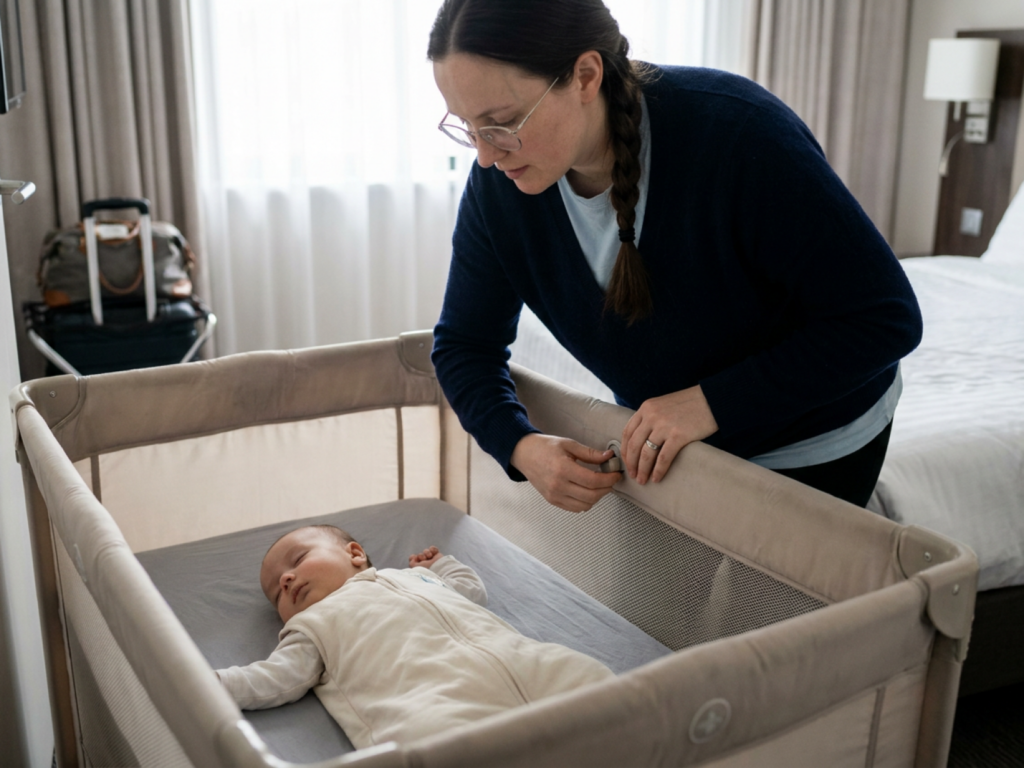
Traveling with a baby often means balancing flexibility with the need for a familiar, safe sleep environment. Portable cribs and travel beds can make that balance easier, but they are not interchangeable with every infant lounger, bassinet, stroller accessory, or soft-sided travel product. The safest choice is a product specifically designed and approved for infant sleep, used according to its instructions.
A practical plan includes checking the sleep space before every use, bringing compatible bedding, and keeping the sleep surface clear. These steps can reduce preventable hazards while acknowledging the realities of hotels, relatives' homes, airports, and changing routines.
Highlights
Choose a portable crib, bassinet, or play yard intended for infant sleep rather than relying on a soft or inclined product.
A firm, flat, level mattress and a snugly fitted sheet are the foundation of a safer travel sleep space.
Keep the sleep area bare: no pillows, loose blankets, stuffed toys, positioners, or added padding.
Inspect unfamiliar cribs and practice assembly at home before traveling.
Room-sharing without bed-sharing can support supervision while preserving a separate infant sleep surface.
What portable cribs and travel beds are designed to do
Portable cribs and travel beds are intended to provide a contained sleep surface when a full-size crib is unavailable or impractical. Depending on the model, the product may fold for transport, include mesh sides, or function as a play yard as well as a sleep space. The important distinction is the manufacturer’s stated purpose and the applicable safety instructions, not the product’s marketing appearance or convenience.
Some travel products are designed only for supervised play, changing, or lounging. A product can look flat and comfortable yet still be unsuitable for unsupervised sleep. Inclined surfaces are particularly concerning because an infant’s head can fall forward, potentially compromising the airway. Soft-sided nests, positioners, cushions, and padded inserts may also create entrapment, suffocation, or overheating hazards.
Before purchase or use, read the product label and manual. Confirm the intended age, weight, and developmental limits; whether the product is approved for sleep; how it must be assembled; and which mattress and sheet combinations are permitted. Do not modify the frame, add an aftermarket mattress, or use accessories that were not supplied or authorized by the manufacturer.
Travel beds also have practical limits. A baby who can roll, sit, pull up, or climb may outgrow a particular configuration even if the stated weight limit has not been reached. Stop using the product when the manual says to stop, or sooner if the child’s movement creates a risk of climbing or falling.
The essential sleep-surface requirements
The sleep surface should be firm, flat, and level. A firm mattress does not conform readily around an infant’s face or body, while a flat surface helps avoid the forward head flexion that can occur on an incline. The mattress should fit the product exactly, with no meaningful gaps between the mattress edge and the frame. Never fill gaps with towels, blankets, foam, or rolled clothing.
Use only a fitted sheet made for that specific mattress and product. The sheet should remain tightly secured at the corners and should not bunch when the baby moves. A loose sheet can become a suffocation or entanglement hazard. Portable cribs sometimes use thinner mattresses than household cribs; that is expected when the product has been engineered and tested as a complete system. A thicker or softer replacement is not necessarily safer.
The rest of the sleep space should remain empty. Do not add pillows, quilts, comforters, bumper pads, stuffed animals, sleep positioners, wedges, or weighted products. If warmth is needed, discuss seasonally appropriate clothing or a non-weighted wearable blanket with the baby’s healthcare professional. The aim is to maintain thermal comfort without placing loose material near the face.
Place the baby on the back for sleep unless a healthcare professional has given individualized instructions that differ. Once the baby is placed on a safe, flat surface, caregivers should avoid repeatedly repositioning the infant with devices intended to hold the body in place. Babies may move into different positions as they develop; the environment should be arranged so that movement does not bring them into contact with hazardous objects.
Inspecting a portable crib before every use
An unfamiliar sleep space deserves the same attention as a newly purchased one. Hotel cribs, borrowed play yards, and family equipment may have missing parts, worn hinges, damaged mesh, or an incompatible mattress. A brief inspection can identify problems before the baby is placed inside.
- Confirm that the product has a clear identity, readable instructions, and no visible recall notice. If the model, age range, or sleep-use instructions cannot be established, choose another sleep space.
- Assemble every rail, hinge, leg, wheel, and locking mechanism exactly as directed. Test that the frame is fully open and stable. Rails should not collapse when pressed lightly, and folding joints should not remain partly engaged.
- Examine mesh, seams, fasteners, and corners for tears, holes, loosened stitching, or exposed hardware. Check that there are no protruding parts or areas where clothing or a limb could catch.
- Verify the mattress is the original or manufacturer-approved mattress, lies flat, and fits snugly on all sides. Look beneath it for missing supports or an uneven base.
- Keep cords, window coverings, bags, luggage, heaters, and furniture far enough away that the baby cannot reach or become entangled in them. Check the floor around the crib for small objects.
Do not use a product with a broken rail, torn mesh, unstable base, missing fastener, unexplained gap, or improvised repair. A damaged item may fail under pressure or create an entrapment point. Photographs from a listing or a verbal assurance from a hotel are not substitutes for an in-person check.
Preparing for hotels and unfamiliar rooms
Travel planning is easier when the sleep arrangement is treated as essential equipment rather than an optional convenience. Ask the accommodation whether it provides a crib or play yard, but do not assume availability, cleanliness, condition, or suitability. Some properties use different models, and a request made at booking may not guarantee that the item will be in the room or fully assembled.
When possible, bring your own fitted sheet and confirm that it matches your portable crib mattress. Practice opening, locking, folding, and transporting the crib before departure. Assembly errors are more likely when caregivers are tired, working in dim light, or managing luggage and a crying baby. Practice also helps identify missing components at home, where replacement is easier.
On arrival, choose a location away from windows, blind cords, lamps, heaters, shelves, tablecloths, and furniture that could be pulled or climbed on. Keep the crib in the same room as the caregiver when practical, while maintaining a separate sleep surface. Room-sharing without bed-sharing can make nighttime observation and feeding more manageable without introducing the hazards of an adult mattress.
Hotel beds, sofas, recliners, and inflatable mattresses are not reliable substitutes for an infant crib. If a suitable sleep space is not available, contact the accommodation before settling in and consider obtaining an approved portable crib locally. A temporary inconvenience is preferable to improvising with a surface that was not designed for infant sleep.
What should not replace a travel crib
Car seats are designed for transportation and protection during a journey, not as routine sleep spaces after the vehicle has stopped. If a baby falls asleep in a car seat, follow current safety guidance and move the baby to a firm, flat, separate sleep surface when it is practical and safe to do so. Do not place the car seat inside a crib or on a bed, sofa, counter, or other elevated surface.
Strollers, baby carriers, and infant swings may be useful for transport or supervised activity, but their posture, restraints, and angles can differ from those of an approved crib. Do not add blankets, cushions, or aftermarket inserts to flatten or pad them. A product marketed for soothing, reflux relief, or napping is not automatically appropriate for unsupervised sleep.
Adult beds create several risks, including soft bedding, gaps between the mattress and wall, entrapment, falls, and an adult’s inadvertent overlay. Sofas and recliners are especially hazardous because an infant can become trapped in a crease or against the adult’s body. Bed-sharing may occur when caregivers are exhausted, so planning a nearby separate sleep space before travel is important.
Likewise, do not improvise a crib from a suitcase, laundry basket, cardboard box, drawer, or padded container unless a recognized public-health program specifically identifies that product as a safe, intended sleep device and provides its instructions. The surface must be engineered for the infant’s size, movement, and breathing needs.
Packing and daily-use routines
A simple routine can make safe practice more consistent during a busy trip. Pack the crib manual or keep a digital copy available, along with the approved fitted sheet and any manufacturer-required support components. If the product uses a separate bag, inspect the bag and frame before leaving home so that transport damage is not overlooked.
At each destination, perform the same short sequence: assemble the frame completely, confirm the locks, check the mattress fit, remove all unauthorized items, and scan the surrounding area for hazards. Recheck after the crib is moved. Folding and reopening can change the fit of a support or leave a rail partly locked, so visual inspection should occur every time.
Keep the sleep space separate from feeding and play materials. Bottles, burp cloths, toys, pacifiers attached to cords, and clothing should not be left loose in the crib. If a pacifier is used, keep it free of clips, strings, and attachments during sleep. Avoid overheating by considering the room temperature, the baby’s clothing, and signs of excessive warmth such as sweating or a hot chest.
Travel disruption can affect feeding, sleep timing, and caregiver alertness. Divide nighttime responsibilities when possible, and identify a safe place to put the baby down before an adult becomes too tired to make decisions. If the baby has a medical condition, uses respiratory equipment, was born prematurely, or has individualized sleep instructions, ask the pediatric clinician how travel may affect the plan.
Choosing a product and knowing when to seek advice
When comparing products, prioritize regulatory compliance, clear instructions, stable construction, an appropriate mattress, and a design that can be used correctly in the spaces where you travel. Portability, weight, and folding size matter, but they should not outweigh sleep-surface safety. Check the manufacturer’s current information for recalls and replacement parts, particularly when buying secondhand.
Be cautious with claims such as “reflux relief,” “anti-roll,” “cocooning,” or “longer sleep.” These phrases describe marketing goals rather than proof that a product is suitable for unattended infant sleep. Ask whether the product is specifically intended for sleep, whether the mattress is firm and flat, and whether the instructions prohibit additional padding or accessories.
Consult a pediatrician, pediatric nurse, or other qualified healthcare professional for individualized questions about prematurity, respiratory disease, neuromuscular conditions, postoperative recovery, feeding-related concerns, or any situation in which a baby cannot be placed or kept safely on the back. Healthcare professionals can help interpret medical needs without replacing the product’s safety instructions.
Caregivers deserve compassion when travel does not go smoothly. A baby may sleep less well in a new setting, and an exhausted adult may feel pressure to accept an unsafe shortcut. Returning to the basic priorities of a separate, firm, flat, clear sleep surface is a useful reset. Safety does not require a perfect trip; it requires a prepared environment and repeated attention to the essentials.
Safety warnings
- Never use an inclined, padded, or unapproved product for unsupervised infant sleep.
- Do not add a second mattress, topper, cushion, wedge, or homemade padding.
- Do not use a crib with torn mesh, broken rails, missing parts, unstable locks, or an unexplained gap.
- Keep loose blankets, pillows, toys, cords, and other soft or dangling items out of the sleep space.
- Move a sleeping infant from a car seat, stroller, swing, or carrier to an approved flat sleep surface when practical.
- Follow the product's age, weight, developmental, assembly, and cleaning instructions.
Tools & Assistance
- Portable crib instruction manual and model information
- Manufacturer recall and replacement-part lookup
- Hotel or accommodation crib request made before arrival
- Pre-travel assembly and mattress-fit check at home
- Pediatric healthcare professional for individualized sleep questions
FAQ
Can a baby sleep in a play yard while traveling?
Some play yards are designed and labeled for infant sleep, while others are intended only for supervised play. Use the product exactly according to its manual, including its original mattress and approved fitted sheet.
Can I use a thicker mattress to make a portable crib more comfortable?
No. An added or replacement mattress may create gaps, excessive softness, or instability. Use only the mattress supplied with the product or specifically approved by its manufacturer.
Is a hotel crib safe to use?
It may be, but inspect it before use. Confirm the model and sleep instructions, check the frame and mesh, verify that the mattress fits snugly, and remove all loose bedding and soft items.
What if my baby falls asleep in a car seat during a trip?
Car seats are for transportation rather than routine sleep. Once the journey ends, move the baby to a separate, firm, flat sleep surface when it is practical and safe to do so.
Should the portable crib be in the same room as the baby?
Room-sharing without bed-sharing is commonly recommended for infant sleep because it allows easier observation and care while preserving a separate sleep surface. Follow your healthcare professional's advice for your baby's circumstances.
Sources
- U.S. Consumer Product Safety Commission — Safe Sleep – Cribs and Infant Products
- Michigan State University Extension — Give babies a safe place to sleep during holiday travel
- Premier Health — 10 Tips For Baby's Safe Sleep On the Road
Disclaimer
This article provides general educational information and does not replace advice from a qualified healthcare professional or the product manufacturer. Seek individualized medical guidance for questions about your baby's health, development, or sleep needs.















Please log in to leave a comment.