
Intro
At 9 months, many babies are becoming active explorers: reaching, babbling, sitting more steadily, reacting to familiar people, and studying the world with intense curiosity. This age can feel exciting and demanding at the same time, especially when your baby seems to learn a new skill one day and then focus on something completely different the next.
Milestones are best understood as developmental signposts, not a strict performance checklist. Genetics, temperament, sleep, feeding, prematurity, medical history, and opportunities for safe movement all influence timing. If you have concerns, especially about loss of skills, asymmetry, hearing, vision, feeding, or social responsiveness, it is appropriate to speak with your baby’s pediatric healthcare professional rather than waiting and worrying alone.
Highlights
By 9 months, many babies sit without support, move toward objects, transfer toys between hands, and begin using more precise finger movements.
Social and communication skills often become more obvious: babies may respond to their name, play peek-a-boo, show stranger awareness, babble repeated sounds, and use gestures.
Development is variable, but certain patterns deserve timely professional guidance, including no response to name, poor eye contact, marked motor asymmetry, or loss of previously acquired skills.
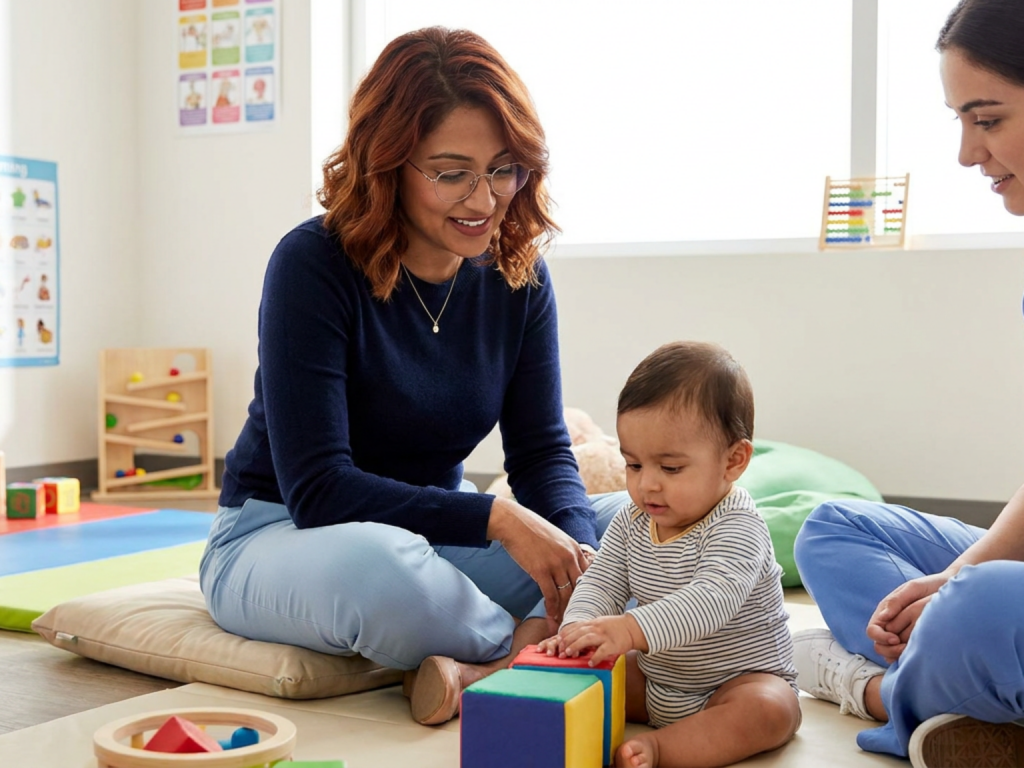
Caregivers support 9-month development through responsive interaction, floor play, reading, safe exploration, and predictable routines.
What development often looks like at 9 months
A 9-month-old is usually in a period of rapid sensorimotor integration: the brain is combining vision, balance, touch, hearing, muscle strength, and social feedback into more coordinated behavior. Many babies at this age sit without support, pivot while seated, reach for toys without toppling immediately, and use their hands to explore shape, texture, weight, and sound.
You may notice that your baby’s attention is more purposeful. Instead of simply mouthing a toy, they may bang it, pass it from one hand to the other, drop it to see what happens, or look toward you for a reaction. This is not mischief; it is early problem-solving and cause-and-effect learning. A baby may also show stronger preferences for familiar caregivers and may become wary of unfamiliar people, which reflects developing memory and attachment.
Milestones at this age do not all arrive together. A baby who is very focused on movement may seem quieter with speech sounds for a few weeks, while a socially vocal baby may be less interested in crawling. The pattern over time matters more than a single day’s behavior.
Gross motor milestones: sitting, crawling, and pulling up
Many babies by 9 months can sit independently, move into or out of sitting with improving control, and use both hands while seated. Some crawl on hands and knees, some commando-crawl on the belly, some scoot, and some move by rolling or pivoting before finding their own method. Crawling is common, but there is variation in how babies become mobile.
Other common gross motor skills include bearing weight on the legs when held upright, rocking on hands and knees, reaching forward from sitting, and pulling to stand while holding furniture. These abilities depend on trunk stability, hip strength, shoulder control, postural reflexes, and motivation. Safe floor play for babies is especially important because it gives the nervous system repeated practice in balance, weight shifting, and protective reactions.
Support development by offering supervised tummy time while awake, placing interesting toys slightly out of reach, and creating a safe, uncluttered floor space. Avoid leaving a baby unattended on a bed, couch, changing table, or elevated surface; mobility can change suddenly. If your baby consistently uses one side much more than the other, keeps one hand tightly fisted, seems unusually floppy or stiff, or cannot sit with help, ask a clinician for guidance.
Fine motor and self-help skills
Fine motor development in infancy becomes more refined around this age. Many 9-month-olds transfer objects between hands, rake small items toward themselves with their fingers, bang two objects together, and use the thumb and side of the index finger in an early pincer-like grasp. A more mature neat pincer grasp, using the thumb and fingertip, often becomes clearer over the next few months.
Self-help skills also start to emerge. Some babies hold a bottle, bring food to the mouth, drink small amounts from an open or training cup with help, or cooperate by leaning toward a spoon. Feeding skills are neurologic and oral-motor skills, not just appetite. Gagging can occur as babies learn textures, but persistent coughing, choking, wet breathing, poor weight gain, or distress with feeds should be discussed with a healthcare professional.
- Offer safe finger foods only if your pediatric clinician has indicated your baby is developmentally ready.
- Use large, age-appropriate toys that cannot be swallowed or inhaled.
- Let your baby practice grasping soft blocks, textured rings, and board books.
- Keep small objects, button batteries, magnets, coins, and medication completely out of reach.
Communication, hearing, and early language
At 9 months, early communication milestones often include babbling strings such as “bababa” or “mamama,” copying sounds, laughing, squealing, and using tone to express excitement or frustration. Many babies turn when their name is called, respond to familiar voices, and look toward objects or people that interest them. They may not understand many words yet, but they are learning the rhythm of conversation.
Receptive language, or understanding, often develops before expressive language. A baby may pause when hearing “no,” respond to a simple phrase such as “come here” with gesture support, or anticipate a familiar routine. Gestures are part of communication too: reaching to be picked up, lifting arms, waving, clapping, or showing a toy can all be meaningful social signals.
Caregivers can support early language development by narrating everyday routines, reading board books, singing, pausing for the baby’s response, and imitating the baby’s sounds. If a baby does not respond to sound, does not turn toward voices, is not babbling, or seems to lose communication skills, prompt evaluation is important. Hearing concerns can be subtle, and early support is valuable.
Cognitive and social-emotional development
Cognitively, 9-month-olds are beginning to understand object permanence: the idea that a person or object still exists when hidden. This is why peek-a-boo becomes so engaging and why separation from a caregiver may suddenly feel more upsetting. A baby may look for a dropped toy, uncover a partially hidden object, or repeat an action to produce a predictable effect.
Socially, babies often show delight in familiar games, respond to facial expressions, and seek reassurance from caregivers in new situations. They may be affectionate, playful, cautious, or intense depending on temperament. Stranger anxiety and separation protest can be normal at this age, but a baby should still show social interest in familiar caregivers through eye contact, vocalization, reaching, smiling, or shared attention.
Responsive caregiving is a powerful developmental tool. When you notice your baby’s signal and respond warmly, you are helping build emotional regulation and trust. This does not mean preventing all frustration; brief, safe challenges such as reaching for a toy or trying to crawl toward you can help persistence and motor planning.
Sleep, feeding, and daily routines
Developmental leaps can affect sleep and feeding. Some babies wake more often when practicing crawling, pulling up, or separation behaviors. Others become distracted during feeds because the environment is suddenly fascinating. A predictable bedtime routine, daytime movement, and calm responses to night waking can help, but sleep patterns still vary widely.
At 9 months, breast milk or iron-fortified formula usually remains a major source of nutrition, while complementary foods provide increasing exposure to textures, flavors, iron, zinc, and allergens as advised by the baby’s clinician. Babies should be seated upright and supervised while eating. Honey is avoided before 12 months because of botulism risk, and choking hazards such as whole grapes, nuts, popcorn, hard raw vegetables, and chunks of hot dog are unsafe.
Daily routines do not need to be rigid. A rhythm of feeding, sleep, floor play, reading, outdoor time, and quiet connection gives the baby repeated opportunities to learn. If growth, hydration, feeding safety, constipation, vomiting, or allergies are concerns, seek individualized medical advice.
How to encourage development safely
The most helpful activities are usually simple, repeated, and responsive. Your baby does not need formal lessons. They need safe space, attentive caregivers, language exposure, and chances to try manageable challenges.
- Play peek-a-boo and hiding games with a cloth or toy to support memory and social engagement.
- Place toys just beyond reach to encourage rolling, pivoting, crawling, and problem-solving.
- Read short board books and name familiar people, objects, and actions.
- Offer containers to put toys in and take them out, which supports hand coordination and cause-and-effect thinking.
- Use gestures with words, such as waving while saying “bye-bye,” to connect language and meaning.
Limit passive screen exposure; babies learn best through live interaction. If screens are used for family communication, such as video calls, keep it interactive and brief. For broader context, a Normal baby development timeline can help caregivers see how skills build across the first year without treating every milestone as a deadline.
When to ask for professional guidance
It is always reasonable to bring developmental questions to a pediatric visit. Clinicians may observe tone, posture, reflex integration, hearing responses, visual tracking, feeding, social communication, and neurologic symmetry. Pediatric developmental screening may involve standardized questionnaires, caregiver concerns, and direct clinical observation.
Ask for guidance if your baby is not sitting with support, does not bear weight on legs when supported, does not respond to name, does not babble, avoids eye contact with familiar caregivers, seems persistently very stiff or very floppy, or uses one side of the body much more than the other. Also seek help for developmental regression in babies, meaning loss of previously acquired skills, at any age.
If your baby was born preterm, corrected age for preterm babies is important. Corrected age adjusts milestone expectations based on the due date rather than the birth date, especially during the first two years. Your pediatric professional can explain how to apply this to your baby’s history and whether early intervention services for infants may be helpful.
Seek medical advice promptly if
- Your baby loses previously acquired motor, language, feeding, or social skills.
- Your baby does not respond to name, familiar voices, or everyday sounds.
- Your baby has poor eye contact, limited social engagement, or no babbling by around 9 months.
- Your baby is persistently very stiff, very floppy, or uses one side much more than the other.
- Feeding involves frequent choking, coughing, wet breathing, poor weight gain, or significant distress.
- You have any concern about seizures, abnormal movements, vision, hearing, or developmental delay.
Tools & Assistance
- Schedule the 9-month well-child visit and discuss developmental observations.
- Use a milestone checklist from a reputable public health source.
- Ask about pediatric developmental screening if you are concerned.
- Contact early intervention services for infants if recommended or if delays are suspected.
- Keep a short note of new skills, lost skills, feeding issues, and caregiver concerns.
FAQ
Should my 9-month-old be crawling?
Many babies crawl by this age, but some use other movement patterns first. Ask a clinician if your baby is not trying to move, cannot sit with support, seems unusually stiff or floppy, or shows strong asymmetry.
Is stranger anxiety normal at 9 months?
Yes, stranger anxiety and separation protest can be normal because memory and attachment are developing. Concern is greater if a baby shows little social connection with familiar caregivers.
How much should a 9-month-old be talking?
Most babies are not using clear words consistently yet, but many babble repeated sounds, respond to name, and use gestures. Lack of babbling or response to sound should be discussed with a healthcare professional.
Do preterm babies follow the same milestone timeline?
Preterm babies are often assessed using corrected age, especially in the first two years. Your pediatric clinician can interpret milestones in the context of gestational age and medical history.
What is the best way to help development at home?
Responsive talking, reading, singing, supervised floor play, safe exploration, and predictable routines are highly useful. Babies learn most from interactive caregiving and repeated practice.
Sources
- Centers for Disease Control and Prevention (CDC) — Milestones by 9 Months | Learn the Signs. Act Early.
- MedlinePlus — Developmental milestones record - 9 months
- Mayo Clinic — Infant development: Milestones from 7 to 9 months
Disclaimer
This article is for informational purposes only and is not a substitute for professional medical evaluation, diagnosis, or treatment. Consult your child’s healthcare professional about concerns or individual medical decisions.















Please log in to leave a comment.