
Intro
Problem-solving play is the everyday learning that happens when a baby notices a goal, tries an action, observes the result, and tries again. A toy that rolls away, a cloth covering a familiar object, or a container that will not open can all become small, meaningful challenges.
For caregivers, it can be reassuring to know that infant problem solving is not about early achievement or getting an answer “right.” It is built through safe exploration, warm interaction, repetition, and time. Babies vary widely in how they approach play, particularly when temperament, opportunity, health, sensory preferences, or prematurity influence their experience.
Highlights
In infancy, problem solving often begins with purposeful movement toward a simple goal, such as obtaining a visible object or making something happen.
Repeated object exploration helps babies learn about cause, effect, spatial relationships, and the properties of materials.
A responsive caregiver can support thinking by pausing, observing, and offering only as much help as the baby needs.
Play should be brief, safe, and matched to the baby’s alertness, motor abilities, and tolerance for stimulation.
What problem solving looks like in infancy
Infant problem solving is usually sensorimotor: babies use looking, reaching, kicking, mouthing, grasping, turning, dropping, and vocalizing to learn how actions change their surroundings. Rather than reasoning verbally, they build practical knowledge through repeated encounters. A young baby may discover that a kick makes a hanging object move. Later, the same baby may pull a cloth to bring a toy closer or rotate a block to fit it through an opening.
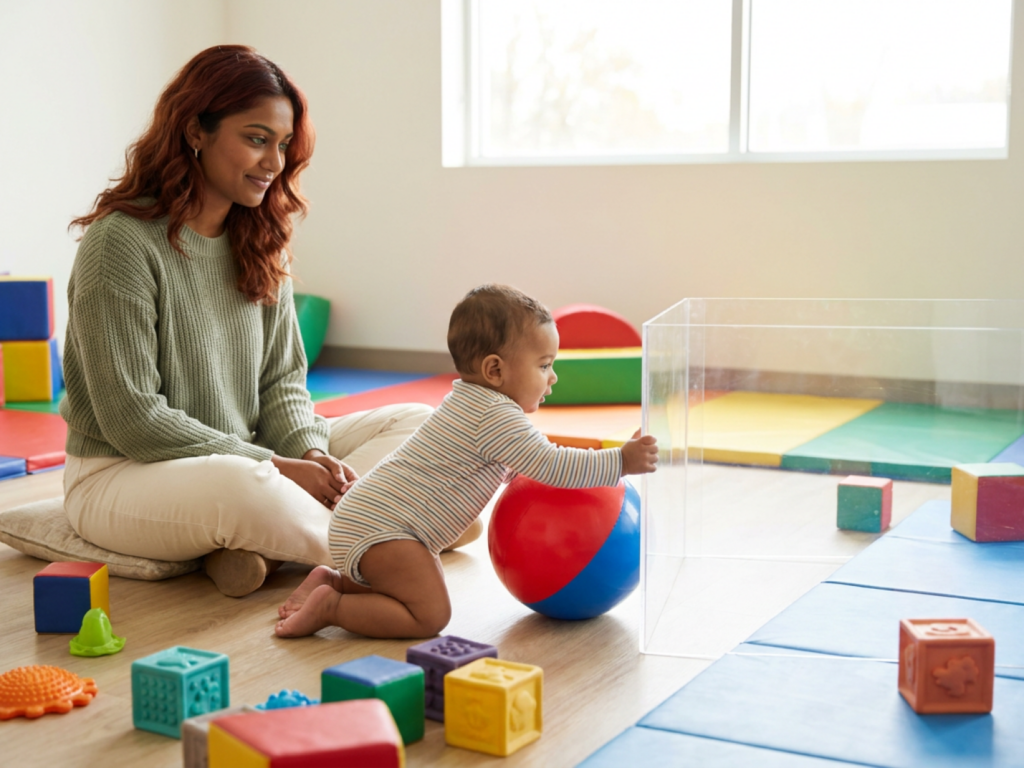
Developmental researchers often describe means-end behavior as coordinating an action, or means, to obtain a desired outcome, or end. For example, a baby who reaches around a transparent barrier instead of repeatedly pushing directly against it is adapting behavior to a constraint. These attempts can be incomplete, inefficient, or inconsistent at first. That is expected. Learning includes watching an outcome, adjusting force or direction, and returning to the challenge.
Problem-solving play is also relational. When a caregiver notices a baby’s gaze, names what is happening, and waits for the next attempt, the baby experiences exploration as shared and emotionally safe. This supports attention and persistence without turning play into a test.
Why object exploration matters
Objects provide information that babies can feel and see. A cup can be banged, tipped, nested, filled, emptied, and rolled. A soft cloth can be pulled, scrunched, briefly placed over a toy, and removed. These actions reveal physical regularities: objects fall when released, some surfaces make sounds, and a hidden item may still be present. Research on object play has found an association between more complex exploratory play and stronger infant problem-solving performance.
Complexity does not require expensive toys. A small selection of sturdy, age-appropriate items is often easier for a baby to investigate than a crowded play area. Rotating materials can renew interest while preserving familiarity. Look for items that invite more than one action, such as nesting cups, large blocks, fabric squares, board books, or containers designed for infants.
Because mouthing is developmentally typical, safety is inseparable from exploration. Use items large enough that they cannot be swallowed, inspect them for loose parts or damage, and keep play supervised. Household items should be chosen cautiously; many common objects can pose choking, strangulation, burn, sharp-edge, or toxic-exposure hazards.
Matching challenges to the baby’s stage
The most useful challenge is one a baby can almost manage. It should invite curiosity but not repeated distress. Early in the first months, offer visual tracking, a caregiver’s face and voice, or a lightweight rattle placed where the baby can see and gradually attempt to reach it. During supervised floor play, place an interesting object slightly to one side to encourage head turning, reaching, rolling, or pivoting according to the baby’s current skills.
As hand use becomes more coordinated, offer safe cause-and-effect toys: a rattle to shake, a soft ball to push, or a simple pop-up or button toy used together. Around later infancy, simple hiding games can support object permanence, the growing understanding that an object continues to exist when out of sight. Partly cover a toy with a cloth, leave a clear portion visible, and allow time for the baby to act before revealing it.
By the end of the first year, many babies enjoy putting large objects into a container, removing them, stacking, opening simple lids, or retrieving a toy from a reachable place. These are broad patterns, not deadlines. For babies born preterm, clinicians may recommend considering corrected age when discussing developmental expectations.
How caregivers can scaffold without taking over
Scaffolding means providing temporary, proportionate support so the baby can remain engaged. Begin by observing. Is the baby looking intently, pausing to plan movement, repeating an action, or signaling frustration? A short wait can be powerful; infants need processing time and may be working through a challenge in a way that is not obvious.
When support is needed, make the task slightly easier rather than completing it. Move a toy a little closer, stabilize a container while the baby explores it, expose one edge of a hidden object, or demonstrate one action and then return the item. Use simple descriptive language: “You found it,” “The ball rolled,” or “You pushed it.” This links attention, action, and outcome without demanding performance.
- Offer one challenge at a time and reduce competing noise or toys.
- Follow the baby’s interest rather than repeatedly redirecting attention.
- Celebrate effort and exploration, including an abandoned attempt.
- Stop or simplify the activity when frustration escalates.
Responsive caregiver interaction supports thinking because the adult adjusts to the baby’s cues. The goal is not to make play harder as quickly as possible. It is to protect the baby’s sense of agency: “I can act, notice, and try again.”
Using routines as problem-solving opportunities
Many of the best opportunities happen during ordinary care. During dressing, pause while a baby works to pull an arm toward a sleeve or reaches for a sock, while still providing practical help and never leaving the baby uncomfortable. At diaper changes, a safe toy held just out of immediate reach may invite visual tracking and reaching. During meals, once a baby is developmentally ready for self-feeding and seated safely, supervised handling of appropriate foods and utensils can offer rich information about grasp, texture, and cause and effect.
Predictable games also make learning easier. Peek-a-boo, a familiar song with a pause before the final word, or hiding a toy under a cloth create an expectation that the baby can test. Repetition is not boredom for infants; it is often how they consolidate a relationship between an action and an outcome. Let the baby request the game again through gaze, movement, vocalization, or excited body language.
Keep the baby’s behavioral state in mind. Hunger, fatigue, illness, teething discomfort, and a busy environment can reduce tolerance for challenge. Short periods of engaged play are sufficient. A calm stop after a successful moment may be more valuable than extending an activity until the baby becomes dysregulated.
When to seek individualized guidance
One difficult play session does not establish a developmental concern. Babies can be cautious with novelty, intensely interested in one type of play, or temporarily less engaged when tired or unwell. It is more helpful to consider patterns across time and settings than to compare a baby closely with another child of the same age.
Bring questions to a pediatrician, health visitor, or other qualified child health professional if you notice loss of previously acquired skills, persistent difficulty using one side of the body, very limited engagement with people or objects, marked distress with ordinary sensory input, or concerns about vision, hearing, movement, feeding, or alertness. A clinician can place play observations alongside medical history, growth, neurologic examination, and standardized developmental surveillance. Developmental screening for infants may be appropriate when a caregiver or clinician has concerns.
Early support is not a label or a prediction. It can clarify what a child needs and connect families with physical therapy, occupational therapy, early-intervention services, or other assessment when indicated. Caregivers know their baby’s everyday patterns well, so brief notes or videos of specific play observations can make a healthcare conversation more concrete.
Safety and caution
- Supervise all object play, especially when babies mouth, drop, or pull materials.
- Avoid small objects, loose pieces, button batteries, magnets, plastic bags, cords, and broken toys.
- Place babies on a stable, safe surface and remain within reach during floor and seated play.
- Stop play if a baby shows escalating distress, breathing difficulty, unusual lethargy, or signs of illness.
- Seek prompt medical advice for suspected ingestion, choking, injury, or a sudden loss of skills.
Tools & Assistance
- Schedule routine developmental surveillance with the baby’s pediatric healthcare professional
- Use supervised floor play with a small rotation of age-appropriate objects
- Ask local early-intervention services how families can access developmental assessment
- Keep a brief record of new skills, interests, and questions for health visits
FAQ
Do babies need educational toys to learn problem solving?
No. Safe everyday objects and warm interaction can provide meaningful learning opportunities. The quality of exploration and caregiver responsiveness matter more than toy complexity.
How long should problem-solving play last?
There is no fixed duration. Follow alertness and interest, and stop when the baby turns away, becomes upset, or appears tired.
Is it okay to help a frustrated baby?
Yes. Offer a small amount of help, such as moving an object closer or showing one action, then let the baby resume exploring.
My baby only wants to drop objects. Is that problem solving?
Often, yes. Repeated dropping lets babies explore gravity, sound, distance, and caregiver responses. Keep it safe and offer variety without forcing a different activity.
Sources
- NIH / PubMed Central — Means-End Problem Solving in Infancy
- ZERO TO THREE — Supporting Thinking Skills From 0-12 Months
- University of Oxford — Object play and problem solving in infancy
Disclaimer
This article is for general educational purposes and is not a diagnosis or substitute for individualized medical advice. Discuss developmental or safety concerns with a qualified healthcare professional.














Please log in to leave a comment.