
Intro
Volume-limiting headphones can be a helpful part of protecting a child’s hearing, especially when tablets, school devices, games, and streaming audio are used often. They are not a guarantee of safety, however. The actual sound reaching the ear depends on the headphone design, the connected device, the recording, background noise, fit, and how long the child listens.
Highlights
Volume-limiting headphones reduce maximum output, but products vary and a label alone should not be treated as proof of safe listening.
An 85 dB limit is common, yet children may still need lower volume, shorter sessions, and quiet listening environments.
Listening duration matters as much as loudness; regular breaks and family rules are part of hearing protection.
A child who needs high volume, misses speech, or has ear symptoms should have age-appropriate hearing testing or medical review.
What volume-limiting headphones are designed to do
Volume-limiting headphones are marketed to keep audio output below a set ceiling, commonly around 85 decibels sound pressure level. The purpose is to reduce the risk of noise-induced hearing injury, which occurs when excessive sound energy damages delicate cochlear hair cells and neural pathways involved in hearing. In children, this matters because hearing supports speech perception, phonological learning, classroom attention, social development, and safety awareness.
A limiter may be built into the headphone circuitry, an inline cable component, a Bluetooth chipset, or a companion app. Some models use passive electrical resistance to reduce output, while others use digital signal processing. These approaches are not identical. The same headphone may behave differently when plugged into a powerful laptop, paired with a tablet, used wirelessly, or connected through an adapter. This is one reason parents should view volume-limited headphones as a risk-reduction tool, not a medical device.
The decibel scale is logarithmic, meaning small numerical changes can represent large changes in sound energy. A difference between comfortable listening and potentially risky listening may not feel dramatic to a child, especially during exciting videos or games. Children may also raise the volume in noisy rooms because they are trying to improve speech clarity, not because they are seeking loud sound. Supportive adult monitoring helps translate a technical feature into safer daily use.
Why the label does not always tell the whole story
Research evaluating consumer-grade headphones for children has shown that products with limited-volume settings do not always deliver a single predictable safe output. Differences in testing methods, headphone fit, seal, frequency response, and limiter design can lead to variable measured sound levels. A package claim such as “85 dB” may refer to a particular laboratory condition rather than every real-world pairing with every device.
This does not mean the products are useless. It means families should combine product selection with listening habits. Over-ear or well-fitting on-ear headphones may reduce the temptation to turn up the volume by improving acoustic isolation, but tight or uncomfortable headphones can make children remove or reposition them, changing sound delivery. Earbuds may sit close to the eardrum and can be difficult to fit safely in younger children, so many families prefer child-sized headphones that are durable, comfortable, and easy to supervise.
Check whether the product has a fixed limit or a switchable mode. Some headphones include a travel or “plane” mode with a higher maximum output to compete with engine noise. That may be understandable in design terms, but it can undermine the purpose of hearing protection if left on for routine use. If the limiter can be disabled, parents and schools need a clear plan for who controls that setting.
Understanding 85 dB and the 60/60 approach
The 85 dB figure is widely used because occupational hearing guidelines often discuss time-weighted exposure at this level. However, workplace limits were developed for adults and for regulated exposure periods; they are not a perfect child-safety threshold. A child’s smaller ear canal can alter sound pressure at the eardrum, and children may have less insight into early auditory fatigue. Many experts therefore encourage a more conservative approach when possible.
A practical household rule is the 60/60 approach: keep the device volume at about 60 percent or lower and limit continuous headphone sessions to about 60 minutes before a break. This is not a precise medical prescription, but it is easy to remember and encourages two protective behaviors: lower intensity and shorter duration. For children who use headphones for school, therapy, travel, or sensory regulation, breaks may need to be planned compassionately rather than imposed abruptly.
Distance and environment also matter. In a quiet room, a child can often hear speech or educational audio at a lower volume. In a car, cafeteria, bus, or busy classroom, background noise can push children to increase volume. Noise-cancelling or isolating headphones may help some older children listen at lower levels, but active noise cancellation should not replace adult awareness of the child’s surroundings, especially outdoors or near traffic.
Choosing headphones for different ages and needs
For toddlers and preschoolers, prioritize simple controls, a comfortable child-sized fit, a durable cable or reliable Bluetooth connection, and a limiter that cannot be easily bypassed. Young children should not sleep with headphones on, chew cords, or use devices unsupervised for long periods. If headphones are used for calming, travel, or medical appointments, keep the volume just high enough for the intended purpose and offer quiet alternatives when possible.
School-age children can learn basic hearing safety language: “If someone nearby can hear your headphones, they may be too loud,” or “Your ears need rest just like your eyes do after screens.” This age group may use headphones for assignments, audiobooks, language learning, and games. Coordinating with teachers can be helpful when classroom listening accommodations are needed, because a child who struggles to understand speech may raise the volume to compensate for auditory, attention, language, or environmental barriers.
For tweens and teens, shared decision-making usually works better than surveillance alone. Explain that ringing, muffled hearing, or sound sensitivity after listening are warning signs, not badges of intensity. Encourage them to use device volume limits, safe-listening notifications, and lower-volume playlists. If they use headphones for music production, gaming chats, or long study sessions, duration becomes especially important. A medically literate family may also consider that individual vulnerability varies: prior ear disease, ototoxic medication exposure, recurrent middle-ear dysfunction in children, or known hearing differences should prompt individualized advice from an audiologist or clinician.
How to use them safely day to day
The safest headphone is the one used within a thoughtful routine. Start by setting device-level volume limits where available, then test the child’s usual apps because one platform may play louder than another. Sit near the child and ask whether the sound is comfortable rather than “Can you hear it?” since many children interpret that question as permission to turn it up. If you can clearly hear the content from a short distance away in a quiet room, the volume deserves checking.
Create predictable breaks. For example, pair a break with the end of an episode, a game level, or a homework section. During breaks, watch for ear rubbing, irritability, headache, tinnitus, or complaints that voices sound muffled. These symptoms do not prove injury, but they are reasons to reduce exposure and seek advice if persistent.
Keep headphones clean and inspect them regularly. Damaged ear cushions can reduce isolation and encourage higher volume. Cables, adapters, and splitters may change output or introduce distortion. Shared school headphones should be cleaned according to local policy to reduce skin and ear irritation risks. Children with ear tubes, active drainage, significant eczema around the ear, or ear pain should have guidance from a healthcare professional before routine headphone use.
When listening behavior may signal a hearing concern
Sometimes the issue is not the headphone but the child’s hearing, auditory processing, language comprehension, or attention. A child who repeatedly asks for higher volume, misses directions, watches mouths closely, seems exhausted after listening, or performs inconsistently in noisy rooms may need more than a new headset. Families often feel guilty when they notice this late, but children are skilled at adapting and may hide difficulty unintentionally.
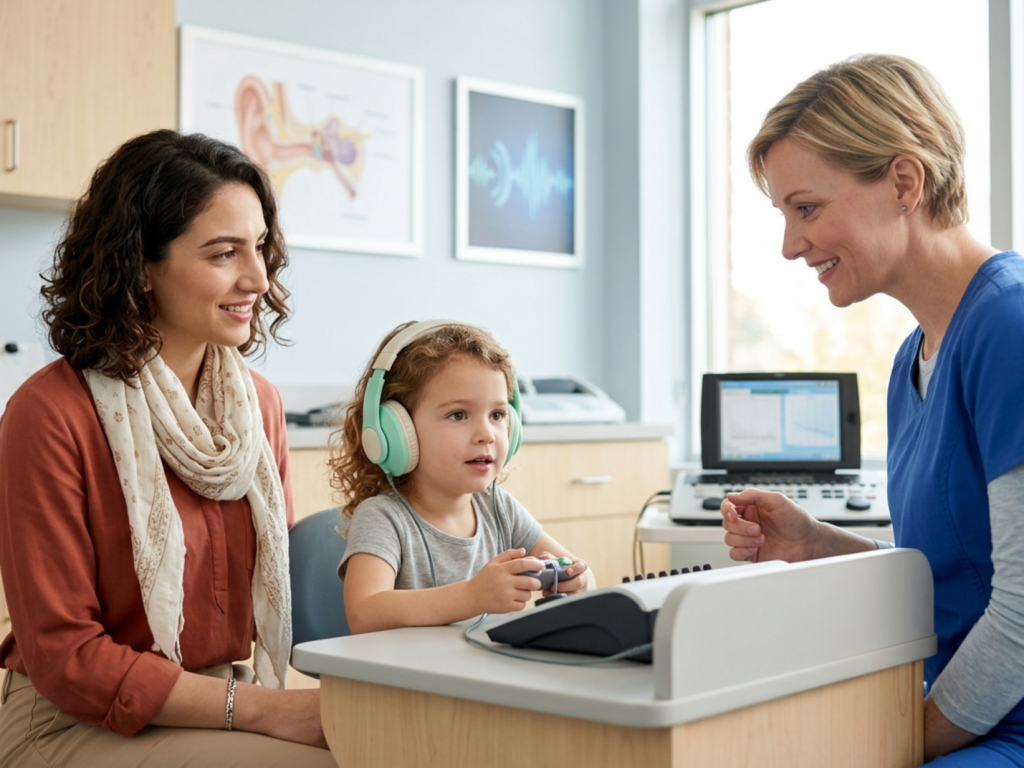
Consider hearing screening or a full audiology assessment if concerns persist, particularly after ear infections, failed school screening, speech-language delay, tinnitus, dizziness, or a sudden change in listening behavior. Age-appropriate hearing testing can include pure-tone audiometry, tympanometry for middle-ear status, speech perception testing, and otoacoustic emissions testing, depending on the child’s age and symptoms. A pediatrician, audiologist, or ear, nose, and throat specialist can help decide what is appropriate.
Volume-limiting headphones are therefore part of a broader hearing-health plan. They sit alongside quieter environments, reasonable screen routines, prompt treatment of ear problems, and attention to communication needs. Parents do not need to create a silent childhood; the goal is to protect the child’s ears while preserving learning, enjoyment, independence, and connection.
When to seek medical advice
- Persistent ringing, buzzing, ear pain, drainage, dizziness, or muffled hearing after headphone use warrants professional advice.
- Sudden hearing change should be treated as urgent and assessed promptly by a clinician.
- A child who consistently needs high volume may need hearing screening rather than louder headphones.
- Avoid routine headphone use during active ear infection or drainage unless a healthcare professional advises it.
- Children with known hearing loss or implanted hearing devices should follow individualized audiology guidance.
Tools & Assistance
- Set device-level volume limits and safe-listening notifications where available.
- Choose child-sized headphones with a non-bypassable or parent-controlled limiter.
- Use the 60/60 approach as a practical family habit: lower volume and planned breaks.
- Ask an audiologist or pediatric clinician about concerns that persist despite safer listening routines.
FAQ
Are volume-limiting headphones completely safe?
No. They can reduce risk, but real output varies by product, device, fit, and listening duration.
Is 85 dB always safe for children?
Not always. It is a common reference level, but children often benefit from lower volume, shorter sessions, and quieter surroundings.
Are earbuds worse than headphones?
Not automatically, but earbuds can be harder to fit and supervise in young children. Many families prefer child-sized over-ear or on-ear models.
What if my child turns the volume up because they cannot hear speech clearly?
Consider background noise, fit, and the audio quality, but persistent difficulty should prompt age-appropriate hearing testing or clinical review.
Sources
- PubMed Central — Consumer-Grade Headphones for Children: Limited volume settings and implications for safe listening
- Michigan Medicine — Are headphones and earbuds exposing your children to noise health risks?
- Hearing Health Foundation — Keep Listening | Headphone & Earbud Safety
Disclaimer
This article is for general educational purposes and does not diagnose, treat, or replace care from a qualified healthcare professional. Seek medical or audiology advice for ear symptoms, hearing concerns, or individualized recommendations.














Please log in to leave a comment.