
Intro
A desk lamp can make reading, drawing, homework, and quiet play more comfortable, but in a child’s room it is also an electrical product, a heat source, and a movable object. Choosing well is not about buying the brightest or cutest lamp; it is about matching the lamp to the child’s age, behavior, room layout, and supervision needs.
This guide is written for caregivers who want practical, evidence-informed precautions without fearmongering. It focuses on injury prevention, visual comfort, fire safety, and developmentally realistic habits. If your child has eye disease, photosensitive epilepsy, migraine, neurodevelopmental differences, sleep disorders, or unusual light sensitivity, discuss lighting choices with a pediatrician, ophthalmologist, optometrist, or occupational therapist.
Highlights
Choose a lamp that is stable, cool-running, correctly rated, and difficult for a child to misuse.
LED lamps are often preferable because they produce less heat than many older bulb types, but wattage, certification, and manufacturer instructions still matter.
Placement is as important as the product: keep lamps away from bedding, curtains, clothing, water, and high-traffic edges.
The safest lamp is one that fits the child’s developmental stage and is paired with clear family rules.
Start with the child, not the lamp
A safe desk lamp begins with a developmental risk assessment. A toddler who climbs, pulls cords, mouths objects, or explores switches needs a different setup from a school-age child who mainly reads at a desk. For infants and very young children, a desk lamp should generally be inaccessible rather than merely explained. For older children, the goal shifts toward safe independence: they can learn not to cover the lamp, not to use damaged cords, and not to move it near bedding.
Think about the child’s motor skills, impulse control, sensory preferences, and medical context. Some children are fascinated by glowing objects or warm surfaces. Some children with autism, attention-deficit/hyperactivity disorder, migraine, or sensory processing differences may be more sensitive to flicker, glare, color temperature, or sudden brightness changes. These observations do not diagnose a condition, but they can help you decide whether to choose a dimmable, low-glare lamp and whether to seek professional guidance.
Use the same mindset you would use for broader home safety for children: remove predictable hazards first, then teach safe behavior in age-appropriate language. A lamp is not a toy, a climbing handle, a clothes hanger, or a night-time tent support. Repeating that calmly is often more effective than waiting until a child has already created a risky setup.
Prioritize stable, cool, certified construction
The lamp base should be heavy or clamp-secured enough that a routine bump does not topple it. A wide base, low center of gravity, non-slip underside, and adjustable arm that stays where placed are all useful. Avoid fragile glass shades, exposed hot bulbs, sharp decorative edges, dangling ornaments, and novelty lamps that invite play. If a lamp clamps to a desk or shelf, check that the surface is thick and strong enough, and recheck the clamp periodically because children may lean on furniture or tug the arm.
Look for electrical safety certification appropriate to your country or region, intact insulation, and a manufacturer label that clearly states the correct bulb type and maximum wattage. Using the correct bulb size and wattage is not cosmetic; a bulb that exceeds the fixture rating can increase heat, damage components, and raise fire risk. If the lamp uses an integrated LED module, follow the manufacturer’s guidance for replacement, cleaning, and disposal.
LED desk lamps are often a good choice for children’s rooms because they are energy efficient and usually run cooler than incandescent or halogen bulbs. However, cool-running does not mean risk-free. Power adapters can warm, cords can fray, and any electrical product can be unsafe if damaged or used near water. Avoid older secondhand lamps unless you can confirm that wiring, plug, switch, shade, and stability are sound. If you notice buzzing, flickering, scorching, melting, a burning odor, exposed wire, or intermittent power, stop using the lamp and have it assessed or replaced.
Control heat and fire risk in the room
Fire prevention is one of the central reasons to choose and place a child’s lamp carefully. A desk lamp should never be covered with clothing, blankets, paper, craft materials, or bedding. Children sometimes drape fabric over a lamp to make a cozy den, soften the light, or create a pretend spotlight; this can trap heat and create a fire hazard. Teach a simple rule: light needs air around it.
Keep the lamp away from curtains, loose papers, plush toys, costumes, laundry piles, and bedding. This is especially important in small rooms where a desk sits close to a bed. If the child reads in bed, a wall-mounted reading light installed safely by an adult may be preferable to a movable desk lamp balanced on a mattress or bedside clutter. Decorative oil lamps, candles, and flame-based lighting do not belong in a young child’s room; they add burn, poisoning, and fire risks and are not equivalent to a desk lamp.
The outlet and cord also matter. Do not overload extension cords or multi-plug adapters. If you need an extension cord as a permanent solution, the room likely needs a safer electrical arrangement. Route cords so they are not under rugs, pinched by furniture, stretched across walkways, or accessible to younger siblings who may pull them. Include the lamp in your family fire-escape plan: children should know that if they smell smoke, see sparks, or notice a burning odor, they should tell an adult immediately and not investigate on their own.
Choose light that supports vision without disrupting sleep
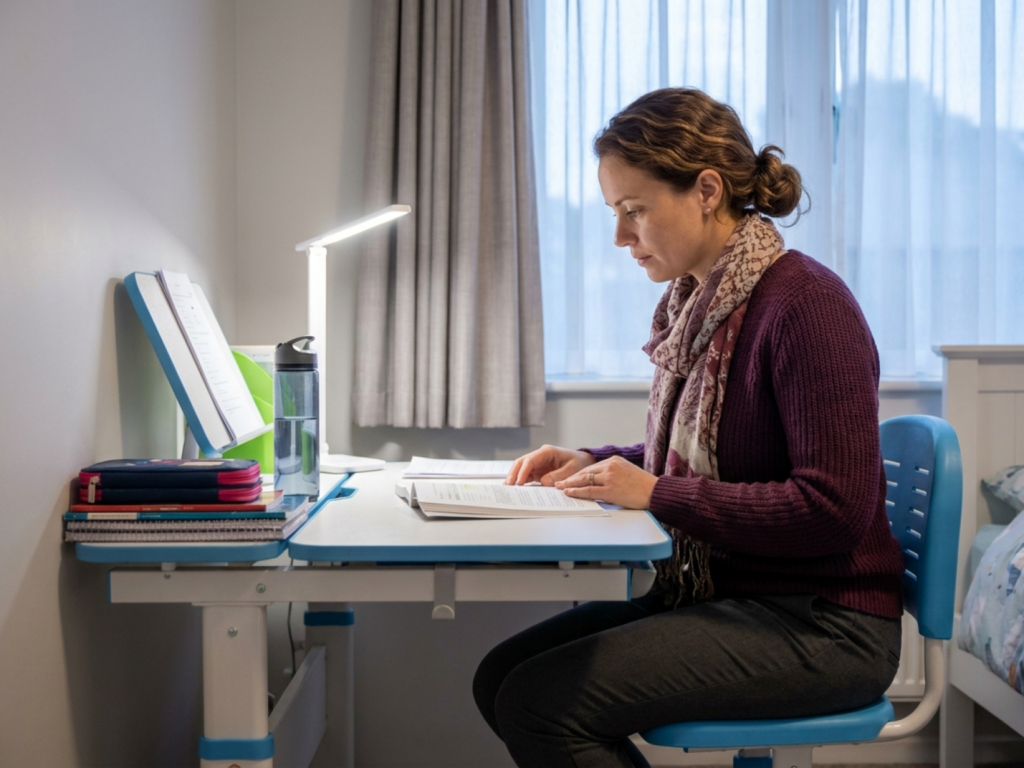
A child’s desk lamp should illuminate the work surface without shining directly into the eyes. Glare can cause squinting, eye fatigue, headaches, or avoidance of reading, though these symptoms can also have other causes and should not be self-diagnosed. Position the lamp on the side opposite the writing hand when possible, so the child’s hand does not cast a shadow across the page. A flexible neck or adjustable arm helps direct light precisely.
Brightness should be sufficient for close work but not harsh. Many families prefer a dimmable lamp because homework, drawing, and bedtime reading require different intensities. Color temperature also matters. Cooler, bluish light can feel alerting and may be useful for afternoon tasks, while warmer light is often more comfortable in the evening. Because light exposure influences circadian rhythm through retinal pathways that affect melatonin timing, avoid very bright or blue-enriched light close to bedtime when sleep onset is a concern.
Flicker is another consideration. Some inexpensive LEDs or dimmers create visible or subclinical flicker that can bother susceptible children. If a child reports eye strain, headache, nausea, visual discomfort, or worsening migraines around a particular lamp, stop using it and ask an eye-care professional or pediatric clinician for advice. Children who need corrective lenses, have amblyopia, strabismus, low vision, or light-triggered neurologic symptoms may need individualized lighting recommendations.
Place the lamp for real-life child behavior
The safest lamp can become unsafe if placed poorly. Put it on a stable desk or shelf, not on a wobbly bedside table, soft surface, stacked books, or toy bin. Keep it away from the desk edge where elbows, backpacks, or pets could knock it down. If the desk is in a shared room, consider the movements of siblings and caregivers as well as the child who uses the lamp.
Water and electricity should be separated. Do not place the lamp near humidifiers, water bottles, fish tanks, paint water, plant pots, or a sink area. If drinks are allowed at the desk, use a stable bottle with a closed lid and keep it on the opposite side from the lamp and power strip. For younger children, it may be simpler to make the desk a no-drink zone.
Cord management should reduce both electrical and strangulation-type hazards. Shorten excess cord with a suitable cord organizer, keep cords behind furniture when safe to do so, and avoid loops that invite play. Do not staple or nail cords. In rooms for children who climb or pull, the safest option may be a lamp that is mounted out of reach or a ceiling/wall light that provides task illumination without a reachable cord.
Match features to age and supervision
For preschool children, consider whether a desk lamp is necessary in the room at all. If it is used for crafts or reading, it may be best brought out only during supervised activity. For early school-age children, choose simple controls, a stable base, cool LED lighting, and clear rules. For tweens and teens, involve them in choosing a lamp that fits their study habits, while still checking certification, wattage, cord condition, and placement.
Helpful features can include a low-heat LED source, enclosed bulb or diffuser, easy-to-reach switch, automatic shutoff timer, dimming, and a sturdy adjustable arm. Less helpful features include exposed novelty bulbs, very lightweight bases, decorative fabric shades close to the bulb, touch controls that activate unpredictably, and USB ports of unclear quality. If the lamp charges devices, make sure the charging function is from a reputable manufacturer and does not encourage a tangle of cables on the desk.
Buying developmentally appropriate child products means thinking about foreseeable misuse, not just intended use. A lamp shaped like an animal or spaceship may be appealing, but if it encourages carrying, cuddling, or covering, it may be less safe than a plain, robust task lamp. A child who has repeatedly misused cords, taken apart electronics, or hidden objects under blankets needs closer supervision and a simpler lighting plan.
Build a simple inspection and teaching routine
A monthly lamp check can prevent many problems. Confirm that the lamp sits firmly, the shade is secure, the bulb or LED housing is intact, the switch works smoothly, and the cord and plug show no cracking, looseness, scorch marks, or exposed conductor. Dust the lamp according to the manufacturer’s instructions, after unplugging it if recommended. Dust and paper buildup near warm components can add avoidable risk.
Teach children concise rules they can remember: keep fabric and paper away from the lamp, do not touch damaged cords, keep water away, turn the lamp off when leaving the room, and call an adult if something smells hot or looks wrong. Practice these rules in a calm moment, not only after a scare. Children learn safety best when adults model it consistently.
Finally, connect lamp safety with the broader safe sleep environment. A child’s bed should not become a workspace full of cords, chargers, papers, and warm electronics. If your child regularly reads late, falls asleep with the lamp on, or needs light because of anxiety or nightmares, respond supportively. A warm, dim night light, a bedtime routine, or consultation with a pediatric clinician may be more appropriate than a bright desk lamp left on all night.
Safety warnings
- Stop using any lamp with exposed wire, scorch marks, melting, buzzing, sparks, or a burning smell.
- Never cover a lamp with clothing, blankets, paper, bedding, or craft materials.
- Keep lamps away from curtains, bedding, water, humidifiers, and cluttered piles of paper or fabric.
- Use only the bulb type and maximum wattage specified by the manufacturer.
- Seek professional advice if light exposure triggers headaches, visual symptoms, seizures, severe sleep problems, or distress.
Tools & Assistance
- Manufacturer instructions and product safety label check
- Monthly cord, plug, switch, shade, and stability inspection
- Local product recall database for lamps, chargers, and power adapters
- Pediatrician, ophthalmologist, optometrist, or occupational therapist for individualized concerns
- Family fire-escape plan and child-friendly fire-safety practice
FAQ
Are LED desk lamps safe for children?
Often, yes, when they are certified, undamaged, correctly used, and placed safely. LEDs usually run cooler than older bulb types, but cords, adapters, glare, and misuse still require attention.
What is the safest place for a desk lamp in a child’s room?
Place it on a stable desk or secured surface, away from edges, bedding, curtains, water, clothing, papers, and high-traffic areas. Keep cords managed and out of reach for younger children.
Should a child sleep with a desk lamp on?
A bright desk lamp is usually not ideal for sleep. If a child needs light at night, consider a dim warm night light and discuss persistent fear, insomnia, or medical concerns with a pediatric clinician.
Can the wrong bulb make a lamp dangerous?
Yes. A bulb that exceeds the lamp’s rated wattage or does not fit the fixture can increase heat and fire risk. Follow the manufacturer’s bulb type and wattage instructions.
Sources
- Nationwide Children's Hospital — Fire Safety
- Health Canada — Safety precautions for decorative and other oil lamps
- Plunket / home-safety resource — Home Safety - Fire, Poisons, Firearms, And Water ...
Disclaimer
This article is for general educational purposes and does not replace medical, vision, electrical, or fire-safety advice. Consult qualified professionals for concerns about your child’s health, vision, sleep, seizures, or home electrical safety.














Please log in to leave a comment.