
Intro
Choosing sports shoes for a child can feel surprisingly complicated. A shoe that works well for walking may not provide the traction, cushioning, or lateral stability needed for basketball, tennis, or running. The best choice depends less on a fashionable label and more on the movement demands of the activity, the child’s comfort, the fit, and the playing surface.
This guide explains how to compare footwear for common childhood activities while keeping safety and development in view. It is intended for general education, not diagnosis or individualized treatment. If a child has persistent pain, a known musculoskeletal condition, an injury, or unusual walking or running mechanics, consult a qualified healthcare professional.
Highlights
Match the shoe to the main activity rather than choosing one pair for every sport.
Comfort, secure fit, and appropriate traction are central safety considerations for children.
Running shoes prioritize forward motion, while court shoes need greater support for cutting and side-to-side movement.
A child’s feedback matters: pressure, rubbing, numbness, slipping, or pain are reasons to reassess the shoe.
Professional guidance is appropriate when discomfort persists or a child has a medical or orthopedic concern.
Start with the activity, not the brand
Athletic shoes are not interchangeable. Footwear designers balance cushioning, flexibility, weight, traction, and structural support according to the movements expected in a particular activity. A child who mainly walks or jogs in a straight line has different mechanical demands from a child who repeatedly stops, pivots, jumps, and moves laterally on a court.
Begin by identifying the activity the child will perform most often, the typical duration, and the surface involved. Outdoor road running, indoor gym classes, artificial turf, grass, and a polished basketball court can all require different traction characteristics. If a child participates in several activities, choose footwear according to the activity that places the greatest demand on the shoe, or consider separate pairs when the difference is substantial.
For younger children, footwear should support participation without making movement unnecessarily difficult. An overly heavy or rigid shoe may feel cumbersome, while an overly soft or unstable shoe may feel insecure during rapid movement. The goal is not to correct a normal foot shape but to provide a comfortable, activity-appropriate interface between the foot and the ground.
Families planning several types of age-appropriate activities for children may reasonably start with a versatile athletic shoe for low-intensity, mixed activities, then reassess when a child begins organized training or a sport with frequent cutting and jumping.
Running and walking shoes
Running involves repeated impact and predominantly forward progression. A running shoe commonly emphasizes shock absorption, a relatively lightweight construction, and flexibility that accommodates the repeated gait cycle. The right amount of cushioning is partly subjective: research on road runners identifies comfort, cushioning, fit, and cost as frequent selection factors. A child should not be expected to tolerate a shoe that feels uncomfortable simply because it has a particular technical feature.
For children who walk for exercise, commute on foot, or participate in low-intensity walking activities, a walking-oriented or versatile athletic shoe may be suitable. It should bend in a way that feels natural during the child’s stride, remain secure around the heel, and provide enough traction for the usual surface. Walking shoes do not necessarily need the same cushioning or design as shoes intended for sustained running.
When assessing a running shoe, ask the child how it feels during several minutes of walking and gentle jogging, not only while standing in a shop. Check whether the heel lifts excessively, the toes are compressed, or the upper presses across the top of the foot. The shoe should feel secure without requiring very tight fastening. If the child reports pain in the foot, ankle, knee, hip, or back during or after running, pause the activity and seek professional assessment rather than trying to solve the problem by purchasing a more corrective shoe.
Children’s feet grow, and a shoe that fitted well a few months ago may become restrictive. However, buying substantially oversized footwear can allow the foot to slide, increase friction, and reduce control. A modest amount of functional space is different from a shoe that is visibly loose.
Aerobic classes, dance, and gym activities
Aerobic classes and general gym sessions may combine running, jumping, landing, repeated direction changes, and short periods of lateral movement. The ideal shoe depends on the class. A low-impact class may be comfortable in a flexible, lightweight athletic shoe, whereas a high-impact routine may place greater demands on cushioning and secure fit.
Look for a sole that provides reliable traction on the actual indoor or outdoor surface without feeling excessively sticky or slippery. The shoe should permit the child to move through the foot during walking and jumping while keeping the heel and midfoot stable enough for rapid transitions. A secure fastening system can help, particularly for children whose feet are narrow or whose shoes tend to slip, but fasteners should not create pressure points.
For dance or activities that require controlled foot articulation, excessive stiffness can interfere with technique. Conversely, a shoe designed only for straight-line running may not offer the lateral support needed for repeated side steps. Ask the instructor whether the activity has a required shoe type, because facility rules and flooring can influence safe traction.
During a trial, observe whether the child can squat, hop, and change direction comfortably. Watch for repeated shoe removal, complaints that the foot feels hot or numb, or attempts to loosen the shoe during class. These observations do not establish a medical problem, but they are useful signals that the fit or design may not suit the activity.
Tennis, basketball, and other court sports
Court sports create demands that are easy to underestimate. Tennis, basketball, and similar activities involve acceleration, deceleration, jumping, landing, pivoting, and frequent side-to-side movement. Sport-specific court shoes generally prioritize lateral support and traction, along with cushioning appropriate to the court and the sport. A running shoe optimized for forward motion may not provide the same level of control during abrupt lateral movement.
For basketball, look for a shoe that feels stable during jumping and landing and that has traction compatible with the playing surface. The collar height is less important than the shoe’s overall fit, secure heel, and ability to support comfortable movement; a high collar does not automatically prevent injury. For tennis, the outsole pattern and durability should suit the court surface when the manufacturer specifies a surface type. Tennis shoes commonly emphasize lateral stability because players repeatedly push off and recover from side-to-side positions.
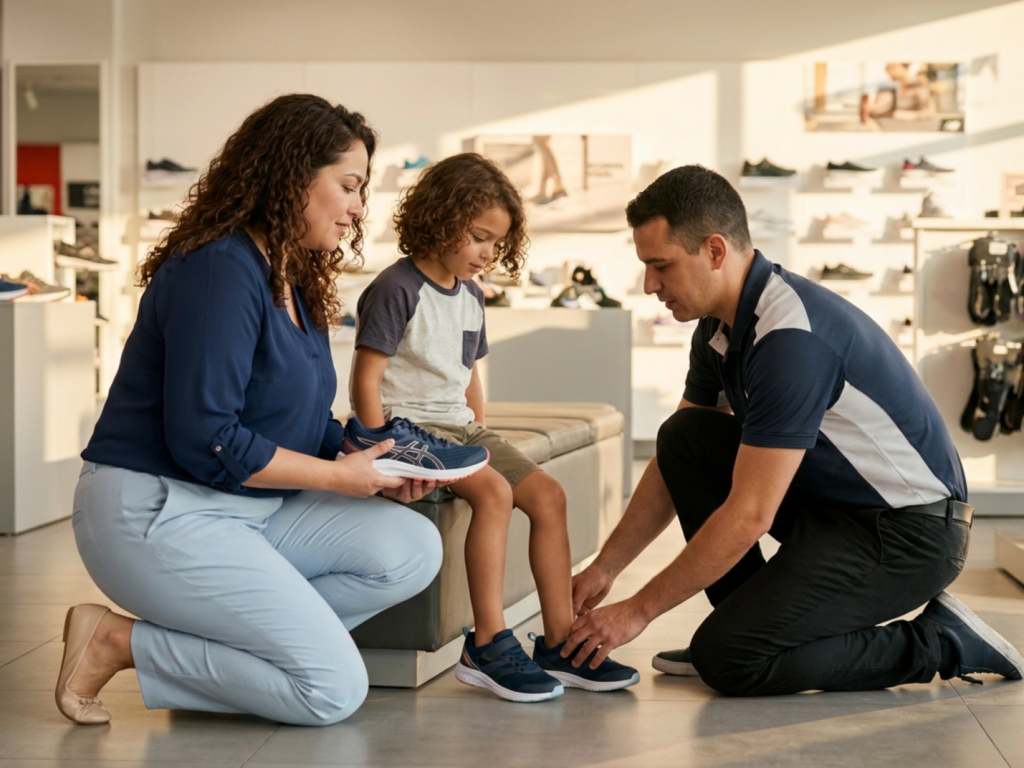
Children should try court shoes while wearing the socks used for play. Have them walk, perform a controlled side step, and make a few gentle stops. The foot should not slide inside the shoe, and the toes should not strike the front during deceleration. The shoe should feel supportive without restricting normal ankle motion or causing pressure at the Achilles region, malleoli, or forefoot.
If a child practices more than one court sport, a general court shoe may be a reasonable compromise for recreational participation, but frequent or competitive training may justify sport-specific footwear. A coach, pediatric clinician, sports medicine professional, or podiatric clinician can help when the child has recurrent discomfort or a history of injury.
Fit, sizing, and comfort in growing feet
Fit is a functional issue, not merely a matter of appearance. Measure or assess both feet because they may differ slightly, and fit the larger foot. Try shoes later in the day if possible, when feet may be somewhat fuller. Use the child’s usual activity socks and allow enough room for the toes to spread without permitting the foot to slide forward or sideways.
Check several areas:
- The toes should not be curled, compressed, or touching the front during normal movement.
- The widest part of the foot should correspond comfortably with the widest part of the shoe.
- The heel should remain reasonably secure during walking and gentle jogging.
- The upper should not create persistent pressure, rubbing, or pinching.
- The child should be able to fasten the shoe securely and independently when developmentally appropriate.
Do not rely on a numerical size alone. Shoe sizing varies among manufacturers and models, and a child’s foot shape matters. A shoe that feels comfortable immediately is often a better starting point than one chosen solely because it is marketed as supportive or corrective.
Inspect the shoes regularly for separated soles, compressed cushioning, uneven wear, or loss of traction. Uneven wear is not by itself proof of an abnormal gait, but it can indicate that the shoe is no longer performing as intended or that a professional assessment would be helpful if accompanied by pain or functional difficulty. Keep the shoes clean and dry according to the manufacturer’s instructions, and avoid sharing footwear when doing so compromises fit or hygiene.
Making a practical and safe choice
For occasional play, one comfortable, versatile athletic shoe may meet a child’s needs. As activity becomes more specialized, the differences between shoe categories become more relevant. A child who runs outdoors several times each week may benefit from a running shoe, while a child who plays basketball or tennis regularly may need court footwear with stronger lateral support and sport-appropriate traction.
Let the child participate in the decision. Comfort is not a superficial preference: it influences whether the child can move naturally and remain engaged. Ask open questions such as, “Where do you feel pressure?” or “Does your heel move when you stop?” rather than asking only whether the shoe is comfortable. Try both shoes, walk on a safe surface, and compare movement with the fastening adjusted correctly.
Introduce unfamiliar footwear gradually before a long practice or competition. Short, supervised use can reveal rubbing, pressure, or slipping. Stop and reassess if the child develops blisters, persistent pain, numbness, swelling, a limp, or reluctance to bear weight. These signs do not identify a specific diagnosis, and continuing to play through them may worsen an unrecognized injury.
Seek medical advice from a pediatrician, pediatric physical therapist, sports medicine clinician, or podiatric clinician when pain persists, repeatedly returns, affects activity, follows an injury, or occurs alongside swelling, weakness, altered balance, or a noticeable change in walking or running. Professional evaluation is more appropriate than selecting increasingly rigid or corrective shoes without guidance.
Safety reminders
- Do not use footwear to self-treat persistent pain, limping, swelling, or a suspected injury.
- Stop activity if the child develops numbness, significant pain, loss of function, or difficulty bearing weight.
- Avoid substantially oversized shoes because excess movement can reduce control and increase friction.
- Sport-specific shoes are not a guarantee against injury; training load, technique, surface, and supervision also matter.
- Seek qualified medical advice for recurrent symptoms or known orthopedic, neurologic, or musculoskeletal conditions.
Tools & Assistance
- A brief shoe-fitting checklist used with the child’s usual socks
- A short movement trial including walking, gentle jogging, hopping, and controlled direction changes
- The coach or activity instructor, especially for court-surface and class-specific requirements
- A pediatrician, sports medicine clinician, pediatric physical therapist, or podiatric clinician for persistent concerns
FAQ
Can a child use running shoes for basketball?
For occasional casual play they may be acceptable, but running shoes are designed mainly for forward movement. Regular basketball requires footwear with traction and lateral stability suited to court movement.
How much extra space should be left in a child’s sports shoe?
The toes should have comfortable room to move without being compressed, but the shoe should not be so large that the foot slides. Because sizing varies, assess movement and fit rather than relying on a fixed size rule.
Should a child wear shoes with arch support?
Not every child needs an added arch feature. Shoe selection should focus on comfort, fit, and activity demands. A healthcare professional can advise if pain or a diagnosed condition raises a specific support question.
When should sports shoes be replaced?
Inspect them for loss of traction, separated materials, compressed cushioning, uncomfortable fit, or visible wear. Replace them when they no longer provide a secure, comfortable platform or when the child has outgrown them.
Is discomfort normal when breaking in new shoes?
Persistent rubbing, pressure, blisters, numbness, or pain should not be considered a normal requirement. Stop use, check the fit and fastening, and seek professional advice if symptoms continue.
Sources
- FootCareMD / American Orthopaedic Foot & Ankle Society — How to Select Athletic Shoes - Expert Orthopaedic Advice
- PubMed / Journal of Science and Medicine in Sport — Athletic footwear: design, performance and selection issues
- Taylor & Francis Online / Sports Biomechanics — How do road runners select their shoes? A systematic review
Disclaimer
This article provides general educational information and does not diagnose, treat, or replace advice from a qualified healthcare professional. Seek medical care for persistent pain, injury, swelling, altered function, or concerns about a child’s movement.












Please log in to leave a comment.