
Intro
Labor pain is shaped by many interacting factors, including contraction strength, cervical dilation, tissue stretching, fatigue, anxiety, previous experiences, and the baby’s position. Fetal position does not determine how labor will feel in a simple or predictable way, but it can influence where pressure is felt, how effectively the head descends, and whether the baby must rotate during labor.
Understanding these relationships can make intense sensations feel less mysterious and help you discuss comfort measures with your midwife, obstetrician, nurse, or birth team. Position changes may support comfort and fetal movement, but they are not a test of coping or a guarantee of a particular birth outcome.
Highlights
Occiput-posterior positioning is commonly associated with stronger lower-back pressure, although not everyone with this position experiences back labor.
Maternal movement can sometimes encourage fetal rotation, improve descent, or redistribute pressure, but its effects vary from person to person.
Sitting, forward-leaning, side-lying, kneeling, and hands-and-knees positions may provide different forms of relief at different stages.
Pain intensity and pain distress are related but distinct; reassurance, continuous support, hydration, rest, and analgesia can matter alongside positioning.
A clinician should assess persistent severe pain, abnormal fetal heart-rate findings, or slow progress rather than attributing everything to fetal position.
Fetal position and the geography of labor pain
Fetal position describes how the baby is oriented within the uterus and pelvis. Clinicians often describe the presenting part, the direction of the occiput, the degree of head flexion, and the level of descent. In a vertex presentation, the occiput is the back of the baby’s head. An occiput-anterior position, in which the baby faces toward the pregnant person’s spine, is generally well aligned with the pelvic inlet and outlet. Occiput-posterior means the baby’s occiput is toward the maternal sacrum, so the baby is facing more toward the abdomen.
These labels are not fixed diagnoses for the entire labor. Babies can rotate as the cervix dilates and the head descends. A posterior baby may rotate to anterior, remain posterior, or adopt an intermediate position. The clinical examination, ultrasound when indicated, fetal descent, and the overall labor pattern are more informative than a single position label.
Fetal orientation can affect the distribution of pressure. When the hard surface of the fetal occiput presses toward the sacrum, some people experience deep, continuous low-back pain in addition to contraction-related abdominal or pelvic pain. Others have little back pain despite a posterior position. This variability reflects differences in pelvic anatomy, fetal flexion, soft-tissue sensitivity, labor stage, and individual pain processing.
Why occiput-posterior positioning may feel especially painful
In an occiput-posterior configuration, the fetal head may present a less compact diameter if flexion is not optimal. The head can therefore place pressure on the sacral area while the uterus generates force against a descent pathway that may require additional rotation. This mechanical pattern is one proposed explanation for “back labor”: pain that is concentrated in the lower back and may persist between contractions rather than disappearing completely when the contraction eases.
Posterior positioning is not synonymous with obstructed labor, and it is not caused by anything the laboring person did. Many babies rotate spontaneously, and many posterior babies are born vaginally. However, persistent posterior or transverse positioning can be associated with slower descent, a longer active phase or second stage, more intensive pushing, and an increased likelihood of assisted vaginal birth or cesarean birth in some circumstances.
A systematic review and meta-analysis of maternal positions in labor found that semi-prone and knee-chest positions were associated with increased spontaneous rotation toward occiput-anterior positioning in the included studies. The review also reported improvements in vaginal delivery rates, shorter active-labor duration, and less low-back pain after delivery. These findings support a plausible mechanical benefit, but they do not mean that a particular posture will rotate every baby or prevent all interventions.
Maternal posture can redistribute pressure
Maternal position changes the relationship between the uterus, pelvis, sacrum, pelvic floor, and fetal head. Upright postures such as standing, walking, kneeling, or supported sitting use gravity and may increase the functional dimensions of parts of the pelvis. Forward-leaning positions can reduce direct pressure on the sacrum and allow the laboring person to move the pelvis in response to each contraction. Side-lying may provide rest, reduce strain, and support controlled descent, particularly when standing is exhausting.
The sitting position has specific evidence for back-pain relief. In a study examining perceptions of labor pain, sitting effectively reduced lower-back pain during cervical dilation of 6 to 8 centimeters, including both pain occurring during contractions and continuous pain. A study of this type cannot predict the response of every individual, but it demonstrates that posture can influence perceived pain intensity rather than merely making a person feel more comfortable.
Hands-and-knees, kneeling, and a supported lunge may create room for pelvic asymmetry and allow the baby to adjust. A semi-prone position can combine a side-lying posture with a forward tilt, while knee-chest positioning may temporarily reduce sacral pressure for some people. The most useful position is often the one that feels more tolerable, can be maintained safely, and fits the fetal and maternal clinical circumstances.
Pain relief is individual and changes throughout labor
Labor pain is not a direct measurement of fetal position. Two people with similar fetal positions may report very different pain because of differences in contraction pattern, cervical examination findings, sleep, fear, prior pain experiences, support, and expectations. A posterior baby can be associated with back labor, but severe pain does not prove that the baby is posterior, and relatively mild pain does not exclude it.
The most effective approach is usually multimodal. Position changes may be combined with breathing strategies, focused touch, heat or water when available and clinically appropriate, massage, sacral counterpressure, rest, emotional reassurance, and pharmacologic analgesia. Neuraxial analgesia, including an epidural, can substantially change pain perception while the baby continues to rotate and descend. It may also reduce the ability to stand or walk, so the team may use supported side-lying, a peanut-shaped positioning aid, or other bed-based adjustments.
It is appropriate to request pain relief at any point in labor. Choosing an epidural or another analgesic method is not a failure to use positioning; likewise, using movement does not imply that medication should be avoided. Pain should be treated according to the person’s preferences and clinical needs.
Using movement safely to support rotation and descent
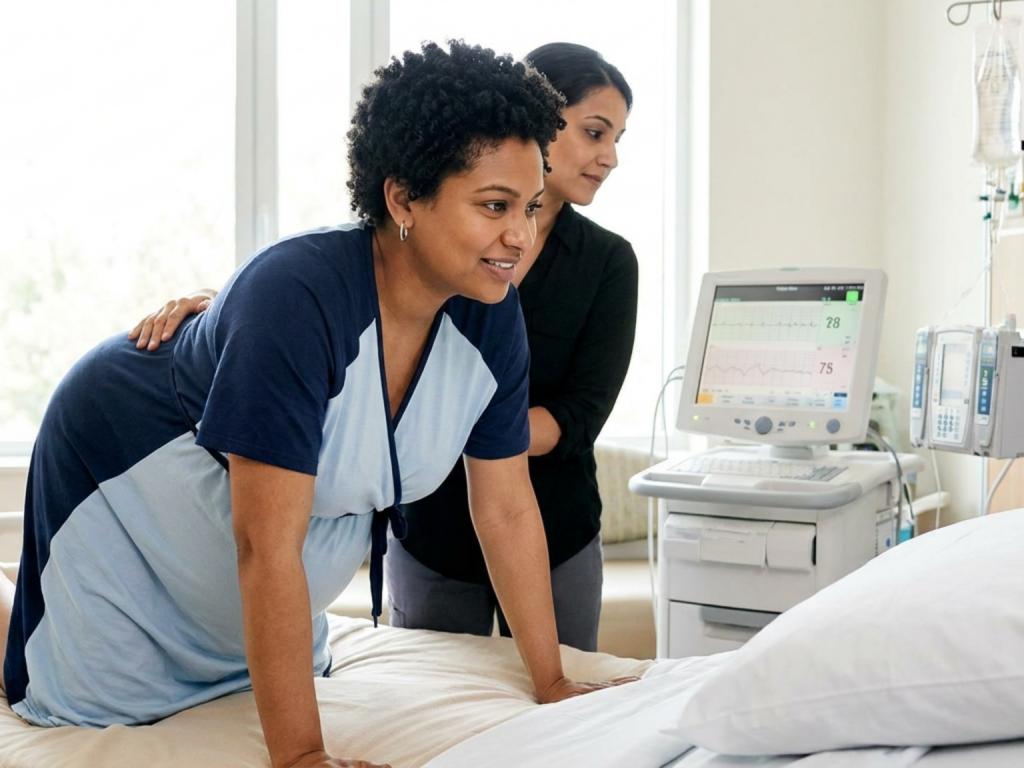
In an uncomplicated labor, many teams encourage freedom of movement and frequent reassessment. A practical strategy is to try one position for several contractions, notice whether pressure becomes more manageable, and then change if it does not help. Alternating active positions with rest can prevent exhaustion. If back labor is prominent, forward-leaning hands-and-knees, kneeling over a raised bed, supported standing, or side-lying may be reasonable options to discuss with the care team.
Positioning should remain responsive rather than rigid. If a contraction makes one posture intolerable, returning to a neutral or supported position is appropriate. A birth partner, nurse, or midwife can help with pillows, a birth ball, a squat bar, or counterpressure, but should not force the pelvis or apply pressure that causes injury. Any technique involving deep pressure, stretching, or a major change in posture should be guided by someone familiar with the pregnancy and labor conditions.
Continuous fetal monitoring, intravenous therapy, blood-pressure concerns, reduced mobility, and an epidural may require adaptations. A person with an epidural should not attempt to stand or walk without appropriate assessment and assistance. The team may use side-to-side turns, exaggerated side-lying, supported sitting, or hands-and-knees on the bed when safe. Monitoring and maternal stability take priority over maintaining a preferred position.
Position during pushing and birth
Fetal position can remain relevant in the second stage. The baby may rotate during pushing, and the birth team assesses descent, head position, caput or molding, maternal effort, and fetal well-being. Upright, lateral, kneeling, supported squat, and hands-and-knees positions can alter pelvic angles and may reduce pressure for some people. Side-lying can be particularly useful when conserving energy, controlling the speed of birth, or accommodating an epidural.
There is no universally superior birth position. A position that feels effective during dilation may feel unsuitable during pushing. Some people prefer an upright posture; others need a supported or semi-reclined position. The familiar supine or lithotomy position may be necessary for certain procedures, urgent birth, assisted vaginal birth, regional anesthesia, or complications. It should not be assumed that a less mobile position caused a difficult labor.
Persistent posterior positioning, lack of descent, or concerning fetal and maternal findings require clinical evaluation. The response may include continued observation, maternal repositioning, manual rotation by an appropriately trained clinician in selected cases, operative vaginal birth, or cesarean birth depending on the circumstances. These decisions cannot be made from pain location alone.
Communication, reassurance, and when to seek help
Describing the quality and location of pain can help the team respond. Useful details include whether pain is mainly in the back, pelvis, abdomen, or perineum; whether it continues between contractions; whether a posture changes it; and whether there is new pressure, numbness, dizziness, or shortness of breath. The team can then assess cervical change, fetal station and position, contraction pattern, vital signs, and fetal heart rate.
Ask what fetal position is suspected, how confident the assessment is, and whether movement is safe. It is reasonable to ask for help trying side-lying, supported sitting, hands-and-knees, or a forward-leaning posture, as well as for analgesia or additional support. A calm explanation of what is happening can reduce fear, even when the pain remains intense.
Seek immediate attention from the birth team for severe or rapidly escalating pain that feels different from expected contractions, heavy bleeding, fainting, chest pain, difficulty breathing, severe headache or visual symptoms, fever, loss of fetal movement before or during labor, or any concern about the baby. During labor, communicate promptly rather than trying to interpret these signs independently.
Important safety considerations
- Do not assume back pain proves that the baby is occiput-posterior or that a complication is present.
- Do not walk, stand, or use stairs after an epidural or while dizzy, weak, or connected to equipment without assistance.
- A position should be stopped if it causes faintness, shortness of breath, severe pain, numbness, or loss of balance.
- Urgent fetal heart-rate changes, heavy bleeding, or maternal instability take priority over attempts to encourage rotation.
- Never use forceful abdominal pressure or aggressive pelvic manipulation without qualified clinical guidance.
Tools & Assistance
- Discuss fetal position, mobility, monitoring, and analgesia options during prenatal visits.
- Ask the labor nurse, midwife, or obstetrician to demonstrate safe supported positions for the current stage of labor.
- Use pillows, a birth ball, a bed rail, or a peanut-shaped positioning aid only with appropriate supervision.
- Create a flexible birth-preference plan that includes comfort measures and possible changes after an epidural.
- Contact the hospital, birth center, or maternity triage service for urgent concerns during labor.
FAQ
Does a posterior baby always cause back labor?
No. Occiput-posterior positioning can increase sacral pressure, but pain patterns vary widely. Back pain may occur with an anterior baby, and some people with a posterior baby feel little back pain.
Can changing position turn a posterior baby?
Some studies suggest that semi-prone and knee-chest positions may increase spontaneous rotation, but no posture guarantees rotation. Positioning should be comfortable, safe, and guided by the clinical situation.
What position is best for back labor?
There is no single best position. Sitting, forward-leaning, hands-and-knees, kneeling, side-lying, and supported standing may help different people. Try options with assistance and stop if symptoms worsen.
Can I change position with an epidural?
Often yes, but usually in bed and with staff assistance. Side-lying, supported sitting, and other bed-based positions may be possible depending on leg strength, blood pressure, monitoring, and local protocols.
Does fetal position determine whether I need a cesarean birth?
No. Fetal position is one factor among many. Descent, rotation, fetal well-being, contraction effectiveness, maternal condition, and the overall labor course determine management.
Sources
- PubMed Central — The impact of maternal position in labor on occiput-posterior fetal position and labor outcomes: a systematic review and meta-analysis
- PubMed — The relationship between the parturient's positions and perceptions of labor pain intensity
- Mayo Clinic — Labor positions
Disclaimer
This article provides general educational information and is not a diagnosis or a substitute for individualized medical advice. Discuss labor pain, fetal position, movement, and urgent symptoms with your qualified maternity care team.















Please log in to leave a comment.