
Intro
Social skills are not a single milestone that a child either has or lacks. They are a gradually developing set of abilities that include noticing social cues, regulating impulses, understanding emotions, taking turns, repairing misunderstandings, and participating in relationships in ways that feel safe and meaningful.
Children build these skills through brain maturation, temperament, language growth, repeated practice, and supportive relationships. Some children need more explicit coaching than others, and that does not mean anything is “wrong” with them. If social difficulties are persistent, intense, or affecting daily life, a pediatrician, child psychologist, speech-language pathologist, occupational therapist, or school-based team can help clarify needs and supports.
Highlights
Social skills develop through repeated, supported practice rather than one-time instruction.
Emotion regulation, language, attention, and executive function all influence how a child participates socially.
Adults can help by modeling, narrating, role-playing, and creating predictable opportunities for peer interaction.
Some children need individualized support, especially when anxiety, neurodevelopmental differences, language delays, sensory processing challenges, or trauma history are involved.
Social skills are developmental, not fixed
Building social skills over time begins with a compassionate assumption: children are learning. A toddler who grabs a toy, a preschooler who interrupts, or a school-age child who misses sarcasm is often showing an unfinished skill rather than deliberate disrespect. Social competence depends on multiple developing systems, including language, attention, working memory, inhibitory control, emotional regulation, and social cognition, which is the ability to interpret other people’s thoughts, feelings, intentions, and perspectives.
Early social learning starts before words. Infants learn through eye gaze, facial expression, vocal tone, joint attention, and responsive caregiving. Over time, children become better able to share focus, imitate, take turns, label emotions, and understand simple social rules. Neural networks involved in reward, threat detection, empathy, executive function, and language gradually coordinate to support more flexible interaction. This is why a child may know a rule in a calm conversation but struggle to use it during a noisy birthday party or competitive game.
It is also normal for social growth to be uneven. A child may be verbally advanced but easily overwhelmed in groups, or warm with adults but hesitant with peers. Another child may want friends but lack the impulse control to wait, listen, or negotiate. Progress is often best measured in small changes: shorter conflicts, quicker recovery, more eye contact when comfortable, more flexible play, or one successful conversation at a time.
What social skills include
Social skills are broader than being polite or outgoing. They include observable behaviors and internal capacities. A medically literate way to think about them is as a functional cluster of social communication, self-regulation, perspective-taking, and relationship maintenance.
- Social attention: noticing faces, gestures, tone of voice, body orientation, and the emotional climate of a situation.
- Social communication: using words, facial expressions, gestures, conversational turn-taking, and repair strategies when a message is misunderstood.
- Emotion regulation: recognizing internal arousal, tolerating frustration, calming after disappointment, and using coping strategies before behavior escalates.
- Executive function: waiting, shifting plans, remembering rules, inhibiting an impulse, and considering consequences.
- Empathy and perspective-taking: understanding that another person may feel, know, want, or believe something different.
- Friendship skills: inviting, joining, sharing, negotiating, apologizing, forgiving, and maintaining connection after conflict.
Because these skills are interconnected, a child who seems “rude” may actually be overloaded, anxious, language-limited, or unable to organize a response quickly. Similarly, a child who avoids peers may be protecting themselves from embarrassment, sensory overwhelm, or repeated social failure. Looking underneath behavior helps adults choose supports that teach rather than punish.
Age-by-age expectations without rigid timelines
In toddlerhood, social learning is concrete and immediate. Children practice imitation, parallel play, simple turn-taking, and emotional signaling. They often need adults to translate: “You both want the truck. First Sam, then you.” Expect short attention spans, strong feelings, and limited sharing. The goal is not perfect cooperation but repeated exposure to predictable, kind social routines.
Preschool learning skills development often includes play-based preschool learning, pretend play, early perspective-taking, and beginning problem-solving with peers. Preschoolers may start to say, “Can I play?” or “I don’t like that,” but they still need coaching to enter play, handle exclusion, and recover from disappointment. At this stage, adults can use short scripts, visual cues, and role-play because children learn well through repetition and concrete examples.
In elementary school, children usually become more aware of rules, fairness, humor, group identity, and friendship stability. They may compare themselves with peers and become sensitive to rejection. This is a key period for teaching conversation skills, teamwork, conflict repair, and social confidence in shy children. Social-emotional development in children at this age benefits from structured opportunities: clubs, cooperative projects, sports with supportive coaching, or small playdates with clear expectations.
Social development teens becomes more complex because adolescents are managing identity, autonomy, peer belonging, digital communication, romantic interest for some, and increased sensitivity to social evaluation. Teenagers still need adult guidance, but they often respond better to collaborative reflection than lectures. Asking, “What did you notice?” or “What might you try next time?” respects their growing independence while supporting adolescent social cognition.
How adults teach social skills effectively
Children rarely learn social skills from correction alone. They need modeling, rehearsal, feedback, and safe opportunities to try again. Adults can make invisible social information visible by calmly narrating what is happening: “Maya moved back when the game got loud. She may need space,” or “When you looked away, Ben thought you were finished talking.” This kind of narration builds social awareness without humiliation.
Modeling is powerful because children learn from observed behavior. Caregivers and teachers can demonstrate greetings, apologies, disagreement, waiting, and active listening. For example, an adult might say, “I interrupted you. I’m sorry. Please finish your thought.” Video modeling, stories, and role-play can also help children preview situations before they occur. Role-play is especially useful when it is brief, playful, and specific: joining a game, responding to teasing, asking for help, or saying no respectfully.
Practice works best when it is repeated across settings. A child might learn a script at home, practice it with a sibling, use it with one peer, and later generalize it to a classroom. Adults can reinforce effort and strategy rather than personality: “You waited for a pause before speaking,” is more useful than, “You’re so social.” This helps children understand which behavior they can repeat.
Peer mentors can be helpful when chosen thoughtfully. A socially skilled peer who is kind, patient, and not pressured into a caretaking role can support inclusion during games or group work. However, adults should avoid making one child responsible for another child’s social success. The goal is a respectful environment where everyone has a role, not a hierarchy of helpers and helped.
Supporting children who struggle socially
Social struggle can arise from many pathways. Some children are temperamentally slow-to-warm and need more time before joining. Some have receptive or expressive language difficulties and cannot process rapid conversation. Others have attention-deficit/hyperactivity traits, autism-related social communication differences, anxiety, sensory processing differences, hearing impairment, motor coordination challenges, or a history of stress that affects threat perception and regulation. These possibilities require careful assessment rather than assumptions.
A useful first step is to identify the barrier. Is the child not noticing the cue, not understanding it, not knowing what to do, or not able to do it under stress? Each answer leads to a different support. A child who misses cues may need explicit teaching and visual supports. A child who understands but freezes may need anxiety-sensitive practice and predictable exposure. A child who becomes impulsive may need movement breaks, shorter turns, or adult-supported pause strategies.
For socially anxious or shy children, gentle scaffolding is usually better than forced performance. Adults can validate the feeling while keeping the door open: “It can feel hard to say hello. We can stand nearby first, then you can wave.” Gradual exposure, choice, and preparation help the nervous system learn safety. Avoid labeling the child as “antisocial” or “too shy” in front of others, because repeated labels can become part of self-concept.
If difficulties are persistent, broad, or impairing, professional consultation is appropriate. A speech-language pathology evaluation may help when conversation, comprehension, pragmatic language, or narrative skills are concerns. An occupational therapy evaluation for preschoolers or older children may be useful when sensory regulation or motor planning affects play. A pediatric or mental health evaluation can consider anxiety, mood, attention, autism spectrum features, trauma-related symptoms, or other developmental factors. Evaluation is not about blame; it is about matching support to need.
Creating everyday practice without pressure
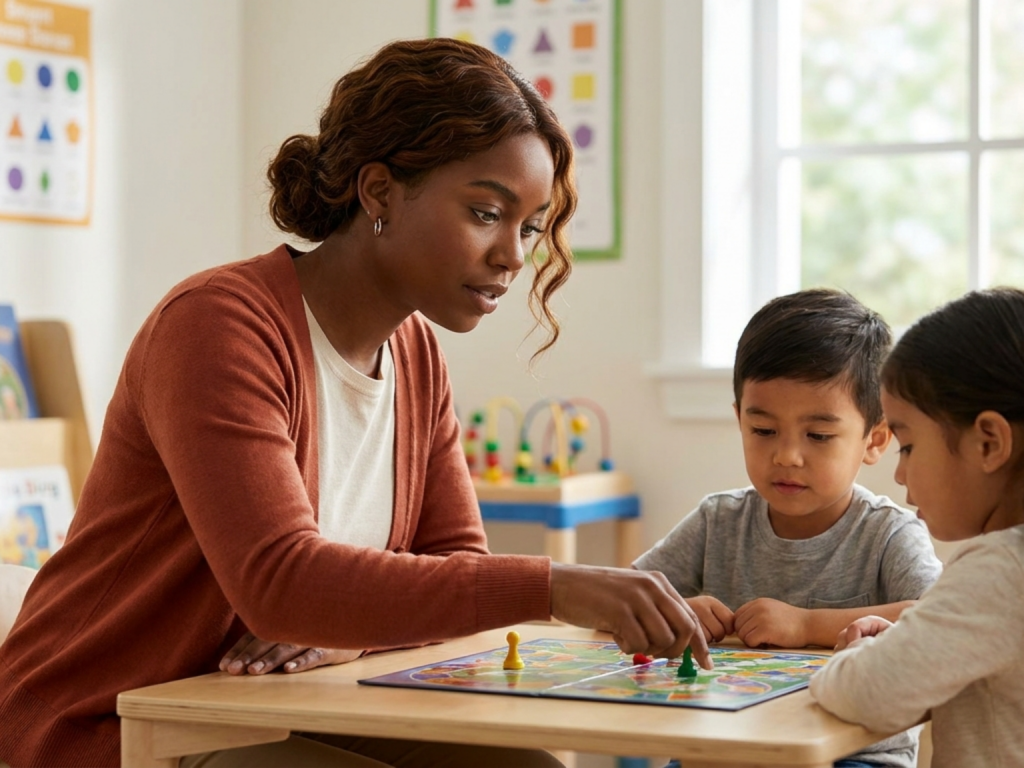
Social practice is most effective when embedded in ordinary life. Family meals can teach turn-taking and listening. Grocery shopping can teach greeting, waiting, and flexible problem-solving. Playground visits can teach joining, negotiating, and reading body language. Board games can teach frustration tolerance, rule-following, and good sportsmanship. The adult’s role is to keep practice small enough for success.
Before a social situation, preview one or two target skills. For example: “At the party, we will practice asking, ‘Can I play?’ and taking a break if it gets too loud.” During the event, use quiet prompts rather than public correction. Afterward, debrief briefly: “What went well? What was hard? What could we try next time?” Long post-event critiques can increase shame and avoidance, especially for children who already feel socially unsuccessful.
Active listening is a foundational skill across ages. Teach children to face the speaker if comfortable, pause their own talking, notice tone, ask a follow-up question, and summarize: “So you felt left out when the teams were picked.” For some children, direct eye contact may be uncomfortable or culturally variable; listening should not be reduced to eye contact. The functional goal is shared attention and respectful response.
Repeated exposure matters. Joining a consistent club, class, team, faith community, library group, or neighborhood activity allows children to see the same peers over time. Familiarity can reduce social threat and increase opportunities for low-stakes connection. For children who have had repeated peer conflict, start with structured activities around shared interests rather than open-ended unstructured play, which can be more demanding.
Digital life, conflict repair, and long-term resilience
Modern social development includes digital communication. Children and adolescents need explicit guidance about tone in text messages, group chats, privacy, consent, screenshots, exclusion, and the difference between online conflict and in-person repair. Because digital cues are limited, misunderstandings can escalate quickly. Families can teach a pause rule: if a message makes the child angry, anxious, or eager to retaliate, wait, breathe, and ask an adult or trusted person before responding.
Conflict is not a sign of failed social development. Repair is one of the most important social skills. Children can learn to name what happened, take responsibility for their part, listen to the other person’s experience, and propose a next step. A simple repair script might be: “I did this. I think it affected you this way. I’m sorry. Next time I will try this.” The script should be sincere and developmentally appropriate, not a forced apology that bypasses understanding.
Long-term resilience grows when children experience themselves as capable of learning socially. Adults can protect that sense of capability by separating the child’s worth from the behavior: “You are a good kid who is still learning how to handle losing,” or “Friendship problems are hard, and we can practice.” This combination of warmth and structure supports healthy self-esteem in children while still teaching accountability.
Progress may be slow, especially for children with neurodevelopmental differences or anxiety. A realistic plan often includes one priority skill at a time, coordinated language between home and school, and regular review of what is improving. Social growth is not about producing an extroverted child. It is about helping each child participate in relationships with more safety, understanding, flexibility, and confidence.
When to seek extra support
- Social withdrawal, fear, aggression, or distress that persists or worsens should be discussed with a healthcare professional.
- Loss of previously acquired social, language, or play skills warrants prompt medical or developmental evaluation.
- Bullying, self-harm comments, or threats toward others require immediate adult intervention and safety planning.
- Marked difficulty with communication, sensory regulation, attention, or peer relationships may benefit from multidisciplinary assessment.
- Do not assume a child is being defiant when anxiety, language difficulty, trauma, hearing problems, or neurodevelopmental differences may be contributing.
Tools & Assistance
- Brief role-play scripts for greetings, joining play, apologizing, and asking for help
- Emotion cards or visual scales to help children identify arousal and feelings
- Structured small-group activities based on the child’s interests
- Pediatrician, school counselor, child psychologist, speech-language pathologist, or occupational therapist consultation
- Short post-event reflection: what went well, what was hard, and one next step
FAQ
Should I push my child to be more social?
Gentle encouragement is helpful, but forcing can increase anxiety or shame. Aim for gradual exposure, preparation, and manageable social steps.
Is shyness a problem?
Not necessarily. Shyness is a temperament pattern, not a diagnosis. Concern rises when avoidance causes significant distress, isolation, or impairment.
How long does it take to build social skills?
It varies. Many children improve over months of repeated practice, but children with language, anxiety, attention, sensory, or neurodevelopmental needs may require longer-term support.
Can social skills be taught directly?
Yes. Modeling, role-play, visual supports, peer practice, coaching, and feedback can all help, especially when teaching is specific and repeated.
When should I ask for an evaluation?
Consider evaluation if social challenges are persistent, occur across settings, cause significant distress, or interfere with learning, friendships, family life, or safety.
Sources
- National Center for Biotechnology Information (NCBI) — Development of social skills in children: neural and behavioral mechanisms
- Positive Action — 13 Evidence-Based Ways to Teach Social Skills in 2025
- Beach Cities Health District — How to Boost Your Social Skills
Disclaimer
This article is for informational purposes only and does not diagnose or treat any condition. Consult a qualified healthcare or developmental professional for concerns about a child’s social, emotional, behavioral, or communication development.
















Please log in to leave a comment.