
Intro
Emotional regulation is the developing ability to notice feelings, understand what they signal, manage their intensity, and respond in ways that fit the situation. Children are not born with mature regulation skills. These abilities emerge gradually through brain development, relationships, language, practice, and repeated experiences of being helped by calm, responsive adults.
Strong emotions, tantrums, irritability, withdrawal, impulsive behavior, and difficulty recovering from disappointment can be challenging for families. They can also be understandable expressions of an immature regulatory system, stress, sensory overload, fatigue, communication difficulty, or unmet needs. Support should be compassionate and individualized, while persistent, severe, or unsafe patterns warrant discussion with a pediatrician or qualified child mental health professional.
Highlights
Emotional regulation develops progressively from infancy through adolescence; it is not a fixed character trait.
Young children usually need co-regulation from trusted adults before they can consistently self-regulate.
Predictable routines, emotion language, connection, and repeated calming practice can strengthen regulation skills.
Behavior should be understood in context, including sleep, health, sensory needs, development, relationships, and environmental stress.
Frequent, severe, worsening, or unsafe difficulties deserve professional assessment rather than blame or punishment.
What emotional regulation means
Emotional regulation includes several related capacities: recognizing an internal state, identifying and communicating the feeling, tolerating emotional intensity, modifying arousal, delaying an impulse, shifting attention, and selecting a constructive response. Regulation does not mean suppressing emotion or remaining calm at all times. A regulated child may still feel angry, frightened, disappointed, or excited; regulation means having enough flexibility to express and manage that state safely.
Research describes regulation as a developmental process shaped by biological characteristics and environmental experience. Temperament, sensory processing, sleep, stress reactivity, language, executive function, and the maturation of neural networks all influence how a child responds. Relationships are equally important. Through repeated interactions, adults help children connect bodily sensations with feeling words, understand limits, and learn that distress can become manageable.
It is useful to distinguish emotion from behavior. Anger is an emotion; hitting is a behavior. Fear is an emotion; avoiding every new situation is a behavior. Adults can validate the feeling while setting a firm boundary around unsafe actions. This approach communicates that all emotions are acceptable to experience, but not every response is acceptable or safe.
How regulation develops across childhood
Infants depend heavily on caregivers to regulate arousal. Holding, rhythmic movement, feeding, predictable responses, and a calm voice can help an infant return to a tolerable state. Over time, infants begin to use simple self-soothing behaviors and become more able to shift attention. Responsive caregiving supports this progression without requiring a baby to calm independently before the relevant capacities have matured.
Toddlers and preschool children are developing language, impulse control, flexible attention, and an understanding of other people’s perspectives. Their emotional reactions may be rapid and intense because the systems that generate arousal can outpace the developing networks that support inhibition and planning. A preschooler may understand a rule when calm but be unable to use that knowledge during a tantrum. This is a temporary loss of access to skills, not necessarily deliberate defiance.
School-age children increasingly use internal strategies such as self-talk, problem-solving, perspective-taking, and seeking help. Peer relationships and classroom expectations create opportunities to practice, but they also introduce social evaluation, conflict, and academic stress. During adolescence, greater cognitive capacity can support reflection and long-term planning, while puberty, sleep changes, social pressures, and heightened sensitivity to reward may complicate regulation. Development varies considerably, so milestones should guide curiosity rather than serve as rigid standards.
Why children become overwhelmed
Children are more likely to lose regulatory capacity when demands exceed available resources. Common contributors include hunger, pain, illness, sleep deprivation, overstimulation, crowded environments, abrupt transitions, frustration, perceived unfairness, separation, and conflict. Communication or learning difficulties can make it harder to explain a problem before distress escalates. Neurodevelopmental differences, anxiety, trauma exposure, chronic stress, and other health conditions may also affect arousal and recovery, but behavior alone cannot establish a diagnosis.
Look for patterns rather than judging isolated incidents. Note what happened before the episode, the child’s observable cues, the behavior itself, what adults did, and how recovery occurred. This functional perspective can reveal predictable triggers, such as demands after a poor night of sleep or transitions away from preferred activities. It can also identify protective factors, including movement breaks, advance warnings, food, quiet space, or one-to-one connection.
During high arousal, reasoning and verbal teaching are often less effective. A child may not be able to answer questions, accept a lecture, or remember a previously practiced strategy. The immediate priorities are safety, reduction of stimulation, and a calm adult presence. Teaching and problem-solving are usually more productive after the nervous system has settled.
Co-regulation before self-regulation
Children commonly need co-regulation before self-regulation: an adult lends organization, calm, language, and physical safety until the child can regain control. The adult’s tone, facial expression, pace, and body position matter. Use few words, lower your voice, reduce competing sensory input, and remain close enough to supervise without crowding. A brief statement such as “You are very upset. I will help keep everyone safe” can be more effective than repeated explanations.
Validation is not the same as giving in. An adult might say, “You wanted more screen time, and stopping feels very hard. I will not let you hit.” This acknowledges the child’s experience while maintaining a clear limit. If aggression occurs, move people and objects out of reach, block harm using the least force necessary, and follow local safeguarding guidance. Physical restraint should not be improvised; urgent professional advice is appropriate when safety cannot be maintained.
Once the child is calmer, reconnect without shaming. Briefly review what happened, identify the earliest warning signs, and rehearse one alternative response. Repair may include an apology, checking on someone who was hurt, helping restore the environment, or practicing a phrase such as “I need a break.” The goal is learning and restored connection, not humiliation.
Practical skills that build regulation
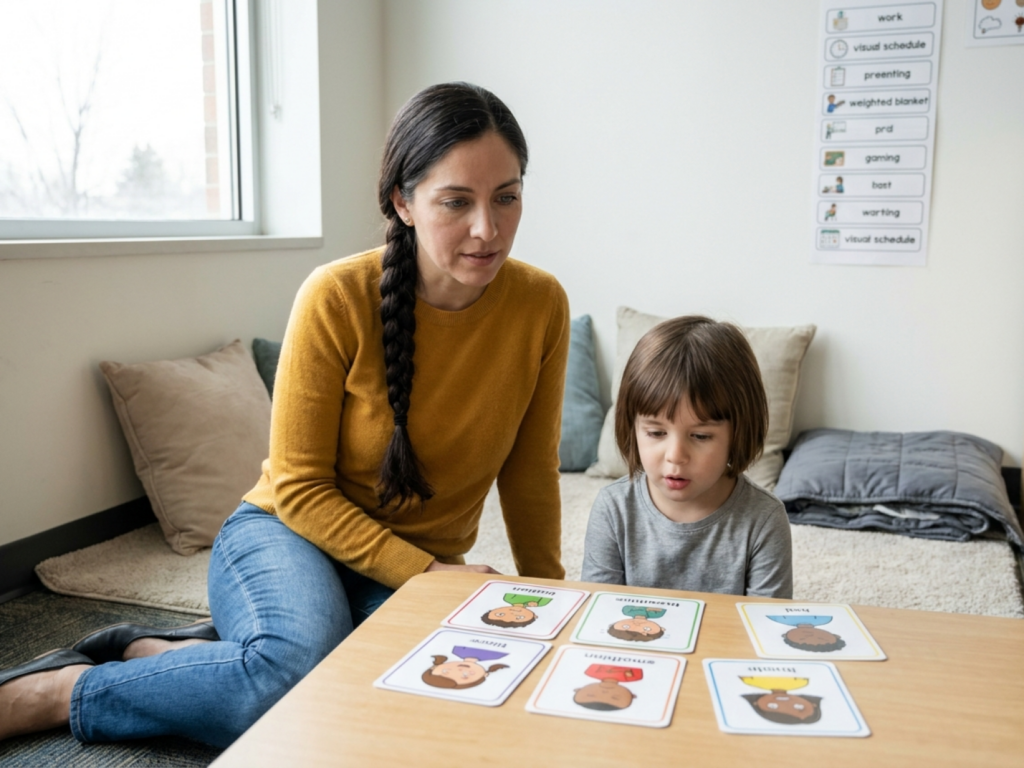
Emotional literacy gives children a way to describe experiences that might otherwise appear only as behavior. Adults can label feelings in ordinary moments: “Your shoulders look tense, and you are squeezing your hands. You may be worried.” Avoid insisting on a label if the child is unsure. Pictures, emotion scales, body maps, stories, puppets, and play can make abstract concepts concrete. Pair feelings with needs and choices: “You are disappointed. Would you like help, a drink, or two quiet minutes?”
Practice coping strategies when the child is already regulated. Options may include paced breathing, blowing bubbles, counting, stretching, jumping, listening to quiet music, drawing, sensory tools, asking for help, moving to a designated calm area, or using a short predictable routine. Not every strategy suits every child. Observe whether a tool reduces arousal or adds stimulation, and allow the child to participate in choosing and adapting it.
Prevention is often more effective than crisis management. Keep routines as predictable as practical, provide transition warnings, use visual schedules, break complex tasks into smaller steps, offer limited choices, and protect sleep and regular meals. Reinforce specific skills rather than praising a vague outcome: “You noticed your body was getting tense and asked for a break.” Consistent responses across caregivers and settings help children generalize learning.
Supporting caregivers and everyday relationships
Caregiver self-regulation is part of the intervention. An adult who is frightened, angry, or exhausted may understandably find it difficult to respond calmly. Before addressing the child, pause when possible, slow breathing, lower the volume of speech, and seek another adult’s assistance. Safety takes priority over appearing perfectly composed. Families benefit from realistic plans that include handoffs, rest, and support rather than placing all responsibility on one caregiver.
Warmth and structure work together. Children need dependable limits, but they also need to know that a difficult episode does not threaten the relationship. Regular moments of positive attention, shared play, reading, physical activity, and curiosity about the child’s interests build emotional security and create more opportunities to practice communication. Avoid comparing siblings or describing a child as “bad,” “dramatic,” or “out of control,” because identity-based labels can intensify shame and obscure the specific skill that needs support.
Coordinate with childcare providers, teachers, and clinicians when difficulties occur in more than one setting. Share observable information, successful strategies, triggers, and safety concerns. A written regulation plan can specify early warning signs, preferred calming supports, communication methods, and escalation procedures. Collaboration is especially important when behavior affects attendance, learning, friendships, family functioning, or physical safety.
When to seek professional assessment
Consider contacting a pediatrician, family physician, child psychologist, psychiatrist, developmental specialist, or other appropriately qualified professional when emotional or behavioral difficulties are persistent, escalating, unusually intense, or present across settings. Assessment is also appropriate when a child cannot participate in ordinary activities, has marked anxiety or avoidance, experiences frequent unexplained physical complaints, has substantial sleep disruption, loses previously acquired skills, or shows significant impairment in learning, relationships, or family life.
Seek urgent help when there is immediate danger, serious aggression, self-injury, threats of suicide, suspected abuse, severe confusion, or an inability to keep the child or others safe. Emergency pathways vary by location; use local emergency services or crisis resources when necessary.
A professional evaluation may consider medical history, development, temperament, sleep, sensory experiences, language, family stress, school functioning, trauma, and possible neurodevelopmental or mental health conditions. Clinicians may recommend parent coaching, behavioral or psychological therapy, school accommodations, speech and language support, occupational therapy, or further assessment depending on the findings. Do not start, stop, or change medication based solely on an article or isolated behavior. The most useful goal is a shared understanding of the child’s needs and a practical, measurable support plan.
When safety comes first
- Get urgent help for serious self-injury, suicidal statements, or immediate danger.
- Seek professional advice if aggression cannot be safely contained or is causing significant injury.
- Arrange clinical assessment for persistent impairment, developmental regression, or severe distress.
- Do not use humiliation, threats, or improvised physical restraint as behavior-management strategies.
- Behavior alone cannot diagnose a mental health, developmental, or medical condition.
Tools & Assistance
- A brief trigger-and-recovery log shared with caregivers and teachers
- A visual daily schedule with advance transition warnings
- An emotion vocabulary chart or body-sensation map
- A personalized calm-down plan practiced during neutral moments
- A pediatric or child mental health appointment for persistent or impairing concerns
FAQ
Is emotional dysregulation always a sign of a disorder?
No. Intense reactions can occur during typical development, especially with fatigue, frustration, transitions, or overload. Concern increases when patterns are persistent, severe, worsening, occur across settings, or cause meaningful impairment or safety problems.
Should adults ignore tantrums?
Ignoring unsafe behavior is not appropriate. Maintain safety, reduce stimulation, and offer calm presence without lengthy negotiation. Teaching, consequences, and repair are usually more effective after the child has recovered.
What is the best calming technique for a child?
There is no universal technique. Some children respond to movement, others to quiet, sensory input, breathing, connection, or visual cues. Practice several options when the child is calm and monitor which approaches reduce distress.
How can teachers and parents work together?
Share specific observations rather than labels: triggers, early warning signs, successful supports, recovery time, and safety concerns. Consistent language and a simple shared plan can help a child use skills across settings.
Can emotional regulation improve with age?
Regulation generally becomes more sophisticated with maturation, relationships, language, and practice. Progress is often uneven, and children may need renewed support during illness, major transitions, stress, or adolescence.
Sources
- PubMed — Emotion regulation in children and adolescents
- PubMed — Development of Emotion Regulation in Typically Developing Children
- Bedfordshire and Luton Children's Health NHS Service — Emotional regulation
Disclaimer
This article provides general educational information and is not a diagnosis or a substitute for individualized medical, developmental, or mental health advice. Consult a qualified healthcare professional about your child's specific needs, and seek urgent help for immediate safety concerns.


















Please log in to leave a comment.