
Intro
Starting preschool is a major developmental transition for a young child and a meaningful emotional milestone for caregivers. Even when a child is curious and socially eager, the first days can bring uncertainty, separation distress, changes in sleep, toileting worries, or a temporary increase in clinginess.
A supportive first-day plan does not aim to eliminate every tear. Instead, it helps the child predict what will happen, trust the adults around them, and gradually build confidence in a new environment. The goal is a calm, consistent, and developmentally realistic beginning.
Highlights
Preschool adjustment is usually a gradual process, not a single event completed on the first day.
Predictable routines, short goodbyes, and warm teacher communication help reduce anxiety for both children and caregivers.
Temporary changes in sleep, appetite, toileting, or behavior can occur during adjustment, but persistent or severe concerns should be discussed with a healthcare professional.
Comfort items, classroom visits, and simple stories about the preschool day can make the unfamiliar feel more manageable.
Understanding the preschool transition
Preschool is often a child’s first repeated experience of separating from a primary caregiver and joining a structured peer group. This transition uses several developing capacities at once: language comprehension, emotional regulation, impulse control, sensory processing, social communication, toileting independence, and early executive function. It is normal for these skills to look stronger at home than they do in a busy classroom.
Readiness is not the same as being tear-free. A child may cry at drop-off and still settle into play within minutes. Another child may enter confidently but become fatigued by lunchtime because they are working hard to follow group routines. The early weeks are best understood as an adaptation period, during which the child’s nervous system is learning that the caregiver leaves, the teacher helps, the day has a pattern, and the caregiver returns.
Caregivers also adapt. Many parents feel grief, guilt, worry, or relief, sometimes all in the same morning. Children are sensitive to adult facial expression, tone, and body tension. This does not mean a parent must pretend to feel nothing. It means the child benefits from a steady message: “You are safe here, your teacher will help you, and I will come back.”
Preparing in the weeks before preschool starts
Preparation works best when it is practical, repetitive, and gentle. In the weeks before the start date, shift bedtime and wake time toward the preschool schedule. Adequate sleep supports emotional regulation, attention, immune function, and frustration tolerance. If mornings are rushed, a child’s stress response may be activated before they even reach the classroom.
Talk about preschool in concrete language. Instead of saying, “You will have so much fun all day,” describe predictable events: “We will hang your backpack, say hello to your teacher, you will play, have snack, listen to a story, and I will come back after outside time.” Picture books about school and saying goodbye can help normalize separation. Some families create a simple visual calendar and mark the start date.
If possible, visit the classroom, playground, or building before the first day. Meeting the teacher, seeing the cubby, and locating the bathroom reduce novelty. If future classmates are known, a short playdate can make the peer environment feel less unfamiliar. These steps are especially helpful for children with cautious temperaments, communication delays, sensory sensitivities, or prior difficult separations.
Practice routine habits that build independence: opening a lunch container, washing hands, putting on shoes, using the toilet, and asking an adult for help. Practice should be low-pressure. The aim is not perfect independence, but a sense of competence.
Talking about worries without increasing fear
Some children can name their concerns: “What if I miss you?” “What if I need the toilet?” “What if no one plays with me?” Others show worry through sleep resistance, stomachaches, irritability, regression, or repeated questions. These reactions are not manipulative; they are common ways young children communicate uncertainty.
Use affect labeling in early childhood: “Your face looks worried. Starting something new can feel strange.” Then add a practical plan: “If you need the toilet, your teacher will show you where it is.” This approach validates emotion while offering structure. Avoid dismissive reassurance such as “There’s nothing to be scared of,” because the child may feel misunderstood. Also avoid long problem-solving conversations right before bed or at the classroom door, when the child is less able to integrate new information.
Ask the teacher about likely triggers. For many preschoolers, toileting, food, rest time, noise, and transitions are more stressful than separation itself. A child who is shy about asking for bathroom help may need the teacher to check in. A child who eats slowly may need reassurance that snack time is not a performance. If the program allows a small comfort object, such as a soft toy or family photo, it can serve as a transitional cue between home and school.
For children who are not yet very verbal, play can teach the concept of leaving and returning. Games such as peekaboo, hide-and-seek, or toy animals going to school and coming home help represent separation in a safe, repeatable way.
What to expect on the first morning
The first morning should be simple and predictable. Prepare clothes, backpack, forms, comfort item, and food the night before. Offer a familiar breakfast and allow extra time so the child does not experience the morning as a crisis. A special but calm ritual, such as choosing a breakfast plate or taking a first-day photo, can help mark the milestone without overwhelming the child.
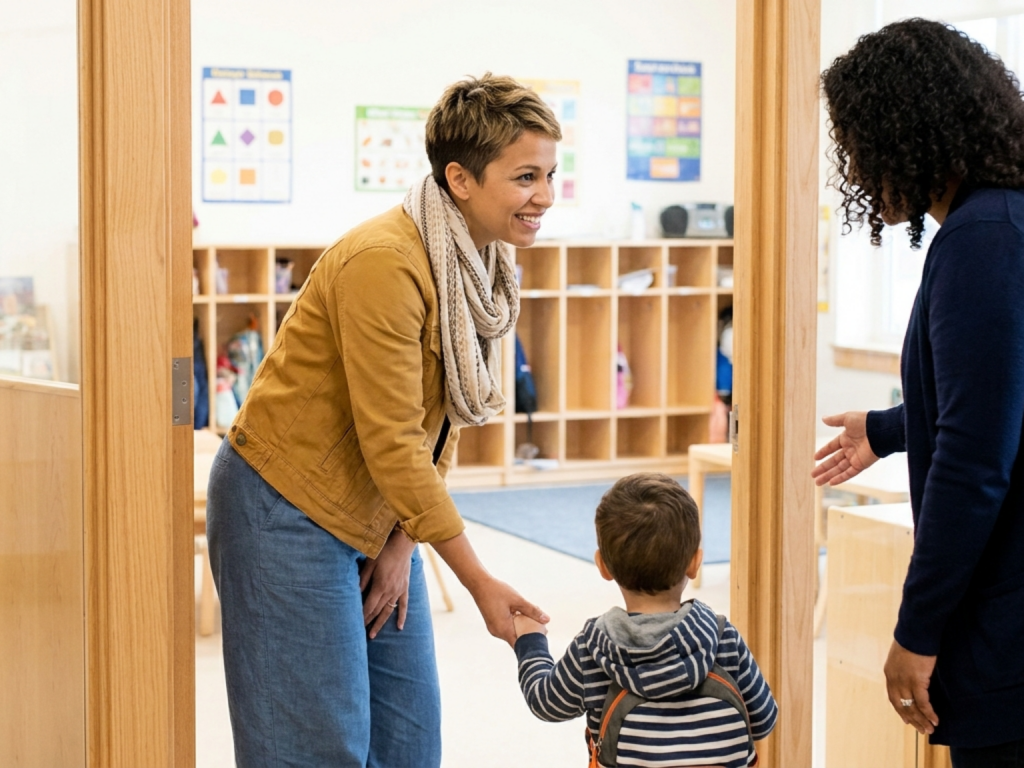
At drop-off, follow the preschool’s recommended routine. Many children do better with a warm, brief goodbye than with repeated returns to the doorway. A goodbye ritual might be two hugs, a phrase, and a wave from the window. Consistency matters because it creates a reliable sequence: connection, goodbye, teacher support, return later. If a parent sneaks away, the child may become more vigilant the next day because the disappearance feels unpredictable.
It is common for children to cry when the caregiver leaves. It is also common for crying to stop after the caregiver is out of sight and the teacher engages the child. Ask the teacher how they communicate about settling. Some schools send a short update; others encourage parents to call after a set time. Clarifying this ahead of time can reduce caregiver anxiety and prevent repeated check-ins that interrupt the classroom rhythm.
If the child refuses to enter, stay calm and let the teacher help. Long negotiations can unintentionally teach that the classroom door is a place where panic grows. A steady handoff communicates confidence in the teacher-child relationship.
The child’s day: routines, play, and fatigue
Preschool days are cognitively and socially demanding. Children must share materials, wait for turns, follow group directions, interpret peer behavior, manage sensory input, and shift activities. Learning through play in preschool is not unstructured idleness; it is the primary way children build language, problem-solving, motor planning, and social understanding.
Many programs include arrival, free play, circle time, snack, toileting, outdoor play, art or sensory activities, lunch, rest, and pickup. A child who knows this rough sequence is better able to predict when the caregiver returns. Visual schedules for preschoolers can be especially useful because young children do not yet understand clock time well.
Expect fatigue after pickup, even if the teacher reports a good day. Some children release their emotions only when reunited with their safest person. This “after-school collapse” may look like crying, defiance, silence, or intense clinginess. It does not necessarily mean preschool is harmful. It may mean the child has used enormous self-control all morning.
After pickup, offer connection before questions. Instead of asking many details, try a snack, water, outdoor movement, or quiet cuddle. Some children share stories later during bath time or bedtime. Avoid pressuring a child to report too much, especially if they are still processing the day.
Supporting separation distress over the first weeks
Separation distress often rises and falls. A child may do well on day one and cry on day three, once they realize preschool is recurring. Illness, poor sleep, family stress, or a change in drop-off caregiver can also reactivate distress. The response should remain compassionate and consistent.
Helpful strategies include:
- Keep the same goodbye words and actions each day when possible.
- Tell the child what you will do while they are at preschool, such as working, shopping, or caring for a sibling, so they do not imagine being excluded from something mysterious.
- Use a return marker the child understands: “I come back after story time,” rather than “at 12:30.”
- Coordinate with the teacher on a soothing activity immediately after drop-off, such as feeding a class pet, choosing a puzzle, or helping set out crayons.
- Maintain consistent preschool routines at home, including sleep, meals, and predictable morning steps.
If distress is intense, do not assume the child is “not ready” after one difficult day. Instead, gather information. How long does crying last? Does the child eat, play, communicate, and accept comfort? Are there specific triggers such as noise, toileting, or separation from a comfort object? Pattern-based behavior observation can guide practical changes.
Health, safety, and developmental considerations
Starting preschool increases exposure to common respiratory and gastrointestinal infections. Hand hygiene, age-appropriate immunizations, staying home when feverish or acutely ill, and following the school illness policy help protect the child and the group. If your child has asthma, allergies, seizures, diabetes, feeding needs, or a history of significant medical events, provide the school with written care plans from the appropriate healthcare professional.
Toileting deserves special attention. Some preschoolers are toilet trained at home but anxious about unfamiliar bathrooms. Others need reminders because they delay voiding during play. Discuss the school’s toileting routines in preschool, clothing suggestions, and how accidents are handled. Shame-based responses can worsen avoidance, so a matter-of-fact plan is important.
Consider consultation if a child has persistent vomiting or severe abdominal pain associated with school, prolonged refusal that does not improve with supportive strategies, regression that continues beyond the adjustment period, extreme aggression, marked withdrawal, loss of previously acquired skills, or concerns about hearing, vision, speech, motor skills, or social communication. These signs do not automatically indicate a disorder, but they justify professional guidance. A pediatrician, developmental-behavioral clinician, child psychologist, speech-language pathologist, occupational therapist, or early childhood mental health clinician may help clarify needs and supports.
Preschool should be a partnership. Teachers know the classroom context; caregivers know the child’s temperament and history; clinicians can help when medical or developmental factors complicate adjustment.
Helping parents manage their own expectations
Parents often imagine the first day as either joyful independence or heartbreaking separation. Reality is usually mixed. A child may cry at goodbye, paint happily, refuse lunch, nap poorly, and proudly show a drawing at pickup. This unevenness is developmentally plausible.
Set expectations around progress, not perfection. The first goal may be entering the classroom with support. The next may be accepting comfort from the teacher. Later goals may include participating in snack, using the toilet, joining group play, or saying goodbye with fewer tears. Small improvements matter because they show the child is building trust.
It can help to plan caregiver support too. Arrange a brief check-in with another adult after drop-off, schedule work flexibly if possible, and avoid judging your parenting by the first morning’s emotions. If your own anxiety feels overwhelming, persistent, or impairing, consider speaking with a healthcare professional or mental health clinician. Supporting the adult’s nervous system supports the child’s transition as well.
Preschool begins a new relationship network around your child. With time, predictable routines, and responsive adults, most children learn that school is a safe place to explore, play, and grow while still being securely connected to home.
When to seek extra support
- Contact a healthcare professional if school-related distress is severe, persistent, or accompanied by concerning physical symptoms.
- Seek urgent medical advice for breathing difficulty, dehydration, severe allergic symptoms, seizure activity, or significant injury.
- Discuss known allergies, asthma, seizures, diabetes, feeding issues, or medication needs with the preschool before attendance.
- Ask for developmental guidance if there is loss of skills, major communication concern, marked withdrawal, or escalating aggression.
- Do not start supplements, sedating products, or medications for preschool anxiety without a clinician’s advice.
Tools & Assistance
- A simple visual morning routine chart
- A brief goodbye ritual practiced at home
- A small comfort item or family photo if the preschool permits it
- A teacher communication plan for first-week updates
- A pediatric or developmental consultation if adjustment concerns persist
FAQ
Is it normal for my child to cry on the first day of preschool?
Yes. Crying at separation is common and often decreases as the child learns the routine and builds trust with the teacher.
Should I stay in the classroom until my child stops crying?
Usually a brief, predictable goodbye works better, but follow the preschool’s transition policy and coordinate with the teacher.
What if my child will not tell me what happened at preschool?
Many preschoolers cannot summarize their day on demand. Offer food, rest, and connection first; details may emerge later through play or conversation.
Can my child bring a teddy bear or comfort item?
Many programs allow a small comfort item, especially during early adjustment. Ask the teacher about classroom rules and safety considerations.
How long does preschool adjustment usually take?
It varies by child, temperament, schedule, and prior separation experience. Some settle within days; others need several weeks of consistent support.
Sources
- National Association for the Education of Young Children (NAEYC) — 13 Tips for Starting Preschool
- Raising Children Network — Starting preschool: practical tips to help
- BabyCenter — First day of preschool: 5 tips for a successful start
Disclaimer
This article is for general educational purposes and does not replace medical, developmental, or mental health advice. Consult a qualified healthcare professional for concerns about your child’s health, behavior, or development.















Please log in to leave a comment.