
Intro
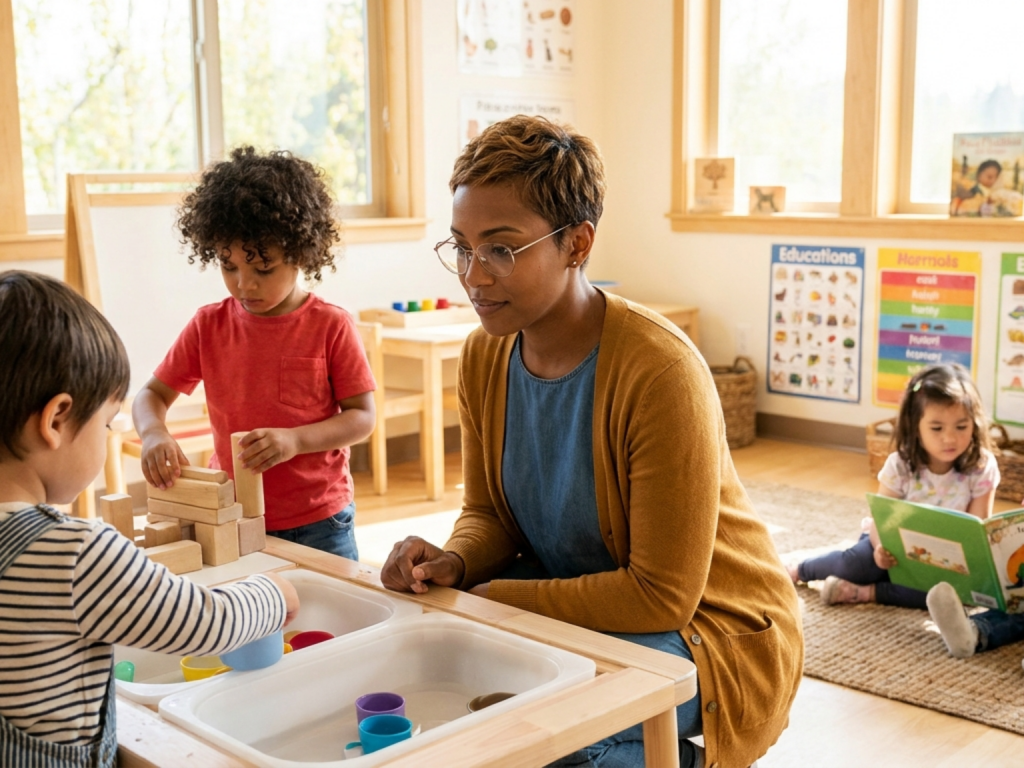
Preschool learning can look wonderfully messy: blocks scattered on the floor, a child repeating the same question, two children negotiating who gets the blue truck, or a teacher turning snack time into a counting game. Beneath these ordinary moments, young brains are building neural networks for language, executive function, social understanding, motor planning, early numeracy, and emotional regulation.
Highlights
Preschoolers learn best through play that is joyful, meaningful, active, iterative, and socially interactive.
High-quality preschool experiences support the whole child, including language, early literacy, math, science, motor skills, relationships, and self-regulation.
Repeated hands-on exploration helps children test ideas, revise strategies, and build flexible problem-solving skills.
Warm adult guidance matters: preschoolers benefit from co-regulation, rich conversation, predictable routines, and developmentally appropriate expectations.
Play is the preschooler’s laboratory
Preschoolers, typically children around 3 to 5 years old, learn best when their minds and bodies are actively involved. For this age group, play is not a break from learning; it is the primary way children investigate cause and effect, practice symbolic thinking, and build cognitive flexibility. When a child stacks blocks, watches the tower fall, changes the base, and tries again, they are using hypothesis testing in a developmentally natural form.
Research on learning through play highlights five features that make experiences especially powerful: they are joyful, meaningful, actively engaging, iterative, and socially interactive. Joy supports motivation and attention. Meaning helps children connect new information to what they already know. Active engagement recruits perception, movement, memory, and problem-solving networks. Iteration allows children to test, fail safely, revise, and try again. Social interaction adds language, perspective-taking, imitation, and shared emotional regulation.
This matters because preschoolers’ prefrontal cortical systems, which support impulse control, planning, and sustained attention, are still immature. A worksheet may ask for attention without providing enough sensory, emotional, or social context. In contrast, a pretend grocery store invites counting, sorting, vocabulary, turn-taking, memory, and flexible thinking in one integrated experience. The child is not merely entertained; they are constructing knowledge through action.
Relationships make learning safer and deeper
Preschool learning is strongly relational. A warm teacher, parent, or caregiver acts as a secure base: the child feels safe enough to explore, make mistakes, ask questions, and tolerate frustration. This emotional safety is not a luxury. Stress physiology can affect attention, working memory, and behavior. When adults respond calmly and predictably, they help regulate the child’s autonomic arousal and support the gradual development of self-regulation.
Co-regulation before self-regulation is a helpful principle. A preschooler who is overwhelmed by a puzzle may need an adult to name the challenge, reduce the task, and model persistence: “This piece is tricky. Let’s turn it slowly and look for the flat edge.” Over time, children internalize this language and use it as private speech to guide their own actions.
Socially interactive learning also supports theory of mind, the ability to understand that other people have thoughts, feelings, and intentions. Pretend play, group projects, storytelling, and classroom jobs all give children opportunities to negotiate roles, repair misunderstandings, and practice empathy. Helping preschoolers express emotions can directly support learning because a child who can identify anger, disappointment, excitement, or worry is better able to stay engaged when tasks become difficult.
Language and literacy grow through conversation
Preschool literacy is much broader than naming letters. It includes oral language, narrative skill, phonological awareness, print concepts, vocabulary, attention to sound patterns, and comprehension. Children learn these skills best when adults talk with them, not only to them. Rich back-and-forth conversation builds semantic networks and strengthens the child’s ability to organize thoughts into words.
Story reading is especially effective when it becomes interactive. Instead of simply finishing the book, adults can pause to ask what the child thinks will happen next, connect the story to the child’s life, explain new words, or invite the child to retell the plot. In high-quality preschool programs, teachers often use story discussion to build early reading foundations while also supporting memory, inference, and emotional understanding.
Everyday routines can become language-rich without feeling like lessons. Cooking introduces words such as stir, sprinkle, measure, dissolve, and compare. Outdoor walks invite classification: rough bark, smooth stones, tiny insects, taller plants. Pretend play builds narrative structure: characters, problems, plans, and endings. For children with persistent difficulty following directions, limited speech clarity, regression in communication, or suspected hearing concerns, families should discuss developmental surveillance and screening with a pediatric clinician. Listening problems in preschoolers can sometimes reflect hearing, language, attention, sleep, or other medical and developmental factors that deserve careful evaluation.
Math is built from real objects and real problems
Early mathematics is not just reciting numbers. Preschoolers develop number sense, one-to-one correspondence, comparison, sorting, pattern recognition, spatial reasoning, measurement concepts, and early logic. These skills grow best through concrete experiences before abstract symbols. Counting crackers, matching socks, sorting toy animals, building ramps, and comparing who has more blocks all make mathematical relationships visible and touchable.
High-quality preschool classrooms often use counting and sorting games rather than isolated drills. A child setting the table may count plates, notice that one cup is missing, and solve a real problem. A child building with blocks may explore symmetry, height, balance, and spatial language such as under, beside, taller, shorter, wider, and between. These experiences support working memory and executive function because the child must hold goals in mind, adjust strategies, and monitor results.
Math also appears to be important for early science learning. Research on preschool science content knowledge has found that children can show considerable science knowledge and that gains occur across the preschool year. In that work, overall knowledge was associated with cognitive abilities and math skills, while math skills significantly predicted gains in science content knowledge. This does not mean preschoolers need formal math pressure. It means that playful numeracy, comparison, measurement, and classification may help children organize observations and reason about the physical world.
Science learning starts with curiosity
Preschoolers are natural scientists when adults protect their curiosity. They ask why ice melts, where shadows go, whether a seed is alive, and what makes a ball roll faster. Science learning at this age is strongest when children can observe, predict, test, describe, and revise ideas using simple materials. A water table, magnet set, garden bed, ramp, flashlight, or collection of leaves can become a powerful learning environment.
The adult’s role is not to deliver long lectures. It is to notice the child’s question and extend it. “What do you think will happen if we add more water?” “How could we make the car go farther?” “What is different about these two leaves?” This kind of guided inquiry supports attention, vocabulary, classification, and causal reasoning. It also teaches children that not knowing is acceptable and that learning often involves trying again.
New vocabulary should be used in context. Words such as float, sink, absorb, evaporate, compare, predict, observe, and experiment become meaningful when paired with direct experience. Children may not retain a definition in isolation, but they can remember that a sponge absorbs water because they squeezed it, watched it drip, and used the word while doing it. This is why hands-on science and language development are closely connected in preschool learning.
The body is part of the learning system
Preschool cognition is embodied. Movement, touch, balance, vision, proprioception, and vestibular input all contribute to how children explore and remember. Fine motor play, such as drawing, cutting with child-safe scissors, stringing beads, or manipulating clay, supports hand strength and visual-motor integration that later help with writing. Gross motor play, such as climbing, jumping, dancing, and running, supports coordination, body awareness, and confidence.
Sensory-rich learning does not need to be elaborate. Sand, water, blocks, fabric, music, rhythm games, and outdoor play give children multiple pathways to encode information. For example, a child learning a pattern may clap it, step it, build it with blocks, and then say it aloud. Each pathway reinforces the others.
Basic physiological needs also influence learning. Sleep, nutrition, hydration, vision, hearing, and physical comfort affect attention and behavior. A hungry or sleep-deprived child may look defiant when the nervous system is simply under-resourced. Predictable meals, nutrient-dense preschool snacks, sufficient sleep, and opportunities for active play can make learning easier. If a child has persistent fatigue, snoring, feeding problems, vision concerns, developmental regression, or loss of skills, caregivers should seek medical guidance rather than assuming it is simply a learning style.
Adult guidance should be intentional, not pressured
Preschoolers benefit from adults who observe closely and plan experiences around children’s interests. High-quality preschool programs often use themes or projects that arise from what children notice: insects in the playground, construction near the school, a new baby sibling, weather changes, or favorite stories. This approach respects motivation while still supporting broad learning goals.
Helpful adult guidance often follows a pattern: watch, join, extend, and step back. First, notice what the child is trying to do. Then join without taking over. Add a word, question, tool, or small challenge. Finally, allow the child time to struggle productively. Too much adult control can reduce exploration; too little support can leave the child frustrated. The balance is sometimes called scaffolding, meaning temporary support that is gradually removed as competence grows.
Pressure, comparison, and premature academic expectations can backfire. Some children are ready to write letters at 4; others are still strengthening fine motor control and symbolic understanding. Some children love group storytelling; others need time to observe before participating. Variation is common. However, variation is different from persistent concern. If caregivers notice major delays in communication, play skills, motor coordination, social reciprocity, hearing, vision, behavior regulation, or daily functioning, consultation with a pediatrician, developmental-behavioral specialist, psychologist, occupational therapist, speech-language pathologist, or early childhood team may be appropriate.
When to seek professional guidance
- Loss of previously acquired language, motor, social, or self-care skills should be discussed promptly with a healthcare professional.
- Persistent difficulty hearing, following spoken directions, or responding to name may need hearing and developmental evaluation.
- Frequent extreme distress, aggression, withdrawal, or inability to participate in daily routines may warrant professional support.
- Concerns about vision, sleep, nutrition, seizures, motor coordination, or developmental delay should not be dismissed as a learning style.
- Avoid using learning activities as treatment for suspected medical, developmental, or behavioral conditions without clinical guidance.
Tools & Assistance
- Daily shared reading with open-ended questions
- Hands-on play materials such as blocks, art supplies, water play, puzzles, and pretend-play props
- Predictable routines with time for outdoor movement and rest
- Developmental surveillance and screening through a pediatric healthcare professional
- Collaboration with preschool teachers, speech-language pathologists, occupational therapists, or early intervention services when concerns persist
FAQ
Do preschoolers need formal academic lessons to be ready for school?
Most preschoolers learn best through guided play, conversation, stories, movement, and hands-on exploration. Formal drills are usually less effective than meaningful, active experiences.
How much should adults help during play?
Offer enough support to keep the child engaged, then step back. Good guidance extends thinking without taking control of the activity.
Is it normal for preschoolers to repeat the same activity many times?
Yes. Repetition helps children consolidate memory, test variations, build mastery, and gain confidence.
What if my child seems behind peers?
Children develop at different rates, but persistent concerns about language, motor skills, social interaction, hearing, vision, behavior, or loss of skills should be discussed with a pediatric clinician.
Sources
- Learning Through Play — The scientific case for learning through play
- National Association for the Education of Young Children — High-quality preschool program: What do children learn?
- National Center for Biotechnology Information / PubMed Central — Exploring Preschool Children's Science Content Knowledge
Disclaimer
This article is for general educational purposes and is not a diagnosis or treatment plan. Consult a qualified healthcare professional for concerns about a child’s development, behavior, hearing, vision, sleep, nutrition, or learning.













Please log in to leave a comment.