
Intro
Ovulation test strips can be a practical way to identify the fertile days in a menstrual cycle, especially when you are trying to time intercourse or insemination. They work by detecting luteinizing hormone, often abbreviated LH, in urine. LH rises before ovulation, and this rise is commonly called the LH surge.
Using the strips correctly matters because small details, such as when you start testing, how concentrated the urine is, and when you read the result, can affect how useful the information is. The goal is not to make home testing feel stressful, but to help you use it with enough precision to guide decisions while knowing when professional advice is needed.
Highlights
Ovulation test strips detect a urinary LH surge, which usually happens before ovulation rather than confirming that ovulation has already occurred.
Testing is most useful when started before the expected fertile window and repeated at roughly the same time each day.
A positive strip usually means the test line is as dark as or darker than the control line, but the exact interpretation should follow the brand instructions.
Reading the strip too early or too late, using overly dilute urine, or missing short LH surges can lead to confusing results.
Irregular cycles, polycystic ovary syndrome, fertility medication, and repeated negative or unclear tests are reasons to discuss ovulation tracking with a clinician.
What ovulation test strips measure
Ovulation test strips are a type of ovulation predictor kit. Most strips measure luteinizing hormone in urine. LH is produced by the pituitary gland and rises sharply in the late follicular phase of the menstrual cycle. This LH surge helps trigger final follicle maturation and ovulation, when an egg is released from the ovary.
A positive ovulation test does not prove that ovulation has occurred. It indicates that LH has reached the threshold detected by that specific test. For many people, ovulation follows approximately 12 to 36 hours after the start of the LH surge, although timing varies. This is why the result is most useful for planning intercourse or insemination soon after the positive result rather than waiting several days.
Strips differ from digital tests because they require visual interpretation. A control line confirms that urine moved through the strip properly. The test line reflects LH concentration. On many strips, the result is considered positive only when the test line is as dark as or darker than the control line. A faint test line is common and usually does not mean a positive result, because low levels of LH can be present throughout the cycle.
When to start testing in the cycle
Correct timing starts before you open the packet. If your cycles are fairly regular, estimate the expected day of ovulation and begin testing a few days earlier. A common approach is to subtract about 14 days from the expected date of the next period, because the luteal phase often lasts around two weeks. For example, in a 28-day cycle, many people begin testing around cycle day 10 or 11, counting the first day of full menstrual bleeding as cycle day 1.
If your cycle length varies, use the shorter recent cycle as a guide so you do not miss an earlier LH surge. For example, if cycles range from 26 to 32 days, starting based on the 26-day cycle is more cautious than waiting for the longer pattern. This may mean using more strips, but it reduces the risk of starting after the surge has already passed.
Testing once daily is often enough for people with predictable cycles and a longer LH surge. However, some people have a short surge that can be missed with once daily testing. If you are consistently seeing near-positive tests but no clear positive, or if prior tracking suggests a brief surge, testing twice daily during the fertile window may be useful. Try spacing tests, such as late morning and evening, while following the product instructions.
How to collect urine and run the strip
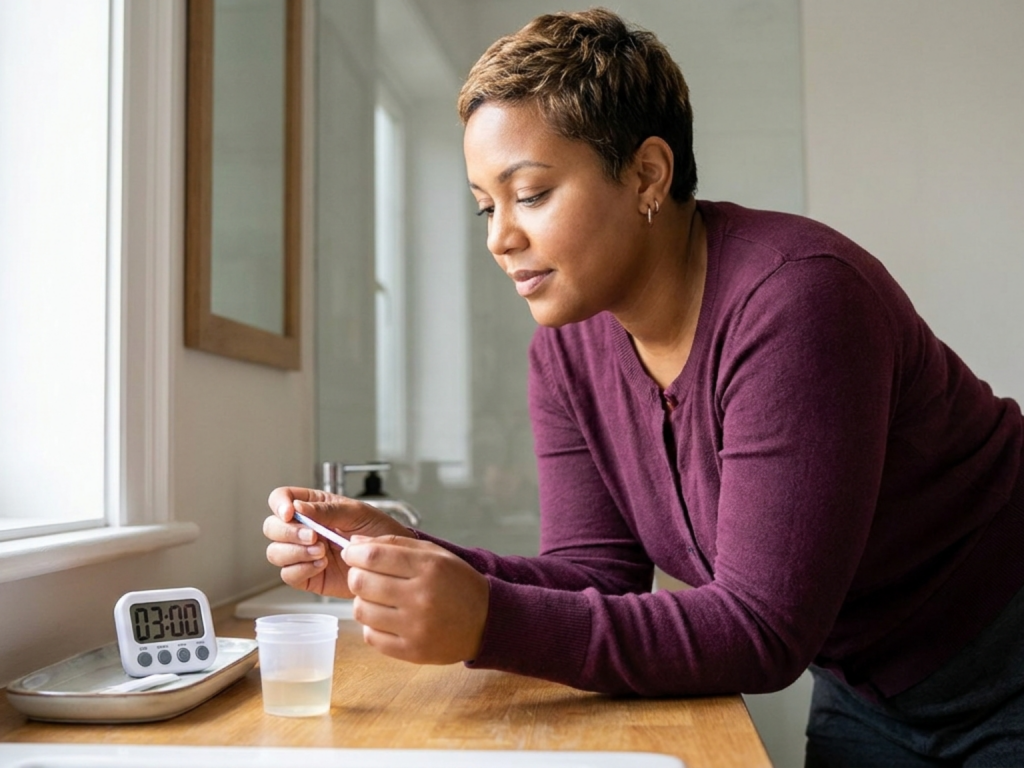
Read the instructions for the specific brand before testing, because dip time, read time, and result thresholds can differ. Use a clean, dry container if the strip is designed to be dipped rather than held directly in the urine stream. Avoid soap residue, disinfectant, or water in the container, because contamination or dilution may interfere with the test.
Many strip tests are used by dipping the absorbent end into urine up to, but not beyond, the printed MAX line. Keep the strip in the urine only for the number of seconds specified by the manufacturer. Dipping beyond the MAX line or leaving it in too long can flood the test and produce invalid or difficult-to-read results.
After dipping, place the strip flat on a clean, dry, nonabsorbent surface. Start a timer. Most tests need to be read after a specific waiting period, often several minutes. Reading too soon may show an incomplete reaction, while reading too late can allow evaporation or background changes that make the strip look darker than it truly was. Do not interpret dried strips as new results.
For best consistency, test at about the same time each day. Some instructions advise avoiding first-morning urine for LH testing because the surge may be better detected later in the day, but recommendations vary by product. Try not to drink excessive fluids for a couple of hours before testing, because very dilute urine can lower the measurable LH concentration.
How to read the result accurately
First, look for the control line. If no control line appears, the test is invalid, even if the test line appears. An invalid result may happen if the strip was defective, expired, flooded, under-dipped, or read outside the allowed time window. Use a new strip and follow the instructions carefully.
If the control line is present, compare the test line with the control line at the manufacturer’s recommended read time. On typical LH strips, a negative result means the test line is absent, faint, or lighter than the control line. A positive result means the test line is as dark as or darker than the control line. Digital ovulation tests may display a symbol or words instead of lines, so the device instructions should guide interpretation.
It can help to record results in a consistent way: date, cycle day, test time, urine concentration if notable, and whether the test was negative, close to positive, positive, or invalid. Photos can be useful for comparison, but lighting and camera settings can distort line darkness. The strip should still be interpreted by eye within the official read window.
A positive test usually marks the start of the most fertile interval. If you are trying to conceive through intercourse, many clinicians advise intercourse on the day of the positive test and the following day, if that is feasible and comfortable. Sperm can survive in the reproductive tract for several days, so intercourse in the days leading up to ovulation can also be effective.
Common mistakes and how to avoid them
One frequent mistake is starting too late. If testing begins after the LH surge, every strip may look negative even though ovulation happened. Starting a few days before expected ovulation, or earlier if cycles are variable, gives the test a better chance of catching the rise.
Another common problem is overinterpreting faint lines. Unlike many pregnancy tests, where any true second line may matter, ovulation strips usually require the test line to match or exceed the control line. A faint LH line can be physiologic and does not necessarily indicate imminent ovulation.
Hydration patterns also matter. Drinking a large volume of fluid before testing can dilute urine. This does not mean you should restrict fluids in an unhealthy way, but it is reasonable to avoid unusually heavy fluid intake shortly before the test. Similarly, testing at widely different times on different days can make patterns harder to compare.
Some users continue reading strips long after the recommended time. This can create apparent positives from drying changes or evaporation effects. Treat the read window as part of the test, not a suggestion. If the strip changes after the allowed time, that later appearance should not replace the timed result.
Finally, remember that an ovulation test is one data point. Cervical mucus, cycle history, basal body temperature, ultrasound monitoring, and blood hormone testing can all provide different information. Basal body temperature tends to confirm a temperature shift after ovulation rather than predict it beforehand, while cervical mucus can suggest increasing estrogen before ovulation. Combining observations may help, but it can also increase anxiety if every sign is treated as definitive.
Special situations that can affect results
Ovulation test strips may be harder to interpret in irregular ovulatory cycles. If cycles are long, unpredictable, or absent, LH surges may occur later than expected, more than once, or not clearly at all. This can happen for many reasons, including postpartum hormonal changes, perimenopause, hypothalamic stress responses, thyroid disease, elevated prolactin, or polycystic ovary syndrome.
Polycystic ovary syndrome can be particularly confusing because some people have higher baseline LH or multiple LH rises without consistent ovulation. In that situation, strips may appear repeatedly positive or nearly positive without giving a clear fertile-window signal. This is a reason to involve a healthcare professional rather than escalating testing indefinitely.
Fertility medications and hormonal treatments may also affect results. Some medications influence ovulation timing, follicle development, or hormone measurements. If you are using prescribed fertility treatment, follow the monitoring plan from your clinician; home strips may not be sufficient or may need to be interpreted in a specific context.
Seek medical guidance if you are under 35 and have been trying to conceive for 12 months without pregnancy, or sooner if you are 35 or older, have irregular or absent periods, known reproductive conditions, recurrent pregnancy loss, or a history of pelvic infection, endometriosis, chemotherapy, ovarian surgery, or partner-related fertility concerns. A clinician can help determine whether ovulation is occurring and whether additional evaluation is appropriate.
A practical testing routine
A simple routine can reduce confusion. Choose the cycle day to begin based on your shortest recent cycle or your expected ovulation date. Keep strips stored as directed, check the expiration date, and have a clean dry container and timer ready before collecting urine.
Test at a consistent time, avoid unusual fluid loading beforehand, dip only to the MAX line for the instructed number of seconds, and lay the strip flat. Read it exactly within the stated time window. Record the result immediately. If the test becomes positive, consider that day and the next day high-priority timing days for conception attempts, while remembering that intercourse in the preceding fertile days can also matter.
If the results are repeatedly unclear, step back from the strip-by-strip interpretation and look at the pattern across the whole cycle. Are you starting early enough? Are you testing consistently? Are the strips valid? Are cycles irregular enough that home LH testing may not be the right tool by itself? Bringing a brief log or photos to a clinician can make the conversation more efficient and less frustrating.
When to be cautious
- Do not use ovulation strips to diagnose infertility, polycystic ovary syndrome, thyroid disease, or other medical conditions.
- Repeated positive or confusing results can occur with irregular cycles or elevated baseline LH and should be discussed with a clinician.
- If the control line does not appear, treat the test as invalid regardless of the test line.
- Do not make medication decisions based on home ovulation strips unless your healthcare professional has specifically instructed you to do so.
- Seek individualized advice sooner if periods are absent, very irregular, unusually painful, or accompanied by concerning symptoms.
Tools & Assistance
- Cycle tracking calendar or fertility app for recording cycle day and test time
- Clean dry urine collection cup and a timer
- Brand-specific ovulation strip instructions kept with the test kit
- Preconception appointment with an obstetrician-gynecologist, midwife, reproductive endocrinologist, or primary care clinician
FAQ
What time of day is best for ovulation test strips?
Follow the specific product instructions. Many people test in late morning, afternoon, or evening and keep the timing consistent. Avoid unusually high fluid intake shortly before testing.
Does a faint test line mean I am about to ovulate?
Usually not. Many LH strips are positive only when the test line is as dark as or darker than the control line. A faint line can reflect normal low-level LH.
Can I miss my LH surge?
Yes. Some LH surges are short, and testing once daily may miss them. Starting early enough and, when appropriate, testing twice daily during the likely fertile window can improve detection.
Do ovulation strips confirm that ovulation happened?
No. They predict likely ovulation by detecting an LH rise. Confirmation may require other methods, such as a sustained basal body temperature shift, serum progesterone testing, or ultrasound monitoring.
Should I keep testing after a positive result?
Usually the first clear positive is the most actionable result for timing. Some people continue testing to understand their pattern, but repeated testing can become confusing and is not always necessary.
Sources
- Cleveland Clinic — Ovulation Predictor Kit (OPK): What To Know
- WebMD — How to Use an Ovulation Test
- Natural Cycles — How and when to take ovulation tests
Disclaimer
This article is for general medical information only and is not a diagnosis or treatment plan. Consult a qualified healthcare professional for personalized advice about ovulation, fertility, menstrual irregularity, or medication use.












Please log in to leave a comment.