
Intro
Social interaction begins long before a baby can speak. In the first year, everyday exchanges such as eye contact, turn-taking sounds, soothing touch, and shared attention help build the foundation for attachment, communication, and later peer relationships.
This article reviews developmentally appropriate social interaction activities for babies, from the newborn period through 12 months. The focus is on simple, responsive, and emotionally attuned activities that fit into daily routines and support bonding without overstimulating a young infant.
Highlights
Babies learn social connection through repeated, sensitive back-and-forth interactions with caregivers.
Short, playful moments such as singing, mirror play, and peekaboo can support early communication.
Routine care can become a powerful social learning opportunity when a caregiver narrates, pauses, and responds.
Infants vary widely in temperament, state regulation, and tolerance for stimulation, so activities should be brief and flexible.
If you have concerns about social responsiveness, discuss them with a pediatric clinician or developmental specialist.
Why social interaction matters in infancy
Social interaction in infancy is not just enrichment; it is part of neurodevelopment. Through serve-and-return exchanges, a baby sends a cue—such as a gaze, smile, vocalization, or body movement—and an adult responds in a timely, predictable way. Over time, these repeated exchanges help organize attention, emotional regulation, and early communication.
For a baby, the social world is built from faces, voices, rhythm, touch, and repetition. Responsive interaction can support attachment, which is the infant’s expectation that a familiar caregiver will provide comfort and safety. That sense of security helps the baby explore, rest, and gradually engage with other people and environments.
Core principles for choosing activities
The best activities are usually simple, brief, and responsive to the baby’s current state. A calm, alert infant may enjoy face-to-face play, while a sleepy or fussy baby may need soothing contact rather than stimulation. The goal is not to keep a baby entertained, but to create a mutually attuned exchange.
Useful principles include following the baby’s cues, pausing to let the baby respond, and stopping when signs of fatigue or overstimulation appear. Many infants benefit more from a few minutes of warm interaction repeated several times a day than from a long, intense play session.
Birth to 3 months: face-to-face connection
In the early months, babies often respond best to close, gentle, predictable interaction. Face-to-face holding, soft speech, and singing help a newborn begin to recognize patterns in voice and expression. Simple imitation—such as copying a facial expression or the rhythm of a coo—can encourage early reciprocity.
Try holding your baby at a comfortable distance during alert moments so the face is easy to see. Talk in short phrases, pause, and wait for a sound, a gaze, or a movement. Even if the response is subtle, that pause teaches the baby that communication has a back-and-forth shape.
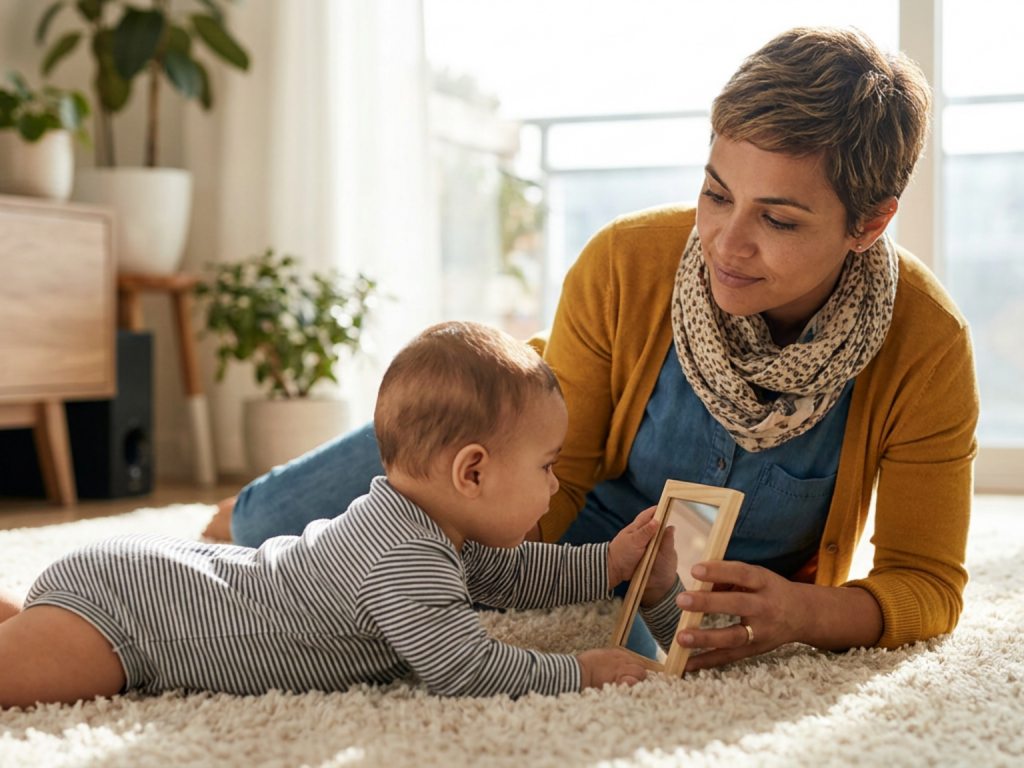
Mirror play can also be introduced in a gentle way. Babies do not understand the mirror at first, but they may enjoy the visual movement, facial contrast, and social tone of the interaction.
4 to 6 months: playful reciprocity
As babies grow, many begin to smile more readily, vocalize, and show greater interest in social games. This is a good time for peekaboo, exaggerated facial expressions, and simple songs with repeated patterns. Games that include a brief pause invite anticipation and help the baby participate in the timing of interaction.
Reach-and-grab play can also become social when an adult offers a toy, waits for the baby to reach, and then responds enthusiastically. The activity is not only about motor skill; it also creates a shared moment of attention. When the baby looks toward the caregiver or vocalizes during play, acknowledge it with words and facial expression.
Reading board books with pictures of faces, familiar objects, or simple scenes can be useful even before a baby understands language. The value lies in the shared attention, voice, rhythm, and emotional tone.
7 to 9 months: shared attention and routine games
During the second half of the first year, many babies become more alert to social patterns and may begin to show stronger preferences for familiar people. Shared attention becomes especially important. When a baby looks at an object and then back at the caregiver, that gaze shift is a major social communication milestone.
Activities such as naming objects, pointing, hiding a toy under a cloth, and finding it together can support attention and early problem-solving. These games also encourage the infant to watch the adult’s face and hands, which strengthens social engagement.
Many babies enjoy simple turn-taking sounds, such as making a noise and waiting for the adult to copy it. This kind of play can lay the groundwork for later conversational rhythm.
10 to 12 months: movement, imitation, and early peer exposure
Older infants often enjoy more active social play, including clapping games, waving bye-bye, and imitating gestures. Imitation is developmentally important because it helps a baby learn social scripts, emotional expression, and the idea that other people can do things on purpose.
Some families begin introducing very brief supervised interactions with other babies. At this age, peer play is usually parallel or observational rather than fully cooperative, but watching another baby can still be valuable. The goal is gentle exposure, not forcing interaction. A baby may watch, reach, smile, or briefly tolerate proximity to another child, and each of those reactions can be meaningful.
Group settings should be kept calm and brief if the baby is easily overstimulated. A familiar caregiver staying close often helps the infant feel secure enough to observe and participate.
Using daily routines as social interaction activities
Daily care moments are often the richest opportunities for social learning. Feeding, dressing, bathing, and diaper changes all contain natural pauses and repetitions that support interaction. When a caregiver narrates what is happening, waits for the baby’s response, and responds to cues, the routine becomes a conversation.
For example, during a diaper change you might describe each step, make eye contact, and pause for a kick, smile, or sound. During feeding, you can slow down occasionally, watch for the baby’s satiety cues, and keep the tone calm. These interactions help the baby learn that their signals matter.
Older guidance often emphasizes “special playtime,” but for babies, ordinary routine care is often just as valuable as planned games. Consistency, warmth, and responsiveness matter more than elaborate toys.
Reading the baby’s cues and avoiding overstimulation
Not every baby wants the same amount of interaction at the same moment. Some infants are highly social and animated, while others need longer quiet periods. Signs that a baby may need a break include turning away, arching, fussing, finger splaying, hiccupping, yawning, or becoming unusually still.
Overstimulation does not mean the baby is harmed by normal life; it means the current level of input may exceed the infant’s ability to process it. Lower the noise, reduce the number of faces or toys, and return to a slower pace. In many cases, a brief pause and a familiar soothing routine are enough.
For medically literate parents or caregivers, it may be helpful to think in terms of state regulation and sensory load. The baby’s nervous system is still developing the capacity to integrate sound, touch, movement, and social input. Responsive pacing supports that process.
When to seek guidance
- Contact a pediatric clinician if a baby rarely makes eye contact or does not respond to voices or faces.
- Ask about developmental screening if social smiling, vocal reciprocity, or shared attention seem markedly delayed.
- Seek help sooner if there is loss of previously observed social skills.
- Do not force interaction when a baby is crying, sleepy, or clearly overwhelmed.
- If a caregiver is feeling persistently disconnected, anxious, or depressed, professional support may improve bonding and interaction.
Tools & Assistance
- Pediatrician or family doctor
- Developmental screening at well-child visits
- Early intervention or infant development services
- Lactation consultant or feeding specialist when feeding is affecting interaction
- Parent-infant support programs through local hospitals or community health centers
FAQ
What are the best social interaction activities for a newborn baby?
For newborns, the most useful activities are face-to-face holding, calm talking, singing, skin-to-skin contact when appropriate, and brief periods of eye contact during awake, alert moments.
How much social play does a baby need each day?
There is no exact quota. A baby usually benefits from many small, responsive interactions spread through the day rather than one long play session.
Is peekaboo good for babies?
Yes. Peekaboo supports anticipation, social reciprocity, and early understanding that people return after brief disappearance, especially in older infants.
Should babies play with other babies?
Occasional supervised exposure can be helpful, but babies usually interact by observing and parallel play rather than true cooperative play. Keep group settings calm and brief.
When should I worry about social development?
Talk with a clinician if you notice persistent lack of eye contact, limited response to voices, little social smiling, or loss of skills the baby previously had.
Sources
- ZERO TO THREE — Activities for Bonding and Learning from Birth to 12 Months
- Penn State Thrive — One-on-One Activities with Your Young Child
- Virtual Lab School — Social-Emotional Development: Experiences and Activities
Disclaimer
This article is for educational purposes only and does not replace individualized medical advice. If you have concerns about your baby’s development, feeding, behavior, or responsiveness, please consult a pediatric clinician.















Please log in to leave a comment.