
Intro
Starting preschool is a major developmental transition for a young child and a major emotional milestone for parents. Even when preschool is safe, warm, and well chosen, the combination of new adults, unfamiliar peers, structured routines, and saying goodbye can activate a child’s stress response.
Highlights
Preschool adjustment is usually a gradual process, not a single successful first day.
Predictable routines, short goodbyes, and a trusted teacher relationship help reduce separation distress.
A child’s tears at drop-off do not necessarily mean preschool is harmful; they often reflect normal attachment and uncertainty.
Persistent, escalating, or impairing anxiety deserves discussion with a pediatrician or child mental health professional.
Why preschool adjustment can feel so big
For many 3- to 5-year-olds, preschool is the first place where they must manage several developmental tasks at once: separating from a primary caregiver, following a group schedule, communicating needs to unfamiliar adults, sharing materials, waiting turns, toileting in a new environment, and tolerating sensory input from a busy classroom. Even children who are socially curious may become dysregulated when these demands arrive all at once.
Separation distress is closely tied to attachment, not weakness or manipulation. A child who cries at drop-off is often communicating, “I feel safest with you, and I am not yet sure this place is safe without you.” From a neurodevelopmental perspective, preschoolers are still building executive functions such as impulse control, working memory, flexible shifting, and emotional inhibition. These skills are immature by design. Predictability acts as an external organizer for the child’s developing brain.
Parents may also feel a physiologic stress response: tight chest, guilt, worry, or an urge to rescue the child from tears. This is understandable. The goal is not to make separation emotion-free. The goal is to help the child experience a repeated sequence: caregiver leaves, another safe adult helps me, I recover, I play, and caregiver returns. Over time, that sequence becomes encoded as safety.
Build predictable rhythms before school starts
Preparation works best when it is practical and concrete. A few weeks before preschool begins, gradually shift wake time, meals, toileting, nap or quiet time, and bedtime toward the school schedule. This does not need to be rigid, but it should be consistent enough that the child’s circadian rhythm, appetite pattern, and morning expectations are not suddenly disrupted on the first day.
A picture-based daily routine can be especially helpful. Preschoolers often understand time through events rather than clocks: breakfast, shoes, car or walk, classroom, snack, play, lunch, rest, pickup. Visual schedules for preschoolers reduce ambiguity and give children something to “read” when language is not enough. Some families draw simple pictures; others use photos of the child’s own backpack, classroom door, or pickup spot.
Practice separations in small doses. Leave the child with a trusted adult for short, predictable intervals and return when you said you would. Narrate the pattern: “I am going to the store. Grandma will play with you. I will come back after snack.” This builds procedural memory for separation and reunion. Avoid making every separation a test; the aim is repeated mastery, not forced toughness.
Books and pretend play also help. Act out a preschool day with stuffed animals: one animal feels nervous, the teacher animal helps, the parent animal comes back. This gives children language for mixed feelings and lets them rehearse coping without being in the emotionally charged moment.
Create a calm and repeatable morning routine
Mornings are often when separation anxiety intensifies, especially if the household is rushed. A consistent morning routine lowers cognitive load for both child and parent. Prepare clothing, backpack, comfort item, forms, and lunch the night before. Offer limited choices: “Do you want the blue cup or the green cup?” rather than open-ended decisions that can stall the morning.
Keep the emotional tone warm but matter-of-fact. Children read adult facial expression, posture, and voice for safety cues. If a parent repeatedly asks, “Are you scared? Are you going to be okay?” the child may infer that school is threatening. A more regulating script is: “You may feel nervous, and your teacher will help you. I will come back after playground time.”
Some children benefit from a brief transitional object. This may be a small comfort item, a family photo, a matching bracelet, or a note with a simple drawing. Check the preschool’s policy first, because some classrooms limit toys for safety or sharing reasons. The object should support coping, not prevent participation. A photo kept in a cubby may be enough for reassurance during the day.
Breakfast, hydration, and sleep matter. Hunger and sleep debt lower frustration tolerance and make cortisol-driven distress harder to downshift. If a child has chronic sleep problems, loud snoring, prolonged bedtime battles, or extreme morning irritability, discuss these concerns with a pediatrician rather than assuming the issue is only behavioral.
Drop-off: short, loving, and predictable
The drop-off routine should be brief, honest, and the same each day. A useful sequence might be: hang backpack, greet teacher, one hug, one phrase, parent leaves. The phrase should be specific and reassuring: “I love you. Your teacher will help you. I will come back after lunch.” A consistent preschool routine teaches the nervous system what happens next.
Avoid sneaking away. Although it may prevent an immediate meltdown, it can increase vigilance because the child learns that caregivers may disappear without warning. Also avoid repeated returns after leaving. Returning every time a child cries can accidentally reinforce the idea that crying is required to bring the parent back. This does not mean ignoring distress; it means transferring support to the teacher in a planned way.
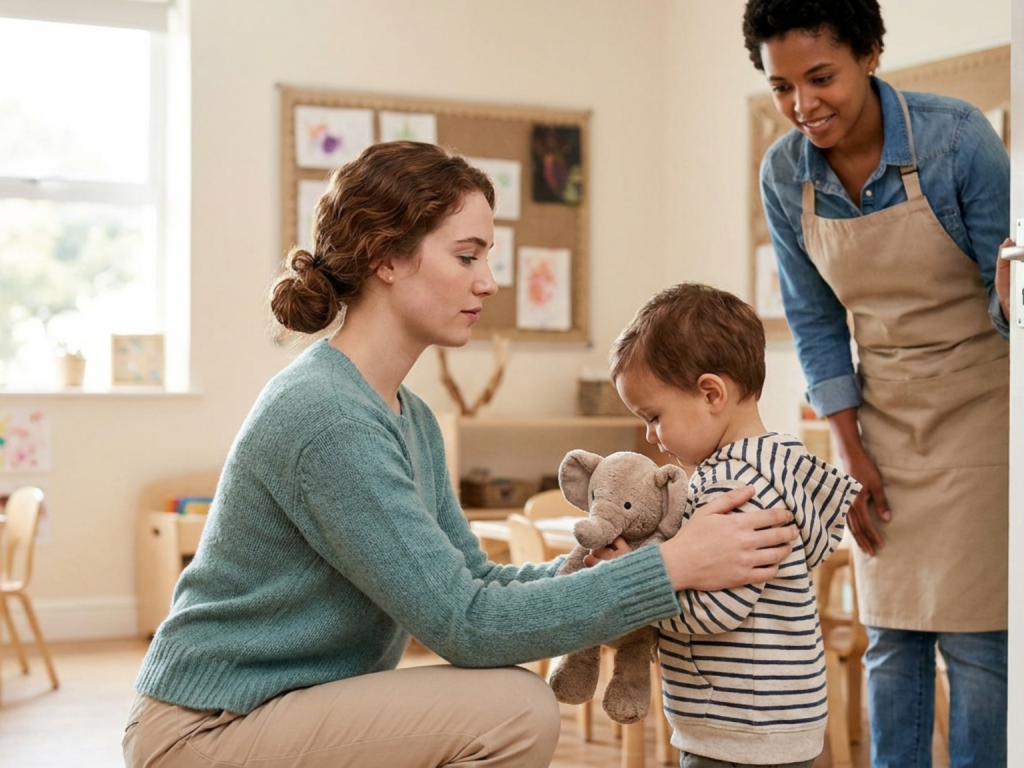
On the first days, calmly reintroduce the teacher and then step back so the teacher can begin building a relationship. A parent can say, “Ms. Lee will help you wash hands and find the blocks.” Then leave with confidence. If the child is crying, the teacher may hold a hand, offer a job, invite the child to feed the class pet, or guide them to a familiar activity.
Many children cry intensely for a few minutes and then settle. Ask the teacher for a brief update later rather than lingering at the doorway. Lingering can keep the child’s attachment system activated and delay engagement. If updates are available, a message such as “She cried for four minutes, then painted and ate snack” can help parents tolerate the next goodbye.
Responding to big feelings without escalating them
Validation is not the same as negotiation. A child can be heard and still go to school. Try concise emotion labeling: “You feel sad that I’m leaving. Goodbyes are hard. I will come back.” Long explanations often overwhelm a distressed preschooler, whose language-processing capacity may be reduced during sympathetic arousal.
Teach coping skills outside the drop-off moment, when the child is calm. Practice “smell the flower, blow the candle” breathing, squeezing a small soft toy, asking a teacher for help, or looking at the visual schedule. During distress, use the same simple cue: “Flower and candle. Teacher will help.”
After school, resist interrogating the child with many anxiety-focused questions. Instead, use open but grounded prompts: “Tell me one thing you played,” or “Who sat near you at snack?” Praise brave behavior specifically: “You were crying and still walked in with your teacher. That was brave.” This reinforces coping, not the absence of tears.
If a child says, “I don’t want to go back,” acknowledge the feeling before problem-solving: “You wish you could stay with me. You also have school tomorrow, and we will use our goodbye plan.” Predictable limits can feel containing when they are delivered with warmth.
Partner with teachers as co-regulators
Teachers are not just supervisors; in preschool they function as co-regulators. Share concise information that helps them support your child: preferred name, comfort strategies, toileting cues, sensory sensitivities, allergies, sleep needs, words the child uses for distress, and any recent family stressors such as a move or new sibling. You do not need to overshare, but relevant context prevents misinterpretation.
Ask the teacher what the arrival routine looks like and align your language with it. If the class starts with handwashing and table toys, rehearse that sequence at home. If the school uses songs, cubby photos, or visual cues, mirror those cues. Preschool transition strategies work best when home and school use similar scripts.
For children with intense drop-off reactions, create a brief plan with the teacher rather than improvising daily. The plan may include a greeting job, a specific activity, a comfort object location, and a parent update after the child settles. Keep the plan simple enough to repeat.
It is also reasonable to ask how long the child remains distressed, whether they participate later, eat, use the toilet, play near peers, or recover with adult help. Duration and recovery matter more clinically than the fact that crying occurs. A child who sobs for five minutes and then engages is different from a child who remains inconsolable for hours, refuses food and fluids, or appears persistently withdrawn.
When separation challenges need extra support
Most preschool adjustment improves over several weeks as routines become familiar and relationships strengthen. However, persistent or worsening distress deserves attention. Consider consulting a pediatrician, developmental-behavioral pediatrician, child psychologist, or licensed child therapist if anxiety remains severe beyond about 6 to 8 weeks, prevents participation, disrupts sleep or appetite, causes frequent somatic complaints such as abdominal pain or headaches, or leads to prolonged panic-like episodes at every separation.
Medical and developmental factors can contribute to difficult adjustment. Hearing or vision problems, language delay, autism spectrum differences, sensory processing differences, trauma exposure, chronic constipation, sleep-disordered breathing, and anxiety disorders can all affect how a child tolerates preschool. Mention any regression, loss of skills, aggressive behavior that is new or severe, or self-injurious behavior promptly to a healthcare professional.
Parents should also seek support for themselves if drop-off triggers intense guilt, panic, or conflict at home. A calm departure is easier when adults have a plan and emotional backup. Sometimes a different caregiver can handle drop-off temporarily if the child separates more easily from that person, but the goal remains secure adaptation, not avoidance.
If a preschool environment seems persistently unsafe, chaotic, punitive, or dismissive of distress, investigate rather than assuming the child is simply resistant. A good program should be willing to communicate, collaborate, and describe how staff comfort children. Adjustment is a shared process between child, family, and school.
A realistic timeline for progress
Adjustment rarely moves in a straight line. A child may do well for several days and then struggle after a weekend, illness, travel, holiday break, or a substitute teacher. Regression after an interruption is common and usually improves when the routine resumes. Parents can say, “Your body forgot the school rhythm for a few days. We will practice again.”
In the first week, success may mean entering the classroom with support. By weeks two to four, many children begin crying less intensely or recovering faster. By weeks four to eight, most are more familiar with the routine, though some still need a structured goodbye. Temperament matters: cautious, highly sensitive, or slow-to-warm children may need more repetition than novelty-seeking children.
Progress markers include shorter crying duration, accepting comfort from the teacher, participating in one activity, eating snack, using the toilet, naming classmates, and talking about school at home. These are signs that the child’s stress response is becoming more manageable.
The parent’s message should remain steady: “School is safe, feelings are allowed, your teacher helps you, and I come back.” Repeated with warmth and confidence, this message becomes the foundation for independence. The aim is not to rush maturity, but to scaffold it until the child can carry more of the routine internally.
When to seek professional guidance
- Separation distress persists or worsens beyond 6 to 8 weeks despite consistent support.
- Your child is inconsolable for long periods, refuses food or fluids, or cannot participate at preschool.
- There are panic-like episodes, frequent vomiting, headaches, abdominal pain, or sleep disruption linked to school.
- You notice developmental regression, loss of skills, self-injury, or severe new aggression.
- You suspect bullying, unsafe supervision, harsh discipline, or a poor fit with the preschool environment.
Tools & Assistance
- Create a picture-based morning and pickup schedule.
- Practice short separations with a trusted adult before preschool begins.
- Agree with the teacher on one brief goodbye routine and one settling activity.
- Use a small comfort item or family photo if the school permits it.
- Consult your pediatrician or a child mental health professional if anxiety is persistent or impairing.
FAQ
Is it normal for my child to cry every morning at preschool drop-off?
Yes, it can be normal, especially early on. The key questions are how long the crying lasts, whether your child recovers with teacher support, and whether they can participate during the day.
Should I stay in the classroom until my child stops crying?
Usually, a brief and predictable goodbye is more helpful. Lingering can prolong distress. Coordinate with the teacher so your child is immediately supported after you leave.
Is it harmful to leave when my child is upset?
Leaving after a loving, honest goodbye is not harmful when the setting is safe and caring. Repeated experiences of distress followed by comfort, play, and reunion help build trust.
Should I let my child bring a comfort object?
Often yes, if the preschool allows it and the object does not interfere with participation. A small item or family photo can bridge home and school.
When should I call the pediatrician?
Call if distress is severe, persists beyond several weeks, causes physical symptoms or sleep disruption, or if you have concerns about development, trauma, safety, or mental health.
Sources
- Nemours KidsHealth — Helping Your Child Adjust to Preschool
- Kreative Kids Academy — Conquering Separation Anxiety: Helping Your Child Adjust to Daycare
- Newport School — Helping Your Child Adjust to Preschool: Parent's Guide to a Smooth Transition
Disclaimer
This article is for general educational purposes and is not a medical diagnosis or treatment plan. Consult a pediatrician or qualified child mental health professional for persistent, severe, or concerning symptoms.















Please log in to leave a comment.