
Intro
Choosing a car seat can feel like a high-stakes decision, especially when your baby is growing quickly and every product label seems to use slightly different language. A convertible car seat is designed to support more than one stage of child passenger safety, usually beginning rear-facing and later converting to forward-facing use with a harness.
This guide explains what convertible car seats do, how they differ from infant seats and booster seats, and how to think about timing, fit, installation, and special medical considerations. The goal is to help you feel more confident while still encouraging individualized guidance from your pediatrician, a certified child passenger safety technician, and your vehicle and car seat manuals.
Highlights
A convertible car seat can be used rear-facing first and later forward-facing with a harness, depending on the child’s size and the seat’s limits.
Rear-facing positioning helps support the head, neck, and spine in a crash, which is especially important for infants and toddlers with proportionally large heads and developing cervical control.
The safest option is not simply the most expensive seat; it is a seat that fits your child, fits your vehicle, and can be used correctly every ride.
Children should stay within the height and weight limits printed by the manufacturer, and caregivers should avoid rushing transitions based on age alone.
What a convertible car seat is
A convertible car seat is a child restraint that can be installed rear-facing for younger children and later converted to forward-facing use with an internal five-point harness. Some models are called all-in-one or 3-in-1 seats because they may also become a belt-positioning booster seat later, but the defining feature of a standard convertible seat is its ability to serve both rear-facing and forward-facing stages.
Unlike many rear-facing-only infant seats, a convertible car seat usually stays installed in the vehicle rather than clicking in and out of a stroller base. It may be heavier and less portable, but it often has higher rear-facing weight and height limits. That can make it useful for families who want to keep a child rear-facing longer or who prefer to buy one seat that lasts across more developmental stages.
Convertible seats are used for newborns only if the seat’s minimum weight, harness position, and recline angle fit the baby correctly. Some newborns, especially small or premature infants, may not fit well in every convertible model. In those cases, an infant car seat may provide a better initial fit, but this depends on the individual child and product.
Why rear-facing matters physiologically
Rear-facing car seat safety is based on the way crash forces interact with a young child’s anatomy. Infants and toddlers have a relatively large head, immature cervical spine structures, and developing neck musculature. In a frontal crash, which is a common severe crash pattern, a rear-facing seat helps distribute force across the back of the child’s head, neck, and torso rather than allowing the head to move forward away from the body.
This does not mean a child will never be injured in a crash, but it explains why public health and pediatric guidance emphasize rear-facing use for as long as the child remains within the seat’s rear-facing height and weight limits. Age alone is not the best marker of readiness because children grow at different rates, and skeletal and neuromuscular development vary.
Parents sometimes worry that a toddler’s bent legs are unsafe or uncomfortable when rear-facing. In most cases, crossed or bent legs are expected and are not a reason by themselves to turn the child forward-facing. The more important concerns are whether the child remains within the manufacturer’s limits, whether the harness fits correctly, and whether the seat is installed at the proper angle and location in the vehicle.
Convertible seat versus infant seat versus booster
An infant car seat is typically rear-facing only, often used from birth, and commonly attaches to a removable base. It can be convenient for transporting a sleeping baby outside the car, although car seats should not be used as routine sleep spaces outside travel. A convertible seat may work from birth for some babies, but it is usually less convenient to carry and may require more attention to newborn fit.
A forward-facing harness seat is used after a child outgrows rear-facing limits and is ready to face forward while still needing a five-point harness. Many convertible seats perform this role after conversion. The harness restrains the shoulders, hips, and crotch area, spreading crash forces over stronger parts of the body.
A belt-positioning booster seat is different. It does not have an internal harness in typical use; instead, it positions the vehicle’s lap and shoulder belt across the child’s body. A booster is for older children who have outgrown a forward-facing harness and can sit upright for the entire ride. Moving to a booster too early can place the belt across the abdomen or neck, increasing the risk of injury.
In short, convertible seats bridge two major stages: rear-facing and forward-facing harness use. They are not a substitute for checking your child’s current measurements, maturity, and the precise labeling on the seat.
How to choose a convertible car seat
The best convertible car seat is one that fits your child, fits your vehicle, and can be used correctly every time. Price, padding, cup holders, and brand reputation may influence preference, but they do not replace correct use. Seats sold through regulated markets must meet applicable safety standards, yet real-world protection depends heavily on installation and harness fit.
When comparing models, look closely at:
- Rear-facing limits: Higher rear-facing height or weight limits may allow longer rear-facing use.
- Newborn fit: If using from birth, confirm the minimum weight, lowest harness slot position, and any required infant insert instructions.
- Vehicle fit: A seat may be safe in general but too large front-to-back for a small vehicle or difficult to install securely in a specific seating position.
- Ease of adjustment: A harness and headrest that are simple to adjust may reduce misuse as your child grows.
- Caregiver needs: Consider whether grandparents, childcare providers, or co-parents can install and tighten it correctly.
Also check the car seat expiration date, crash replacement policy, and whether the seat has been recalled. Avoid using a secondhand seat unless you know its full history, including crashes, missing parts, cleaning methods, and expiration status.
Installation and harness fit basics
Correct installation is as important as choosing the right category of seat. Convertible seats may be installed with either the vehicle seat belt or the lower anchors, depending on the child’s weight, the seat’s instructions, and the vehicle manual. Using both systems together is not allowed unless both manuals specifically permit it. Once installed, the seat should move less than 1 inch side-to-side or front-to-back when checked at the belt path.
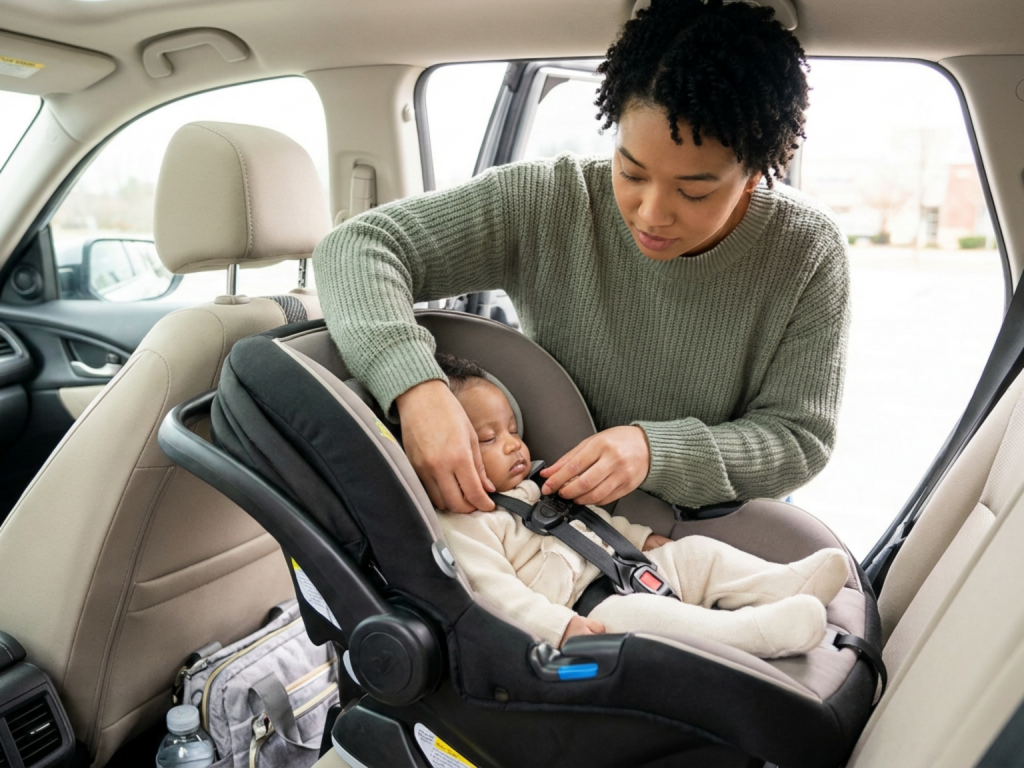
For rear-facing use, pay close attention to the car seat recline angle. Newborns and young infants need a recline that helps keep the airway open and reduces chin-to-chest flexion. Older babies with better head control may be allowed a more upright angle if the manufacturer permits it. If a baby has a history of prematurity, hypotonia, craniofacial differences, respiratory disease, or difficulty maintaining oxygenation, discuss car travel positioning with the baby’s clinician.
Harness fit should be checked before every ride. Rear-facing harness straps usually come from at or below the shoulders, while forward-facing harness straps usually come from at or above the shoulders; always follow your manual. The chest clip at armpit level helps position the harness correctly on the torso. After tightening, you should not be able to pinch excess harness webbing at the collarbone area. Bulky coats or thick bunting under the harness can create dangerous slack, so use thin layers and place blankets over the secured harness if needed.
When to convert from rear-facing to forward-facing
Families often ask for a precise age to turn a convertible car seat forward-facing. A more useful approach is to follow the rear-facing car seat limits set by the manufacturer. Many children can remain rear-facing beyond their second birthday, and guidance supports keeping them rear-facing as long as they fit within those limits.
You may need to convert when your child exceeds the rear-facing weight limit, the height limit, or another stated fit rule such as head position relative to the shell. Do not rely only on clothing size, age, or whether the child’s feet touch the vehicle seat back. If the manual says the child has outgrown rear-facing use, then it is time to use the seat forward-facing if the child also meets the forward-facing minimum requirements.
When converting, reroute the belt through the forward-facing belt path, adjust the harness height, set the seat angle as required, and attach the top tether if your vehicle has a tether anchor. The top tether for forward-facing seats is a major safety feature because it helps limit forward motion of the child’s head and upper body during a crash. Many installation errors happen during this transition, so it is a good moment to request a check from a certified child passenger safety technician.
Special medical and practical considerations
Some babies need additional assessment before routine travel. Premature infants, low-birth-weight infants, and babies with certain cardiopulmonary, neuromuscular, or airway conditions may have difficulty maintaining safe oxygen saturation or airway positioning in a semi-reclined seat. Hospitals may recommend car seat tolerance screening for selected infants, but practices vary. If your baby has medical complexity, ask the clinical team what travel position is appropriate and whether a standard convertible seat is suitable.
Feeding, reflux, recent surgery, bracing, casts, or medical devices can also affect positioning. Do not modify a car seat, add unapproved padding, cut straps, or use aftermarket inserts unless they came with the seat or are specifically approved by the manufacturer. Even well-intended modifications can alter crash performance.
Daily life matters too. A correctly used seat is one that caregivers can manage when tired, rushed, or juggling siblings. Keep the manual accessible, register the seat for recall notices, and practice adjusting the harness as your child grows. If rides involve taxis, rideshares, or multiple vehicles, plan ahead so the seat can be installed securely each time rather than relying on improvisation.
Common mistakes to avoid
Convertible car seats are highly effective when used correctly, but misuse is common. The most frequent problems include a loose installation, loose harness, wrong harness height, incorrect recline, premature forward-facing transition, and failure to use the tether in forward-facing mode. These errors are understandable; manuals can be dense, vehicles differ, and growth changes happen quickly.
A practical routine can reduce risk. Before driving, check that the seat is locked in place at the belt path, the harness is snug, the chest clip is at armpit level, and there are no bulky layers under the straps. Review the height and weight limits at well-child visits or whenever you notice a growth spurt. If you move the seat, wash the cover, change vehicles, or convert modes, treat it as a new installation and recheck everything.
Finally, remember that the back seat is the safest location for children in most circumstances, and children should not ride in front of an active passenger air bag. If your vehicle has unusual seating, no back seat, or limited tether anchors, consult the vehicle manual and seek individualized help rather than guessing.
Safety cautions
- Do not turn a child forward-facing before they meet the seat’s stated requirements and have outgrown rear-facing limits.
- Do not place a rear-facing car seat in front of an active passenger air bag.
- Do not use bulky coats, thick blankets, or aftermarket inserts under the harness.
- Do not use a car seat after a significant crash unless the manufacturer and safety guidance indicate it is acceptable.
- Seek medical guidance for premature infants or babies with airway, respiratory, neurologic, or cardiac concerns.
Tools & Assistance
- Schedule a car seat check with a certified child passenger safety technician
- Read both the car seat manual and the vehicle owner’s manual before installation
- Register the car seat with the manufacturer for recall notifications
- Use the manufacturer’s height, weight, and fit labels to track when a mode is outgrown
- Ask your pediatrician about travel positioning if your baby has medical complexity
FAQ
Can a newborn use a convertible car seat?
Sometimes. The seat must allow the baby’s weight and height, the harness must fit correctly, and the recline must support the airway. Small or premature infants may need a different option or medical guidance.
Are convertible car seats safer than infant car seats?
Not automatically. Both can be safe when appropriate for the child and installed correctly. The safer choice is the one that fits the child, the vehicle, and the caregiver’s ability to use it properly.
When should I turn my child forward-facing?
Use the seat rear-facing until your child reaches the rear-facing height or weight limit, or another outgrown rule in the manual. Avoid switching based on age alone.
Can I install a convertible seat with both lower anchors and the seat belt?
Usually no. Use one approved installation method unless both the car seat manual and vehicle manual clearly allow using both together.
Do I need a professional car seat check?
It is strongly helpful, especially for first installation, switching modes, premature infants, or complex vehicles. A certified technician can teach you how to install and adjust the seat correctly.
Sources
- Centers for Disease Control and Prevention — Child Passenger Safety: Get the Facts
- American Academy of Pediatrics — Car Seats: Information for Families
- National Highway Traffic Safety Administration — Car Seats and Booster Seats
Disclaimer
This article is for general educational purposes only and does not replace medical advice or individualized child passenger safety guidance. Consult your pediatrician and a certified child passenger safety technician for concerns about your child’s health, positioning, or car seat use.














Please log in to leave a comment.