
Intro
Traveling with a baby can be joyful, exhausting, and logistically complicated all at once. Hotel sleep is one of the biggest worries for many caregivers because the environment is unfamiliar, the equipment may vary, and everyone may be more tired than usual.
The reassuring news is that safe sleep in a hotel is usually possible with planning, a careful room check, and a willingness to say no to unsafe substitutes. The core principles are the same as at home: a baby should sleep on the back, on a firm and flat surface, in a separate sleep space, without loose bedding or soft objects.
Highlights
Hotel sleep safety depends less on the brand of equipment and more on whether the baby has a firm, flat, separate sleep surface with no soft bedding.
Call ahead, ask specific questions about cribs or play yards, and bring a backup plan if possible.
Avoid improvised sleep locations such as adult beds, couches, armchairs, pillows, car seats outside the car, and makeshift nests.
Keep routines familiar, but do not let convenience override safe sleep practices.
Why hotel sleep needs extra planning
Safe sleep guidance can feel harder to follow when you are away from home. A hotel room may have unfamiliar furniture, heavy bedding, tight floor space, bright hallway light, or a crib that is not the same as the one your baby uses every night. You may also be managing late check-in, time zone changes, feeding schedules, and caregiver fatigue. None of that means you are doing anything wrong; it means the sleep environment deserves deliberate attention.
The safest hotel setup is built around the same physiologic risk-reduction principles used at home. Infants should be placed supine, meaning on the back, for every sleep. They should sleep on a firm, flat infant sleep surface that does not indent deeply under the baby’s weight. The sleep space should be separate from adult sleep spaces, even when room-sharing. It should be free of pillows, quilts, loose blankets, stuffed toys, bumpers, sleep positioners, and other soft or weighted items.
These recommendations are designed to reduce the risk of sleep-related infant deaths, including suffocation, entrapment, and sudden unexpected infant death. Travel does not change a baby’s airway anatomy or arousal physiology. In fact, travel can increase the temptation to use unsafe workarounds because caregivers are tired and routines are disrupted. Planning ahead is not about perfection; it is about making the safer choice easier when everyone is worn out.
Call the hotel before you arrive
Before booking, call the hotel directly rather than relying only on a website checkbox. Ask whether they provide cribs, portable cribs, or play yards, and whether availability can be guaranteed or is first-come, first-served. Many hotels use the word crib loosely, so clarify what the sleep product actually is. A pack-and-play may be acceptable if it is intact, assembled according to the manufacturer’s instructions, and used with its original firm mattress or pad.
Useful questions include whether the sleep space has a tight-fitting sheet, whether the equipment has been recalled, whether staff assemble it or leave it for guests, and whether it has any broken parts, sagging mesh, missing hardware, or added padding. If the staff cannot answer, that does not automatically mean the item is unsafe, but it does mean you should inspect it yourself on arrival.
If your baby is very young, was born preterm, has a medical condition affecting breathing, muscle tone, feeding, or airway protection, or uses medical equipment, consider discussing travel sleep plans with your pediatric clinician before the trip. Clinicians cannot inspect a hotel crib for you, but they can help you think through your baby’s individual risk factors and whether travel timing, altitude, long drives, or disrupted feeding plans require extra caution.
Inspect the crib, play yard, or portable sleep space
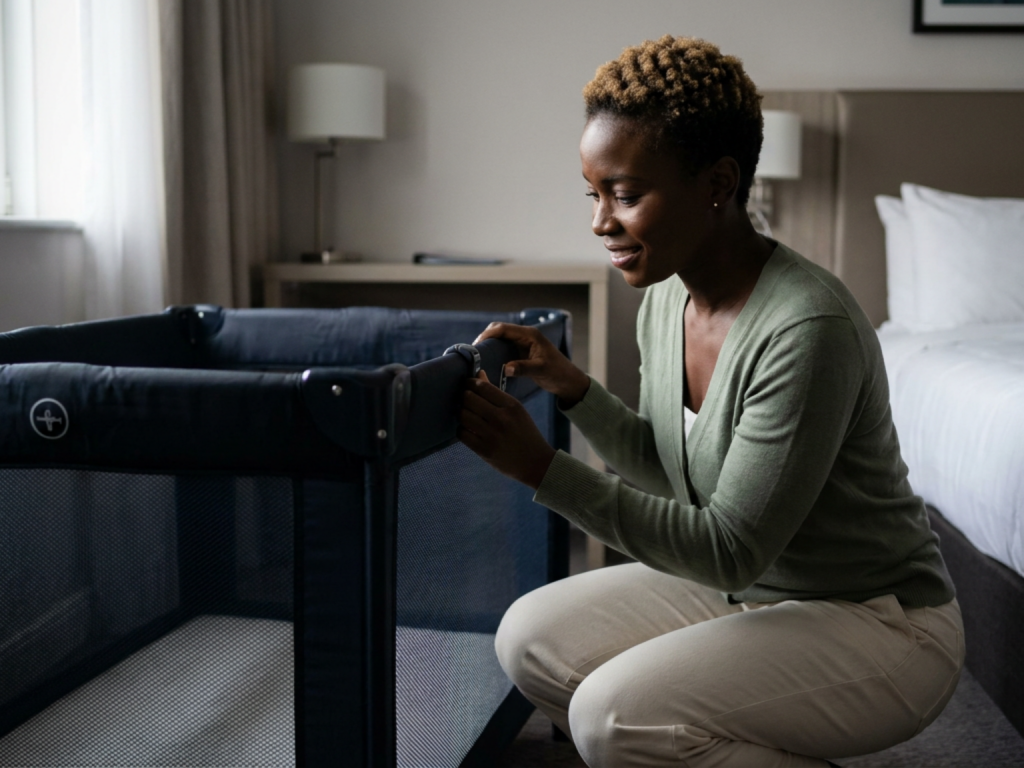
When you enter the room, check the sleep space before bedtime, not when the baby is already crying and everyone is exhausted. The surface should be firm and flat, with no slope or soft padding. The mattress or pad should fit snugly, leaving no gaps where a baby could become trapped. The sheet should fit tightly and should not bunch up around the baby’s face.
Look for structural problems. The frame should lock securely. Mesh sides should be intact without tears or loose threads. Wooden slats, if present, should not be broken or widely spaced. There should be no loose screws, sharp edges, unstable legs, or collapsing rails. Do not use a crib or play yard that seems damaged, unstable, or incorrectly assembled.
Resist adding anything to make the surface feel more comfortable. Adult comfort standards are not infant safety standards. Extra blankets, folded towels, mattress toppers, nursing pillows, and soft pads can create suffocation or entrapment hazards. Infant sleep positioners are also not a safe solution for hotel sleep, including for babies with reflux concerns, unless a specific medical device has been prescribed and supervised by a healthcare professional.
If the hotel provides only a bare play yard pad and a fitted sheet, that may look minimal, but minimal is usually the goal. A separate infant sleep surface should look relatively empty. The baby can wear appropriate sleep clothing or a non-weighted sleep sack if you use one at home and it fits correctly.
What to do if the hotel does not have a crib
It is stressful to arrive and discover that the promised crib is unavailable. Try to avoid last-minute improvisation. If your baby still needs an infant sleep space, the best backup is often a portable crib, travel crib, or play yard that you bring yourself and know how to assemble safely. Practice setting it up before the trip, and bring the original sheet designed for that model.
If you cannot bring your own, ask whether the hotel can contact a nearby partner property, baby gear rental company, or local service that provides current, clean, safety-compliant infant sleep equipment. If you use a rental service, request the exact type of product and inspect it carefully. Cleanliness matters, but structural safety matters more.
Avoid using an adult bed as a substitute. Hotel beds often have soft mattresses, thick duvets, pillows, gaps near headboards, and spaces beside walls or furniture where entrapment can occur. Couches and armchairs are especially hazardous for infant sleep because a baby can roll into cushions or become wedged beside a caregiver. A drawer, laundry basket, or padded suitcase is not a reliable safe sleep space unless it is a regulated infant sleep product designed for that purpose, which these items are not.
If no safe option is available, it may be safer to change hotels, delay bedtime briefly while locating equipment, or adjust travel plans rather than rely on an unsafe sleep surface. That can feel frustrating and expensive, but it is a reasonable safety decision.
Manage bedding, temperature, and clothing
Hotel rooms often run hot, cold, or inconsistently because of individual heating and cooling units. Overheating during infant sleep is a recognized concern, so aim for a comfortable room temperature for a lightly clothed adult rather than making the room very warm. Check your baby’s chest or back of the neck rather than hands or feet, which may feel cool even when core temperature is adequate.
Use sleep clothing appropriate for the room. A wearable blanket or non-weighted sleep sack can be helpful if it is the correct size and does not cover the face. Avoid weighted sleep products, loose blankets, hats indoors during sleep, and multiple heavy layers unless a clinician has given specific instructions for a medical reason.
Keep hotel bedding away from the baby’s sleep area. Adult pillows, duvets, decorative cushions, and spare blankets should be moved to a closet, high shelf, or another area where they cannot fall into the crib or play yard. If the crib is placed near an adult bed, make sure bedding cannot drape into the baby’s space.
Also check cords and nearby hazards. Move the sleep space away from window blind cords, curtain ties, lamps, chargers, plastic bags, housekeeping supplies, and furniture edges. If the room is small, it is better to rearrange movable furniture than to place the baby near strangulation or entrapment hazards.
Room-sharing without bed-sharing in a hotel
Room-sharing without bed-sharing is often the most practical hotel arrangement. Place the baby’s crib, travel crib, or play yard close enough that you can hear and respond, but not so close that adult bedding, pillows, or your body could enter the baby’s sleep space. This setup supports feeding and comforting while preserving a separate sleep environment.
Feeding at night requires extra attention during travel because caregivers may be more sleep-deprived than usual. If you bring the baby into bed for feeding, try to plan how you will stay awake and return the baby to the separate sleep space afterward. Sitting on a couch or armchair when extremely drowsy can be particularly risky if you fall asleep holding the baby.
If two caregivers are traveling, consider assigning roles for night feeds, diaper changes, and equipment checks. A quick verbal routine can help: baby on back, surface clear, sheet tight, room comfortable, cords away. Repetition may feel excessive, but it reduces errors when sleep pressure is high.
Some families worry that a baby will protest sleeping in an unfamiliar travel crib. That is common. Soothing, feeding, rocking, and comforting are all compatible with safe sleep, as long as the baby is placed back in the safe sleep space for sleep. Familiar cues such as a usual sleep sack, bedtime song, or white noise machine at a safe volume may help preserve routine without adding hazards.
Car seats, strollers, and transit naps
Travel often involves naps in car seats or strollers. Car seats are essential for safe vehicle travel, and many babies fall asleep in them. The key distinction is that a car seat is designed for crash protection in a vehicle, not routine sleep outside the car. When the drive is over, move the baby to a firm, flat sleep surface as soon as practical, especially for young infants.
In sitting devices, a baby’s head can flex forward, which may affect airway position, particularly in younger infants or babies with low muscle tone, prematurity, respiratory illness, or other medical vulnerabilities. Straps, angles, and padding also differ when a car seat is placed on a hotel floor compared with being installed correctly in a vehicle.
During long drives, plan breaks for feeding, diapering, and checking your baby’s position. Keep the harness correctly fitted while in the car seat, and avoid adding aftermarket head supports, strap covers, or padding unless approved by the car seat manufacturer. Once at the hotel, do not leave the baby sleeping overnight in the car seat, stroller, swing, or bouncer.
If your trip involves significant transit, build the day around realistic sleep needs. A slightly inconvenient stop to transfer the baby to a safer sleep space is preferable to stretching an unsafe nap because everyone is tired.
Preserve routine while staying safety-focused
Babies often sleep better when the hotel bedtime resembles home. A predictable sequence such as feeding, diaper change, sleep clothing, dim lights, song, and crib can cue sleep even in a new setting. If your baby uses a pacifier, you can offer it for sleep if appropriate for your child; do not attach it to strings, clips, or stuffed toys in the sleep space.
Light and noise control can help. Portable blackout shades, painter’s tape used safely away from the crib, or placing the crib in a darker part of the room may reduce early waking. A white noise machine or app can mask hallway sounds, but keep the volume moderate and the device away from the baby’s head and out of reach of cords.
Safe sleep products for babies are sometimes marketed as travel solutions, but not every convenient item is safe for unsupervised sleep. Be cautious with loungers, inclined sleepers, padded nests, in-bed sleepers, and products that promise reflux relief or longer stretches. A safe infant sleep product should meet applicable safety standards and still follow the basic rule: back, firm, flat, separate, and clear.
Finally, give yourself compassion. Hotel nights may be fragmented. Your baby may wake more often. You may need to comfort more than usual. Safe sleep does not require a perfect vacation sleep schedule; it requires returning to the safest available sleep setup every time the baby sleeps.
Safety warnings for hotel baby sleep
- Do not place a baby to sleep on an adult hotel bed, couch, armchair, pillow, or soft bedding.
- Do not add extra padding, blankets, towels, or mattress toppers to a crib or play yard.
- Do not use damaged, unstable, recalled, or incorrectly assembled hotel sleep equipment.
- Do not leave a baby sleeping routinely in a car seat, stroller, swing, or bouncer once travel has ended.
- Seek medical advice before travel if your baby was born preterm or has breathing, feeding, neuromuscular, or airway concerns.
Tools & Assistance
- Call the hotel before booking and confirm the exact infant sleep equipment available.
- Pack a familiar travel crib or play yard if you cannot guarantee a safe hotel option.
- Bring a fitted sheet designed for your own portable crib model.
- Use a brief room safety checklist before every sleep period.
- Ask your pediatric clinician for individualized travel guidance if your baby has medical risk factors.
FAQ
Is a hotel pack-and-play safe for a baby to sleep in?
It can be safe if it is intact, correctly assembled, has its original firm flat pad, uses a tight-fitting sheet, and contains no loose bedding or soft objects.
Can my baby sleep in the hotel bed with me just for one night?
An adult hotel bed is not recommended for infant sleep because of soft bedding, pillows, gaps, and entrapment risks. A separate infant sleep surface is safer.
What if my baby only falls asleep in the car seat after a long trip?
Use the car seat for travel, but once you arrive, move the baby to a firm, flat sleep surface as soon as practical. Ask your clinician for advice if your baby has medical vulnerabilities.
Should I bring my own travel crib?
Bringing your own travel crib can reduce uncertainty, especially if the hotel cannot guarantee equipment. Practice assembly at home and use only the manufacturer-approved mattress or pad.
Can I use blankets if the hotel room is cold?
Loose blankets are not recommended in an infant sleep space. Consider appropriate sleep clothing or a correctly sized non-weighted sleep sack, and adjust the room temperature if possible.
Sources
- Consumer Reports — What to Do When Your Hotel Doesn't Have a Crib for Your Baby
- Premier Health — 10 Tips For Baby's Safe Sleep On the Road
- Taking Cara Babies — My Top 5 Sleep Tips for Traveling With a Baby
Disclaimer
This article is for informational purposes only and does not replace medical advice. Consult your pediatric clinician for guidance specific to your baby, especially if your child was born preterm or has medical concerns.













Please log in to leave a comment.