
Intro
Movement during birth is not about performing perfectly or staying active at all costs. It is about using position, rhythm, support, and rest to help the body respond to labor pain in a way that feels safer and more manageable.
For a medically literate reader, it may help to think of position changes as a practical interface between physiology and comfort: they can alter pelvic dimensions, redistribute mechanical load, reduce muscle guarding, change sensory input, and support coping. They should always be adapted to the birthing person’s clinical situation, fetal status, mobility, medications, and guidance from the care team.
Highlights
Movement can sometimes reduce pain by changing mechanical load, decreasing muscle guarding, and adding non-pain sensory input.
There is no single best labor position. A useful position is one that improves coping, protects safety, and can be changed when it stops helping.
Support people can help with balance, counterpressure, reminders to hydrate, and position transitions, but touch and movement should remain consent-based.
Monitoring, epidural analgesia, IV lines, fatigue, or medical complications may limit movement, but supported position changes are often still possible with clinical help.
Why movement can change pain perception
Labor pain is complex. It is shaped by uterine contractions, cervical dilation, pelvic floor stretch, tissue ischemia, inflammatory signaling, fetal descent, fear, fatigue, and the way the nervous system interprets threat. Position changes cannot remove all of that physiology, and they are not a substitute for clinical assessment. They can, however, change the context in which pain is processed.
One useful concept is movement-evoked pain, meaning pain that increases or changes with activity. Evidence from musculoskeletal pain research shows that guided exercise therapy can reduce movement-evoked pain compared with no treatment. Birth is not the same as chronic musculoskeletal pain, but the principle is relevant: carefully chosen, supported movement can sometimes reduce pain amplification rather than worsen it.
Movement may help by distributing pressure across different joints and soft tissues, reducing sustained compression in one area, and interrupting involuntary bracing. It may also provide proprioceptive and cutaneous input, which can compete with or modulate pain signals. A person who feels trapped on their back may experience more fear and muscle tension; a person who can rock, lean, or shift weight may feel more agency, even if contractions remain intense.
Changing positions during contractions
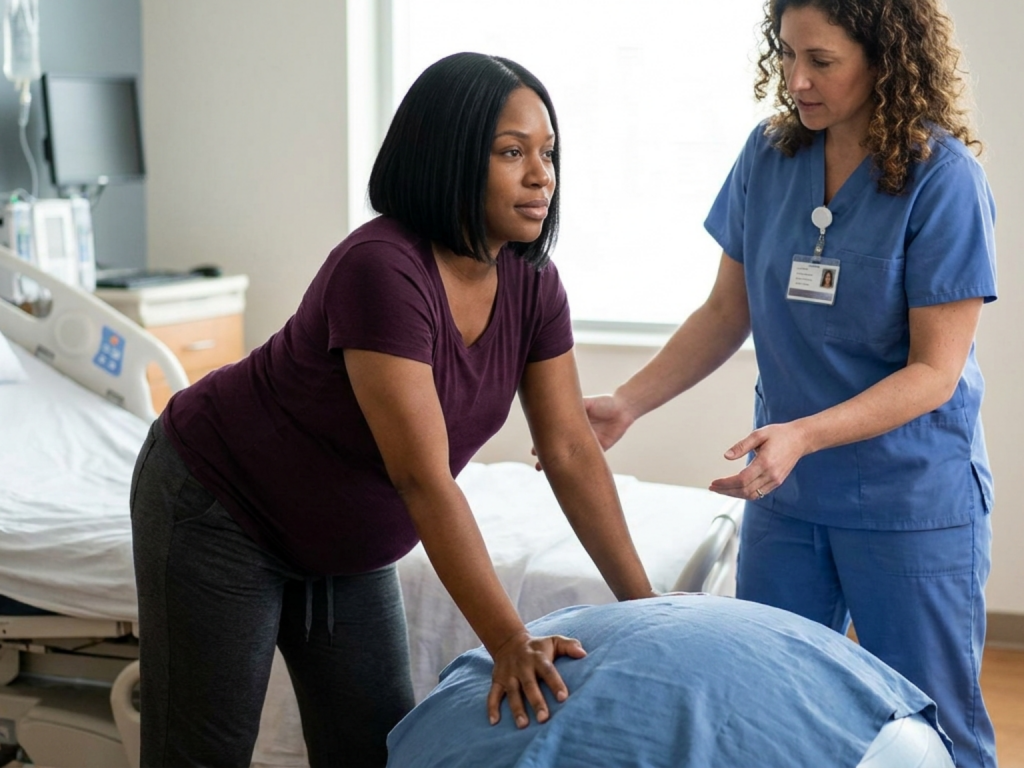
Changing positions during contractions is most useful when it is simple, repeatable, and responsive to the body’s cues. During early labor, some people prefer walking, slow stair climbing, swaying, pelvic rocking, or leaning over a counter. In active labor, smaller shifts may be more realistic: turning from one side to the other, leaning forward over a raised bed, kneeling with support, or sitting on a birth ball with steady assistance.
Upright positions in labor may feel helpful because they allow gravity-assisted descent and reduce the sense of being pinned in place. Forward-leaning labor positions can reduce pressure on the lower back for some people, especially when the abdomen is supported and the shoulders can soften. A side-lying position during contractions may be better when fatigue, nausea, epidural analgesia, or fetal monitoring makes upright movement impractical.
A practical approach is to try one position for several contractions, then reassess. Useful signs include easier breathing between contractions, less panic, less localized back or hip pain, and a sense that the pelvis can release. If a position increases dizziness, sharp pain, numbness, shortness of breath, or distress, it should be stopped and the care team should be notified.
Pelvic mechanics and fetal position
Labor pain is often described as abdominal cramping, but pelvic mechanics matter. The sacrum, sacroiliac joints, pubic symphysis, pelvic floor, and hip rotators all participate in how pressure is felt. When the fetal head presses strongly against the sacrum or when the fetal position creates more posterior pressure, contractions may be felt as intense low back or rectal pain.
The hands-and-knees position for back labor can be useful because it unloads the sacrum, allows the abdomen to hang forward, and may reduce direct posterior pressure. Some people also find relief with asymmetrical positions, such as one foot on a low stool while leaning forward, because asymmetry can change pelvic inlet and outlet relationships. These positions should be supervised if balance is poor, membranes are ruptured with mobility restrictions, or there are concerns about fetal monitoring.
Sacral counterpressure during contractions can be paired with movement. A support person, nurse, doula, or partner may apply firm, steady pressure to the sacrum or hips while the birthing person leans forward, kneels, or rests on hands and knees. This should be guided by the birthing person’s feedback; too much pressure, the wrong location, or touch without consent can increase distress rather than relieve it.
Combining rest, support, and touch
Movement works best when it is balanced with rest. Labor can last many hours, and constant activity may lead to exhaustion. Alternating active positions with restorative positions can preserve energy while still preventing prolonged pressure in one posture. For example, a person might walk or sway for several contractions, then rest in side-lying positions with pillows between the knees, then return to supported sitting or kneeling.
Partner support during labor pain can make position changes safer and more effective. Support people can stabilize the shoulders during a squat, hold a hand during a slow turn, adjust pillows, offer fluids, apply warm packs if approved, or remind the birthing person to unclench the jaw and hands. In supportive and palliative pain care more broadly, positioning and movement are recognized as accessible comfort measures that caregivers and family members can help provide.
Touch-based strategies should remain specific and reversible. Effleurage, hip squeezes, sacral pressure, massage, warm compresses, or shower water may feel helpful during one phase and intolerable later. The birthing person should be able to say stop, lighter, firmer, higher, lower, or no touch without needing to explain. Pain relief in birth is dynamic; a good support plan changes with the contraction pattern, cervical progress, fatigue, and emotional state.
Movement with monitoring, epidural, or fatigue
Safe movement during fetal monitoring depends on the clinical context and the equipment available. Some units use wireless monitoring or intermittent auscultation for appropriate low-risk situations; others require continuous external or internal monitoring. Even with monitors, movement may still be possible through standing at the bedside, rocking in a chair, leaning over the bed, side-lying, or using a peanut ball. The nurse or midwife can usually help protect signal quality while preserving as much mobility as the situation allows.
Position changes after epidural analgesia require extra caution. Epidural medication can reduce pain but may also affect motor strength, proprioception, blood pressure, and the ability to stand safely. Walking is not appropriate for many people after epidural placement, but assisted bed-based position changes can still matter. Side-to-side rotation, supported sitting, a throne position, lateral release with pillows, or a peanut ball may reduce pressure points and support fetal descent while maintaining fall precautions.
Fatigue is also a clinical variable. A position that helped at 4 centimeters may be unrealistic at 8 centimeters. Shaking, nausea, rectal pressure, or transition-phase intensity can make fine instructions hard to follow. At that point, the goal is not performance; it is safety, oxygenation, hydration, reassurance, and manageable choices. If movement no longer helps, pharmacologic analgesia, anesthesia consultation, or other medical options can be appropriate and compassionate.
Building a flexible pain-relief plan
A useful birth plan does not need to predict the perfect position. It can simply state that the person would like freedom of movement when clinically appropriate, help changing positions, support for hands-and-knees or forward-leaning options, and reminders to reassess comfort regularly. It can also name preferences about touch, counterpressure, shower use, birth ball use, and when to discuss medical pain relief.
Practice can help before labor, especially for people with pelvic girdle pain, hypermobility, prior injury, neurologic conditions, high BMI, or balance concerns. Prenatal physical therapy, childbirth education, or a consultation with the birth team can identify positions that are realistic and positions that should be avoided. The goal is not to train for endurance; it is to create familiar options so the body is not asked to learn everything during intense pain.
During labor, the most helpful question is often: what changed after the last position change? If breathing became easier, pelvic pressure felt more productive, or fear decreased, the position may be worth repeating. If pain became sharp, localized, or alarming, it should be abandoned and assessed. Movement during natural childbirth and medicated birth can both be valid. The safest plan is flexible, clinically supervised, and centered on the birthing person’s real-time feedback.
When to get clinical help
- Stop moving and call the care team for dizziness, faintness, chest pain, severe shortness of breath, or sudden weakness.
- Do not walk or stand without explicit help after epidural analgesia or if leg strength feels reduced.
- Ask before using deep squats, lunges, or hands-and-knees positions if there are fetal monitoring concerns, bleeding, severe hypertension, or mobility restrictions.
- Report sharp, focal, unusual pain rather than assuming it is normal contraction pain.
- Seek urgent guidance for heavy bleeding, fever, severe headache, vision changes, or concerns about fetal movement before labor is established.
Tools & Assistance
- Discuss mobility preferences with an obstetric clinician or midwife before labor.
- Ask a nurse, doula, or physical therapist to demonstrate safe position transitions.
- Use a birth ball, peanut ball, pillows, shower, or warm pack only when approved for the clinical setting.
- Create a short birth preference note describing movement, touch, and pain-relief preferences.
- Reassess pain, fatigue, fetal monitoring needs, and fall risk throughout labor.
FAQ
Is movement during labor always better than lying down?
No. Movement can help some people, but rest, side-lying, or bed-based positions may be safer or more relieving depending on fatigue, fetal monitoring, epidural use, and clinical status.
How often should positions be changed?
There is no fixed schedule. Many people reassess every few contractions or whenever pain, pressure, fatigue, or fetal monitoring needs change.
Can I still change positions after an epidural?
Often yes, but usually with assistance and fall precautions. Bed-based turning, supported sitting, side-lying, and peanut ball positioning may be options.
What if movement makes pain worse?
Stop that movement and ask for clinical guidance. Pain that becomes sharp, focal, alarming, or associated with dizziness or weakness should be assessed.
Sources
- PubMed / National Library of Medicine — It Hurts to Move! Intervention Effects and Assessment Methods for Movement-Evoked Pain in Patients With Musculoskeletal Pain: A Systematic Review with Meta-analysis
- Mayo Clinic — Exercise helps ease arthritis pain and stiffness
- PubMed / National Library of Medicine — Pain relief using cutaneous modalities, positioning, and movement
Disclaimer
This article is for general medical education and does not diagnose, treat, or replace care from an obstetric clinician, midwife, anesthesiologist, physical therapist, or other qualified professional. Always follow individualized medical advice during pregnancy and birth.
















Please log in to leave a comment.