
Intro
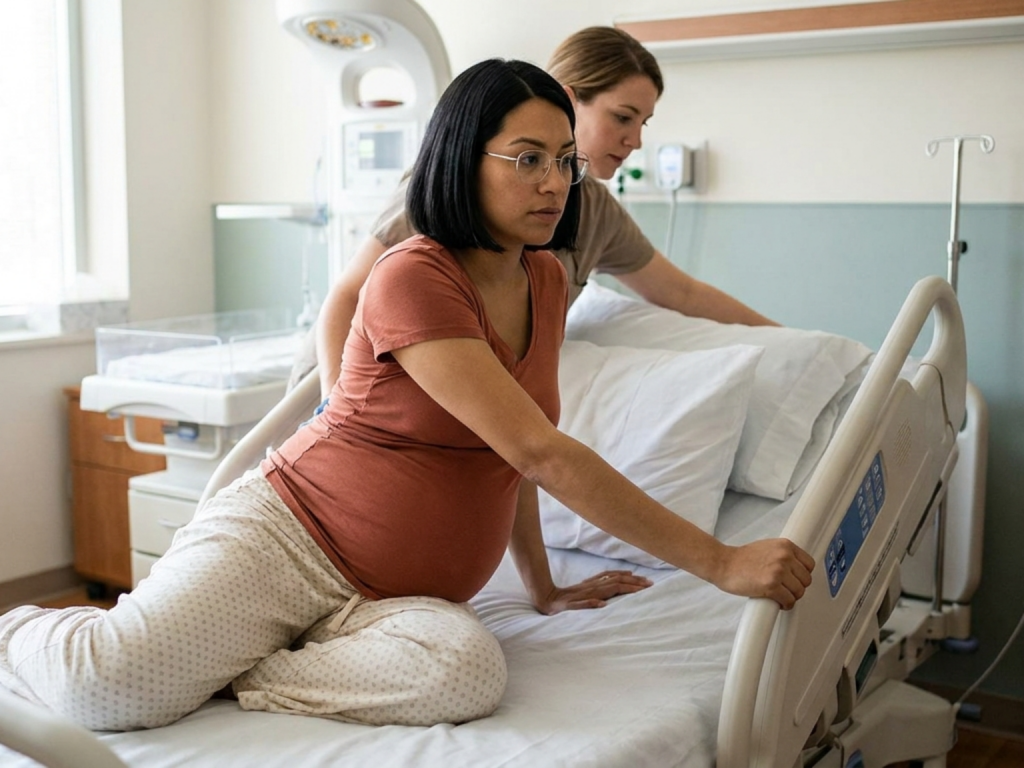
Changing position in labor is usually less about following a fixed schedule and more about responding to what your body, your baby, and your care team are telling you. A posture that feels useful at the start of a contraction can become ineffective, exhausting, or simply intolerable an hour later. That does not mean anything is wrong; it often means labor has moved into a different phase and your body needs a different mechanical advantage.
For many people, the question is not whether to move, but when a change is likely to improve comfort, pelvic mechanics, rest, or monitoring. In low-risk labor, mobility and upright posture are commonly encouraged, and if you do not have epidural analgesia, comfort is a reasonable guide. The key is to treat position as a clinical and sensory tool, not as a test of endurance.
Highlights
There is no single correct labor position, and many people benefit from changing positions repeatedly as labor evolves.
A position change is often useful when pain localizes, fatigue builds, contractions feel less productive, or a posture no longer feels sustainable.
Upright positions can support movement and gravity, while side-lying positions can help a person rest and recover between contractions.
If you have epidural analgesia or continuous fetal monitoring, position changes may still be possible, but they often need staff help and a little more planning.
The simplest rule: change when the current position stops helping
There is no universal timetable for labor positioning. The most practical rule is to change when the current position stops supporting the work of labor or stops supporting you. That might mean you feel more pain, more fatigue, more pressure, or less sense of control. It can also mean that contractions are becoming harder to manage in a posture that once felt fine. Labor is dynamic, so a position that is comfortable in early labor may be the wrong fit during active labor or pushing.
For low-risk labor, upright positions during labor are often reasonable because they can encourage movement, help you use gravity, and make it easier to sway, lean, or shift weight from side to side. The important point is not to chase a perfect posture. It is to notice whether your current position is reducing distress, supporting descent, and allowing you to breathe and rest between contractions. If the answer becomes no, that is a sensible moment to change.
What the labor phase is asking from you
Different phases of labor tend to reward different kinds of movement. In early labor, many people do well with frequent position changes, walking, swaying, leaning forward, or alternating with periods of rest. The goal is often comfort and conservation of energy. As labor becomes more intense, you may need a posture that gives the pelvis more room or helps you focus through contractions. At that stage, a single position does not have to be maintained for long if it is not working.
Side-lying positions can be useful when you need to rest, when your legs feel shaky, or when standing and sitting upright start to feel draining. Kneeling, hands-and-knees, or squatting can be helpful when you want to reduce pressure on the lower back or encourage a sense of pelvic opening. For some people, hands-and-knees for back labor is especially useful because it can shift pressure away from the sacrum. The right cue is usually simple: if a posture helps you cope better, keep it; if not, change it.
Pain pattern, back labor, and fatigue are common reasons to switch
One of the clearest signs that a position change may help is a change in the pain pattern. If contractions start to feel more one-sided, if you develop strong sacral pressure, or if pain seems to concentrate in the back rather than across the whole pelvis, a different posture may redistribute force more effectively. This does not prove anything about fetal position on its own, but it often tells you that the current alignment is no longer ideal.
Fatigue is another strong signal. Labor can become less efficient when you are too tired to stay relaxed, and a posture that requires a lot of muscle work may make that worse. In that setting, it can be rational to switch from a standing or kneeling posture to a supported side-lying position, or to use pillows, a birth ball, or the bed to reduce effort. A change does not need to be dramatic to matter. Small adjustments, including changing the angle of your hips or shifting weight to one side, can improve comfort enough to let you continue.
Epidural analgesia and fetal monitoring change the practical options
After epidural analgesia, position changes after epidural analgesia are still important, but they usually need more assistance. Numbness, reduced proprioception, and blood pressure effects can make unassisted movement unsafe. Even so, changing position may still help with comfort, circulation, and pelvic mechanics. Side-to-side tilting, supported side-lying, and careful use of pillows are common ways to keep movement in the picture without losing stability. The exact options depend on the level of numbness and the policies of the unit.
Monitoring also matters. If your team uses mobility-compatible fetal monitoring, you may be able to continue moving rather than staying flat in bed. That can make a real difference in comfort and labor progress. When movement is limited for monitoring, the reason should be explained clearly so you understand whether the restriction is temporary, technical, or medically necessary. In most cases, the question is not whether movement is allowed in principle, but which movement is safe right now and how much support you need to do it safely.
How to change positions safely and productively
A good position change is usually deliberate, not rushed. Before moving, take a moment to notice where your pain is, how steady you feel, whether you need help with balance, and whether there are wires, IV tubing, or other supports to account for. Then choose a posture that matches the problem you are trying to solve. If you need rest, side-lying may be the best first move. If you feel pressure in the back, leaning forward or hands-and-knees may be worth trying. If descent seems slow and you are still coping well, upright positions can remain useful.
It is also reasonable to give a position a short trial if it is comfortable enough to continue. Many people need several contractions to know whether a posture is helping. At the same time, do not stay in a position that causes worsening pain, dizziness, shortness of breath, or a sense that something is not right. Ask your clinician or nurse to help with pillows, rail placement, bed adjustments, or a chair if you need one. In labor, the safest position is the one that supports the physiology of the moment and can be maintained without strain.
When a position change is not enough
Sometimes a new posture improves comfort but does not solve the underlying problem. That can happen when labor is advancing normally but your body is tired, and it can also happen when the pain pattern or fetal tracing needs clinical assessment. Positioning is a useful tool, but it is not a substitute for evaluation if something is off. Persistent severe pain between contractions, heavy bleeding, fever, faintness, or a clear change in fetal movement or fetal heart rate all deserve prompt attention from your maternity team.
It is also important to remember that no single position is mandatory. Newcastle Hospitals NHS Foundation Trust notes that there is no single right or wrong labor position and that you can change as often as you like. That is a sound way to think about labor: use position changes as often as they are helpful, and stop only when comfort, safety, or monitoring requires a different approach. If you are unsure whether a change is appropriate, ask for guidance rather than guessing.
When to seek urgent help
- Seek immediate review for heavy vaginal bleeding, severe constant abdominal pain, or a sudden change in how you feel.
- Tell your maternity team promptly if you feel faint, short of breath, or unable to move safely after a position change.
- Report fever, shaking chills, or fluid that suggests your membranes have ruptured, especially if you feel unwell.
- Ask for urgent assessment if fetal movement seems reduced or the fetal heart tracing is causing concern.
- Do not continue trying positions on your own if numbness, weakness, or unsteadiness follows epidural analgesia.
Tools & Assistance
- Your midwife, obstetrician, or labor nurse for real-time position guidance
- A birth ball or stool if your care team says it is appropriate
- Pillows and rolled blankets for side-lying support and pelvic tilt
- A labor checklist that notes what positions help, what hurts, and when changes were made
FAQ
How often should I change position in labor?
There is no fixed interval. Many people change whenever comfort, fatigue, pain pattern, or monitoring needs make the current posture less useful.
Is upright always better than lying down?
Not always. Upright positions can help mobility and gravity, but side-lying positions are often better when you need rest, support, or relief from exhaustion.
Should I keep moving if I have an epidural?
Movement may still be possible, but it usually needs staff help and a safer setup. The exact options depend on the epidural effect and unit policy.
What if one position suddenly becomes much more painful?
Change position and tell your maternity team. A new pain pattern can be a normal labor variation, but it can also signal that you need assessment.
Sources
- World Health Organization — Intrapartum care for a positive childbirth experience
- Mayo Clinic — Labor positions
- Newcastle Hospitals NHS Foundation Trust — Positions for labour
Disclaimer
This article is for educational purposes only and does not replace assessment, diagnosis, or advice from your maternity team or other qualified clinician.


















Please log in to leave a comment.