
Intro
Many caregivers notice that a child seems to learn more easily when information is drawn, spoken aloud, read, written, acted out, or explored with hands-on materials. Wanting to understand a child’s learning preferences is caring and practical, especially when homework feels stressful or a child starts saying, “I’m just not good at this.”
At the same time, the science is more nuanced than the popular phrase “learning style” suggests. Evidence does not support labeling a child as only a visual, auditory, reading/writing, or kinesthetic learner and then teaching everything only in that mode. A safer, more effective approach is to observe preferences, reduce barriers, match teaching methods to the task, and seek professional evaluation when learning, attention, language, hearing, vision, or emotional concerns persist.
Highlights
Learning preferences can be useful observations, but rigid learning-style labels may limit expectations and opportunities.
Research does not show that matching all teaching to a child’s preferred style reliably improves academic outcomes.
Children usually learn best through multimodal instruction: seeing, hearing, discussing, reading, writing, practicing, and receiving feedback.
Persistent academic difficulty should prompt consideration of vision, hearing, language, attention, sleep, anxiety, and neurodevelopmental factors.
Support works best when it is flexible, strengths-based, and coordinated with teachers and healthcare professionals.
Start with curiosity, not a fixed label
When parents ask how to identify a child’s learning style, they are often trying to solve a real problem: the child remembers stories but not worksheets, understands math with blocks but freezes on paper, or can explain a topic aloud yet struggles to write it down. These observations matter. They can reveal how a child engages attention, organizes information, regulates frustration, and retrieves memory.
However, it is medically and educationally safer to think in terms of learning preferences and learning conditions, not fixed biological categories. A child may prefer drawing diagrams for science, listening to a story for literature, manipulating counters for arithmetic, and writing flashcards for vocabulary. The most helpful question is not “What type of learner is my child forever?” but “What kind of representation, practice, and feedback does this task require, and what helps my child access it today?”
Labels can unintentionally narrow a child’s identity. If a child is repeatedly told, “You are a hands-on learner,” adults may underestimate their ability to learn from reading or listening. If a child is called “visual,” they may avoid oral discussion or active practice. A supportive approach keeps options open: “You seem to understand this better when we draw it first; now let’s also say it aloud and practice applying it.”
Observe patterns across real tasks
Identification begins with careful observation over several weeks, not a single quiz or online checklist. Watch the child during different tasks: new vocabulary, story comprehension, arithmetic procedures, spelling, science concepts, music, sports, and chores. Notice not only performance but also energy, frustration tolerance, attention span, and how quickly the child can use feedback.
Common preference patterns include:
- Visual preference: The child benefits from diagrams, color-coding, maps, timelines, picture schedules, charts, or seeing an example before trying independently.
- Auditory preference: The child remembers explanations, songs, rhymes, discussion, oral rehearsal, or teaching the idea back to someone else.
- Read/write preference: The child likes lists, written instructions, note-taking, rewriting definitions, making summaries, or using text-based study guides.
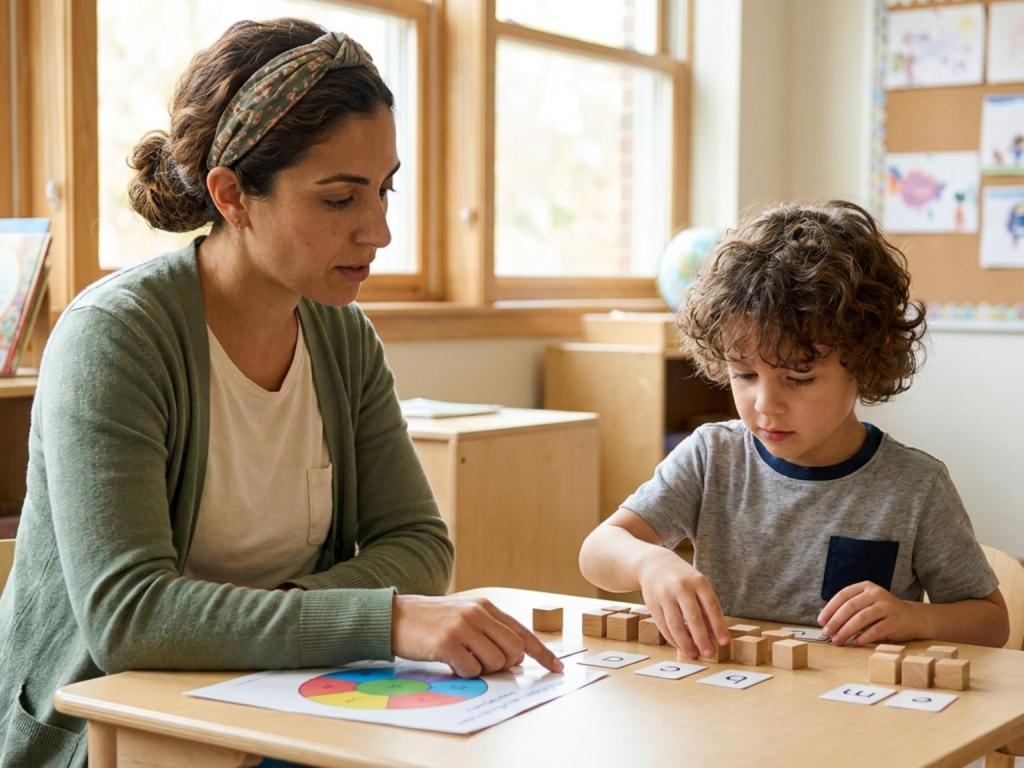
- Kinesthetic preference: The child learns through movement, models, role-play, experiments, manipulatives, tracing, building, or practicing in real contexts.
Also observe what looks like a “style” but may actually be a barrier. A child who avoids reading may have dyslexia, uncorrected vision problems, language comprehension difficulty, fatigue, or anxiety. A child who needs movement may be regulating attention, not necessarily demonstrating a unique kinesthetic learning pathway. A child who “doesn’t listen” may have hearing difficulties, auditory processing challenges, receptive language concerns in children, or simply instructions that are too long for their developmental stage.
Use questionnaires cautiously
Tools such as VARK-style questionnaires can help families start a conversation about whether a child prefers visual, auditory, reading/writing, or kinesthetic methods. They can also encourage children to reflect on study habits: “Do I remember better after drawing it, saying it, reading it, writing it, or doing it?” That metacognition can be valuable.
But questionnaires should not be treated as diagnostic tests. They do not diagnose learning disorders, attention-deficit/hyperactivity disorder, language impairment, autism, anxiety, intellectual disability, or sensory deficits. They also do not prove that a child will learn best when every lesson is delivered in the preferred format. A child’s answers may change with age, mood, teacher style, subject difficulty, sleep, motivation, and self-confidence.
If you use a questionnaire, discuss the results in flexible language. For example: “This suggests you often like pictures and examples. Let’s try adding diagrams to your history notes, but we will still practice reading, writing, and explaining the ideas.” Keep a short learning log for two to four weeks. Record the task, strategy used, effort level, and outcome. Patterns in real performance are often more useful than a one-time score.
Understand what the science says
The popular learning-styles idea proposes that children learn best when instruction is matched to a preferred mode, such as visual or auditory. Scientific reviews and experimental studies have not supported this “matching” claim. In other words, teaching a “visual learner” only visually, or an “auditory learner” only through listening, has not been shown to reliably improve learning outcomes.
This does not mean all children learn the same way, and it does not mean preferences are meaningless. Children differ in prior knowledge, language skills, working memory, processing speed, motivation, executive function, emotional safety, and sensory access. These differences are real and important. The key distinction is that evidence favors matching the method to the content and cognitive demand, not matching all instruction to a stable learning-style label.
For example, geometry often needs visual-spatial representation. Phonemic awareness often needs listening to and manipulating speech sounds. Handwriting requires motor practice. Scientific experiments require observation and hands-on procedure. Reading comprehension requires vocabulary, background knowledge, syntax, inference, and discussion. Effective teaching usually combines modalities because complex learning recruits multiple cognitive systems.
There is also a psychological caution. Research suggests that learning-style labels can influence how adults judge children’s intelligence and academic potential. A label meant to help may become a ceiling. Children benefit more from a growth-oriented message: “Your brain can use many tools. We will find strategies that fit the task and practice them.”
Adapt learning with multimodal strategies
The most practical approach is to create a flexible “strategy menu.” Start with the child’s preferred entry point, then add other modes so the child builds durable understanding. This is especially useful for homework, exam revision, and emotionally difficult subjects.
For a child with a strong visual preference, try concept maps, illustrated vocabulary cards, color-coded steps, timelines, labeled diagrams, graphic organizers, and worked examples. Then ask the child to explain the diagram aloud and solve a new problem without looking. For an auditory preference, use read-alouds, discussion, rhythm, oral rehearsal, recordings, and “teach-back.” Then add written notes or drawings so the learning is not only verbal.
For a read/write preference, encourage lists, summaries, written self-quizzes, sentence starters, and rewriting instructions in the child’s own words. Then add discussion or a visual model to deepen understanding. For a kinesthetic preference, use manipulatives, experiments, tracing letters in sand, acting out stories, measuring ingredients, building models, or walking through math facts. Then connect the activity to symbols, words, diagrams, or written explanations.
Multimodal does not mean making every lesson elaborate. It can be simple: see it, say it, do it, write it, apply it. For example, to learn fractions, a child might cut fruit into halves and quarters, draw the parts, say the fraction aloud, write the equation, and solve a word problem. The repetition across formats strengthens memory and transfer.
Match the method to the task
Task-matched teaching is often more effective than style-matched teaching. Ask: What does the child need to learn? A fact, a concept, a procedure, a motor pattern, a social rule, a story structure, or a problem-solving strategy?
Facts often need spaced retrieval practice: brief self-quizzes spread over time. Concepts need examples and non-examples. Procedures need modeling, guided practice, and feedback. Motor skills need repetition with body-based correction. Reading comprehension needs vocabulary, background knowledge, fluency, and conversation. Writing needs planning, sentence construction, revision, and stamina. Math problem-solving needs representation, language comprehension, number sense, and executive planning.
If a child is learning spelling, simply hearing the word may not be enough. They may need to see the word, segment sounds, notice spelling patterns, write it, and retrieve it later. If a child is learning photosynthesis, a diagram helps, but so does explaining the role of light, water, carbon dioxide, chlorophyll, glucose, and oxygen. If a child is learning social studies, a timeline may support chronology, while discussion supports cause and effect.
This approach respects the child’s preferences without allowing them to avoid necessary skills. A child who dislikes writing still needs supported writing practice. A child who loves talking still needs to learn how to read instructions. A child who thrives with movement still needs gradually increasing capacity for seated academic work, with developmentally appropriate breaks.
Create a supportive home learning environment
Children learn better when their nervous system is not in constant threat mode. Homework battles can trigger avoidance, shame, anger, or somatic complaints such as headaches and stomachaches. A calm structure helps the prefrontal cortex support attention, planning, inhibition, and working memory.
Use predictable routines: a snack or movement break after school, a defined homework start time, short work intervals, and a visible checklist. Many children do well with 10 to 20 minutes of focused work followed by a brief break, depending on age and attention capacity. Younger children often need more adult co-regulation; adolescents may need help planning rather than direct supervision.
Offer choices within boundaries: “Do you want to start with reading or math?” “Do you want to use the whiteboard or notebook?” “Would you rather review vocabulary by flashcards or by teaching me?” Choice supports autonomy without removing expectations.
Praise process more than traits. Instead of “You’re so smart because you’re a visual learner,” try “You used the diagram, checked your answer, and corrected the mistake.” This reinforces strategy use and resilience. If frustration rises, pause. A dysregulated child is less able to encode new information. Return with a smaller step, a model, or a different representation.
Know when to seek professional support
Sometimes learning difficulties persist despite good instruction, flexible strategies, and emotional support. This is not a parenting failure. It may indicate that the child needs a more specific evaluation. Consider speaking with the child’s teacher, pediatrician, or another qualified clinician if concerns are persistent, impairing, or worsening.
Helpful next steps may include hearing and vision assessment, school-based educational testing, psychoeducational evaluation, speech-language pathology evaluation, occupational therapy evaluation for fine-motor or sensory-motor concerns, or validated developmental screening tools for younger children. The appropriate pathway depends on the child’s age, symptoms, school context, and medical history.
Seek guidance sooner if the child loses previously acquired skills, has frequent headaches or visual complaints during reading, cannot hear or follow age-appropriate directions, has major language delays, shows severe school avoidance, or experiences anxiety, sadness, sleep disruption, or behavioral escalation around learning. Learning problems can affect self-esteem quickly; early support can prevent a cycle of avoidance and failure.
Families deserve collaborative care. Teachers can describe classroom performance, clinicians can assess medical and developmental contributors, and caregivers can share what happens at home. The goal is not to find a permanent label for the child’s style. The goal is to understand the child’s needs and build a plan that helps them participate, practice, and grow.
When to be cautious
- Do not use a learning-style label to limit a child’s exposure to reading, writing, listening, discussion, or hands-on practice.
- Persistent reading, math, attention, speech-language, or motor difficulties should be discussed with qualified professionals.
- Vision or hearing problems can mimic inattention or learning difficulties and may need formal screening.
- School refusal, panic, depressed mood, or frequent physical complaints around learning deserve clinical attention.
- Online quizzes cannot diagnose learning disorders, ADHD, autism, anxiety, or sensory impairment.
Tools & Assistance
- Keep a two-week learning log noting task, strategy, effort, and outcome.
- Ask the teacher which subjects and settings are most difficult for the child.
- Use multimodal study routines: see it, say it, do it, write it, apply it.
- Request hearing, vision, developmental, speech-language, or psychoeducational evaluation when concerns persist.
- Create a predictable homework routine with short work periods and planned breaks.
FAQ
Is my child really a visual, auditory, or kinesthetic learner?
Your child may have preferences, but evidence does not support treating these as fixed categories that determine all instruction. Most children benefit from multiple methods matched to the task.
Should I stop using learning-style strategies completely?
No. Diagrams, discussion, writing, and hands-on practice can all be useful. The caution is to avoid using only the preferred method or assuming it is the only way your child can learn.
What if my child refuses reading but loves hands-on activities?
Use hands-on activities as an entry point, but do not ignore reading difficulty. If avoidance persists, discuss possible vision, language, dyslexia, attention, or anxiety concerns with professionals.
Are VARK questionnaires harmful?
They can be harmless conversation starters if used flexibly. They become problematic when treated as diagnostic tests or when they restrict expectations for the child.
When should I request an evaluation?
Consider evaluation when difficulties are persistent, affect daily school functioning, cause distress, or do not improve with appropriate instruction and support.
Sources
- CWC (Child Wellness Care) — Understanding Learning Styles in Children and Teens
- Nature — Beware the myth: learning styles affect parents', children's and teachers' judgments of students' intelligence and academic achievement
- American Educator — Ask the Cognitive Scientist: Does Tailoring Instruction to Learning Styles Help Students Learn?
Disclaimer
This article is for informational purposes only and does not diagnose or treat learning, developmental, or medical conditions. Consult a pediatrician, psychologist, educator, speech-language pathologist, or other qualified professional for concerns about a child’s learning or health.













Please log in to leave a comment.