
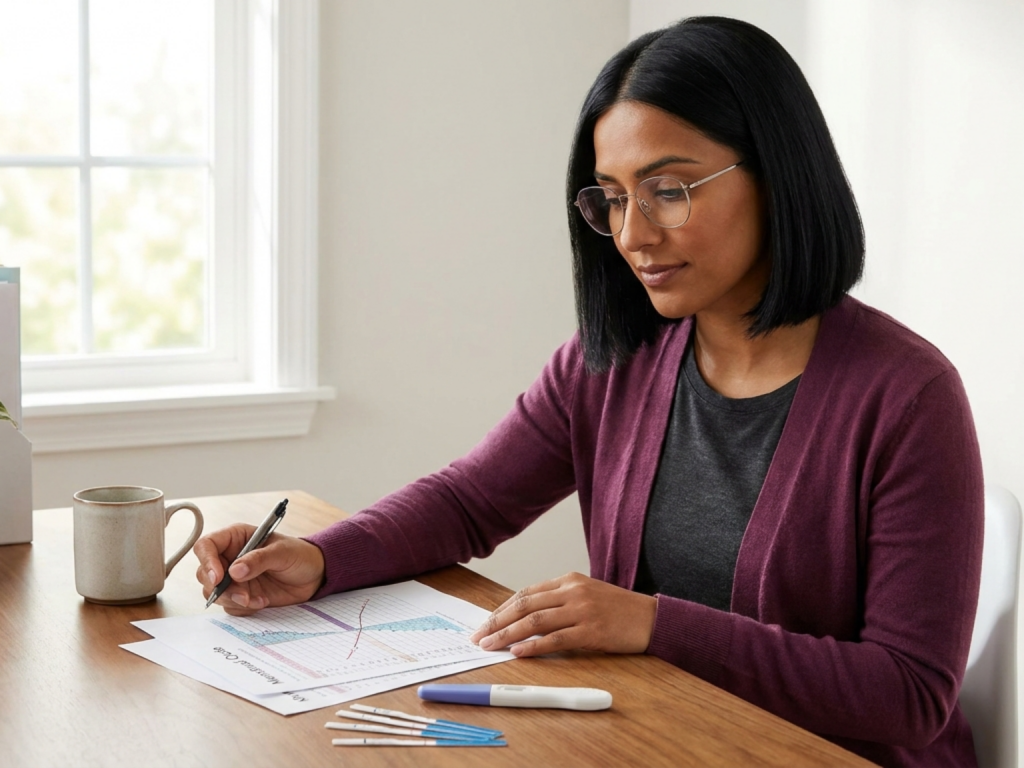
Intro
The fertile window is the short part of the menstrual cycle when sex or insemination can realistically lead to pregnancy. For many people trying to conceive, understanding this window can reduce some of the guesswork, although it cannot make timing perfectly predictable.
In most cycles, the fertile window lasts about six days: the five days before ovulation and the day of ovulation. The exact days vary from person to person and often from one cycle to the next, which is why ovulation tracking is helpful but never absolute.
Highlights
The fertile window is usually about six days long, centered on ovulation rather than menstruation.
Sperm survival before ovulation is the main reason fertility begins several days before the egg is released.
The egg itself survives for only about 12 to 24 hours after ovulation, so the fertile window closes quickly afterward.
Cycle length, irregular ovulation, illness, stress, medications, and postpartum or perimenopausal changes can shift fertile timing.
If conception is taking longer than expected, a clinician can help assess ovulation, semen factors, tubal factors, and overall reproductive health.
What the fertile window means
The fertile window is the period in a menstrual cycle when viable sperm and a viable egg can overlap in the reproductive tract. It is not the same as the whole middle of the cycle, and it is not simply the day someone notices ovulation symptoms. It is a biologically defined interval around ovulation, the release of an egg from the ovary.
For pregnancy to occur, sperm need to be present in the upper reproductive tract around the time the egg is released. After ejaculation, sperm must pass through cervical mucus, the uterus, and toward the fallopian tube. Fertile-type cervical mucus, which is usually clearer, stretchier, and more lubricative, supports sperm transport and survival. Once ovulation occurs, the egg is picked up by the fallopian tube, where fertilization may occur if sperm are present.
This is why the fertile window is broader than the lifespan of the egg alone. The egg remains capable of fertilization for a relatively short period, but sperm can arrive earlier and remain viable. In practical terms, the fertile window describes the days when intercourse before ovulation can still result in sperm being available at the critical moment.
How many days it usually lasts
The fertile window is commonly described as lasting about six days: the five days before ovulation plus the day of ovulation itself. This estimate is supported by reproductive physiology and by population data showing that the probability of conception is concentrated in this interval. It does not mean that every person has exactly six equally fertile days, but it is a useful clinical and practical framework.
The reason for this six-day estimate is the difference between sperm and egg survival. Sperm can survive for about three to five days in favorable cervical mucus. The egg, by contrast, usually survives for about 12 to 24 hours after ovulation. Because sperm may wait for the egg, sex several days before ovulation can still lead to pregnancy. After ovulation has passed and the egg is no longer viable, the chance of conception in that cycle falls sharply.
Some educational resources describe fertility as extending to one day after ovulation. This reflects the fact that the egg may remain viable into the following day, depending on when ovulation occurred and how timing is measured. In everyday cycle tracking, the distinction between the day of ovulation and the next calendar day can be imprecise because ovulation is an event, not a full-day state.
Which days are most fertile
Although the fertile window may last about six days, the days within it are not equivalent. Pregnancy chances are generally highest in the final few days before ovulation and on the day of ovulation. This is when fertile cervical mucus is most supportive and when sperm are most likely to be present in good condition when the egg appears.
From a practical standpoint, many clinicians advise regular intercourse every one to two days during the fertile window when a couple is trying to conceive, if that is comfortable and feasible. This approach reduces pressure to identify one perfect day. It also accounts for the reality that ovulation prediction methods estimate timing rather than prove it in advance.
The most fertile days often include the two days before ovulation and the day of ovulation. However, someone who has sex three, four, or even five days before ovulation may still conceive, particularly if sperm survival is supported by fertile cervical mucus. Conversely, sex only after ovulation may miss the opportunity because the egg’s lifespan is short.
This timing can be emotionally charged. People often feel they have failed if intercourse did not happen on the exact day a test or app predicted. In reality, conception depends on several factors: ovulation timing, sperm quality, tubal function, cervical mucus, endometrial receptivity, and chance. A well-timed cycle still may not result in pregnancy, and that does not necessarily mean anything is wrong.
Why calendar estimates can be wrong
Calendar-based ovulation estimates usually assume that ovulation happens about 14 days before the next period, not necessarily on day 14 of every cycle. In a regular 28-day cycle, ovulation often occurs around day 14, but this is an average pattern rather than a rule. A person with a 24-day cycle may ovulate earlier, and a person with a 35-day cycle may ovulate later.
Even people with fairly regular cycles can ovulate earlier or later in a given month. Research on the timing of the fertile window shows substantial cycle-to-cycle variation. This matters because a calendar app that predicts ovulation based only on previous cycle length may place the fertile window several days away from the true fertile days.
Several factors can shift ovulation timing, including acute illness, major stress, changes in sleep, substantial weight change, intense exercise, breastfeeding, polycystic ovary syndrome, thyroid disorders, perimenopause, and some medications. Recent discontinuation of hormonal contraception can also be followed by a period of cycle variability for some people.
Calendar tracking can still be useful, especially for noticing patterns over several months. But calendar-based ovulation estimates are best treated as approximations. If cycles are irregular, very short, very long, or frequently anovulatory, relying on a calendar alone can make the fertile window harder to identify and may delay appropriate evaluation.
Tracking signs of the fertile window
Several home methods can help estimate the fertile window, although none is perfect. Cervical mucus observation can be useful because estrogen rises before ovulation and changes mucus quality. Fertile mucus is often slippery, clear, stretchy, or wet-feeling. These changes may begin several days before ovulation, which makes them more useful for timing intercourse than signs that appear only after ovulation.
An ovulation predictor kit measures luteinizing hormone in urine. A positive result suggests that ovulation may occur soon, often within about 24 to 36 hours, although timing varies. These tests can be helpful for many people, but they may be harder to interpret in conditions with persistently elevated or multiple LH surges, such as some patterns seen with polycystic ovary syndrome.
Basal body temperature rises after ovulation because progesterone has a thermogenic effect. This can confirm that ovulation likely occurred, but it usually does not predict the fertile window early enough for timing sex in that same cycle. It is often more useful for identifying patterns over time.
Some people combine methods: menstrual cycle dates, cervical mucus, ovulation predictor kit results, and basal body temperature. This layered approach can provide a more nuanced picture than any single method. Still, home ovulation tracking limitations are real. If results are confusing, cycles are irregular, or conception is not occurring, a healthcare professional can help interpret patterns and decide whether testing is appropriate.
When the fertile window is harder to predict
The fertile window is harder to predict when ovulation is irregular or absent. Cycles shorter than about 21 days, longer than about 35 days, highly variable cycles, or skipped periods can all make timing less reliable. Bleeding does not always confirm that ovulation occurred; some people have anovulatory bleeding, especially during adolescence, postpartum transitions, perimenopause, or with endocrine conditions.
Postpartum and breastfeeding cycles deserve particular caution. Ovulation can occur before the first postpartum period, so pregnancy can be possible before menstrual bleeding has returned. At the same time, breastfeeding may suppress ovulation unpredictably. Anyone trying to avoid or achieve pregnancy during this period should discuss individualized guidance with a clinician.
Age also affects fertility, but it does not change the basic definition of the fertile window. The six-day window still centers on ovulation. What may change is the probability that a given cycle will result in pregnancy, largely because egg quantity and quality decline over time and other reproductive factors become more common.
Medical evaluation is reasonable if cycles are persistently irregular, if ovulation signs never appear, if periods are very painful or very heavy, or if there is a history of pelvic inflammatory disease, endometriosis, recurrent pregnancy loss, chemotherapy, ovarian surgery, or known semen concerns. People age 35 or older are often advised to seek fertility evaluation after six months of trying; younger people commonly seek evaluation after 12 months, though earlier advice is appropriate when risk factors are present.
Using the fertile window without pressure
Knowing how long the fertile window lasts can make conception planning more grounded, but it should not become a source of constant self-monitoring. The goal is to identify a practical range of days, not to control every biological variable. For many couples, intercourse every one to two days during the expected fertile window is enough to cover the highest-probability days.
If tracking becomes stressful, it may help to simplify. Some people use cervical mucus as the main sign and add an ovulation predictor kit only for a few days around expected ovulation. Others prefer regular intercourse across the middle part of the cycle without intensive tracking. The best method is the one that is medically appropriate, emotionally tolerable, and sustainable.
It is also important to remember that the fertile window applies to the chance of fertilization, not the whole process of becoming pregnant. Fertilization, embryo development, transport through the fallopian tube, implantation, and early hormonal signaling all have to occur. Even with accurate timing, many cycles do not result in pregnancy.
If the fertile window feels confusing, or if timing sex is affecting your relationship, mental health, or sexual wellbeing, it is reasonable to ask for help. A reproductive health clinician can review cycle history, medications, medical conditions, and partner factors. Support can be practical as well as medical: sometimes the most helpful next step is replacing uncertainty with a clear, individualized plan.
When to seek medical advice
- Seek urgent care for severe pelvic pain, fainting, shoulder-tip pain, or heavy bleeding, especially if pregnancy is possible.
- Ask a clinician about cycles that are consistently shorter than 21 days, longer than 35 days, or highly unpredictable.
- Get medical advice if you have no periods for several months and are not pregnant, postpartum, or using a method known to suppress bleeding.
- Consider earlier fertility evaluation if there is known endometriosis, pelvic infection history, recurrent pregnancy loss, chemotherapy exposure, or semen concerns.
- Do not use ovulation tracking as contraception unless you have been trained in a validated fertility awareness method and understand its failure risks.
Tools & Assistance
- Menstrual cycle diary or reputable cycle tracking app
- Ovulation predictor kit used according to package instructions
- Cervical mucus observation recorded over several cycles
- Preconception visit with an obstetrician-gynecologist, midwife, or fertility clinician
- Fertility evaluation if conception is delayed or cycles are irregular
FAQ
Is the fertile window always exactly six days?
No. Six days is a useful estimate based on sperm and egg survival, but the exact fertile days can vary by cycle and by person.
Can you get pregnant after ovulation?
Possibly, but only for a short time. The egg usually survives about 12 to 24 hours after ovulation, so the chance drops quickly once that time has passed.
Can you get pregnant five days before ovulation?
Yes, it is possible because sperm can survive for several days in fertile cervical mucus. The probability is usually higher closer to ovulation.
Does a regular period mean I ovulate on day 14?
Not necessarily. Day 14 is a common estimate for a 28-day cycle, but ovulation timing varies with cycle length and can vary between cycles.
What if ovulation tests are positive for several days?
That can happen for different reasons, including testing patterns or hormonal conditions. If results are repeatedly confusing, a healthcare professional can help interpret them.
Sources
- National Library of Medicine — The timing of the “fertile window” in the menstrual cycle
- Cleveland Clinic — Ovulation: Calculating, Process, Pain & Other Symptoms
- NHS — Periods and fertility in the menstrual cycle
Disclaimer
This article is for general medical information and does not replace personalized advice, diagnosis, or treatment from a qualified healthcare professional.












Please log in to leave a comment.