
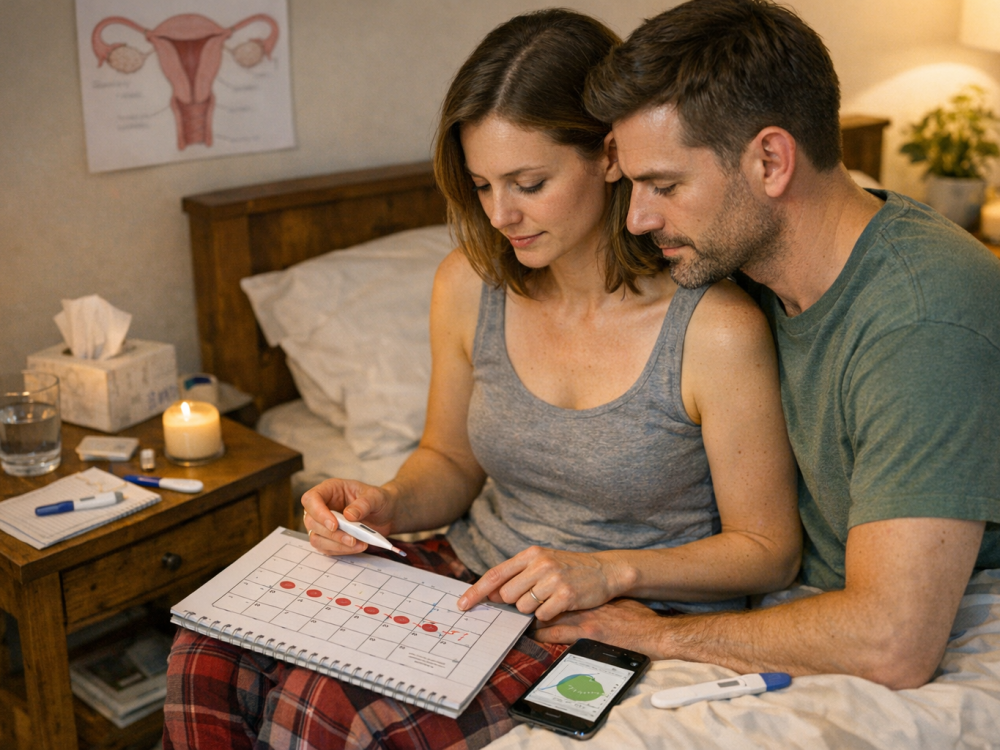
Intro
Identifying the best days to conceive is primarily about estimating ovulation and timing intercourse within the fertile window. In reproductive physiology, the fertile window is the interval during which viable sperm can be present in the female reproductive tract before ovulation and the oocyte remains capable of fertilization after ovulation. Because sperm may survive for several days under favorable cervical mucus conditions, while the egg is usually viable for only about 12–24 hours, the days immediately before ovulation and the day of ovulation are the most important.
For medically literate readers, the key concept is that fertility is not tied reliably to a fixed calendar day such as “day 14” for every person. Ovulation generally occurs approximately 12–14 days before the next menstrual period, but follicular-phase length varies widely between individuals and from cycle to cycle. Evidence-based fertility tracking therefore combines cycle history, cervical mucus observations, basal body temperature patterns, and sometimes ovulation predictor kits or clinical evaluation, especially when cycles are irregular or conception is delayed.
Highlights
The fertile window is centered on ovulation, not on a universal cycle day. Research shows that conception is most likely in the days immediately before ovulation and on ovulation day.
Sperm survival explains why intercourse before ovulation can lead to pregnancy, whereas the oocyte’s short post-ovulatory viability limits fertility after ovulation.
Calendar calculations can help estimate fertile days, but they are less reliable when cycles are irregular, postpartum, perimenopausal, or affected by endocrine disorders.
Cervical mucus and basal body temperature provide biologic clues, but they work best when tracked consistently over multiple cycles.
If pregnancy does not occur after an appropriate interval, or if cycles are very irregular, professional evaluation can identify ovulatory, tubal, uterine, endocrine, or male-factor contributors.
Understanding the fertile window
The is the limited span of days in a when can plausibly result in conception. A landmark analysis of healthy women found that the spans six days ending on the day of ]]: the five plus day. The highest were observed on the two and on the day of itself. Johns Hopkins Medicine describes a practical seven-day window: the five , day, and the day after ovulation. The extra day is a pragmatic allowance for uncertainty in identifying ovulation precisely.
The biologic rationale is straightforward. Sperm can remain viable in the reproductive tract for up to about five days, particularly when estrogen-dominant cervical mucus is abundant, slippery, and supportive of sperm transport. By contrast, the ovulated oocyte is usually capable of fertilization for only 12–24 hours. Therefore, can be more effective begins only after ovulation has been confirmed.
In practice, the “best days” are usually the two and the day of ovulation. be predicted perfectly in advance, couples often improve coverage by having every day or every other day throughout the estimated .
Why cycle day alone is not enough
A common teaching is that occurs on day 14 of a 28-day cycle. This is a useful simplification, but it can be misleading. The luteal phase, the interval from to the next menstrual period, is often around 12–14 days, while the follicular phase, from menstruation to , varies more substantially. A person with a 35-day cycle may ovulate around day 21, while a person with a 24-day cycle may ovulate around day 10. with regular cycles, occasional early or late can occur.
The NCBI-published study on fertile-window timing challenged the assumption that fertile days can be reliably assigned to fixed cycle days for all women. The probability of being in the varied substantially across the cycle, and the fertile days were not confined to the classic mid-cycle interval for every participant. This matters clinically because mistiming is a common, modifiable reason for delayed conception in otherwise fertile couples.
Cycle-day estimates are most useful when cycles are predictable and have been tracked for several months. They are less dependable when cycles are irregular, recently changed, or affected by factors such as polycystic ovary syndrome, thyroid dysfunction, hyperprolactinemia, hypothalamic amenorrhea, postpartum physiology, lactation, perimenopause, significant weight change, intense exercise, or recent discontinuation of hormonal contraception.
Using the calendar method to estimate fertile days
The calendar method estimates the fertile interval from prior lengths. It is not a diagnostic test of , but it can help identify when to focus intercourse. Mayo Clinic describes a standard approach: track at least 6–12 menstrual cycles, identify the shortest and longest cycles, subtract 18 from the shortest cycle to estimate the first fertile day, and subtract 11 from the longest cycle to estimate the last fertile day. For example, if the shortest cycle is 26 days and the longest is 30 days, the estimated fertile interval is cycle days 8–19.
Johns Hopkins Medicine also emphasizes that typically occurs about 12–14 days before the next menstrual period. If someone has very regular 28-day cycles, ovulation may occur near day 14, making days 9–15 or so a practical fertile-window estimate depending on the method used. In a regular 32-day cycle, ovulation may be closer to day 18; in a regular 25-day cycle, closer to day 11.
A structured calendar approach can be used as follows:
- Record the first day of full menstrual bleeding as cycle day 1.
- Track cycle length for at least six cycles, and ideally up to twelve.
- Use the shortest-cycle and longest-cycle calculation to estimate the broad fertile range.
- Update calculations monthly as new cycle data accumulate.
- Time intercourse every day or every other day during the estimated fertile interval.
The main limitation is that the method predicts fertile days from past cycles. It cannot confirm that ovulation will occur in the current cycle, and it may overestimate or underestimate the if ovulation shifts.
Cervical mucus: a real-time sign of rising fertility
changes in response to estradiol as the dominant follicle matures. In the less fertile part of the cycle, mucus may be scant, sticky, tacky, or thick. As approaches, mucus often becomes more abundant, clear, slippery, stretchy, and similar to raw egg white. This type of mucus facilitates sperm survival and transport through the cervix and is considered a strong clinical sign of high fertility.
Peak fertility is generally associated with the last day of the most fertile-quality mucus, although this is easier to identify retrospectively. For conception purposes, it is reasonable to treat the appearance of slippery, stretchy, egg-white cervical mucus as a prompt to have intercourse that day and over the next several days, especially if it aligns with the expected from cycle tracking.
Cervical mucus observation is useful because it reflects current endocrine physiology rather than relying only on past cycle length. However, interpretation can be affected by semen, lubricants, vaginal infections, cervical procedures, medications, breastfeeding, dehydration, and individual variability. If mucus is persistently absent or difficult to interpret, other methods such as predictor kits or clinical assessment may be helpful.
Basal body temperature: confirming ovulation after it happens
Basal body temperature, or BBT, is the resting body temperature measured immediately after waking and before significant activity. After , progesterone from the corpus luteum has a thermogenic effect, commonly producing a sustained temperature rise. This biphasic pattern can help confirm that ovulation likely occurred.
BBT is less useful for predicting the best days in the current cycle because the temperature rise usually occurs after ovulation, when the most fertile days have already passed. Its greatest value is retrospective: after several cycles, a person may see whether ovulation tends to occur around a consistent cycle day and can then plan intercourse before the expected rise in future cycles.
For more reliable BBT interpretation, measure temperature at the same time each morning, after adequate sleep, using a thermometer suitable for basal readings. Note confounders such as fever, alcohol, disrupted sleep, travel, shift work, and illness. A single temperature value is rarely meaningful; the pattern over time is what matters.
Ovulation predictor kits and luteinizing hormone detection
predictor kits, or OPKs, detect the urinary luteinizing hormone surge that typically precedes ovulation. The LH surge often occurs about 24–36 hours before ovulation, making a positive OPK a useful prompt for intercourse on the day of the positive test and the following day. OPKs can be particularly helpful for people whose cycles are regular enough to know when to begin testing but variable enough that calendar estimates are imprecise.
OPKs are not perfect. Some people, particularly those with polycystic ovary syndrome or chronically elevated LH, may have confusing or persistently positive results. Others may miss a short LH surge if testing is too infrequent or if urine is very dilute. A positive OPK suggests that ovulation may be imminent, but it does not prove that follicular rupture occurred. If there is concern about anovulation, clinicians may use mid-luteal progesterone testing, ultrasound follicle tracking, or evaluation for endocrine causes.
Used together, calendar tracking, , and OPKs can improve timing. For example, a person might start OPK testing a few days before the earliest expected fertile interval, increase intercourse when fertile-type mucus appears, and prioritize the day of a positive OPK and the next day.
How often to have intercourse during the fertile window
For to or the is a practical . Johns Hopkins Medicine notes that the best chances occur with sex every day or this period. Daily ]] does not usually harm sperm quality in healthy men, but may be easier to sustain and still provides good coverage because for several days.
A pragmatic approach is:
- If cycles are predictable, begin expected and continue through ]]]] day.
- If ]] cervical mucus appears earlier than expected, treat that as the start of the high-fertility period.
- If using OPKs, have on the day of a positive result and the following day, while also covering the preceding days if possible.
- If causes stress, aim for every two to three , with increased frequency around the estimated .
Couples should avoid letting tracking become so burdensome that it worsens sexual function, anxiety, or relationship strain. Conception requires exposure during the , but it does not require in every cycle.
Special situations that can make fertile days harder to identify
Some reproductive contexts make less predictable. Irregular cycles, cycles shorter than about 21 days or longer than about 35 days, very light or absent periods, intermenstrual bleeding, severe dysmenorrhea, known endometriosis, prior pelvic inflammatory disease, loss, chemotherapy history, ovarian surgery, and age over 35 may warrant earlier medical guidance. Male-factor infertility is and cannot be assessed by menstrual tracking alone.
Postpartum and lactational cycles may be anovulatory or irregular before regular menstruation resumes. After stopping hormonal may return quickly for , while cycle regularity may take time to re-establish for others. Perimenopause is associated with more variable follicular development and cycle length, reducing the reliability of calendar prediction.
Medical is generally recommended if after 12 months of regular in women under 35, after 6 months in women aged 35 or older, or there are known risk factors for infertility or irregular . Evaluation may assessment, ovarian reserve testing and tubal , and semen analysis. The exact timing and scope should be individualized with a qualified clinician.
Putting the methods together: a practical cycle plan
A combined approach often works better than relying on one sign. Begin with cycle tracking to estimate the broad fertile interval, then use cervical mucus and, if desired, OPKs to identify the highest-probability days within that interval. BBT can then help confirm whether likely occurred and refine planning for subsequent cycles.
For a person with 28–30 day cycles, a practical plan might be to begin watching cervical mucus soon after menstruation, start OPK testing around day 10 or 11, and have intercourse every other day from around day 9 until a day or two after the LH surge or until fertile mucus resolves. For someone with longer cycles, testing and focused intercourse may begin later; for shorter cycles, they may need to begin earlier. The plan should be adjusted to the individual’s actual cycle history rather than a generic day-14 assumption.
The most important principle is to have sperm present before . If intercourse occurs only after a rise or after pain has resolved, the highest-fertility interval may already have passed. Conversely, intercourse too early and then not again near may also miss the optimal days. A broad, low-stress strategy that covers the five days before and day is usually preferable to trying to identify a single perfect day.
When to seek medical guidance
- Cycles that are consistently shorter than 21 days, longer than 35 days, absent, or highly irregular may indicate ovulatory dysfunction.
- Seek earlier advice if you are 35 or older, have known endometriosis, prior pelvic infection, recurrent miscarriage, or a history of ovarian or pelvic surgery.
- Do not rely on fertility apps alone if cycles are irregular; many apps use calendar assumptions that may not reflect actual ovulation.
- Persistent pelvic pain, abnormal bleeding, or symptoms of endocrine disease should be assessed by a healthcare professional.
- If pregnancy has not occurred after 12 months of regular unprotected intercourse, or after 6 months at age 35 or older, consider fertility evaluation.
Tools & Assistance
- Menstrual cycle diary or fertility tracking app used with awareness of its limitations
- Cervical mucus observation chart
- Basal body temperature thermometer and chart
- Urinary ovulation predictor kits
- Consultation with an obstetrician-gynecologist, reproductive endocrinologist, or fertility clinic when indicated
FAQ
What are the best days to conceive?
The highest-probability days are usually the two days before ovulation and the day of ovulation. Because ovulation timing can vary, many clinicians recommend intercourse every day or every other day during the fertile window.
Can I get pregnant five days before ovulation?
Yes, it is possible. Sperm can survive for several days in favorable cervical mucus, which is why the fertile window begins before ovulation rather than only on ovulation day.
Is ovulation always on day 14?
No. Day 14 is an approximation for a 28-day cycle, but ovulation varies with cycle length and from cycle to cycle. It is more accurate to estimate ovulation as occurring roughly 12–14 days before the next period.
Is basal body temperature enough to time intercourse?
BBT mainly confirms ovulation after it has occurred, so it is less useful as a real-time predictor. It works best when combined with cycle tracking, cervical mucus observation, or ovulation predictor kits.
How often should we have sex when trying to conceive?
Every day or every other day during the estimated fertile window is a common evidence-based approach. If tracking is stressful, intercourse every two to three days across the cycle can still provide reasonable coverage.
Sources
- National Center for Biotechnology Information (NCBI) — The timing of the “fertile window” in the menstrual cycle
- Johns Hopkins Medicine — Calculating Your Monthly Fertility Window
- Mayo Clinic — Rhythm method for natural family planning
Disclaimer
This article is for informational purposes only and does not replace individualized medical advice, diagnosis, or treatment. Consult a qualified healthcare professional for personal fertility concerns or before making medical decisions.












Please log in to leave a comment.