
Intro
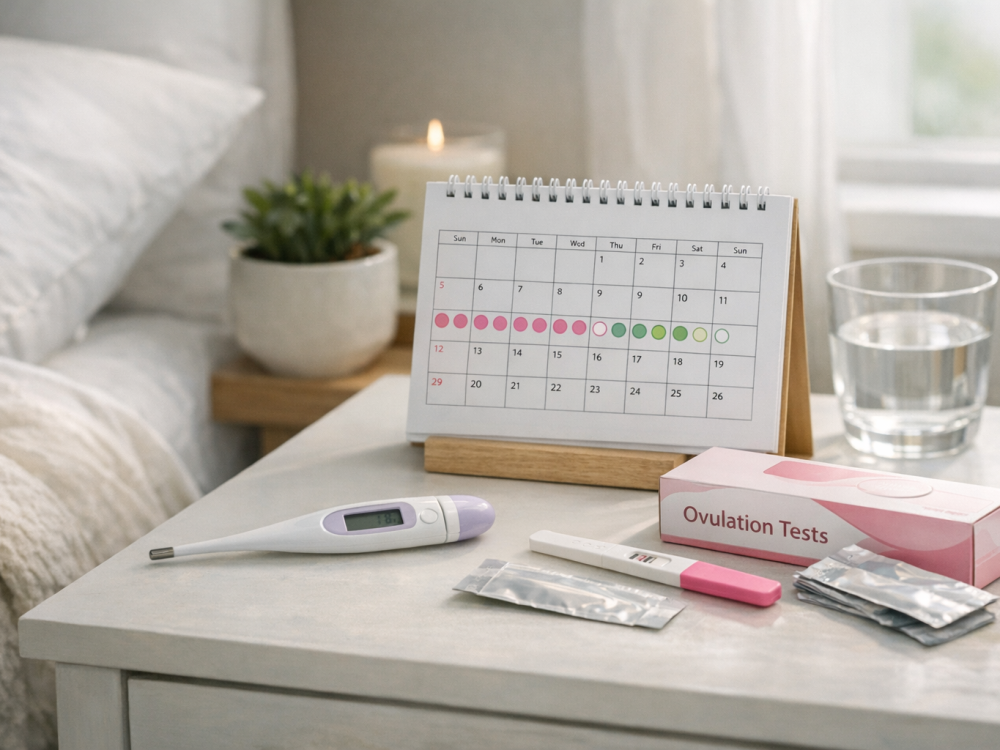
For most couples trying to conceive, timing intercourse around ovulation is the single most actionable, evidence-based strategy. Conception is biologically constrained by the lifespan of sperm and the egg: sperm can survive in the reproductive tract for up to about five days under favorable cervical mucus conditions, while an ovulated egg is typically fertilizable for only 12 to 24 hours. This creates a relatively short but predictable fertile window within each menstrual cycle.
A practical timing strategy combines cycle tracking, recognition of ovulatory signs, and appropriately frequent intercourse during the fertile window, without turning the process into a daily source of stress. The goal is not to identify one perfect moment, but to ensure that motile sperm are already present in the reproductive tract when ovulation occurs.
Highlights
The highest-yield strategy is intercourse every day or every other day during the fertile window, rather than daily intercourse throughout the entire month.
The fertile window generally includes the five days before ovulation, the day of ovulation, and sometimes the day after, because sperm and the egg have different survival times.
Ovulation usually occurs about 14 days before the next menstrual period, making cycle length more useful than the calendar date alone.
Cycle tracking improves timing, but predictions should be updated monthly because ovulation can vary from cycle to cycle.
If cycles are irregular, ovulation is unclear, or conception is delayed, medical evaluation can identify common and treatable factors.
Understanding the fertile window
The is the interval in the during which can plausibly result in pregnancy. According to major clinical sources, it is centered on , when the ovary releases an oocyte into the fallopian tube. Because sperm may remain viable for up to five days and the egg survives for approximately 12 to 24 hours, the fertile interval begins several and ends shortly after ]].
Johns Hopkins Medicine describes the as the five days leading up to ]], the day of ]], and the day after, totaling about seven days. The American College of Obstetricians and Gynecologists emphasizes a six-day based on the same physiology: sperm survival up to five days and the egg’s shorter post- lifespan. In practical terms, both frameworks support the same behavior: have regularly in the days before and around ovulation.
The most important clinical implication is that after ovulation alone is often too late. Fertilization is most likely when sperm are already in the reproductive tract as the egg is released. Therefore, the strategy is anticipatory rather than reactive: window and begin before the expected ovulation day.
Ovulation timing: why the next period matters more than day 14
A common simplification is that ovulation occurs on day 14 of the . This is true only for some people with a 28-day cycle. A more physiologically useful rule is that ovulation usually occurs about 14 days before the next menstrual period, not necessarily 14 days after the last one began. The first half of the cycle, the follicular phase, varies more between individuals and between cycles. The second half, the luteal phase, is often closer to two weeks, though it can also vary.
For example, a person with a 28-day cycle may ovulate around day 14, while someone with a 35-day cycle may ovulate closer to day 21. Conversely, someone with a 24-day cycle may ovulate closer to day 10. This is why using a fixed calendar day can be misleading.
A medically literate approach is to estimate ovulation retrospectively and prospectively. Retrospectively, if the next period starts on cycle day 30, ovulation may have occurred around day 16. Prospectively, if cycles are consistently 30 days, the may be targeted roughly from day 11 through day 17, allowing for biologic variability. The more variable the cycle length, the broader the timing window needs to be.
The core strategy: intercourse every day or every other day during the fertile window
For most couples, the evidence-based recommendation is straightforward: have sex every day or every other day during the . Johns Hopkins Medicine and ACOG both support this frequency. Mayo Clinic similarly notes that the rhythm method can be used to identify fertile days and recommends regular ]] during those days when pregnancy is desired.
Daily during the can maximize the chance that sperm are present near , but every-other-day is also a strong strategy and is often more sustainable. Because sperm can survive for several days, intercourse does not need to occur at the exact moment of ovulation. For many couples, every other day reduces performance pressure while maintaining excellent biologic coverage.
A practical example for a predictable 28-day cycle might look like this:
- Cycle day 1: first day of full menstrual bleeding.
- Estimated ovulation: around cycle day 14.
- : approximately cycle days 9 through 15, with some clinicians including day 16 as a buffer.
- Intercourse plan: every other day from day 9 to day 15, or daily if preferred and comfortable.
This plan should not be interpreted as a prescription for all cycles. It is a template. If cycles are longer, shorter, or variable, the should be shifted accordingly and updated as new cycle data accumulate.
Tracking methods: strengths and limitations
Cycle tracking is the foundation of most timing strategies. The rhythm method, as described by Mayo Clinic, involves recording lengths to predict ovulation and fertile days. For , the same calculations that help identify fertile days can guide . However, calculations should be updated monthly because cycle length and ovulation timing can change.
Several tools and physiologic signs may improve timing accuracy:
- Menstrual calendar tracking: Recording the first day of bleeding and cycle length over several months helps estimate the likely ovulation range. This is most useful for people with relatively regular cycles.
- Cervical mucus observation: Around the , cervical mucus often becomes clearer, stretchier, and more slippery, resembling egg white. This reflects estrogen-driven changes that support sperm survival.
- Ovulation predictor kits: These detect the urinary luteinizing hormone surge that usually precedes ovulation. They can be helpful when cycles are somewhat variable, though they do not guarantee ovulation occurred.
- Basal body temperature: A sustained temperature rise typically occurs after ovulation due to progesterone. This is better for confirming ovulation retrospectively than for predicting the best day to have sex in the current cycle.
- Cycle-tracking apps: Apps can organize data and estimate fertile windows, but their predictions are only as good as the input data and assumptions. They may be less reliable in irregular cycles.
No home tracking method is perfect. The best approach is often layered: use menstrual history to estimate the , add cervical mucus or ovulation predictor kits to refine timing, and avoid overinterpreting a single abnormal cycle.
Timing strategies for regular cycles
In regular cycles, timing can be relatively efficient. Regular does not mean exactly the same length every month; many clinicians consider mild variation normal. The key is whether a predictable pattern exists. If cycle length is usually 26 to 30 days, ovulation is likely to occur within a manageable range, and intercourse can be targeted accordingly.
A practical strategy is to identify the shortest and longest recent cycle lengths, estimate ovulation as roughly 14 days before the next expected period, and begin intercourse several days before the earliest expected ovulation date. For example, if cycles are usually 27 to 29 days, ovulation may occur around days 13 to 15. Intercourse every other day from day 8 or 9 through day 16 would usually cover the .
Couples who prefer not to track closely can use a simpler method: have throughout the cycle after menstruation ends. This reduces the risk of missing ovulation, but it may be less targeted. A more focused approach is intercourse every day or every other day during the estimated , which balances biologic effectiveness and emotional sustainability.
Timing strategies for irregular or unpredictable cycles
Irregular cycles make calendar-based timing less reliable. If cycle length varies substantially, ovulation may occur earlier or later than expected, and some cycles may be anovulatory. In this setting, relying only on a predicted day of ovulation can lead to missed opportunities and unnecessary frustration.
For irregular cycles, consider a broader, more flexible strategy:
- Track bleeding patterns for several months, including cycle length and flow characteristics.
- Use ovulation predictor kits over a wider range of days, especially if cycles vary but ovulation still occurs.
- Pay attention to fertile cervical mucus, which can provide about estrogenic changes.
- Have every two to three days through much of the mid-cycle period, or every other day when fertile signs appear.
- Seek medical guidance if cycles are very long, very short, absent, or associated with symptoms suggesting endocrine or gynecologic conditions.
Irregular cycles can be associated with many factors, including polycystic ovary syndrome, thyroid disease, hyperprolactinemia, changes in weight or energy availability, intense exercise, perimenopause, and medication effects. This article cannot diagnose those conditions. A clinician can evaluate is occurring and whether preconception testing or treatment is appropriate.
Avoiding common timing mistakes
Many couples make it needs to be. One common mistake is waiting for a positive predictor test and then having ]] only result. Because the days often include the days before ]], it is better to begin before the predicted surge if possible.
Another mistake is assuming that more ]] is always better. ACOG specifically cautions against overstressing about daily sex throughout the month. Daily window is reasonable if desired, but it is not necessary for everyone. Every-other-day ]] during the is typically sufficient and may be better tolerated emotionally and physically.
A third mistake is using the rhythm method as if it were highly precise. Calendar-based prediction is useful for planning, but biologic variability is real. Mayo Clinic notes that rhythm-method calculations should be updated monthly. Johns Hopkins also emphasizes tracking natural family planning is less reliable when used for contraception. , the implication is to use the method as a guide, not as an exact forecast.
Finally, couples may focus entirely on timing and overlook . Timing matters, but ]] also patency, semen parameters, uterine factors, age, medical conditions, and lifestyle factors. If within a reasonable interval, the issue may not be timing alone.
When to seek medical advice
Preconception counseling is useful even before with chronic complications, loss, irregular cycles, known gynecologic disease, or medications . A clinician can review immunizations, medications, genetic risks, folic acid intake, and optimization of conditions such as diabetes, hypertension, thyroid disease, epilepsy, autoimmune disease, or psychiatric disorders.
within several months of appropriately , but professional evaluation is recommended sooner in certain circumstances. People aged 35 or older are often advised to seek evaluation after six months of may be advised to seek evaluation after 12 months, assuming no known risk factors. Earlier assessment is reasonable if cycles are absent or highly irregular, there is known endometriosis or pelvic inflammatory disease, prior ectopic pregnancy, chemotherapy exposure, suspected male factor infertility, or a history of reproductive surgery.
Medical evaluation may include confirmation of , ovarian reserve testing, semen analysis, assessment of fallopian tube patency, uterine cavity evaluation, and review of endocrine factors. The appropriate workup depends on age, history, duration of trying, and clinical context. Timing correctly is valuable, but it should not delay care when risk factors are present.
A practical month-by-month plan
A structured plan can help couples apply the evidence without becoming preoccupied with a single day. The following is a general educational framework, not individualized medical advice.
- Month 1: Record cycle day 1, note usual cycle length, and begin intercourse every other day during the estimated . If the cycle is 28 days, this is often around days 9 to 15 or 16.
- Months 2 to 3: Update the fertile-window estimate using actual cycle length. Add cervical mucus tracking or predictor kits if desired, especially if the first estimate seemed inaccurate.
- Months 4 to 6: Continue every-day or every-other-day intercourse during the . If cycles are irregular, broaden the window and consider discussing ovulation assessment with a clinician.
- Beyond 6 to 12 months: Depending on age and risk factors, consider fertility evaluation rather than continuing timing changes alone.
The central principle remains consistent: do not aim for one perfect act of intercourse. Aim for repeated sperm exposure across the and the day of ovulation. This approach aligns with the known survival of sperm and the egg and is the most practical timing strategy for most couples.
Medical cautions
- Do not rely on calendar timing alone if cycles are absent, highly irregular, or unpredictable.
- Seek prompt care for severe pelvic pain, heavy abnormal bleeding, or suspected ectopic pregnancy symptoms.
- Review medications and chronic conditions with a clinician before conception whenever possible.
- If you are 35 or older, consider earlier fertility evaluation if pregnancy has not occurred after six months of trying.
- Timing intercourse cannot overcome all causes of infertility; semen, ovulatory, tubal, uterine, and age-related factors may need assessment.
Tools & Assistance
- Menstrual cycle diary or medically oriented cycle-tracking app
- Ovulation predictor kits for luteinizing hormone surge detection
- Cervical mucus tracking with daily observations during the mid-cycle interval
- Preconception consultation with an obstetrician-gynecologist, midwife, or reproductive endocrinology specialist
- Semen analysis and fertility evaluation when clinically indicated
FAQ
What is the best day to have sex to get pregnant?
There is no single guaranteed best day. The highest-yield period is the fertile window, especially the days before ovulation and the day of ovulation, because sperm should ideally be present before the egg is released.
Is daily sex better than every other day?
Both are reasonable during the fertile window. Major clinical sources recommend sex every day or every other day during this period; every other day is often easier to sustain and still provides good coverage.
How do I estimate ovulation if my cycle is not 28 days?
Ovulation typically occurs about 14 days before the next period. For longer cycles, ovulation is usually later; for shorter cycles, it is usually earlier. Tracking several cycles improves the estimate.
Are ovulation predictor kits necessary?
They are not required, but they can help refine timing, particularly when cycles are variable. They detect the LH surge that usually precedes ovulation, but they do not guarantee that ovulation occurred.
When should we get medical help if timing is not working?
Many clinicians advise evaluation after 12 months of trying if under 35, or after six months if 35 or older. Seek earlier care for irregular or absent cycles, known reproductive conditions, or suspected male factor infertility.
Sources
- Johns Hopkins Medicine — Calculating Your Monthly Fertility Window
- Mayo Clinic — Rhythm method for natural family planning
- American College of Obstetricians and Gynecologists — Trying to Get Pregnant? Here's When to Have Sex
Disclaimer
This article is for educational purposes only and does not replace individualized medical advice, diagnosis, or treatment. Consult a qualified healthcare professional for personal preconception or fertility guidance.














Please log in to leave a comment.