
Intro
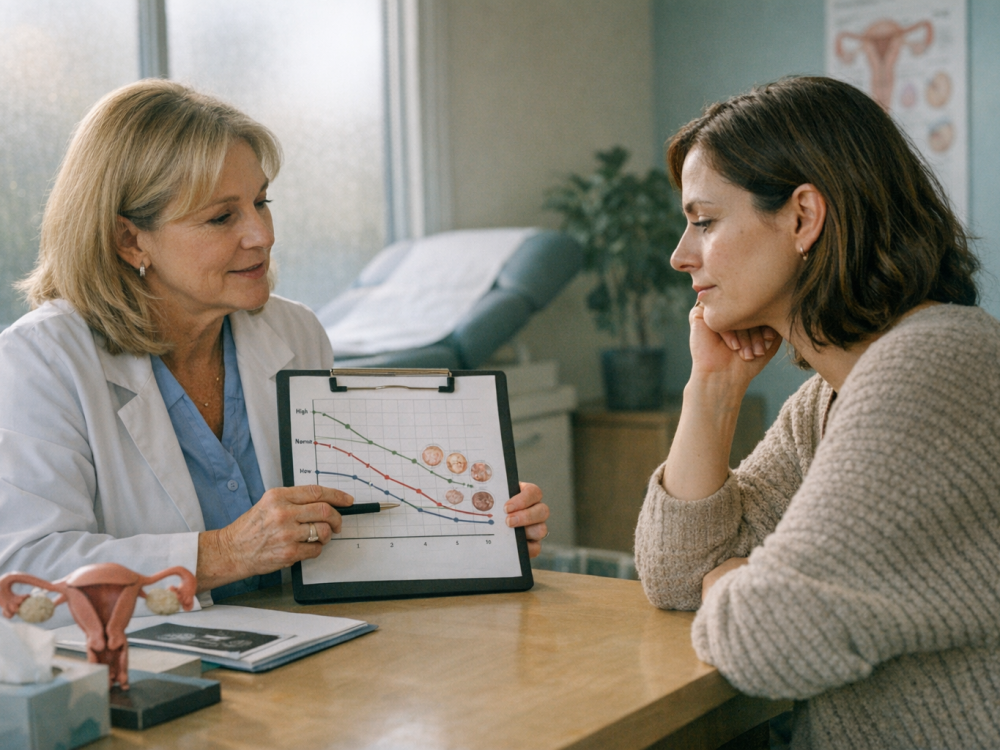
Age is one of the most important biological factors influencing the chance of getting pregnant, but it is also one of the most emotionally sensitive topics in reproductive health. Many people build their families later for deeply valid reasons: education, relationships, finances, career timing, health, or simply not feeling ready earlier. Understanding how fertility changes with age can help with planning, but it should never be used to create shame or blame.
For medically literate readers, the key concept is that age affects fertility mainly through ovarian aging: the progressive decline in both oocyte quantity and oocyte quality. This affects the probability of conception per cycle, the time it may take to conceive, the risk of miscarriage, and the likelihood that assisted reproductive technologies will be needed. Male age matters too, especially from the mid-40s onward, although the effect is generally less abrupt than in people with ovaries.
Highlights
Female fertility is highest from the late teens through the late 20s, begins to decline around age 30, and falls more quickly after the mid-30s.
The decline is driven largely by reduced ovarian reserve and increasing rates of chromosomal abnormalities in eggs, which can lower conception rates and raise miscarriage risk.
Published data suggest the chance of conceiving within one year is about 85% before age 30, 75% at age 30, 66% at age 35, and 44% at age 40.
Male age can also affect fertility: after about age 45, conception may take longer and some pregnancy and child health risks may increase.
If pregnancy is taking longer than expected, early consultation with a qualified clinician can clarify options without necessarily meaning something is wrong.
The basic pattern: fertility declines with age, especially after 35
Fertility is not a switch that turns off at a single birthday. It is a gradual biological process wide individual variation. However, population-level data show a consistent pattern: the is generally highest in the late teens and 20s, starts to decline around age 30, and declines more rapidly age 35. By the early 40s, natural conception is still possible for some people, but the is much lower.
One government heh resource estimates that women in their early to mid-20s have about a 25% to 30% in a given if they are having regular unprotected . This monthly chance declines slowly in the early 30s, then more rapidly 35, reaching roughly 5% per cycle by age 40. A scientific review similarly reports of conceiving in one year is approximately 85% for women under 30, 75% at age 30, 66% at age 35, and 44% at age 40.
These figures are averages, not predictions for any one person. A 38-year-old may conceive quickly, while a 28-year-old may need for ovulatory, tubal, uterine, , endocrine, or other factors. Age is powerful, but it is never the whole story.
Why age affects fertility: ovarian reserve and egg quality
People with ovaries are born with a finite pool of oocytes. Over time, the number of remaining follicles declines through atresia and . This is often described as a reduction in reserve, meaning the quantity of eggs available for recruitment and is decreasing. Tests such as anti-Müllerian hormone, antral follicle count, and follicle-stimulating hormone may help clinicians estimate ovarian reserve, but they do not perfectly predict whether a person will conceive naturally in a given month.
Egg quality is equally important. As age increases, a larger proportion of oocytes have chromosomal abnormalities, particularly errors in chromosome separation during meiosis. These aneuploid embryos are less likely to implant, more likely to miscarry, and, in some cases, may lead to chromosomal conditions. This is why decline after the mid-30s is not only about having fewer eggs; it is also about the decreasing probability that any given egg will produce a chromosomally typical embryo capable of ongoing development.
This biology can feel unfair, especially for people who are healthy, active, and menstruating regularly. Regular periods can indicate ongoing , but they do not necessarily mean is the same as it was earlier in life. Menstruation may continue for years while egg quantity and quality are declining.
Age and time to pregnancy
refers to how long it takes to unprotected around the fertile window. Because is probabilistic, even no in several to . Age changes those odds.
In younger years, the probability per cycle is higher, is more likely to occur within the first several months of . In the mid-to-late 30s and early 40s, each individual cycle has a of success, so the over six or twelve months falls. This is one reason clinical guidance often recommends earlier evaluation for people aged 35 or older.
General guidance commonly suggests seeking evaluation 12 months of if under 35, 6 months if 35 or older, and sooner if there are known concerns such as irregular or absent periods, endometriosis, prior pelvic infection, recurrent miscarriage, known issues, chemotherapy exposure, or a history of ovarian, tubal, or uterine surgery. These timelines are not meant to pressure anyone; they exist because time is a clinically relevant factor when ovarian reserve is declining.
Miscarriage and chromosomal risks increase with age
Age also affects what happens after conception. Miscarriage is common at all reproductive ages and is often caused by chromosomal abnormalities that occur by chance. As oocyte age increases, the risk of embryonic aneuploidy rises, which contributes to a higher miscarriage rate.
A review cited in the source material reports miscarriage rates of about 16% in women under 30 and about 27% at age 40. These numbers can be painful to read, particularly for anyone who has experienced pregnancy loss. It is important to emphasize that miscarriage is usually not caused by something the pregnant person did or did not do. If losses are recurrent, medical evaluation may identify treatable factors in some cases, but sometimes no clear cause is found.
Chromosomal conditions also become more common with increasing maternal age. This does not mean that most pregnancies at older ages are affected, but the risk is higher than at younger ages. Prenatal screening and diagnostic testing options can help estimate or confirm certain chromosomal findings. Decisions about screening, diagnostic testing, and pregnancy management are personal and should be made with an obstetric clinician, genetic counselor, or maternal-fetal medicine specialist as appropriate.
Pregnancy after 35: possible, common, but medically different
Many people have hehy pregnancies and healthy babies after age 35. The term historically used in obstetrics, advanced maternal age, generally refers to pregnancy with an expected delivery at age 35 or older. The term can sound alarming, but it is primarily a clinical risk category used to guide counseling, screening, and monitoring.
According to ACOG, fertility peaks from the late teens through the late 20s, begins declining by age 30, and declines faster in the mid-30s. ACOG also notes that natural pregnancy is unlikely for most people by age 45 because of reduced egg number and egg quality. Pregnancy at older ages may carry higher risks of miscarriage, stillbirth, multiple pregnancy, and chromosomal abnormalities. Other complications, such as gestational diabetes, hypertensive disorders of pregnancy, placenta-related problems, cesarean birth, and preterm birth, may also become more common with age, often interacting with baseline health conditions.
Preconception care is particularly valuable for people planning pregnancy in their mid-30s or later. This may include reviewing medications for pregnancy safety, optimizing chronic conditions such as hypertension, diabetes, thyroid disease, autoimmune disease, or epilepsy, discussing folic acid, checking immunization status, and considering genetic carrier screening. The goal is not to medicalize every later-life pregnancy, but to reduce modifiable risks before conception whenever possible.
Male age matters too
Fertility conversations often focus on maternal age, but paternal age can also influence outcomes. Sperm production continues throughout life, yet semen parameters, sperm DNA integrity, sexual function, and overall heh can change with age. The decline is typically more gradual than ovarian aging, but it can still be clinically meaningful.
The Better Health Channel notes that male over age 45 can prolong the time it takes to conceive and may be associated with increased risks. Advanced paternal age has been studied in relation to miscarriage, some pregnancy complications, and certain neurodevelopmental or genetic outcomes, although absolute risks for many outcomes remain low and are influenced by multiple factors.
For couples or partners , it is reasonable to evaluate both partners rather than assuming age-related difficulty is solely ovarian. Semen analysis is noninvasive and often part of an initial assessment. Lifestyle factors such as smoking, heavy use, anabolic steroid use, heat exposure to the testes, obesity, untreated sleep apnea, and some medications may also affect sperm health and are worth discussing with a clinician.
Assisted reproduction and age: helpful, but not a guarantee
Assisted reproductive technologies, including induction, intrauterine insemination, and in vitro fertilization, can help . However, age remains a major determinant of success, using one’s own eggs. IVF can improve the efficiency of bringing eggs and sperm together and selecting embryos for transfer, but fully reverse age-related egg quality decline.
Some people consider fertility preservation, such as egg or embryo freezing, before they are ready to attempt pregnancy. Freezing eggs at a younger age generally preserves eggs at the age they were retrieved, which may improve future options. Still, egg freezing does not guarantee a baby, and outcomes depend on age at freezing, number of mature eggs stored, lab quality, sperm factors if embryos are made, uterine heh, and future medical circumstances.
For some individuals or couples, donor eggs, donor sperm, donor embryos, gestational carriers, or adoption may become part of family-building discussions. These are deeply personal choices involving medical, emotional, ethical, legal, cultural, and financial considerations. A reproductive endocrinologist and infertility specialist can explain realistic probabilities and options based on an individual’s history.
Practical planning without panic
Understanding age-related can support thoughtful planning, but it should not become a source of constant fear. If you know you want children, age can be one factor in deciding , whether to seek preconception counseling, or whether to explore preservation. If you are unsure, a consultation can still be useful; you do not need to have every life decision finalized before asking questions.
Helpful steps to discuss with a care professional may include:
- Reviewing menstrual regularity, , pelvic surgeries, infections, endometriosis symptoms, and family history of early menopause.
- Assessing general changes, nutrition, exercise, sleep, and substance exposure.
- Considering when appropriate, while understanding its limitations.
- Evaluating sperm if there is a male partner or sperm source.
- Discussing timing for evaluation based on age and known risk factors.
Most importantly, statistics describe groups, not destinies. They can guide decisions, but they cannot define your worth, your future, or the legitimacy of your hopes. If the , you are not alone; support from clinicians, counselors, partners, peers, or support groups can make the process less isolating.
When to seek medical advice promptly
- If you are 35 or older and have been trying to conceive for 6 months without pregnancy, consider a fertility evaluation.
- If you are 40 or older and want to conceive, early consultation is advisable rather than waiting many months.
- Seek care sooner for irregular or absent periods, known endometriosis, prior pelvic infection, recurrent miscarriage, or prior ovarian or tubal surgery.
- If a male partner is over 45 or has known sperm, hormonal, sexual function, or medical issues, include semen and reproductive evaluation early.
- For severe pelvic pain, heavy abnormal bleeding, or suspected ectopic pregnancy symptoms, seek urgent medical care.
Tools & Assistance
- Preconception appointment with an obstetrician-gynecologist, family physician, midwife, or reproductive endocrinologist
- Menstrual cycle and ovulation tracking using a reliable app, calendar, or ovulation predictor kits
- Semen analysis through a fertility clinic, urologist, or reproductive medicine service
- Genetic counseling or carrier screening when recommended based on personal, family, or ancestry-related risk
- Mental health counseling or fertility support groups for coping with uncertainty, loss, or treatment stress
FAQ
What age is best for getting pregnant biologically?
Biologically, fertility is generally highest from the late teens through the late 20s. However, the best time to have a child also depends on health, relationships, safety, finances, values, and personal readiness.
Can I still get pregnant naturally after 35?
Yes. Many people conceive naturally after 35, but the average monthly chance is lower and miscarriage risk is higher than at younger ages. If pregnancy has not occurred after 6 months of trying, medical evaluation is commonly recommended.
Is pregnancy impossible at 40?
No, pregnancy at 40 is possible, but the chance per cycle is much lower, around 5% in some estimates, and the risk of miscarriage and chromosomal abnormalities is higher. Early consultation can help clarify options.
Do fertility tests tell me exactly how likely I am to get pregnant?
Not exactly. Tests such as AMH, antral follicle count, and FSH can provide information about ovarian reserve, especially for treatment planning, but they do not perfectly predict natural conception in any single person.
Does the father’s age affect chances of pregnancy?
Yes, male age can matter. After about age 45, conception may take longer, and some risks may increase. A semen analysis and medical review can be useful when pregnancy is delayed or when risk factors are present.
Sources
- PubMed Central — Knowledge about the impact of age on fertility: a brief review
- American College of Obstetricians and Gynecologists — Having a Baby After Age 35: How Aging Affects Fertility and Pregnancy
- Better Health Channel — Age and fertility
Disclaimer
This article is for general informational purposes only and does not replace personalized medical advice. If you are trying to conceive or have concerns about fertility, pregnancy loss, or pregnancy risks, consult a qualified healthcare professional.
















Please log in to leave a comment.