
Intro
Toddler language learning can feel both magical and worrying: one week a child says only a few words, and soon after they may name animals, demand snacks, or narrate a favorite routine. Families often wonder what is typical, what helps, and when to ask for professional guidance.
This article explains toddler language development in a medically informed but practical way. It is not meant to diagnose a child; instead, it can help caregivers observe receptive and expressive language skills, support communication at home, and know when to discuss concerns with a pediatrician, audiologist, or speech-language pathologist.
Highlights
Toddlers learn language through responsive social interaction, not simply by hearing many words in the background.
Quality of input matters: varied vocabulary, longer sentences, grammatical diversity, and warm turn-taking are especially helpful.
Hearing is tightly linked to speech, language, and cognitive development, so concerns about listening should be taken seriously.
Some variation is normal, but missed milestones or regression deserve timely professional evaluation.
What language learning looks like in toddlers
Language learning toddlers are building several systems at once. Receptive language is what a child understands; expressive language is what they communicate through sounds, words, signs, gestures, and early sentences. Speech refers more specifically to the motor production of sounds, while language includes vocabulary, grammar, meaning, and social use. A toddler may understand far more than they can say, which is why observation should include pointing, following directions, pretend play, and responses to familiar words.
Between about 12 and 18 months, many children enter the holophrastic stage, when a single word carries the meaning of a whole idea. “Milk” may mean “I want milk,” “there is milk,” or “the milk spilled.” Between about 18 and 24 months, many children begin the two-word stage, combining words such as “more banana,” “daddy go,” or “big truck.” These phrases may sound simple, but they show an important cognitive shift: the child is beginning to combine meanings and express relationships.
Speech and language developmental milestones are useful guideposts, not rigid pass-or-fail tests. Toddlers develop at different rates, and multilingual children may distribute vocabulary across languages. What matters clinically is the whole communication profile: comprehension, gestures, play, social reciprocity, hearing, oral-motor function, and steady progress over time.
Why responsive interaction matters more than word counts alone
Research on parent-child interaction suggests that the amount of speech a toddler hears is helpful, but the quality of language input is even more important. Toddlers benefit from diverse vocabulary, richer sentence structure, and conversational turns that match their attention. In other words, a caregiver does not need to talk constantly. A calm, responsive exchange about what the child is already noticing is often more powerful than a stream of adult narration.
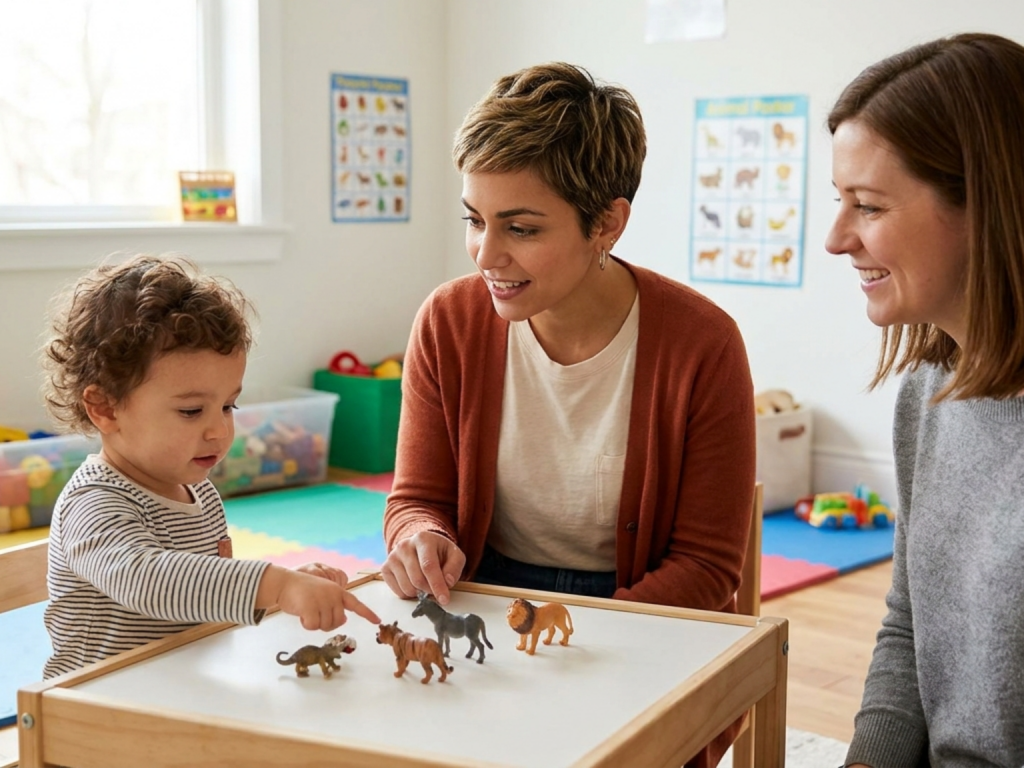
Serve-and-return interaction is a useful model. The child “serves” by looking, pointing, vocalizing, smiling, handing over a toy, or saying a word. The adult “returns” by responding in a meaningful way: naming the object, expanding the child’s message, waiting for another turn, or adding a gentle challenge. If a toddler says “dog,” an adult might say, “Yes, a big dog is running.” This gives the child confirmation plus new vocabulary and grammar.
Quality input can include longer sentences and varied grammar, as long as the interaction stays emotionally connected. For example, “The red cup is under the chair” teaches color, object, location, and sentence structure. Toddlers do not need formal lessons to absorb this. They learn during diaper changes, meals, walks, bath time, picture books, and waiting rooms when adults respond warmly and specifically to their interests.
Hearing, listening, and the medical side of language growth
Hearing is a foundational sensory pathway for spoken language. A toddler who has fluctuating hearing from middle-ear fluid, recurrent ear infections, congenital hearing differences, or delayed access to amplification may miss parts of speech. Even mild or intermittent hearing reduction can make words sound incomplete, especially in noisy environments. Because toddlers cannot always report what they hear, families may notice inconsistent responses, unusually loud media preferences, limited imitation, or frustration during communication.
Evidence indicates that toddlers who begin using hearing aids or cochlear implants before age 2 can show more advanced language abilities and better growth in theory of mind than children who receive access later. Theory of mind refers to understanding that other people have thoughts, feelings, and perspectives. This does not mean every child with delayed language has hearing loss, but it does mean hearing evaluation for speech delay is a key step when concerns arise.
Caregivers should also consider the listening environment. Background television, overlapping adult conversations, and noisy toys can reduce the clarity of speech input. Face-to-face interaction, slower pacing, and visual cues help toddlers map sounds to meaning. If a child has known hearing differences, families should follow the plan from their audiology and medical team and ask for support if devices are difficult to tolerate or use consistently.
Everyday activities that support language without pressure
The most effective language-building activities are usually ordinary, repeated, and emotionally safe. Toddlers learn through meaningful routines because repetition helps the brain predict, compare, and remember. A caregiver can use the same phrases during handwashing, getting dressed, or snack time, then gradually add new words. For example: “Socks on. Blue socks on. One sock, two socks.”
Helpful strategies include:
- Follow the child’s lead: Talk about what the toddler is touching, watching, or trying to do.
- Expand, do not quiz: If the child says “car,” respond with “fast car” or “the car is going.”
- Use wait time: Pause after a comment so the child has a chance to gesture, vocalize, or answer.
- Read interactively: Point to pictures, label actions, make animal sounds, and let the child turn pages.
- Sing and rhyme: Nursery rhymes and songs emphasize rhythm, sound patterns, and predictable language.
- Offer choices: “Apple or yogurt?” encourages meaningful communication more gently than “Say apple.”
It is usually better to reduce performance pressure. A toddler who is repeatedly told “say it” may become quiet or frustrated. Modeling is kinder and often more effective: “You want water. Water, please.” Gestures and signs can also support communication and do not prevent speech; for many children, they reduce frustration while spoken language develops.
When variation is normal and when to seek guidance
Normal variation can be wide. Some toddlers are cautious speakers who understand well and then have a vocabulary burst. Others talk early but still need support with pronunciation, frustration tolerance, or social communication. Multilingual toddlers may mix languages, use words from different languages for the same concept, or appear to have fewer words in one language while their total conceptual vocabulary is stronger across both. These patterns can be typical.
However, some signs deserve timely discussion with a pediatrician or qualified clinician. Consider seeking guidance if a toddler is not using single words by around 16 months, is not combining two words by around 24 months, does not seem to understand simple directions, rarely points or uses gestures, does not respond to name consistently, loses previously used words or social skills, or seems unusually frustrated because communication is not working. Regression at any age should be evaluated promptly.
A speech-language pathologist evaluation may assess comprehension, expressive vocabulary, speech sound production, play, feeding or oral-motor factors when relevant, and social communication. A pediatrician may recommend hearing testing, developmental screening, or referral to early intervention services. Seeking help is not an accusation that a caregiver has done something wrong. It is a way to understand the child’s profile and provide support during a highly responsive period of brain development.
Supporting the whole toddler: emotion, play, and connection
Language does not develop separately from emotional and social development. Toddlers often have big ideas and limited tools for expressing them. When words are hard to find, they may cry, grab, hit, run away, or say “no” repeatedly. These behaviors can be communication attempts, especially when the child is tired, hungry, overstimulated, or transitioning between activities.
Caregivers can support toddler emotional regulation by naming feelings and modeling simple phrases: “You are mad. The block tower fell. Help, please.” This links bodily experience, emotion words, and problem-solving. During a tantrum, the immediate goal is safety and co-regulation, not vocabulary practice. After the child is calmer, a brief recap can help: “You wanted the truck. Waiting was hard. Next time, say ‘my turn.’”
Play is also a language laboratory. Pretend feeding a doll, driving toy cars, hiding animals, or building towers creates reasons to use words such as in, out, open, stuck, more, mine, help, go, stop, big, and again. The adult’s role is not to control the play but to add language that fits the child’s focus. A warm relationship makes the toddler more likely to take communicative risks, imitate new words, and stay engaged long enough for learning to happen.
Screen time, books, and realistic family routines
Families are busy, and many caregivers worry they are not doing enough. Language support does not require expensive toys, perfect scripts, or constant one-on-one time. Short, repeated moments matter: narrating a grocery choice, naming body parts during bath time, or reading two pages of a board book before bed. Consistency and responsiveness are more important than creating an ideal learning environment.
Passive background media is generally less useful for toddlers than live interaction because screens cannot reliably respond to a child’s gaze, gesture, or misunderstanding. If families use video content, co-viewing can make it more language-rich: pause, label what happened, connect it to real life, and invite the child to respond. Still, a shared book, song, or pretend game usually offers more turn-taking.
Books are especially powerful because they combine shared attention, repetition, vocabulary, and emotional closeness. Toddlers do not have to sit still for an entire story. They may point, skip pages, name pictures, or request the same book many times. Repetition is not a problem; it is a learning tool. A caregiver can keep the experience positive by following the child’s pace and using expressive, natural language rather than turning reading into a test.
When to get professional advice
- Seek prompt medical advice if your toddler loses words, gestures, social interest, or other previously acquired skills.
- Discuss concerns if your child is not using single words by about 16 months or not combining two words by about 24 months.
- Ask about age-appropriate hearing testing if speech is delayed, responses to sound are inconsistent, or ear problems are recurrent.
- Consult a clinician if feeding, choking, unusual voice quality, or oral-motor concerns accompany speech difficulties.
- If you are worried, you do not need to wait; early evaluation can clarify whether support is needed.
Tools & Assistance
- Pediatric well-child visits with developmental surveillance and screening
- Audiology assessment for age-appropriate hearing testing
- Speech-language pathologist evaluation
- Early intervention services available through local or regional programs
- A simple home log of words, gestures, comprehension, hearing concerns, and regression if any
FAQ
Should I correct my toddler’s pronunciation?
Gentle modeling is usually better than direct correction. If your child says “tat” for “cat,” you can respond, “Yes, cat. The cat is sleeping.”
Can using signs delay spoken language?
For most toddlers, gestures and signs support communication and reduce frustration. They do not replace spoken modeling; caregivers can sign and say the word together.
Is bilingualism a cause of language delay?
Bilingual exposure does not cause language disorder. A bilingual toddler’s vocabulary should be considered across languages, and concerns should be assessed by professionals familiar with multilingual development when possible.
How much should I talk to my toddler?
Focus on responsive, meaningful interaction rather than constant talking. Follow your toddler’s attention, use varied vocabulary, expand their words, and allow turn-taking.
When should hearing be checked?
Hearing should be checked when there is speech delay, inconsistent response to sound, recurrent ear problems, or caregiver concern. A pediatrician can guide appropriate referral.
Sources
- Institute for Infant and Infant Studies — Parent-Child Interactions Support Early Language Development in Diverse Families
- Association for Psychological Science — The Littlest Linguists: New Research on Language Development
- Community Consolidated Regional Care Center — A guide to language development in early childhood
Disclaimer
This article is for informational purposes only and does not replace medical evaluation, diagnosis, or treatment. If you have concerns about your child’s language, hearing, development, or behavior, consult a qualified healthcare professional.


















Please log in to leave a comment.