
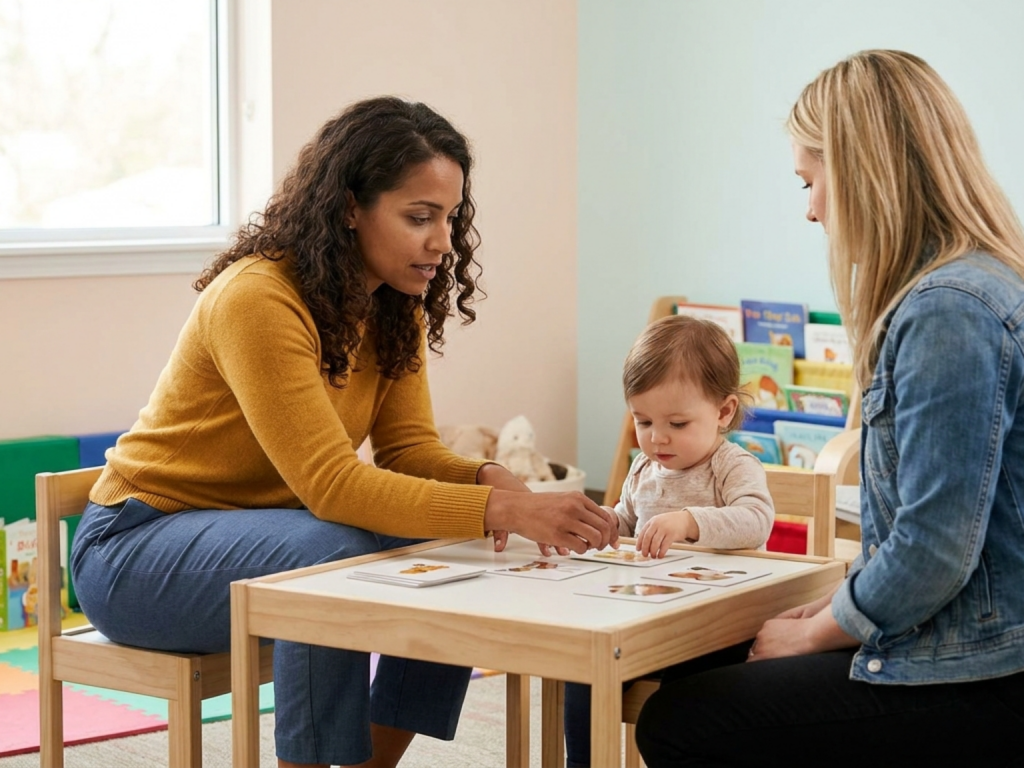
Intro
Speech and language development is one of the most closely watched parts of early childhood, and for good reason: communication affects learning, relationships, behavior, and safety. At the same time, children develop at different rates, and a single missed milestone does not automatically mean a child has a disorder.
This guide summarizes typical speech and language milestones by age, using medically recognized developmental benchmarks. It is intended to help caregivers notice patterns, support everyday communication, and know when to ask a pediatrician, speech-language pathologist, or hearing specialist for guidance.
Highlights
Speech development includes both expressive skills, such as sounds and words, and receptive skills, such as understanding names, routines, and directions.
Hearing is foundational for speech and language; concerns about response to sound should be discussed promptly with a healthcare professional.
Milestones are ranges, not strict deadlines. Persistent delays, regression, or loss of skills deserve timely evaluation.
Everyday interaction, shared reading, singing, and responsive conversation are powerful ways to support communication.
Understanding speech, language, and normal variation
Speech development is often used as a broad phrase, but clinicians usually distinguish several related domains. Speech refers to the motor production of sounds: articulation, voice, fluency, and the coordination of breathing, lips, tongue, palate, and jaw. Language refers to the symbolic system children use to understand and share meaning, including vocabulary, grammar, gestures, social communication, and comprehension. A child may have difficulty in one domain while progressing well in another.
Milestones are best interpreted as patterns over time rather than single pass-or-fail events. Some children talk early, some observe quietly before a rapid vocabulary burst, and bilingual or multilingual children may distribute vocabulary across languages. However, wide variation does not mean every delay should be watched indefinitely. If a child is not responding to sound, has lost words, rarely uses gestures, or is becoming increasingly frustrated because communication is difficult, professional input is appropriate.
Receptive language, or understanding, usually develops alongside expressive language, or talking. For example, before toddlers say many words, they often respond to their name, recognize familiar routines, point, wave, look toward named objects, and follow simple directions. These behaviors matter because they show that the child is mapping sound, attention, and meaning together. Caregivers know their child best, and concerns should be taken seriously even when a brief office visit seems reassuring.
Birth to 6 months: listening, crying, cooing, and early sound play
In the first months of life, speech development is rooted in hearing, bonding, and early turn-taking. Newborns communicate through crying, facial expression, body movement, and changes in alertness. They may quiet to a familiar voice, startle or react to loud sounds, and become soothed by rhythmic speech or singing. These early responses are not “talking,” but they are part of the neural foundation for later communication.
By around 2 to 3 months, many babies coo and make vowel-like sounds such as “ooo” or “ahh.” They may smile in response to a caregiver’s face or voice and appear to enjoy back-and-forth vocal play. This social reciprocity is important: when an adult pauses, the baby may vocalize; when the baby vocalizes, the adult responds. These small exchanges resemble the structure of later conversation.
By about 4 to 6 months, babies often turn their eyes or head toward sounds, notice toys that make noise, and vary their cries for different needs. Babbling may begin with repeated or playful sounds, and infants may laugh, squeal, or experiment with pitch and volume. At this age, caregivers can support development by narrating routines, responding warmly to sounds, singing, and giving the baby quiet face-to-face time. If a baby does not startle to loud sounds, does not appear to notice voices, or seems unusually silent, a pediatrician should assess whether hearing or another medical factor needs evaluation.
6 to 12 months: babbling, gestures, recognition, and first words
Between 6 and 12 months, communication usually becomes more intentional. Babies often babble with consonant-vowel combinations such as “ba,” “da,” or “ma,” and later may repeat syllables like “bababa” or “dadada.” They begin to recognize common words, respond to their name, notice emotional tone, and look toward familiar people or objects when named. These skills show that the brain is linking sound patterns with meaning.
Gestures become especially important in the second half of the first year. A baby may reach to be picked up, show an object, wave, shake the head, or point. Pointing is a major communicative step because it allows the child to direct another person’s attention. Caregivers can strengthen this skill by labeling what the child looks at: “You see the dog,” “That is your cup,” or “The ball rolled away.”
Around 10 to 12 months, some children say a first meaningful word such as “mama,” “dada,” or the name of a favorite object. The key is consistent meaning, not perfect pronunciation. A child may say “ba” for bottle or ball, and that still counts as a meaningful word if used reliably. By the first birthday, many children understand simple phrases like “no,” “come here,” or “bye-bye,” especially when paired with gesture and routine. If there is no babbling, no response to name, limited eye contact or social engagement, or no gestures by the end of this period, caregivers should seek professional advice rather than waiting many more months.
12 to 24 months: first words, vocabulary growth, and simple phrases
The second year is often when expressive language becomes more visible. From 12 to 17 months, many toddlers use several words, imitate familiar sounds, and understand simple questions. They may identify a few body parts, follow one-step directions with gestures, and use words plus gestures to request, protest, or share interest. Pronunciation is typically immature; “wawa” for water or “nana” for banana can be developmentally expected.
Between 18 and 24 months, vocabulary often expands more quickly. Many toddlers begin combining two words, such as “more milk,” “daddy go,” or “big truck.” They may use names of familiar people, favorite foods, animals, toys, and action words. Some sources describe around 50 or more words by about 2 years as a useful benchmark, while other clinical resources note that many children approach or exceed 100 words by age 2. The exact number matters less than a consistent upward trend and functional communication.
Receptive skills also grow. Toddlers may point to named pictures, bring a familiar object when asked, understand “mine” and “yours” in context, and follow simple instructions such as “put it in the box.” They may also begin using pronouns, although errors are common. A caregiver can support this stage by expanding the child’s speech rather than correcting it harshly. If the child says “dog,” the adult might say, “Yes, a big dog is running.” If the child says “more,” the adult can model “more banana.” Evaluation is recommended if a toddler has no meaningful words by around 16 months, is not combining words by around 24 months, does not seem to understand simple directions, or loses previously used words.
2 to 3 years: rapid vocabulary expansion and early sentences
From 2 to 3 years, many children show a major increase in speech and language ability. Vocabulary may grow from dozens of words to hundreds. By around age 3, some children use approximately 500 words, though individual variation is substantial. Children start producing two- and three-word phrases, then longer utterances, and they increasingly use language to comment, ask, pretend, negotiate, and tell simple events.
Grammar becomes more organized during this period. A child may use plurals, early verbs, location words like “in” or “on,” and pronouns such as “me,” “you,” or “I,” often with errors. They may ask simple questions: “What that?” or “Where kitty?” By age 3, many children can speak in short sentences and be understood by familiar listeners most of the time. Unfamiliar listeners may still miss some words because articulation is developing.
Speech sounds also mature gradually. At this stage, children often produce consonants such as p, b, m, h, n, w, and may be developing additional sounds. It is common for difficult sounds to be simplified, clusters to be reduced, or longer words to be shortened. The pattern should still become clearer over time. Concerning signs include very limited vocabulary, little interest in communicating, speech that is extremely difficult for familiar caregivers to understand, inability to follow simple directions, or frequent frustration linked to not being understood. A speech-language evaluation can identify whether support is needed and can also guide caregivers in home strategies.
3 to 4 years: clearer speech, storytelling, and more complex understanding
Between 3 and 4 years, children typically become more conversational. They may speak in sentences of four or more words, ask many questions, describe what happened at preschool or during play, and participate in pretend scenarios. They can often understand concepts such as “same” and “different,” begin grouping objects by category, and follow two-part directions, especially when attention and context are supportive.
Vocabulary continues to expand quickly. Children may use words for colors, shapes, sizes, feelings, and actions. They begin to understand time words, although “yesterday,” “tomorrow,” and “later” may still be confusing. Storytelling is emerging: a child may describe a sequence, but the order may be incomplete or repetitive. Adults can help by gently scaffolding: “First you built the tower, then it fell, and then you laughed.”
Speech intelligibility improves. Many 3- to 4-year-olds are understood by people outside the family much of the time, though some sounds such as r, l, th, s, z, sh, ch, and j may still be developing. Stuttering-like disfluencies can appear transiently during rapid language growth, such as repeating words or phrases. If disfluency is severe, persistent, associated with tension, or causing distress, consultation is advised. Other reasons to seek evaluation include limited sentence use, poor comprehension compared with peers, loss of skills, or speech that remains very hard for unfamiliar listeners to understand.
4 to 5 years: complex sentences, sound refinement, and school readiness
By 4 to 5 years, many children use more complex sentences, tell longer stories, describe past and future events, and adapt language to different listeners. They may explain how to do a familiar task, answer “why” and “how” questions, and use conjunctions such as “because,” “and,” or “but.” They often enjoy jokes, rhymes, songs, and sound play, which are early supports for later reading and phonological awareness.
Comprehension becomes more sophisticated. Children may follow multi-step directions, understand spatial terms such as “behind” or “next to,” and grasp simple time sequences. They can often categorize objects, compare features, and describe functions: “A spoon is for eating.” These skills are important for classroom routines, peer play, and early literacy.
Speech should be mostly understandable to unfamiliar adults by this age, although a few later-developing sounds may not be perfect. Persistent sound errors can still merit attention if they affect intelligibility, confidence, or early literacy. By age 5, many children can use complex sentences, retell events with a beginning and end, and participate in back-and-forth conversation. Caregivers should ask for guidance if a child cannot answer simple questions, struggles to tell basic experiences, has a very limited vocabulary, is hard to understand, or avoids talking because communication feels difficult.
How caregivers can support speech development at every age
The most effective support is usually responsive, warm, and woven into daily routines. Children learn language through repeated, meaningful interaction, not through pressure to perform. Instead of quizzing constantly, caregivers can follow the child’s interest, label what the child is seeing, pause to invite a response, and expand what the child says.
- Talk during routines: name foods, clothing, bath items, body parts, and actions.
- Read together daily: choose books with clear pictures, repetition, rhythm, and chances for the child to point or predict.
- Use child-directed speech: speak clearly, with natural expression, but avoid exaggerated correction.
- Model expansions: if the child says “car go,” respond with “Yes, the red car is going fast.”
- Encourage gestures and words: pointing, waving, signs, and verbal attempts all support communication.
- Reduce background noise: television and devices can make it harder for children to hear speech patterns clearly.
Caregivers should also protect hearing health. Recurrent ear infections, persistent fluid behind the eardrum, or concerns about response to sound can affect speech access. A hearing test may be recommended even if a child passed newborn screening, because hearing status can change. When delays are present, early intervention does not “label” a child in a negative way; it provides assessment, coaching, and targeted support during a period of high neuroplasticity.
When to seek professional guidance
- No response to sound, name, or familiar voices should be discussed promptly with a healthcare professional.
- Loss of previously acquired words, gestures, or social communication skills warrants timely evaluation.
- No babbling by late infancy, no meaningful words by around 16 months, or no two-word phrases by around 24 months should not be ignored.
- Speech that remains very difficult for familiar caregivers to understand, or later for unfamiliar adults, may need assessment.
- Persistent feeding, breathing, voice, or motor concerns alongside speech delay should be reviewed medically.
Tools & Assistance
- Schedule a visit with the child’s pediatrician to review developmental concerns and medical history.
- Request a hearing evaluation with an audiologist if sound response or ear health is a concern.
- Ask for assessment by a licensed speech-language pathologist.
- Contact local early intervention services for children under age 3 or school-based services for older children.
- Keep a simple communication diary with new words, gestures, comprehension skills, and caregiver concerns.
FAQ
Do boys really talk later than girls?
Average timing can differ slightly, but sex alone should not be used to dismiss a significant delay. If milestones are not emerging, seek professional guidance.
Does bilingualism cause speech delay?
Bilingualism does not cause a language disorder. A bilingual child’s total vocabulary across languages should be considered, and concerns should be evaluated by professionals familiar with multilingual development when possible.
Should I wait and see if my toddler is not talking?
A short period of observation may be reasonable for mild concerns, but lack of words, lack of gestures, poor comprehension, or regression should prompt evaluation rather than prolonged waiting.
Can screen time teach a child to talk?
Children learn language best through responsive human interaction. High-quality media may supplement learning, but it should not replace talking, reading, singing, and play with caregivers.
Is unclear pronunciation normal in preschoolers?
Some sound errors are normal, especially with later-developing sounds. However, if speech is hard to understand or the child becomes frustrated, a speech-language evaluation can help.
Sources
- National Institute on Deafness and Other Communication Disorders, NIH — Speech and Language Developmental Milestones
- Mayo Clinic — Language development: Speech milestones for babies
- Children's Hospital of Philadelphia — Age-Appropriate Speech and Language Milestones
Disclaimer
This article is for informational purposes only and does not replace medical evaluation, diagnosis, or treatment. Consult a pediatrician, audiologist, or speech-language pathologist for concerns about a child’s development.















Please log in to leave a comment.