
Intro
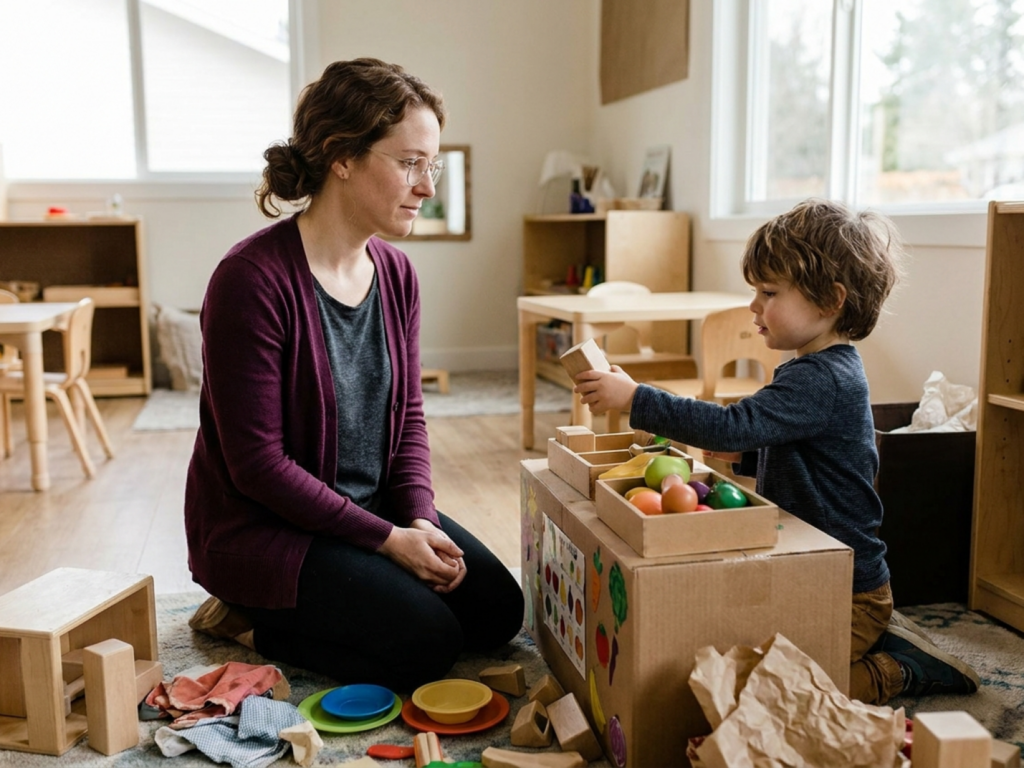
Pretend play is a child’s use of objects, actions, language, or ideas to represent something beyond the immediate reality. A spoon can become an airplane, a child can act as a doctor, or a block can stand for a telephone. This capacity, often called symbolic or representational play, develops alongside language, social understanding, executive function, and emotional regulation.
Development is variable rather than linear. Children may show advanced pretend play in one setting and simpler play when tired, stressed, unfamiliar with the materials, or playing alone. Age ranges provide useful reference points, not rigid pass-or-fail milestones. The quality, flexibility, and progression of play usually matter more than whether a child performs one specific action on a particular date.
Highlights
Pretend play usually begins with simple functional actions and becomes increasingly symbolic, sequenced, flexible, and socially coordinated.
Language and pretend play develop together: children gradually move from copying familiar routines to creating narratives and negotiating roles.
Adults support development best by following the child’s lead, modeling briefly, and allowing the child to control the direction of the play.
Differences in pretend play should be interpreted in the context of communication, social interaction, motor skills, attention, and everyday functioning.
A healthcare professional can help evaluate persistent concerns without assuming that a play difference alone indicates a diagnosis.
What pretend play means in development
Pretend play involves mental representation: the child treats one thing as if it were another, acts out an absent event, or adopts an imagined identity. Early examples may include pretending to drink from an empty cup, placing a toy phone to the ear, or feeding a doll. Later, children coordinate several actions into a meaningful sequence, such as preparing a meal, serving it, and putting the dishes away.
Researchers often distinguish between simple object substitution, role play, social pretense, and extended narrative play. These forms overlap, and development is not perfectly stage-bound. Receptive language, expressive language, imitation, attention, and the ability to hold an idea in mind all contribute. A child does not need elaborate toys to demonstrate pretense; ordinary household objects can reveal sophisticated symbolic thinking.
Pretend play is also relevant to self-regulation. When children act within an imagined scenario, they practice maintaining a goal, inhibiting an immediately preferred response, shifting roles, remembering rules, and managing emotional arousal. Research reviews describe associations between early play and later self-regulation, although play is only one influence among many and does not function as a stand-alone treatment.
Infancy to about 18 months: copying familiar actions
During the second year of life, many children begin to imitate everyday routines and use objects in increasingly purposeful ways. A child may brush a doll’s hair, stir an empty bowl, offer a toy cup to an adult, or lift a remote control as if speaking into a phone. At first, these actions may be closely tied to what the child has just observed. The child is learning that objects have conventional uses and that people can reproduce actions even when the original event is not occurring.
Early pretend play may be brief, repetitive, and dependent on a familiar prop. That does not make it insignificant. Repetition helps consolidate motor plans, object knowledge, imitation, and shared attention. A caregiver who joins the action with simple language, such as “The teddy is drinking,” gives the child a model without requiring a performance.
Some children show pretense first through gestures or actions, while others express it through vocalizations or words. The timing can vary with temperament, language exposure, opportunity for interactive play, and developmental profile. Observing how a child communicates interest and shares attention is more informative than counting isolated pretend actions.
About 18 to 24 months: combining actions and symbols
In the later toddler period, pretend play commonly becomes more intentional and varied. Children may direct an action toward a doll, use an object in an unconventional way, or pretend that an absent item is present. A block may become food, a box may become a bed, or a child may “cook” using empty containers. The child may also begin to understand another person’s pretense and participate in short shared routines.
Sequences are still usually short and familiar. A toddler might put a toy animal to bed, cover it, and say goodnight. If an adult adds too many steps or changes the story abruptly, the child may return to a preferred routine. This reflects the developing capacity for working memory and cognitive flexibility rather than a lack of imagination.
At this age, language and pretend play often reinforce one another. Words label roles, actions, and imagined objects; pretense gives those words a meaningful context. Adults can support this period by narrating what the child is already doing, offering one small extension, and waiting for the child to respond. “The cup is empty. Shall we pour more?” is usually more supportive than taking over the entire scenario.
About 22 to 34 months: longer and more organized play
Across the toddler years, pretend play may become more elaborate in several dimensions: the number of related actions, the use of multiple objects, the ability to represent events that are not immediately visible, and the inclusion of another person in the sequence. A child may now organize a miniature routine, assign a role to a caregiver, or combine familiar experiences into a novel scenario.
Research examining developmental change between 22 and 34 months found that pretend-play sequences can become more sophisticated over time, while also showing substantial individual variation. The central developmental trend is not simply “more toys” or “more talking.” It is increasing coordination: actions connect to one another, objects can stand for absent things, and the child can sustain an imagined premise for longer.
Caregivers may notice emerging role flexibility, such as switching from parent to baby or from veterinarian to patient. However, many toddlers still prefer repetition and may become distressed when another person violates the play script. Predictable repetition can be developmentally useful. Adults can preserve the child’s theme while gently introducing flexibility: “The puppy is sick. We can take it to the clinic, then help it rest at home.”
This is also a period in which pretend play and self-regulation begin to intersect more visibly. The child practices waiting for a turn, following a simple imagined rule, and recovering when the story changes. These capacities remain immature and require co-regulation from adults.
Ages 3 to 5: role play, narratives, and social negotiation
Preschool-age children often expand pretend play from isolated routines into sustained scenarios. They may create a restaurant, hospital, classroom, family, rescue mission, or imaginary creature world. The play can include role assignment, dialogue, props used symbolically, invented problems, and attempts to resolve those problems. Children may also distinguish between the real and pretend frames, even when the story is emotionally intense.
Language becomes increasingly important. Children use narrative structure, causal explanations, questions, humor, and imagined perspectives. They may explain what a box represents, tell a peer how the game works, or revise a storyline after a suggestion. The ability to maintain a shared premise is still developing, so disagreements about roles and rules are common. In cooperative play in preschool years, children are learning both social imagination and practical negotiation.
Play at this age can provide a safe context for emotional expression, but adults should avoid treating every fictional event as a direct statement of the child’s psychological state. A child may play “being sick” because the theme is familiar or interesting, not because the child is medically distressed. Calm observation and open-ended questions are preferable to interrogation.
Helpful adult support includes providing time, space, and open-ended materials; joining when invited; modeling language for compromise; and helping children repair conflicts. Instead of dictating the story, an adult might say, “You are the pilot, and I am waiting for instructions. What happens next?” This preserves agency while extending language and planning.
Ages 5 to 7 and beyond: complex worlds and shared rules
In early school years, pretend play may become more complex, collaborative, and rule-governed. Children can sustain multi-part narratives, maintain several characters, create maps or written signs, and combine pretend play with construction, drawing, digital media, or physical games. They may develop fictional worlds with histories, systems, and recurring characters. The distinction between pretend play and games with formal rules can become less clear as children negotiate both.
Executive functions become increasingly visible. Children plan a scenario, remember agreed rules, inhibit actions that would disrupt the shared story, and revise ideas in response to peers. They also develop greater metacognition: they can discuss whether a story is fair, why a character behaved in a certain way, or how the game should be changed. Creative and narrative play may continue throughout middle childhood, although it may be expressed through role-playing games, building projects, performance, writing, or collaborative problem-solving.
Older children may use pretend play to explore competence, morality, identity, danger, relationships, and cultural roles. Themes can be repetitive or dramatic without being pathological. The most useful questions concern flexibility, enjoyment, social reciprocity, and whether play coexists with participation in daily activities. Children should not be pressured to perform imaginative play in an adult-defined way; some demonstrate representation through drawing, storytelling, construction, movement, or internal fantasy rather than conventional doll or costume play.
How adults can support pretend play
Supportive play does not require specialized equipment or elaborate acting. Begin by observing what captures the child’s attention and imitate the child’s action. Add one related idea, then pause. This “follow, model, and wait” approach gives the child room to initiate, communicate, and organize the play.
- Offer flexible materials such as blocks, containers, fabric, toy figures, paper, crayons, and safe household objects.
- Use descriptive language that matches the child’s level, then introduce occasional new words for actions, feelings, locations, and roles.
- Allow repetition while making small, optional extensions to the familiar script.
- Ask open questions sparingly; comments and pauses often support richer play than a stream of questions.
- For peer play, coach turn-taking and repair without resolving every disagreement for the children.
- Protect uninterrupted time and reduce background media when sustained play is the goal.
Play should remain voluntary and emotionally safe. A child who is tired, anxious, hungry, or overstimulated may use simpler play temporarily. Responsive adults adjust expectations, help regulate distress, and return to playful exploration when the child is ready.
When differences deserve professional discussion
Variation in pretend play is common, and no single absent behavior establishes a diagnosis. Nevertheless, caregivers may reasonably consult a pediatrician, family physician, child psychologist, speech-language pathologist, occupational therapist, or developmental specialist when concerns are persistent, occur across settings, or affect participation and relationships.
Examples for discussion include very limited imitation or symbolic play beyond the expected developmental period, loss of previously acquired play or communication skills, little shared attention, marked difficulty understanding or joining another person’s play, or repetitive play that is unusually rigid and causes significant distress when interrupted. Concerns are more meaningful when considered alongside language comprehension, expressive communication, social reciprocity, sensory responses, motor development, adaptive skills, and emotional regulation.
A professional assessment should use developmental history, observation, caregiver report, and appropriate standardized tools when indicated. Families can prepare by recording examples of play across home and childcare settings, noting what prompts engagement, and documenting any regression. Seeking guidance is not an accusation or a prediction; it is a way to understand the child’s strengths and identify appropriate support. Early consultation can be useful even when the eventual conclusion is that the child’s variation falls within a broad range.
When to seek guidance
- Discuss any loss of previously acquired play, language, or social skills promptly with a healthcare professional.
- Seek developmental advice when play concerns occur with persistent communication, social, motor, sensory, or adaptive difficulties.
- Do not use pretend-play milestones alone to diagnose autism, language disorder, intellectual disability, or another condition.
- Avoid forcing pretend play or interpreting a single theme as proof of a hidden emotional problem.
- Urgent medical care is appropriate for acute safety concerns, injury, severe distress, or suspected abuse; these issues are separate from ordinary play variation.
Tools & Assistance
- Keep a brief play observation log across familiar and unfamiliar settings.
- Use open-ended household materials and protect regular child-led playtime.
- Ask a pediatrician or family physician about developmental screening when concerns persist.
- Request assessment from speech-language, occupational, psychological, or developmental professionals when appropriate.
- Share observations with childcare or school staff to compare patterns across environments.
FAQ
At what age does pretend play start?
Early forms often emerge during the second year, commonly through imitation of familiar routines such as feeding a doll or pretending to use a phone. Timing varies, and early symbolic actions may be brief.
Is repetitive pretend play a concern?
Repetition is common and can help children practice a sequence. It warrants discussion when play is persistently rigid, causes substantial distress, limits participation, or occurs with broader communication or developmental concerns.
How can I encourage pretend play without taking over?
Follow the child’s lead, describe the action, add one small related idea, and pause. Offer open-ended materials and let the child decide whether to accept or reject your suggestion.
Does a child need to play with dolls or costumes to show imagination?
No. Imagination can appear through storytelling, drawing, construction, movement, object substitution, role-playing games, or explanations of an imagined situation.
When should I ask for a developmental evaluation?
Consult a healthcare professional when concerns persist across settings, skills regress, or differences in play accompany communication, social, motor, sensory, adaptive, or emotional difficulties.
Sources
- PubMed Central — Developmental Changes in Pretend Play from 22- to 34-months in Autism Spectrum Disorder: A Repeated Measures Study
- PubMed Central — Pretend play as the space for development of self-regulation
- Early Childhood Research & Practice — The Role of Pretend Play in Children's Cognitive Development
Disclaimer
This article provides general educational information and does not diagnose, treat, or replace advice from a qualified healthcare professional. Consult your child’s clinician for individualized developmental concerns.

















Please log in to leave a comment.