
Intro
Babies can deteriorate quickly during an emergency, and their small airways, immature respiratory control, and limited ability to communicate make first aid especially important. A calm, prepared caregiver can provide immediate support while arranging professional medical help.
This article covers common first-aid priorities for infants, including choking, unresponsiveness, cardiopulmonary resuscitation (CPR), minor injuries, burns, and when urgent assessment is needed. First aid is temporary care, not a diagnosis or substitute for emergency services or a clinician's evaluation.
Highlights
Call emergency services immediately when a baby is unresponsive, not breathing normally, or has severe breathing difficulty.
For a conscious choking infant under 1 year, alternate five back blows with five chest thrusts and repeat until the obstruction is expelled or the baby becomes unresponsive.
Begin infant CPR if the baby is unresponsive and not breathing normally; use gentle compressions and follow dispatcher instructions.
Do not shake, blindly sweep the mouth, or perform abdominal thrusts on an infant.
After any serious event, even if the baby appears to recover, obtain prompt medical advice.
Start with safety and a rapid assessment
Before approaching, check that the environment is safe for you and the baby. Remove hazards such as traffic, water, smoke, electricity, or unstable furniture. Then assess responsiveness by speaking to the baby and gently tapping the sole of the foot. Do not shake the infant. Observe breathing for no more than 10 seconds. Occasional gasping, irregular snorting, or agonal breathing is not normal breathing and should be treated as an emergency.
If the baby is unresponsive, is not breathing normally, or has only abnormal gasps, call your local emergency number and place the phone on speaker if possible. Ask another person to bring an automated external defibrillator (AED), if available, and to meet emergency responders. If you are alone, follow the emergency dispatcher’s instructions. A dispatcher can guide CPR and choking care while help is traveling.
If the baby is conscious and breathing effectively, keep the infant warm, limit movement, and continue observing. Do not offer food, drink, or medication during an acute emergency. Any significant change in color, consciousness, breathing effort, or muscle tone warrants urgent professional advice.
Choking in a baby under 1 year
Suspect severe airway obstruction when a baby cannot cry, cough effectively, or breathe, or becomes cyanotic, limp, or silent. If the baby is coughing forcefully or making sounds, allow the cough to continue while watching closely; do not slap the back during an effective cough. If the cough becomes weak or the baby cannot breathe, begin first aid.
- Support the baby’s head, neck, and jaw with one hand. Place the infant face-down along your forearm or thigh, keeping the head lower than the chest and supporting the jaw without compressing the throat.
- Give five firm back blows between the shoulder blades using the heel of your hand. After each blow, check whether the object has been expelled.
- If the obstruction remains, turn the infant face-up while supporting the head and neck. Keep the head lower than the chest and give five gentle but distinct chest thrusts on the breastbone, using two fingers just below the nipple line.
- Continue alternating five back blows and five chest thrusts until the object comes out, the baby begins to breathe effectively, or the infant becomes unresponsive.
Never use abdominal thrusts on a baby, put your fingers blindly into the mouth, or try to push the object deeper. If the baby becomes unresponsive, lower the infant to a firm, flat surface, call emergency services if this has not already occurred, and start CPR. Each time the airway is opened during CPR, look for a visible object and remove it only if you can see and grasp it safely.
Infant CPR when the baby is unresponsive
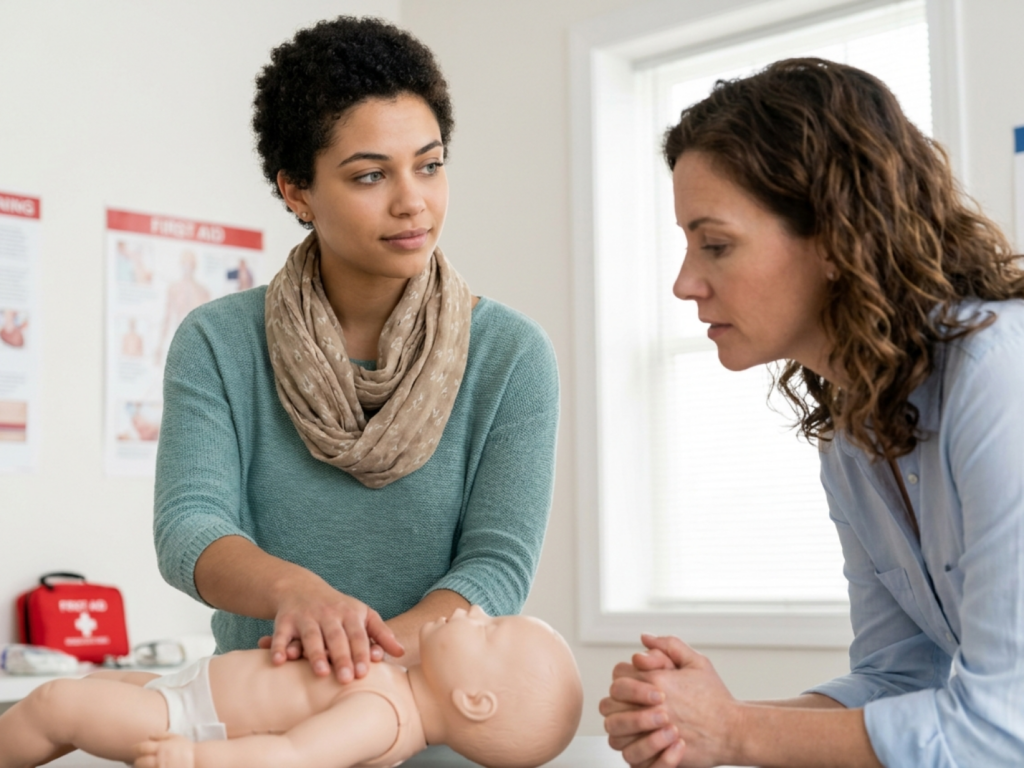
Infant CPR is indicated when a baby is unresponsive and not breathing normally. Place the infant on a firm, flat surface. Activate emergency services and use speakerphone so that you can receive instructions. If an AED is available, turn it on and follow its prompts; use infant or pediatric pads when available, without delaying emergency care to search for them.
Begin with chest compressions. Use two fingers in the center of the chest on the lower half of the breastbone, avoiding the xiphoid area and the ribs. Compress to about one-third of the chest depth, approximately 4 cm in many infants, at a rate of 100 to 120 compressions per minute. Allow the chest to recoil fully between compressions and keep pauses as short as possible.
For a trained rescuer able to provide breaths, use the standard 30 compressions followed by two breaths when alone. Open the airway with a neutral head position rather than marked extension. Make a seal over the baby’s mouth and nose and give two gentle breaths, each just sufficient to produce visible chest rise; excessive volume or force can injure the lungs. Continue cycles of compressions and breaths until the baby shows signs of life, an AED directs you to pause, another trained rescuer takes over, or emergency professionals arrive.
If you are unwilling or unable to provide rescue breaths, continuous chest compressions are preferable to doing nothing while awaiting dispatcher guidance. Formal infant CPR training is strongly recommended for parents, relatives, childcare workers, and other regular caregivers.
Bleeding, wounds, and falls
For a small superficial cut, wash your hands, apply gentle direct pressure with clean gauze or cloth, and rinse the wound with clean running water once bleeding is controlled. Avoid applying harsh chemicals, powders, or unprescribed products. Cover the area with a clean dressing and observe for persistent bleeding, increasing swelling, spreading redness, discharge, or fever, which require medical advice.
For heavy bleeding, use firm continuous direct pressure and call emergency services. Do not repeatedly lift the dressing to inspect the wound; add another layer over it if blood comes through. If an object is embedded, do not remove it. Apply pressure around the object and wait for professional help.
After a fall or impact, keep the baby still if a neck, back, or major injury is possible. Seek urgent assessment after loss of consciousness, repeated vomiting, seizure, unusual sleepiness, difficulty waking, abnormal behavior, unequal pupils, weakness, persistent inconsolable crying, or fluid or blood from the nose or ears. Babies may not show obvious external injury after a significant head impact, so a low threshold for contacting a clinician is appropriate. Do not give food or drink before assessment if a serious injury may require procedures or sedation.
Burns, scalds, and thermal injuries
For a minor thermal burn, remove the baby from the heat source and cool the affected area under cool running water for 20 minutes when feasible. Start cooling promptly, but prevent hypothermia by keeping the rest of the baby warm and avoiding a prolonged whole-body exposure. Remove clothing or jewelry near the burn only if it is not stuck to the skin. Do not pull away adhered fabric.
Do not apply ice, butter, oils, toothpaste, powders, or adhesive dressings. Do not break blisters. After cooling, cover the burn loosely with sterile non-adherent material or clean plastic film, keeping it away from the face and ensuring that it does not constrict swollen tissue.
Because infants have delicate skin and a relatively large surface-area-to-volume ratio, obtain medical advice for burns in a baby even when the area appears limited. Emergency assessment is particularly important for burns involving the face, hands, feet, genitals, major joints, or a circumferential area; deep or white, charred, or numb skin; chemical or electrical burns; inhalation of smoke; or any burn larger than a small superficial area. Chemical exposure requires emergency guidance and careful removal of contaminated clothing.
Other urgent situations and prevention
Suspected poisoning, swallowed medication, button-battery ingestion, or contact with a chemical requires immediate contact with local emergency services or a poison information center. Do not induce vomiting and do not give milk, water, food, or activated charcoal unless a poison specialist or clinician specifically instructs you to do so. Keep the container, product name, estimated amount, and time of exposure available for responders.
For a nosebleed, sit or hold the baby upright with the head slightly forward and apply gentle pressure to the soft part of the nose only if the baby can tolerate it. Do not tilt the head backward. For a suspected eye injury, do not rub the eye or attempt to remove an embedded object; cover it loosely and seek urgent care. Electrical injury, drowning, breathing difficulty, seizure, severe allergic reaction, or sudden collapse always warrants emergency help, even if the baby subsequently appears improved.
Prevention reduces the need for emergency intervention. Use age-appropriate foods and supervision during feeding, keep small objects, medicines, batteries, cords, hot liquids, and cleaning products out of reach, and maintain a clear safe sleep environment. Learning infant choking response and CPR before an emergency is valuable. Include caregivers, grandparents, and childcare providers in the training, and review the emergency plan, local numbers, home address, and available first-aid supplies regularly.
Call emergency services now
- The baby is unresponsive, not breathing normally, or has abnormal gasping.
- The baby has severe breathing difficulty, blue or gray coloring, or becomes limp.
- Choking does not resolve promptly, or the baby becomes unresponsive.
- There is uncontrolled bleeding, a serious head injury, a major burn, or possible spinal injury.
- A button battery, medication, chemical, or unknown substance may have been swallowed.
- The baby has a seizure, drowning episode, severe allergic reaction, or sudden collapse.
Tools & Assistance
- Book an infant CPR and choking-response course through a recognized first-aid or resuscitation organization.
- Save the local emergency number and poison information center number in every caregiver's phone.
- Keep a stocked first-aid kit with gauze, clean dressings, gloves, and a digital thermometer.
- Post the home's exact address and emergency instructions where babysitters and visitors can find them.
- Ask the baby's clinician how to obtain region-specific guidance for fever, injury, and emergency transport.
FAQ
Should I perform abdominal thrusts on a choking baby?
No. For an infant under 1 year, use alternating back blows and chest thrusts. Abdominal thrusts can injure an infant.
What if I am not trained in infant CPR?
Call emergency services, use speakerphone, and follow the dispatcher's instructions. If the baby is unresponsive and not breathing normally, begin chest compressions rather than waiting passively.
Should I sweep my finger through the baby's mouth during choking?
Only remove an object that is clearly visible and easy to grasp. A blind finger sweep may push the object farther into the airway.
Does a baby need medical assessment after recovering from choking?
Yes. Seek prompt medical advice after a significant choking episode, particularly if rescue maneuvers were required, breathing remains abnormal, or coughing, wheezing, or color changes continue.
Can I use ice on a baby's burn?
No. Cool running water is preferred when appropriate. Ice can further damage injured skin and contribute to hypothermia.
Sources
- Mayo Clinic — Choking: First aid
- MedlinePlus — Choking - infant under 1 year
- MedlinePlus — CPR - infant: MedlinePlus Medical Encyclopedia
Disclaimer
This article provides general educational information and does not diagnose or treat medical conditions. In an emergency, call local emergency services and follow the instructions of qualified healthcare professionals.
















Please log in to leave a comment.