
Intro
Starting school is a major developmental transition. A child may feel excited, curious, proud, worried, or overwhelmed, sometimes within the same day. Caregivers can make this period more manageable by combining emotional reassurance with practical preparation and close collaboration with school staff.
There is no single timetable for adjustment. Temperament, previous care experiences, language, neurodevelopmental profile, health, family circumstances, and the predictability of the school environment all influence how a child responds. The goal is not to eliminate every difficult feeling, but to help the child experience school as understandable, supported, and increasingly safe.
Highlights
Predictable routines and brief, confident goodbyes can reduce uncertainty.
School visits, visual information, and role-play help children rehearse unfamiliar experiences.
Ongoing communication between caregivers and educators is a central protective factor.
Temporary distress is common, but persistent or severe impairment deserves professional assessment.
Understand the transition from the child’s perspective
School entry requires a child to manage several simultaneous changes: separating from familiar caregivers, entering a new physical environment, following group instructions, communicating needs, tolerating sensory stimulation, and shifting between activities. These demands draw on executive functions such as working memory, inhibitory control, cognitive flexibility, and sustained attention. A child who manages well at home may therefore appear tired, irritable, quiet, or less organized during the early school period.
School transitions in children are also relational. The child is learning whether adults will notice distress, respond consistently, and help with repair after mistakes. Some children show anxiety through crying or refusal; others become unusually compliant, physically clingy, aggressive, withdrawn, or somatically focused, reporting headaches or stomachaches. These behaviors communicate difficulty but do not, by themselves, establish a diagnosis.
Begin with curiosity rather than judgment. Ask open questions such as, “What part of the day felt easiest?” or “Was there a time you did not know what would happen next?” Drawing, puppets, books, and pretend play may reveal concerns that are difficult to verbalize directly. Avoid promising that school will be fun all the time; a more credible message is that school may include hard moments and that trusted adults can help.
Prepare gradually before the first day
Preparation works best when it is concrete, repeated, and paced to the child’s tolerance. If possible, visit the school or walk past it, identify the entrance, locate the classroom, and meet the teacher or another familiar staff member. A classroom visit, photograph, map, or short video can reduce the cognitive load of imagining an unfamiliar setting. Ask the school what the arrival sequence, toileting arrangements, meal schedule, outdoor time, and collection procedure will be.
Rehearse the parts of the day that are most likely to be difficult. Use dolls or role-play to practice hanging up a coat, asking for help, joining an activity, eating lunch, and saying goodbye. Keep practice brief and end with success. A simple visual schedule using drawings or photographs can show the sequence from waking to school, then school to home. For children who benefit from explicit predictability, pair the schedule with first-then language, such as “First we enter the classroom, then you choose a book.”
Share relevant information with school staff before attendance begins. This may include communication methods, sensory sensitivities, sleep concerns, food restrictions, mobility needs, separation triggers, calming strategies, cultural or family routines, and previous experiences of loss, displacement, hospitalization, or frightening events. The Institute of Education Sciences emphasizes family engagement, social-emotional learning, and trauma-informed supports as practical components of early transition planning.
Establish supportive home routines
Children generally cope better when the biological demands of school are not competing with avoidable sleep loss, rushed mornings, or missed meals. Shift bedtime and wake time gradually if the school schedule differs substantially from the holiday routine. Prepare clothing, bags, medication information, and lunch the evening before. Build a morning sequence that contains a small buffer for delays, because time pressure can amplify dysregulation.
Practice self-care skills in ordinary situations rather than turning them into high-stakes tests. Depending on age and ability, the child might learn to open a lunch container, use the bathroom, wash hands, manage clothing fasteners, put belongings in one place, and tell an adult when help is needed. Offer limited choices, such as choosing between two outfits, while keeping the overall routine stable. Independence should be scaffolded: demonstrate, do the task together, then reduce assistance gradually.
A transitional object, family photograph, small note, or other school-approved item may provide continuity for some children. Confirm the school’s rules and avoid making the object the only available coping strategy. Teach several options, including slow breathing, squeezing and releasing the hands, looking at a visual cue, seeking a named adult, or moving briefly to a quiet area. These strategies are most effective when practiced during calm periods and supported through co-regulation rather than demanded during peak distress.
Handle separation and the first weeks
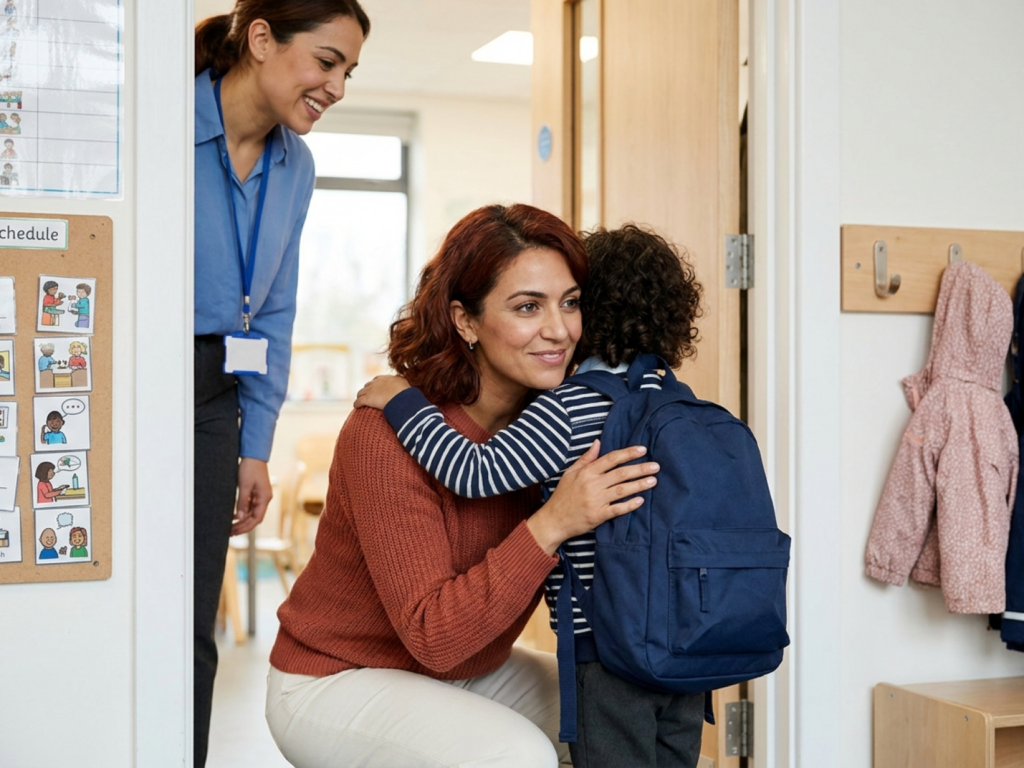
A consistent goodbye routine is usually more helpful than prolonged negotiation. Use the same short sequence each day: acknowledge the feeling, state what will happen, complete a predictable goodbye, and transfer responsibility to the receiving adult. For example: “You are worried, and I will come back after story and outdoor time. We will hug, wave, and then your teacher will help you choose an activity.” Do not disappear without saying goodbye, but also avoid repeated returns that unintentionally prolong uncertainty.
Coordinate the handover with the teacher. Some children settle more easily when they enter with a specific job, such as carrying the attendance folder, watering a plant, or choosing a puzzle. Others need a quieter arrival, a visual check-in, or access to a familiar activity. Ask the school to report observable information rather than only saying that the child was “good” or “bad”: how long distress lasted, what helped, whether the child ate, participated, rested, and connected with peers.
At home, expect decompression. A child may hold themselves together at school and release emotion later through crying, irritability, clinginess, or an after-school meltdown. Offer food, water, rest, movement, and connection before asking many questions or scheduling extra demands. Maintain boundaries calmly while recognizing that behavior may reflect depleted regulatory capacity. Adjustment should gradually show some improvement, even if progress is uneven. The research on successful early school transitions highlights the importance of coordinated support from parents, children, and school personnel rather than placing responsibility on the child alone.
Adapt support to neurodevelopmental and health needs
Some children require more individualized planning because of autism, attention-deficit/hyperactivity disorder, developmental language differences, sensory processing difficulties, motor limitations, chronic illness, hearing or vision impairment, anxiety, or previous traumatic experiences. This does not mean that school entry is inappropriate; it means that the environment and expectations may need thoughtful modification. Useful supports can include a visual timetable, reduced verbal load, advance warning of changes, preferential seating, a quiet regulation space, extra processing time, predictable adult check-ins, and alternative ways to communicate distress.
Ask the school how it identifies a point person and how concerns are documented. A written transition plan can specify the child’s strengths, likely stressors, early signs of overload, preferred supports, emergency contacts, and criteria for reviewing the plan. Where relevant, caregivers may consult the child’s pediatrician, psychologist, speech-language pathologist, occupational therapist, or other qualified clinician. Professionals can help distinguish an expected adjustment response from difficulties requiring further evaluation, without assuming that every school-related behavior reflects a medical disorder.
Trauma-informed care is especially important when a child has experienced violence, bereavement, forced migration, family separation, serious illness, or other significant adversity. Staff should prioritize safety, predictability, choice, and relationship-building, while avoiding coercive exposure or public discussion of private history. Caregivers should share only information necessary to support the child and clarify who may access it.
Build a collaborative home-school plan
Effective collaboration is specific, reciprocal, and sustainable. Agree on the best communication channel, how often updates will occur, and which observations matter. A brief daily note may be useful initially, but indefinite intensive reporting can burden families and staff. Over time, transition to a weekly review focused on patterns, progress, and adjustments. Ask what the child enjoys, which adults they seek, and when participation is strongest; strengths are clinically and educationally useful because they identify routes into engagement.
Use shared language for goals. Rather than “make the child stop crying,” a goal might be “enter the classroom with adult support and choose an activity within ten minutes.” Rather than “improve behavior,” specify “use a help card or gesture before leaving the group.” Review whether the plan is working across settings and whether demands are being increased gradually. The family and school should also agree on how to respond if the child refuses attendance, becomes physically unsafe, or develops new health complaints.
Resources on supporting young children’s transitions recommend school visits, information sharing, classroom familiarity, and ongoing parent-teacher communication. These actions are not merely logistical; they create continuity between the child’s attachment relationships at home and the new relationships being formed at school.
Know when to seek additional help
Many children need several weeks to establish trust and stamina. Monitor function rather than focusing only on visible emotion. Consider seeking guidance if distress remains intense or worsens, the child cannot separate or participate despite consistent support, sleep and appetite are substantially disrupted, physical complaints are frequent, toileting regresses persistently, or there is marked withdrawal, aggression, panic, or loss of previously acquired skills. Also seek advice when school concerns and family observations differ significantly.
Start with the teacher and school leadership, then contact the child’s healthcare professional if concerns persist or affect functioning. Depending on the situation, an assessment may consider anxiety, language or learning needs, sensory factors, sleep, pain, medication effects, family stress, or other medical and psychosocial contributors. Urgent help is appropriate for immediate safety concerns, suspected abuse, serious self-injury, severe breathing or allergic symptoms, or other acute medical problems.
Professional support should complement, not replace, the child’s relationship with responsive adults. Reassure the child that needing help is acceptable. Frame meetings around problem-solving and accommodations, not blame. A successful transition is measured by growing participation, security, communication, and recovery—not by perfect mornings from the outset.
When to seek prompt professional support
- Contact a healthcare professional when distress is persistent, escalating, or significantly impairing sleep, eating, attendance, or family functioning.
- Seek evaluation for frequent unexplained physical complaints or persistent loss of previously acquired skills.
- Ask the school to review the plan when the child cannot participate despite consistent, reasonable supports.
- Seek urgent help for immediate danger, serious self-injury, suspected abuse, or acute medical symptoms.
Tools & Assistance
- A picture-based morning and school-day visual schedule
- A brief, consistent goodbye script practiced at home
- A transition notebook or agreed secure communication channel with the teacher
- A school visit, classroom rehearsal, or meeting with the designated transition staff member
- A written support plan listing triggers, strengths, calming strategies, and review dates
FAQ
How long does it usually take a child to adjust to school?
Adjustment varies widely. Some children settle within days, while others need several weeks or longer. Look for gradual improvement in recovery, participation, sleep, and trust rather than expecting distress to disappear immediately.
Should caregivers stay at school during drop-off?
That depends on the school’s policy and the child’s needs. A brief, predictable handover is often preferable to an extended separation, but some children benefit from a planned gradual entry. Agree on the approach with school staff and review its effect.
What if my child cries every morning?
Acknowledge the feeling, keep the goodbye consistent, and ask staff what happens after separation. If crying remains intense, lasts for a prolonged period, or is accompanied by major functional changes, discuss an individualized plan with the school and the child’s healthcare professional.
Is regression after starting school concerning?
Temporary changes such as increased clinginess, fatigue, or occasional toileting accidents can occur during stress. Persistent, severe, or worsening regression warrants discussion with school staff and a qualified healthcare professional.
How can I help a child who does not talk about school?
Avoid repeated direct questioning. Try play, drawing, shared reading, or specific prompts about activities, people, sounds, and transitions. Ask the teacher for observations and consider professional guidance if the child appears distressed or communication changes substantially.
Sources
- PubMed — Barriers to and Facilitators of Successful Early School Transitions for Young Children
- Springer / Early Childhood Education Journal — Supporting Young Children’s Transitions to School: Recommendations for Families
- Institute of Education Sciences — Practical Resources to Support Early Learners' Transitions to School
Disclaimer
This article provides general educational information and is not a diagnosis or individualized medical advice. Consult a qualified healthcare professional and the child’s school team for concerns about development, mental health, safety, or functioning.


















Please log in to leave a comment.