
Intro
When a child resists a familiar routine, everyday tasks can quickly become emotionally exhausting for the entire household. A child may refuse to brush teeth, delay getting dressed, leave bed repeatedly, demand one more story, or become distressed when a caregiver changes the usual sequence. These behaviors are common, but they can become more persistent when routines vary from day to day or when adults respond differently under pressure.
Routine resistance is not necessarily deliberate defiance. Children may be responding to separation anxiety, a need for control, difficulty shifting attention, fatigue, sensory discomfort, or an unclear expectation. A supportive approach combines empathy with predictable limits, while remaining alert to sleep, developmental, emotional, and medical factors that may warrant professional assessment.
Highlights
Routine resistance often reflects difficulty with transitions, separation, fatigue, or loss of control rather than simple disobedience.
Inconsistent expectations can unintentionally reinforce protesting, delaying, and repeated requests.
Predictable but flexible routines are usually more sustainable than rigid schedules that cannot accommodate real family life.
Bedtime resistance should be addressed calmly and consistently, with attention to sleep needs and possible underlying concerns.
What routine resistance can look like
Routine resistance may appear as refusal, bargaining, stalling, emotional outbursts, or repeated attempts to restart a completed step. At bedtime, common patterns include refusing to get into bed, leaving the bedroom, calling for a caregiver, asking repeated questions, requesting food or water, and becoming tearful or angry when lights are turned off. During the day, a child may resist dressing, toothbrushing, meals, homework, school departure, or transitions away from preferred activities.
The behavior may be situational rather than constant. A child can cooperate at school but resist intensely at home, or follow a routine for several days before struggling again. This fluctuation does not mean the child is manipulating the family or that caregivers have failed. It may reflect changing sleep pressure, developmental needs, stress, illness, family schedule changes, or the child’s limited capacity for self-regulation at that moment.
Families may describe this pattern as routine refusal in children. The more a routine becomes associated with conflict, hurried instructions, or unpredictable consequences, the more emotionally charged the transition can become.
Why inconsistent routines make problems harder
Children learn not only from what adults say, but also from what happens after they protest. If leaving bed eventually results in extra play, a later bedtime, prolonged attention, or access to a preferred activity, the child may learn that delaying is effective, even when no one intends to reward it. Similarly, if one caregiver enforces a limit while another routinely changes it, the child receives mixed information about what is expected.
Inconsistency is understandable. Adults may be exhausted, working different shifts, managing siblings, responding to illness, or trying to avoid a public meltdown. However, unpredictable routines can increase uncertainty and give the child more reason to test boundaries. This is one explanation for Difficulty maintaining routine: the routine may be technically defined, but its timing, sequence, or follow-through changes frequently.
Consistency does not require identical behavior every day. A useful goal is a small set of stable cues: approximately predictable timing, the same essential steps, brief explanations, and similar responses to protest. A routine can remain flexible for travel, weekends, cultural practices, or unusual family demands while preserving its basic structure.
Common reasons a child resists
Young children often seek control because many aspects of their lives are decided by adults. Choosing when to stop playing, enter the bath, or separate from a caregiver can feel like a loss of autonomy. Offering limited, acceptable choices can reduce this struggle. For example, a caregiver might ask whether the child wants the blue or green pajamas, or whether teeth should be brushed before or after the bedtime story. These are examples of controlled choices during routines; they provide agency without allowing the child to avoid the routine altogether.
Separation anxiety is another important contributor, particularly around sleep. A child may resist lying down because bedtime creates distance from a parent or because the child anticipates being alone. This is often described as bedtime resistance and separation anxiety. Reassurance, a predictable goodbye, and a calm return to the planned routine may help, but persistent or severe anxiety deserves professional discussion.
Fatigue can also increase irritability and reduce a child’s ability to cooperate. Conversely, a schedule that is poorly matched to the child’s sleep needs may make bedtime difficult. Sensory factors, including discomfort from clothing, toothbrushing, bathing, noise, lighting, or the feel of bedding, may be relevant. Other possibilities include stress at school, family changes, pain, reflux, breathing problems during sleep, medication effects, or emotional concerns. Caregivers should avoid assuming that every refusal is behavioral.
Building a routine that a child can follow
Start with the smallest workable routine rather than attempting to redesign the entire day. Select two or three high-impact periods, such as the morning departure and bedtime. Define the essential steps in a consistent order. For bedtime, this might include toileting, washing, pajamas, a brief story, a goodnight phrase, and lights out. The sequence should be short enough that adults can maintain it even on difficult evenings.
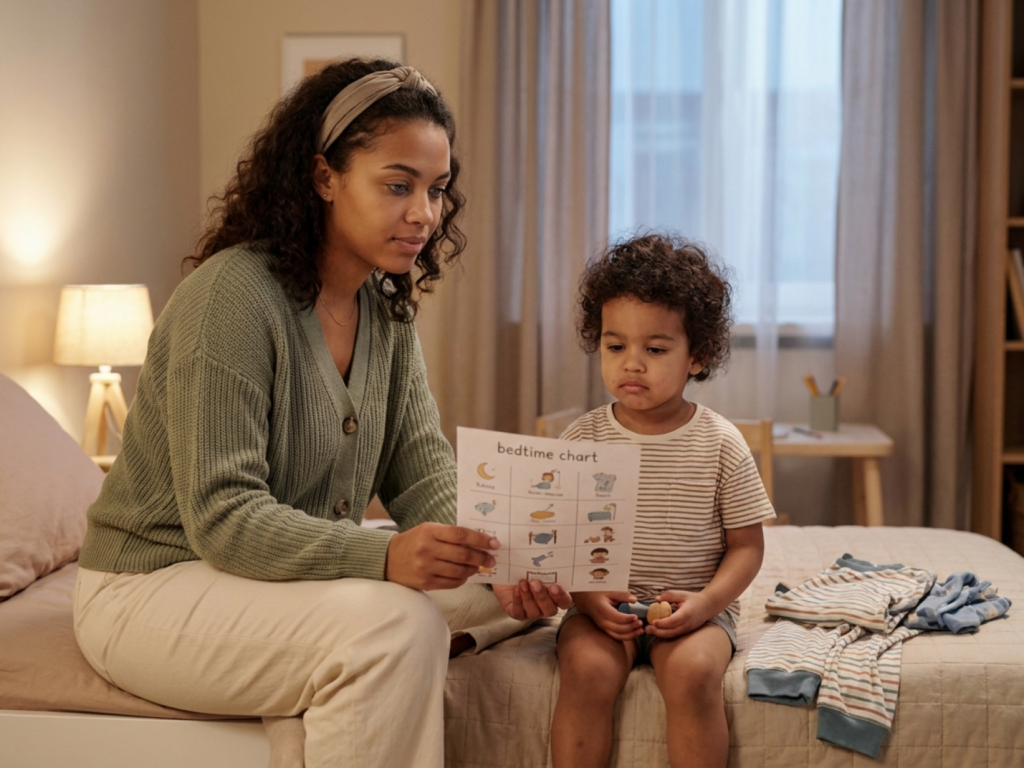
Use clear language and advance warnings. Statements such as “In five minutes, the tablet goes away; then we put on pajamas” are usually easier to follow than repeated commands delivered at the last moment. Visual reminders can support working memory, especially for preschool and early school-age children. A visual schedule for preschool routines may show pictures or simple words for each step. The child can move a marker or check off completed tasks, but the schedule should not become another source of pressure.
Keep instructions brief, concrete, and neutral. Instead of debating whether the child feels like brushing teeth, acknowledge the feeling and restate the expectation: “You do not want to stop playing. It is time to brush teeth, and I will help you.” Praise specific cooperation, such as entering the bathroom promptly or staying in bed after a reminder. Avoid lengthy lectures during the transition, when the child may already be dysregulated.
A helpful principle is predictable but flexible routines. Preserve the essential sequence while allowing reasonable adjustments, such as a shorter story when the child is ill or an earlier bath after a late activity. Explain the change briefly so flexibility does not feel random.
Responding to bedtime resistance consistently
Bedtime works best when the pre-sleep period is calm, predictable, and not dominated by stimulating activities or prolonged negotiation. A consistent schedule and a brief wind-down routine can help the child anticipate sleep. The American Academy of Sleep Medicine review describes stalling, protesting, clinging, and repeated requests after lights out as common bedtime-resistance behaviors. These patterns are often maintained when limits are unclear or inconsistently applied.
Before changing the plan, clarify the family’s response. Decide which requests are handled before lights out, what reassurance will be offered afterward, and how the caregiver will respond if the child leaves the room. Responses should be brief, calm, and boring rather than punitive or highly interactive. Repeatedly introducing new negotiations can unintentionally extend the interaction and make resistance more rewarding.
At the same time, do not ignore a child who may be frightened, in pain, struggling to breathe, or experiencing a significant change in behavior. A routine-based strategy should never replace assessment of possible illness or a serious emotional concern. If sleep disruption persists, daytime functioning deteriorates, or caregivers cannot implement the plan safely, seek advice from a pediatric healthcare professional.
Managing transitions without escalating conflict
Transitions are difficult because they require a child to stop one activity, shift attention, tolerate disappointment, and begin a less preferred task. Give a warning before the transition, identify what will happen next, and make the first step easy to start. A timer, visual cue, song, or consistent phrase can become a reliable transition signal. These transition supports for children are most effective when introduced during calm periods rather than for the first time during a crisis.
When a child protests, try to separate emotional validation from negotiation. “You are angry that playtime is over” recognizes the feeling; “Playtime is still over, and now we are putting on shoes” maintains the limit. If the child becomes overwhelmed, reduce language, lower the number of choices, and provide practical help. Safety takes priority if the child runs away, hits, bites, or throws dangerous objects.
After the routine is complete, reconnect without shaming. A child can be held accountable for behavior while still being treated with dignity. Caregivers can later review what made the transition difficult and adjust the timing, sensory environment, or amount of preparation.
When professional support is appropriate
Consider discussing routine resistance with a pediatrician when it is persistent, severe, worsening, or impairing sleep, nutrition, school attendance, family functioning, or relationships. Professional input is also appropriate when the child has loud snoring, pauses in breathing, unusual movements during sleep, chronic pain, recurrent nighttime vomiting, extreme daytime sleepiness, or a marked change from the child’s usual behavior.
Additional assessment may be useful when resistance occurs across many settings and is accompanied by substantial anxiety, persistent low mood, aggression, developmental concerns, communication difficulties, sensory distress, or problems sustaining attention. These features do not establish a diagnosis, but they can help clinicians decide whether screening, behavioral consultation, sleep evaluation, occupational therapy assessment, or child mental health support is appropriate.
Bring a brief record of the routine: timing, steps, the child’s response, caregiver responses, sleep duration, unusual symptoms, and what improves or worsens the situation. A clinician can help distinguish a developmentally common pattern from a problem requiring more structured intervention. Families do not need to wait until the situation becomes a crisis to ask for help.
When to seek prompt medical advice
- Breathing pauses, gasping, loud habitual snoring, or concerning movements during sleep
- Persistent pain, vomiting, severe itching, or other physical symptoms linked to routine refusal
- A sudden and marked behavioral change, especially after illness, injury, or a major stressor
- Aggression, self-injury, elopement, or behavior that creates an immediate safety risk
- Routine difficulties that substantially impair sleep, eating, school attendance, or family functioning
Tools & Assistance
- A simple picture or written routine chart
- A timer or consistent verbal transition warning
- A one-week record of sleep, routines, protests, and caregiver responses
- A scheduled discussion with the child’s pediatrician or family physician
- Behavioral sleep consultation or child mental health support when indicated
FAQ
Is routine resistance always a sign of defiance?
No. Resistance may reflect fatigue, separation anxiety, sensory discomfort, stress, difficulty shifting attention, or a need for control. The pattern and context matter more than the behavior alone.
Should parents use exactly the same routine every day?
A stable sequence and predictable expectations are helpful, but routines can be flexible. Aim to preserve the essential steps and explain reasonable changes rather than requiring rigid sameness.
What should a caregiver do when a child repeatedly leaves bed?
First check for illness, fear, pain, or safety concerns. If the child is well, use a pre-agreed, calm, brief response and avoid extending the interaction through repeated negotiations. Seek professional advice if the problem persists.
Can visual schedules help older children?
Yes. Older children may prefer written checklists, phone reminders, or a jointly designed schedule. The format should match the child’s developmental level and support independence rather than function as a punishment.
When should routine problems be evaluated?
Seek clinical guidance when the difficulty is persistent, severe, worsening, associated with physical or emotional symptoms, or interfering significantly with sleep, school, eating, safety, or family life.
Sources
- American Academy of Sleep Medicine — Behavioral Treatment of Bedtime Problems and Night Wakings in Infants and Young Children
- American Psychological Association — Helping children get a good night's sleep
- Merck Manual Professional Edition — Sleep Problems in Children
Disclaimer
This article is for general educational purposes and is not a diagnosis or a substitute for individualized medical advice. Consult a qualified healthcare professional about persistent, severe, or concerning routine and sleep problems.
















Please log in to leave a comment.