
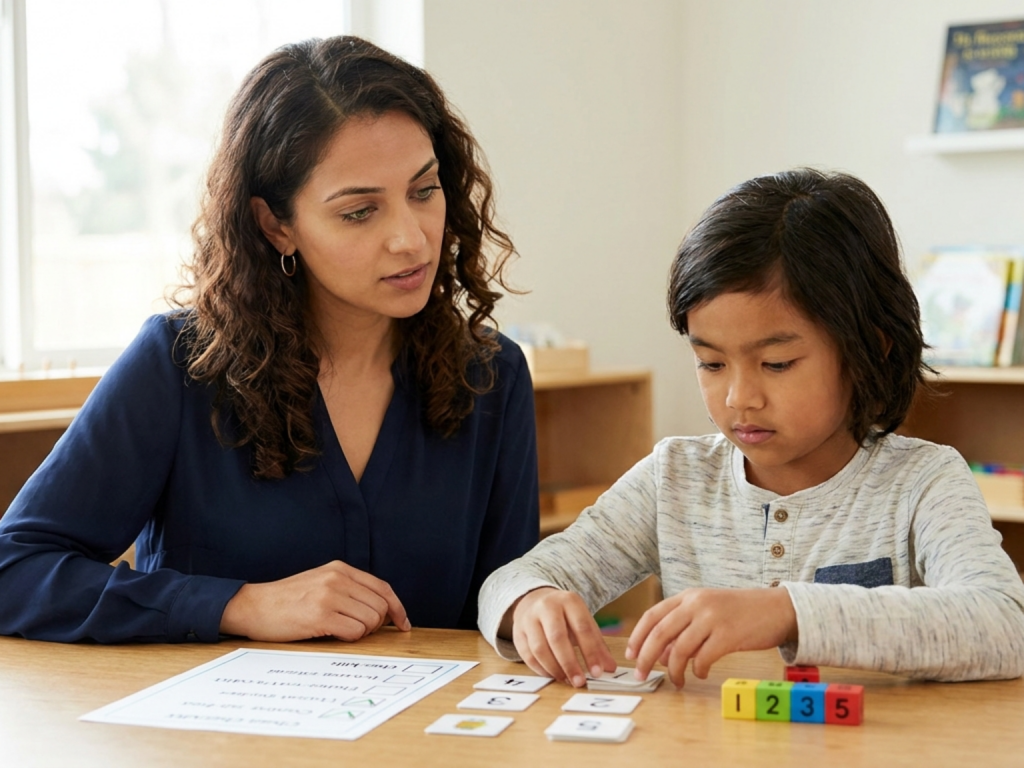
Intro
School-age children develop cognitive skills through a gradual interaction of brain maturation, education, relationships, play, sleep, nutrition, and daily routines. These abilities shape how a child pays attention, remembers information, solves problems, uses language, reasons about rules, and adapts to increasingly complex social and academic expectations.
Children do not all progress at the same pace. A supportive approach looks for patterns over time, respects individual differences, and involves teachers, pediatric clinicians, psychologists, speech-language professionals, or occupational therapists when concerns are persistent or functionally significant.
Highlights
Cognitive development in school-age children includes attention, working memory, language, reasoning, planning, and problem solving.
Children usually move from concrete thinking toward more abstract reasoning across the school years, but the timing varies widely.
Daily routines, reading, play, sleep, physical activity, and emotionally safe learning environments can support cognitive growth.
Persistent academic, attention, language, or behavioral concerns deserve professional evaluation rather than assumptions or blame.
What cognitive skills include
Cognitive skills are the mental capacities children use to take in information, organize it, remember it, and apply it. In school-age children, these skills include sustained attention, selective attention, working memory, long-term memory, processing speed, language comprehension, expressive language, visuospatial reasoning, numeracy, planning, impulse control, and flexible thinking. These abilities are not isolated. A child solving a math problem, for example, must understand language, hold steps in working memory, inhibit distractions, retrieve prior knowledge, and check whether the answer makes sense.
The school years are especially important because children are asked to learn in structured settings for longer periods. They must listen to instructions, follow classroom routines, compare ideas, categorize information, explain their reasoning, and manage frustration when a task is difficult. Cognitive development therefore has both academic and emotional dimensions. A child who appears unmotivated may actually be overloaded by weak working memory, language demands, anxiety, sleep deprivation, sensory challenges, or a mismatch between instruction and developmental readiness.
Medically and educationally, it is useful to think about function rather than labels alone. The key questions are: What is the child being asked to do? Which cognitive demand is hardest? Is the difficulty present across settings? Is it new, worsening, or longstanding? Does it interfere with learning, friendships, safety, or self-esteem? These questions help families and professionals decide whether simple supports are enough or whether a more formal assessment is needed.
Typical development across the school years
In the early school years, roughly ages 6 to 7, many children become better at concrete operations: they can sort objects, understand simple cause and effect, follow rules, compare quantities, and think more logically about information they can see or manipulate. They may still struggle with abstract ideas, multiple-step instructions, or taking another person’s perspective consistently. Vocabulary often expands quickly, and children become more able to compose sentences, tell stories in sequence, and use categories such as animals, tools, foods, or emotions.
During the middle school-age years, children usually improve in attention span, memory strategies, reading comprehension, arithmetic reasoning, and awareness of their own thinking. They begin to use rehearsal, grouping, note-taking, and self-correction more intentionally. They can compare two or more features at once, understand that people may have mixed feelings, and recognize that rules can have exceptions. This is also when differences in learning profiles may become more visible because academic work relies less on simple recognition and more on integration of information.
By the later school years, often around ages 10 to 12 and beyond, many children begin to show early formal operational thinking. This means they can reason about possibilities, hypothetical situations, moral dilemmas, scientific variables, and future consequences with increasing sophistication. However, formal reasoning is uneven. A child may debate a complex social issue yet forget homework materials or misjudge online risks. Executive functions, including planning and impulse control, continue maturing into adolescence and young adulthood.
Milestones are guides, not strict deadlines. Bilingualism, neurodevelopmental differences, chronic illness, trauma exposure, hearing or vision problems, educational opportunity, and family stress can all influence how cognitive skills appear. A child can be bright and still need support in reading, attention, motor planning, language processing, or emotional regulation.
Attention memory and executive function
Attention is the gateway to learning, but it is not one single skill. Sustained attention helps a child stay with a task; selective attention helps them ignore irrelevant noise; shifting attention helps them move from one activity to another; and divided attention allows them to manage more than one demand, such as listening while writing. In school-age children, these systems are still developing, which is why long lectures, cluttered worksheets, or rapid transitions can overwhelm some learners.
Working memory is the ability to hold and manipulate information briefly. It is essential for mental arithmetic, reading comprehension, spelling, following multi-step directions, and copying from a board. A child with working memory weakness may understand concepts during a conversation but lose track when asked to complete several steps independently. This can look like carelessness, when the underlying issue is cognitive load.
Executive function refers to self-management skills supported by frontal-subcortical brain networks. These include planning, organization, inhibition, emotional regulation, task initiation, time awareness, and cognitive flexibility. Executive function develops slowly and is highly sensitive to sleep, stress, hunger, anxiety, medication effects, and environmental structure. Supportive scaffolding can make a major difference: visual schedules, predictable routines, short instructions, checklists, and calm feedback reduce unnecessary load and allow the child to practice independence gradually.
Research on cognitive training suggests that targeted, sustained practice can improve core abilities such as attention, memory, and reasoning, particularly when training is consistent and embedded in school routines. This does not mean every commercial brain-training program is medically necessary or equally effective. Families should look for interventions with evidence, realistic goals, qualified supervision, and measurable functional outcomes, such as better classroom participation or improved completion of daily tasks.
Language reasoning and learning
Language development remains central throughout the school years. Children use language not only to speak but also to think, remember, negotiate, read, write, and understand instructions. Vocabulary growth supports comprehension in science, history, mathematics, and social life. A child who lacks the language for comparison, sequence, probability, or emotion may struggle to show what they know even when their nonverbal reasoning is strong.
Reasoning develops from concrete comparison toward more abstract relationships. Younger school-age children often do best when they can see, touch, draw, count, or act out a problem. Older children increasingly manage symbols, analogies, hypotheses, and mental transformations. Categorization also becomes more refined: instead of grouping items only by obvious features, children begin to classify by function, hierarchy, and shared properties. For example, they may understand that mammals are a category within animals and that whales belong there despite living in water.
Reading and numeracy place heavy demands on multiple cognitive systems. Reading requires phonological awareness, decoding, vocabulary, fluency, background knowledge, and comprehension monitoring. Mathematics requires quantity sense, symbolic understanding, working memory, visual-spatial organization, and procedural learning. Difficulties in either area should not be dismissed as laziness. Early, precise support is usually more helpful than waiting for a child to fail repeatedly.
Parents and educators can support language and reasoning through conversation, shared reading, library visits, museum exposure, nature observation, board games, cooking, building activities, music, and age-appropriate problem solving. The goal is not constant instruction. Children benefit from adults who ask open questions, model curiosity, explain words in context, and allow time for the child to reason aloud.
Home and school strategies that help
Effective cognitive support is usually ordinary, consistent, and relational. Children learn best when adults combine warmth with structure. Predictable routines reduce decision fatigue, while responsive conversation builds language, confidence, and metacognition. A homework routine, for example, can include a regular time, a low-distraction workspace, short breaks, needed materials, and a clear endpoint. This teaches planning without turning every evening into a conflict.
Screen time deserves thoughtful management. Digital tools can be educational, but excessive or poorly timed screen use may displace sleep, reading, physical activity, face-to-face language, and imaginative play. Families can prioritize content quality, co-viewing when possible, device-free meals, and screen-free wind-down time before bed. The most helpful approach is usually consistent and calm rather than punitive.
Practical supports include:
- Give one or two instructions at a time, then ask the child to repeat the plan in their own words.
- Use visual calendars, checklists, timers, and labeled storage to externalize memory and organization.
- Break complex work into smaller steps with brief movement breaks between tasks.
- Encourage reading across formats, including print books, audiobooks paired with text, and informational material tied to the child’s interests.
- Use real-life math in cooking, shopping, travel time, games, and household planning.
- Provide specific feedback, such as “You checked your answer two ways,” rather than global praise or criticism.
Sleep, nutrition, physical activity, hearing, vision, and emotional safety are foundational. A child who is chronically tired, iron deficient, anxious, bullied, or unable to hear classroom instruction clearly may show cognitive difficulties that improve when the underlying issue is addressed. If there is a sudden decline in school performance, attention, memory, behavior, or language, families should seek medical advice promptly.
When to seek professional guidance
Many cognitive differences are part of normal variation, but some patterns warrant evaluation. Consider speaking with a pediatrician, family physician, teacher, school psychologist, speech-language pathologist, occupational therapist, or developmental-behavioral specialist if difficulties are persistent, impairing, or present across more than one setting. Examples include marked problems following instructions, frequent loss of learned skills, severe inattention, poor comprehension despite adequate instruction, trouble forming sentences, unusual memory problems, major organizational impairment, or distress that interferes with learning.
Evaluation is not about assigning blame. It can clarify whether a child needs hearing or vision testing, sleep assessment, mental health support, language evaluation, psychoeducational testing, occupational therapy assessment, or classroom accommodations. A careful assessment may consider attention-deficit/hyperactivity disorder, specific learning disorder, language disorder, intellectual disability, autism spectrum disorder, anxiety, depression, trauma-related symptoms, seizure disorders, medication effects, chronic illness, or environmental stressors. Only qualified professionals should diagnose these conditions.
Families can prepare for appointments by gathering concrete examples: teacher comments, report cards, work samples, reading levels, behavior patterns, sleep schedule, medical history, medications, developmental history, and what has already helped. It is also useful to ask the child how school feels. Children often know when something is hard, even if they cannot name the cognitive skill involved.
The most supportive message for a child is that skills can grow and help is available. Cognitive development is changeable, but growth usually requires the right match of expectations, instruction, practice, rest, and emotional support. When adults respond early and respectfully, children are more likely to experience learning as a solvable challenge rather than a personal failure.
Seek professional advice if
- A child has a sudden decline in memory, attention, language, behavior, or school performance.
- Learning difficulties persist despite consistent instruction and supportive routines.
- The child shows loss of previously acquired skills or new neurological symptoms.
- Anxiety, low mood, sleep problems, bullying, or school refusal interferes with daily functioning.
- Hearing, vision, seizures, medication effects, or chronic illness may be affecting learning.
Tools & Assistance
- Schedule a pediatric or family medicine visit for persistent cognitive or school concerns.
- Request a school-based learning evaluation or meeting with the educational support team.
- Ask about hearing and vision screening if attention or comprehension problems are present.
- Use a daily homework routine with short tasks, breaks, and visual checklists.
- Keep examples of schoolwork, teacher notes, sleep patterns, and behavior changes for appointments.
FAQ
What are cognitive skills in school-age children?
They include attention, memory, language, reasoning, problem solving, planning, organization, processing speed, and flexible thinking.
Is it normal for a school-age child to think concretely?
Yes. Younger school-age children often rely on concrete examples. More abstract reasoning usually develops gradually through the later school years and adolescence.
Can cognitive skills improve with practice?
Many cognitive skills are changeable. Consistent teaching, routines, targeted interventions, sleep, emotional support, and appropriate practice can help, especially when difficulties are identified early.
When should parents worry about attention or memory?
Seek guidance if problems are persistent, worsening, present in multiple settings, or interfering with learning, friendships, safety, or emotional wellbeing.
Should families use brain-training programs?
Some structured cognitive training interventions have evidence, but programs vary. Discuss options with educators or healthcare professionals and focus on functional improvements, not only game scores.
Sources
- PubMed Central (PMC) — Improving Cognitive Abilities in School-Age Children via Cognitive Training Intervention
- AboutKidsHealth — Cognitive development in school-age children
- NCBI - NIH — Cognitive Development In School-Age Children
Disclaimer
This article is for general educational information and is not a diagnosis or treatment plan. Consult a qualified healthcare or educational professional for concerns about a child's development, learning, behavior, or health.

















Please log in to leave a comment.