
Intro
School-age children often feel deeply before they can explain clearly. A child who cries over homework, snaps at a sibling, refuses to join a game, or becomes quiet after school may be showing a normal but still developing emotional system, not simply “bad behavior.” Understanding feelings in this age group means looking beneath the surface: What emotion is present, what triggered it, what the child believes about the situation, and what skills they have for coping?
For medically literate readers, it helps to think of emotional development as an interaction between neurodevelopment, language, attachment security, executive function, peer context, and stress physiology. Children can learn emotional literacy and regulation, but they usually need repeated modeling, co-regulation, and practice rather than lectures delivered during a meltdown.
Highlights
School-age children are building more complex emotional understanding, including hidden feelings, mixed emotions, and the difference between what someone shows and what they feels inside.
Emotion coaching works best when adults connect first, name feelings during calm moments, and model regulation under stress.
Peer acceptance, body awareness, academic pressure, family stress, and sleep can all influence a child’s emotional reactivity.
Persistent, impairing, or unsafe emotional changes deserve professional assessment rather than blame or punishment alone.
What feelings look like in school-age children
School age is not one uniform developmental stage. A 6-year-old and a 13-year-old may both be “school age,” but their emotional capacities, social pressures, and cognitive skills are very different. In general, younger school-age children are learning to connect facial expressions, body sensations, and situations with emotion words. They may know “mad,” “sad,” and “happy,” but need help distinguishing frustration from disappointment, embarrassment from guilt, or anxiety from excitement.
Between about 6 and 8 years, many children become highly invested in friendship acceptance and fairness. They may react strongly to exclusion, losing a game, being corrected publicly, or feeling that a rule was applied unevenly. Their emotion regulation in school-age children is still heavily supported by adults; they often need reminders, predictable routines, and help shifting attention.
From about 9 to 11 years, peer pressure increases and children become more aware of competence, comparison, and body changes. A child may appear more private, self-critical, or sensitive to teasing. By 12 to 14 years, body image, belonging, independence, and identity become more prominent. Moodiness and short-tempered responses can occur as the adolescent brain manages hormonal changes, sleep shifts, social evaluation, and more complex academic demands.
Importantly, emotional growth is uneven. A child may use sophisticated language when calm but lose access to those skills when distressed. This is not necessarily manipulation. High arousal can reduce working memory, cognitive flexibility, and impulse inhibition, making adult co-regulation especially important.
The three layers of emotion understanding
Research on children’s emotion understanding describes several related but distinct skills. One useful framework includes external, mental, and reflective aspects of understanding feelings. These layers help adults see why “Use your words” may be too vague unless the child has been taught what words, what context, and what coping steps to use.
- External understanding: The child recognizes facial expressions, tone of voice, body posture, and common causes of emotion. For example, they learn that a classmate may feel sad after being left out or angry after someone breaks a promise.
- Mental understanding: The child begins to understand that emotions can depend on beliefs, expectations, memories, and hidden experiences. Two children may react differently to the same event because they interpret it differently.
- Reflective understanding: The child recognizes mixed emotions, moral emotions, and regulation strategies. They may realize, “I am happy I won, but I also feel bad that my friend is upset,” or “I can be angry and still choose not to hit.”
Training studies suggest that emotion understanding can improve with deliberate teaching. Children benefit when adults explicitly discuss causes of emotions, facial cues, hidden feelings, mixed feelings, and coping choices. These skills are not just “soft skills”; they support peer relationships, classroom functioning, conflict resolution, and adaptive self-monitoring skills.
For school-age children, emotional literacy also includes interoception: noticing internal body signals such as a tight chest, stomach discomfort, flushed face, clenched jaw, or restless energy. Some children experience these sensations as “I feel sick” or “I need to leave” before they can label worry, shame, or anger. Gentle curiosity helps translate body cues into emotional language.
Why feelings can come out as behavior
Children rarely present an emotion in a neat, adult-friendly form. Fear may look like refusal. Shame may look like anger. Sadness may look like irritability. Overwhelm may look like silliness, avoidance, or shutdown. This is why school-age behavior problems should be interpreted in context rather than treated as isolated acts of defiance.
Several mechanisms are relevant. First, executive functions are still developing. Inhibitory control, planning, task initiation, cognitive flexibility, and error tolerance mature gradually through childhood and adolescence. Second, language may lag behind emotional intensity. A child who cannot say, “I felt humiliated when I read aloud and made a mistake” may instead say, “I hate school.” Third, the stress response can narrow a child’s problem-solving capacity. When sympathetic arousal is high, the nervous system prioritizes protection over reflection.
Common emotional triggers include academic difficulty, social exclusion, transitions, hunger, sleep deprivation, sensory overload, family conflict, bullying, perfectionism, and fear of disappointing adults. A child with learning differences may become distressed during reading or math because the task repeatedly produces failure. A child with anxiety may avoid schoolwork not because they do not care, but because starting the task activates threat physiology.
None of this means that boundaries are unnecessary. Children need clear limits and accountability. However, limits work best when paired with skill building. A helpful adult stance is: “All feelings are allowed; all behaviors are not. I will help you understand the feeling and choose a safer response.”
How adults can teach emotional language
Emotional teaching is most effective outside the peak of distress. During a meltdown, the priority is safety, reduced stimulation, and calm adult presence. Later, when the child’s nervous system has settled, adults can help the child build vocabulary and insight.
Start with observation rather than accusation. Instead of “You are being dramatic,” try “Your voice got louder and your hands were tight when homework started. I wonder if you felt frustrated or worried.” This gives the child a possible map without forcing agreement. If they reject the word, offer alternatives: “Maybe annoyed, embarrassed, tired, or overwhelmed?”
Use everyday moments. Characters in books, films, sports, and family stories provide emotionally safer material because the child is not the center of attention. Ask, “What do you think he felt when that happened?” “Could she be feeling two things at once?” “What might help without hurting anyone?” These conversations strengthen theory of mind and reflective understanding.
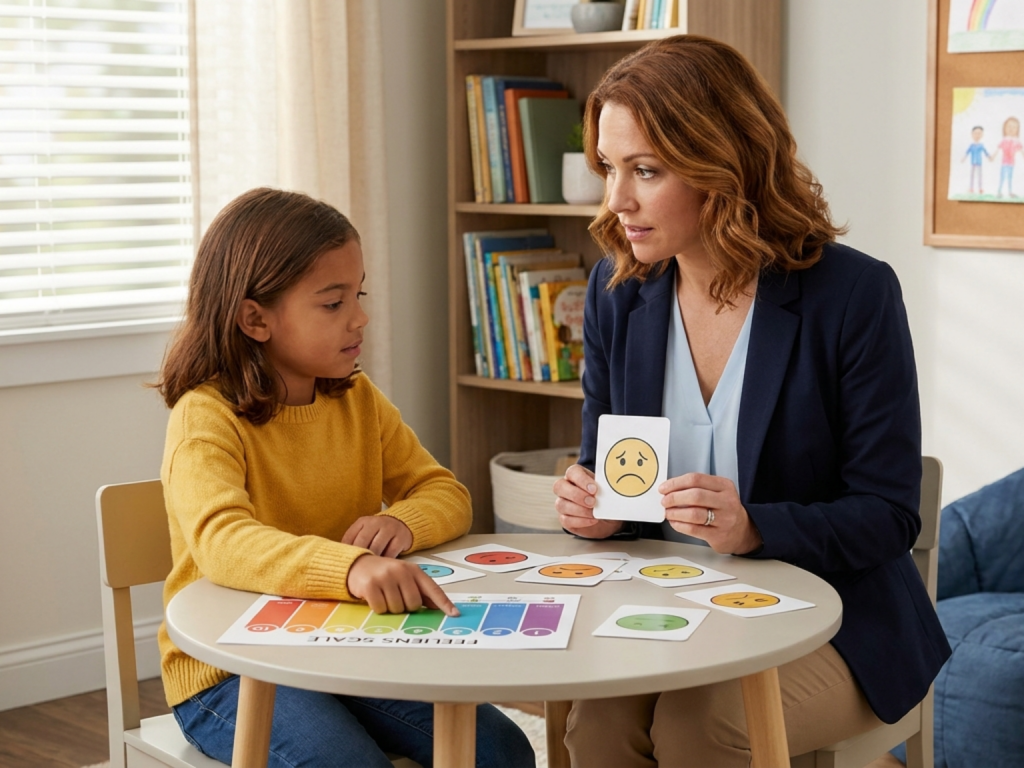
Caregivers can also teach intensity scales. A 0-to-10 scale, color zones, or a thermometer image can help children notice early escalation. The goal is not to suppress emotion but to intervene sooner. A child who can say “I’m at a 5” may be able to take a break before reaching a 9.
Keep the emotional vocabulary broad but practical. Useful words include irritated, disappointed, left out, jealous, nervous, pressured, proud, relieved, guilty, ashamed, confused, and overwhelmed. Pair each word with body cues, typical thoughts, and coping options. Over time, naming feelings becomes a bridge from reaction to choice.
Co-regulation, modeling, and positive interactions
Children learn regulation through relationships before they can reliably self-regulate. Co-regulation means the adult uses their own calm voice, predictable behavior, and supportive presence to help the child’s arousal decrease. This is not permissiveness. It is neurodevelopmentally informed support.
Modeling matters because children observe how adults handle frustration, mistakes, conflict, and repair. An adult who says, “I am getting frustrated, so I’m going to pause and take a breath before I answer,” demonstrates a concrete regulation strategy. Apologizing after an adult overreacts is also powerful: “I used a sharp voice. That was not okay. I am sorry. I will try again.” This teaches accountability without shame.
Secure relationships are protective. When children believe an adult will stay connected while setting limits, they are more able to tolerate correction. In practice, this means noticing positive behavior frequently, not only intervening when something goes wrong. A high ratio of positive interactions to reprimands can reduce defensiveness and increase cooperation.
Effective positive reinforcement for children is specific and immediate. “You were angry and still kept your hands safe” is more useful than “Good job.” “You asked for help before yelling” identifies the exact replacement behavior. For many families, Behavior management school age approaches work best when emotional coaching and consistent routines are integrated rather than treated as separate systems.
Role-play can help. Practice what to say when teased, how to ask for a break, how to disagree respectfully, or how to recover after losing a game. Rehearsal during calm moments makes the skill more available during real stress.
Supporting feelings at school and with peers
School is an emotional environment as well as an academic one. Children are managing performance demands, peer hierarchies, adult expectations, noise, transitions, and comparison. A child who seems fine at school may collapse emotionally at home after holding it together all day. Another child may show distress in class because the demands exceed their current coping capacity.
Helpful school supports often include predictable routines, clear expectations, access to a calm space, discreet check-ins, and explicit teaching of social problem-solving. Teachers and caregivers can use shared language for feelings and coping plans so the child does not have to relearn expectations in each setting. For example, the same “pause, name it, choose a tool” sequence can be used at home and in the classroom.
Peer conflict should be handled with nuance. Adults may be tempted to solve every disagreement, but children also need guided practice. Ask what happened, what each person may have felt, what the child wanted, and what repair might look like. Repair can include apology, restitution, changed behavior, or respectful distance. Forced apologies without understanding rarely teach empathy.
For older school-age children, privacy and dignity become especially important. Public correction can intensify shame. A brief, quiet prompt may work better than a lecture in front of peers. Children in late elementary and early adolescence often need adults to respect their growing autonomy while still providing structure.
When to seek professional guidance
Strong feelings are normal, but some patterns warrant evaluation. Consider consulting a pediatrician, child psychologist, school counselor, developmental-behavioral pediatrician, or child psychiatrist if emotional reactions are persistent, impairing, unsafe, or markedly changed from the child’s baseline. Professional input is also important when there are concerns about trauma exposure, bullying, neurodevelopmental differences, learning disorders, depression, anxiety, self-harm, aggression, substance exposure, or family stressors affecting safety.
Medical contributors should not be overlooked. Sleep disorders, chronic pain, headaches, gastrointestinal symptoms, endocrine problems, medication effects, nutritional deficiencies, and neurologic conditions can influence mood and regulation. A child who is suddenly irritable, withdrawn, exhausted, or emotionally explosive may need a broad assessment rather than a purely behavioral interpretation.
Assessment does not mean something is “wrong” with the child. It can clarify strengths, stressors, developmental needs, and practical supports. Families may benefit from parent coaching, cognitive-behavioral strategies, school accommodations, family therapy, social skills support, or trauma-informed care depending on the situation. Decisions about diagnosis or treatment should be individualized and made with qualified professionals.
Most importantly, children need to know that feelings are understandable and manageable. The adult message can be steady: “You are not in trouble for having a feeling. We will keep everyone safe, learn what your feeling is telling us, and practice what to do next.”
Seek urgent help if safety is a concern
- Any talk of self-harm, wanting to die, or not wanting to exist should be taken seriously and assessed promptly.
- Aggression that could seriously injure the child, others, or animals requires immediate safety planning and professional help.
- Sudden severe mood, behavior, confusion, hallucinations, or neurologic symptoms need urgent medical evaluation.
- Emotional distress linked to bullying, abuse, neglect, or trauma should be addressed with appropriate safeguarding support.
- Do not stop, start, or change psychiatric or neurologic medications without a qualified clinician.
Tools & Assistance
- Create a family feelings vocabulary chart with body cues and coping choices.
- Use a 0-to-10 emotion intensity scale during calm practice.
- Coordinate language and coping plans with teachers or school counselors.
- Schedule a pediatric or mental health evaluation if emotions are persistent, impairing, or unsafe.
- Practice role-play scripts for teasing, losing, disappointment, and asking for help.
FAQ
Is it normal for a school-age child to cry or get angry quickly?
Yes, occasional intense reactions can be developmentally normal, especially with fatigue, stress, peer conflict, or difficult tasks. Seek guidance if reactions are frequent, unsafe, or impair daily functioning.
Should I talk about feelings during a meltdown?
Keep language brief during peak distress. Focus on safety, calm presence, and reducing stimulation; teach and problem-solve later when the child is regulated.
Can children really learn emotional regulation?
Yes. Evidence supports teaching emotion recognition, causes, hidden feelings, mixed emotions, and regulation strategies through repeated practice and supportive relationships.
What if my child refuses to name feelings?
Do not force it. Offer gentle guesses, use stories or characters, describe body cues, and revisit later. Some children need more time, privacy, or visual tools.
When should school be involved?
Involve school when emotional distress affects attendance, learning, peer relationships, classroom behavior, or safety. Shared plans often work better than home-only strategies.
Sources
- PubMed Central (National Institutes of Health) — Children's emotion understanding: A meta-analysis of training studies
- Virtual Lab School — Social-Emotional Development: School-Age Children
- American Psychological Association — How to help kids understand and manage their emotions
Disclaimer
This article is for educational purposes only and is not a diagnosis or treatment plan. Consult a qualified healthcare or mental health professional for concerns about a child’s emotional health, safety, or development.

















Please log in to leave a comment.