
Intro
Play is not a break from learning; for children, it is one of the main ways learning happens. Through play, children practice movement, language, problem-solving, self-control, and social understanding in ways that feel natural and motivating. It also gives adults a window into how a child thinks, copes, and connects.
Because play touches so many developmental domains at once, it matters for both healthy growth and emotional security. Some children play loudly and physically, others quietly and imaginatively, and many move between styles. If a child seems to lose interest in play, cannot engage at all, or shows other developmental concerns, it is wise to speak with a pediatrician or other qualified professional.
Highlights
Play supports cognitive, emotional, social, and physical development at the same time.
Shared play helps strengthen the parent-child bond and can improve a child’s sense of safety.
Active and imaginative play both build skills children use in school and daily life.
Play gives children a safe way to practice risk, failure, repair, and resilience.
Play is a core part of development
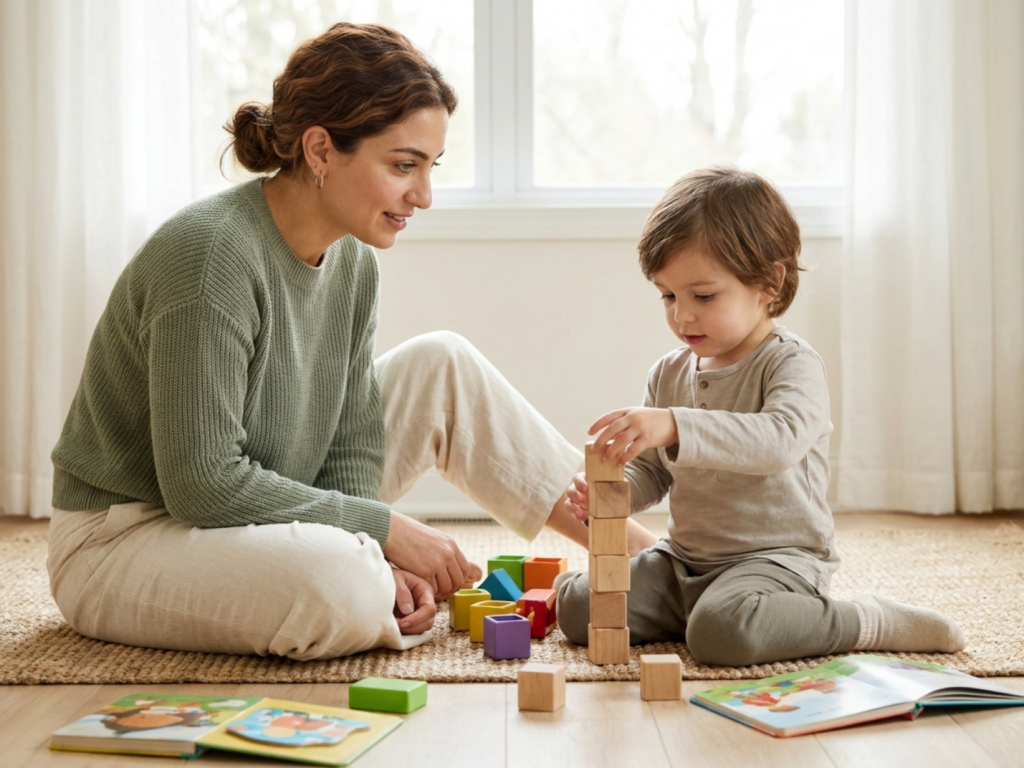
In child development, play is best understood as active exploration. A child who stacks blocks, pretends to cook, chases a ball, or invents rules for a game is not simply passing time. The child is testing ideas, adjusting to feedback, and learning how actions lead to consequences. That is why play is often described as biologically meaningful rather than optional.
Research consistently links play with social, emotional, cognitive, and physical well-being. It also helps children build resilience, meaning the ability to recover after stress or disappointment. This is especially relevant when children are living with uncertainty, family stress, or other adversity. In those settings, play can provide a sense of control, predictability, and connection that supports healthy development.
Importantly, play is not one single activity. Free play, pretend play, physical play, and social play each exercise different skills. A child does not need to be constantly entertained by adults. Often the most valuable play is open-ended, child-led, and rich in room for imagination.
Play builds thinking skills and executive function
One of the clearest benefits of play is its effect on cognition. During play, children solve problems, remember steps, shift strategies, and hold multiple ideas in mind. These abilities are part of executive function, a set of mental skills that includes working memory, inhibition, and cognitive flexibility. In everyday life, executive function supports following directions, waiting turns, and adapting when plans change.
That is why creative play in children matters so much. When a child turns a blanket into a tent or a box into a spaceship, the child is practicing symbolic thinking. Symbolic thinking is a foundation for language, storytelling, reading readiness, and later academic learning. Pretend play also encourages planning: What should happen first? Who does what? What if the story changes?
Play also teaches cause and effect in a safe way. Children can experiment, make mistakes, and try again without high stakes. That repeated rehearsal is powerful because it strengthens learning through active problem-solving rather than passive instruction alone.
Play supports emotional regulation and resilience
Children experience strong feelings during play all the time: excitement, frustration, disappointment, pride, and joy. These moments matter because they give children repeated practice in emotional regulation, the ability to manage arousal and respond in a flexible way. A child who loses a game, watches a tower fall, or cannot get a toy to work learns that distress can be tolerated and repaired.
Creative play in children also offers a safe route for emotional expression. In pretend scenarios, children can act out fear, caregiving, conflict, rescue, or separation in a way that is contained and understandable. This does not mean play is therapy on its own, but it does mean play can help children rehearse coping strategies and build psychological resilience.
Adults help most when they join with calm attention. A supportive parent or caregiver can name feelings, model patience, and help a child settle after frustration. That co-regulation gradually supports self-regulation, which is a key developmental goal in early and middle childhood.
Social play teaches cooperation and connection
Play with other people is one of childhood’s best classrooms for relationships. Social play for children teaches turn-taking, shared goals, negotiation, and repair after conflict. Children learn to read facial expressions, tone of voice, body position, and other social cues. They also learn that other people have thoughts and wishes that may differ from their own.
These skills are not abstract. When two children decide who goes first on a swing, invent rules for a board game, or build a fort together, they practice peer interaction in real time. They may disagree, but they also learn how to cooperate, compromise, and keep going. Over time, that practice supports social competence, friendship skills, and confidence in groups.
Shared play is also valuable within families. Playful back-and-forth with a trusted adult can strengthen the parent-child bond, improve attunement, and help a child feel emotionally secure. In many families, a few minutes of fully present play can have more impact than a long explanation or correction.
Physical play shapes the body as well as the brain
Children need movement, and physical play for children is one of the healthiest ways to provide it. Running, climbing, jumping, balancing, throwing, dancing, and rough-and-tumble play all build motor coordination, strength, endurance, and spatial awareness. These activities also support cardiorespiratory fitness and muscle development in age-appropriate ways.
Physical play matters because development is sensorimotor as well as mental. A child who learns how far to jump, how to catch a ball, or how to move carefully on an uneven surface is refining balance, proprioception, and motor planning. Those skills carry into playground activity, sports, handwriting, and daily self-care tasks.
Healthy physical play includes some manageable challenge. Children benefit from developmentally appropriate risk, such as climbing a little higher or balancing on a new surface, when the environment is reasonably safe and supervised. Small, acceptable challenges help children learn judgment and confidence. The goal is not to remove every possibility of falling or failing; it is to offer space to practice skill and self-protection.
How adults can protect time for healthy play
Adults do not need to turn play into a lesson plan. In fact, too much direction can reduce the developmental value of play. A better approach is to create regular time, safe space, and simple materials, then follow the child’s lead. Blocks, boxes, balls, crayons, dress-up items, and outdoor spaces can all invite rich play without expensive equipment.
Families can also think about balance. Children need routines, sleep, school, and responsibilities, but they also need daily unstructured play. Screen-based activities may be enjoyable, yet they do not fully replace imaginative, social, and movement-based play. Whenever possible, try to preserve time for active and face-to-face play.
For children with developmental, sensory, mobility, or communication differences, play may need to be adapted rather than reduced. That can include simpler toys, shorter play periods, quieter settings, or support from occupational therapy, early intervention, or other services. If concerns arise about a child’s ability to play, respond, move, or interact, seek professional guidance rather than waiting for the issue to resolve on its own.
When to seek professional advice
- A child loses play skills they previously had.
- A child shows persistent pain, fatigue, or shortness of breath during play.
- A child rarely engages in any play or seems unable to sustain interest.
- A child has major concerns with movement, language, attention, or social interaction.
- A parent worries that play has become unsafe, extreme, or developmentally unusual.
Tools & Assistance
- Pediatrician or family doctor
- Early intervention services
- Occupational therapist for motor, sensory, or play concerns
- School counselor, psychologist, or special education team
- Community playgrounds, libraries, and parent-child playgroups
FAQ
Is play really necessary, or is it just a reward after learning?
For children, play is part of learning itself. It helps build language, movement, thinking, and social skills in a natural and motivating way.
Does screen-based gaming count as play?
It can be playful, but it does not replace all forms of play. Children still need movement, imagination, and real-time social interaction.
What if my child prefers to play alone?
Some solitary play is normal and can be very creative. If a child persistently avoids others or seems unable to engage, it is worth discussing with a professional.
Can play help children who are under stress?
Yes. Play can support coping, connection, and emotional recovery, especially when a child is living with stress or uncertainty.
Sources
- PubMed — The importance of play in promoting healthy child development and maintaining strong parent-child bonds
- PubMed — The importance of play for the development of children in the 21st century
- American Academy of Pediatrics — The Power of Play: A Pediatric Role in Enhancing Development in Young Children
Disclaimer
This article is for general educational purposes only and does not replace individualized medical advice from a pediatrician or other qualified health professional.
















Please log in to leave a comment.