
Intro
Cooperation is a developing set of skills that helps children coordinate with others, share resources, follow agreed rules, solve disagreements, and contribute to group activities. It is not a fixed personality trait or a simple measure of obedience. A child’s ability to cooperate is influenced by cognitive development, language, emotional regulation, temperament, relationships, cultural expectations, and the immediate demands of a situation.
Adults can support cooperation by making expectations understandable, practicing skills in manageable situations, and responding to mistakes with calm guidance. The goal is not to eliminate normal resistance or strong emotions, but to help children gradually learn how to participate, repair conflicts, and recognize that their actions affect other people.
Highlights
Cooperation develops gradually and varies according to age, context, culture, and emotional state.
Children learn cooperative behavior through repeated practice, modeling, specific feedback, and predictable boundaries.
Fairness, reciprocity, and confidence that group rules will be applied consistently can make cooperation easier.
Connection and emotional regulation usually support cooperation more effectively than threats, shame, or excessive punishment.
What cooperation means in childhood
Cooperation includes several related abilities rather than one behavior. A young child may cooperate by handing an object to an adult, helping tidy toys, waiting briefly for a turn, or following a familiar routine. Older children may negotiate roles in a game, compromise about shared materials, complete a household responsibility, or adjust their behavior after hearing how it affected someone else.
These abilities rely on executive functions such as inhibitory control, working memory, cognitive flexibility, and planning. Language development also matters because children need words to request help, express disagreement, clarify rules, and propose alternatives. Empathy and perspective-taking develop over time, so a child may understand that another person is upset without yet being able to consistently change their behavior in response.
Research describes cooperation as shaped by both biological and cultural influences. Children learn from caregivers, siblings, peers, schools, and community norms. Expectations should therefore be developmentally appropriate and culturally respectful. A behavior that looks like refusal may sometimes reflect fatigue, sensory overload, limited comprehension, anxiety, hunger, or a task that exceeds the child’s current capacity.
Build the foundation before asking for cooperation
Children are more likely to cooperate when they feel connected to the adult making the request. Connection does not mean removing limits. It means approaching the child as a person whose needs and abilities matter, while still maintaining a clear boundary. Eye contact is not required, particularly for children who find it uncomfortable; a calm voice, physical proximity, and simple language may be more appropriate.
Give instructions that are specific, brief, and positively framed. “Put the blocks in the basket, then choose a book” is easier to act on than “Stop making a mess.” For multi-step tasks, divide the activity into smaller steps and check comprehension. Offer limited choices when possible: “Would you like to carry the cups or place the napkins?” A meaningful choice can preserve the child’s sense of agency without making the core expectation optional.
Predictable routines reduce the amount of negotiation required. Visual schedules, transition warnings, timers, and consistent household expectations can be useful, especially for children with attention, language, sensory, or neurodevelopmental differences. Cooperation should not depend on a child suppressing legitimate communication. Adapt the environment and the task when the demand is unreasonable or accessibility needs are present.
Teach cooperation as a skill
Do not assume that a child knows how to cooperate simply because an adult has explained the rule. Teach the component skills directly. Model how to ask for a turn, how to offer an alternative, how to disagree respectfully, and how to seek adult assistance. Rehearse these behaviors when everyone is calm rather than waiting until a conflict is already intense.
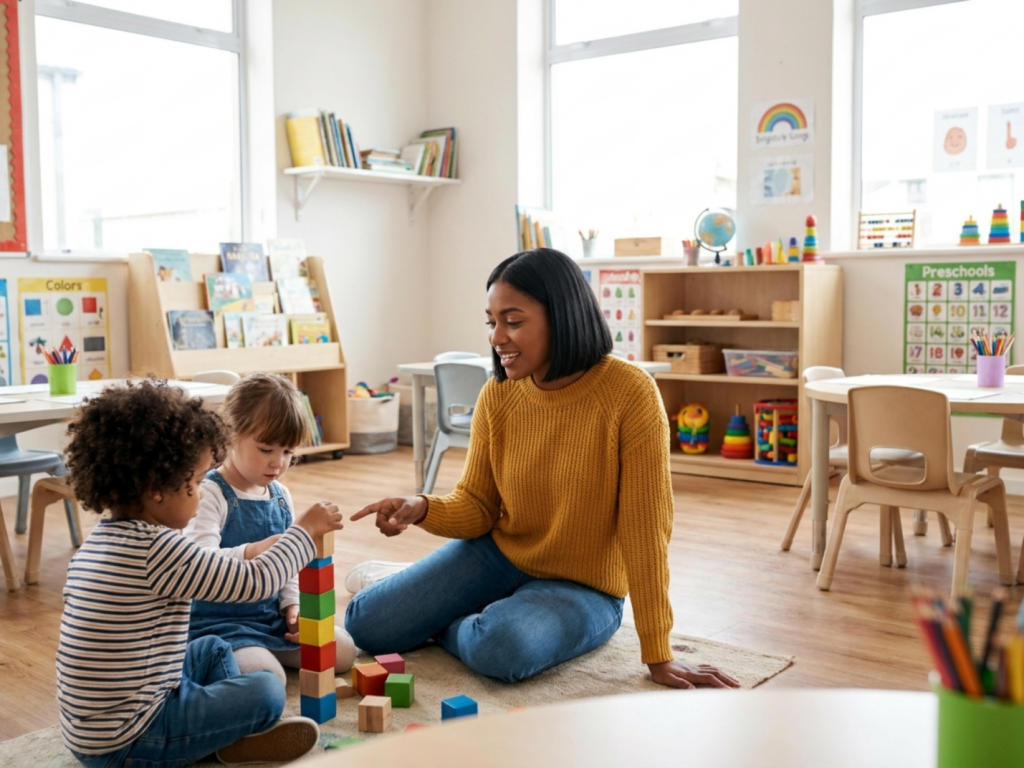
Start with short, achievable activities. Two children might build one structure together, take turns adding pieces to a puzzle, or carry out a simple cooking task with clearly assigned roles. Collaborative building activities are particularly useful because the shared goal is visible and adults can help children practice planning and flexible thinking. Cooperative games for children can also provide structured repetition of turn-taking, waiting, rule-following, and tolerating an outcome that is not preferred.
Use descriptive feedback instead of broad labels. “You gave your sister a turn after she asked” identifies the behavior that should be repeated. Reinforcement can include attention, acknowledgment, additional responsibility, or access to a preferred shared activity; it does not need to be material rewards. Training and practice can strengthen helping and cooperative behaviors over time, but progress is usually uneven. A child may use a skill at home and struggle to use it at school or with peers.
Support fairness, reciprocity, and group expectations
Children are sensitive to fairness, although their understanding of fairness changes with age and experience. Explain the reason for a rule in concrete terms: “Everyone gets a turn so each person can play,” or “We keep the walkway clear so people do not trip.” Rules are more credible when adults apply them consistently and acknowledge exceptions openly rather than relying on arbitrary authority.
Research on children’s cooperation suggests that expectations about fairness and the consequences of unfair behavior influence whether children choose to contribute. This does not mean that children need harsh punishment to cooperate. It means they benefit from a social environment in which agreements are understandable, contributions are noticed, and harmful or exploitative behavior is addressed reliably.
At home, distinguish equality from equity when appropriate. Children may not need identical tasks or identical support. A younger child might put away a few items while an older child completes a longer task. State the shared purpose and recognize different contributions. In classrooms and groups, adults can assign rotating roles so that leadership, helping, and decision-making are distributed rather than repeatedly given to the most assertive child.
Handle refusal and conflict without escalating
Refusal is communication as well as behavior. First consider whether the child understood the request, had enough time to transition, or was physically and emotionally able to comply. A calm adult can acknowledge the feeling while maintaining the limit: “You wanted to keep playing. It is time to leave, and I will help you get ready.” This response validates the experience without promising that the child will always get the preferred outcome.
During high arousal, reasoning and perspective-taking are temporarily less available. Reduce language, protect safety, and postpone teaching until the child has regained regulatory capacity. Avoid public humiliation, threats of abandonment, physical punishment, and prolonged arguments. These responses may produce immediate compliance in some situations but can undermine trust, increase stress, and teach that power rather than problem-solving governs relationships.
After the situation, use a brief repair conversation. Ask what happened, identify each person’s perspective, and plan one specific alternative for next time. A child might practice saying, “I am still using it; can I have two more minutes?” or “Can we make a different rule?” Repair may involve an apology, replacing a damaged item, helping someone recover, or rejoining the activity appropriately. The aim is accountability paired with a path back into the relationship.
Use play and peer experiences for practice
Play provides repeated, motivating opportunities to practice cooperation without making every interaction feel like a lesson. Choose activities that match the child’s developmental level and interests. Begin with one peer or a small group if large-group play is overwhelming. Adults can narrate the process briefly: “You are both reaching for the same truck. Let us decide how to share it.” Avoid taking over every disagreement; provide enough support for children to experience successful negotiation.
Before a playdate or group activity, preview two or three expectations, such as asking before taking, keeping hands safe, and getting help when a disagreement feels too difficult. Prepare duplicate high-interest materials when possible and include an activity with a shared objective. For children who are shy, impulsive, or socially inexperienced, gradual exposure and shorter sessions may be more productive than demanding immediate participation in a busy group.
Peer difficulties should be interpreted carefully. Occasional conflict is common, but persistent social isolation, repeated aggression, extreme distress, or an inability to participate across settings may warrant further assessment. Teacher observations, developmental history, hearing and language considerations, sleep, stress, and neurodevelopmental factors can all be relevant. A pediatrician, child psychologist, speech-language pathologist, occupational therapist, or other qualified professional can help identify supportive strategies without reducing the child to a label.
Keep expectations compassionate and realistic
Cooperation is affected by sleep, illness, pain, hunger, transitions, family stress, and sensory demands. Expectations should be adjusted temporarily when a child is unwell or overwhelmed, while the underlying skill can be revisited later. This is different from abandoning boundaries; it is a recognition that learning and self-regulation depend on available capacity.
Adults should also examine their own modeling. Children notice whether caregivers listen, interrupt, share decision-making, apologize, and follow the rules they set. Describe your reasoning and demonstrate repair after mistakes: “I spoke too sharply. I was frustrated, and I am going to try that again.” Such modeling makes cooperation reciprocal rather than a one-way demand made of children.
Seek professional guidance when cooperation problems are severe, persistent, worsening, or present in multiple environments, particularly when they interfere with learning, friendships, family functioning, or safety. Consultation is also appropriate when caregivers suspect language delay, hearing difficulty, anxiety, attention problems, sensory processing differences, autism, trauma exposure, or another developmental or medical concern. Professional assessment should be individualized and should inform support, not blame.
When to seek additional support
- Repeated aggression, unsafe behavior, or inability to recover from ordinary conflicts
- Persistent social isolation or distress across home, school, and peer settings
- A sudden change in cooperation accompanied by sleep, mood, developmental, or physical symptoms
- Concern about hearing, language comprehension, attention, anxiety, trauma, or neurodevelopment
- Caregiver strategies are increasing conflict or the family feels unable to maintain safety
Tools & Assistance
- A visual routine or transition timer
- Short role-play scripts for asking, waiting, disagreeing, and repairing
- Cooperative games and shared building or household activities
- A brief daily record of triggers, supports, and successful cooperative moments
- Guidance from a pediatrician, teacher, or child-development professional
FAQ
Why does my child cooperate at school but not at home?
Different settings provide different structure, expectations, relationships, and levels of fatigue. Home may be where a child releases stress after sustained effort. Compare the demands and supports in each setting, then discuss patterns with caregivers and teachers.
Should I reward my child every time they cooperate?
Immediate, specific feedback is often useful when a skill is new. Over time, natural outcomes, shared enjoyment, responsibility, and positive attention can maintain cooperation. Rewards should support learning rather than replace connection or become the only reason to participate.
What if my child refuses to share?
Sharing develops gradually, and children may need help understanding ownership, turn-taking, and time limits. Protect essential personal possessions, use predictable turns for shared materials, and teach language for requesting and waiting rather than forcing every object to be surrendered.
Can consequences improve cooperation?
Logical, predictable consequences can clarify boundaries, such as pausing an activity when play becomes unsafe. Consequences work best when they are proportionate and paired with teaching and repair. Harsh or humiliating punishment is not a reliable substitute for skill-building.
When should I ask a professional about cooperation difficulties?
Seek advice when difficulties are persistent, occur across settings, impair relationships or learning, involve safety, or appear alongside developmental, emotional, behavioral, or physical concerns. A qualified professional can help evaluate contributing factors and identify appropriate supports.
Sources
- PubMed — Cooperation in children
- Proceedings of the National Academy of Sciences — Third-party punishment increases cooperation in children through (misaligned) expectations and conditional cooperation
- PubMed — The maintenance of cooperative and helping behaviours in young children
Disclaimer
This article is for general educational purposes and does not diagnose, treat, or replace individualized medical or developmental advice. Consult a qualified healthcare or child-development professional about concerns involving your child.


















Please log in to leave a comment.