
Intro
Preschool cognitive growth is the rapid expansion of thinking, memory, language, problem-solving, attention, and early self-regulation that typically occurs between about 3 and 5 years of age. It can feel magical to watch: a child starts asking more layered questions, inventing elaborate pretend worlds, remembering routines, negotiating rules, and noticing patterns that were invisible to them only months earlier.
This growth is not a race or a single score. It reflects brain maturation interacting with relationships, sleep, nutrition, emotional safety, play, language exposure, and health. If you are concerned about a child’s learning, behavior, hearing, vision, speech, or social communication, a pediatrician or qualified developmental professional can help interpret what is typical variation and what deserves evaluation.
Highlights
Preschool cognition develops through the integration of language, memory, executive function, emotional regulation, and social learning.
Responsive caregiving and rich daily experiences help build sturdy brain architecture, especially when emotional security and learning opportunities occur together.
Play is not separate from learning; pretend play, conversation, movement, and shared reading all support cognitive networks.
Developmental variation is common, but persistent loss of skills, limited communication, or major difficulty functioning should be discussed with a healthcare professional.
What preschool cognitive growth means
Preschool cognitive growth refers to the way a young child’s brain becomes increasingly able to take in information, organize it, remember it, use it flexibly, and communicate about it. In practical terms, this includes vocabulary expansion, symbolic thinking, early numeracy, categorization, working memory, attention shifting, inhibitory control, problem-solving, and the ability to learn from other people. These skills do not develop in isolation. A child’s thinking is closely linked with emotional regulation, motor development, social communication, and physical health.
Between ages 3 and 5, many children become more capable of holding a simple rule in mind, following two- or three-step directions, comparing quantities, sorting objects by shape or function, and using language to explain what they want. They may ask “why” and “how” questions, tell stories that mix real and imagined events, and begin to understand time concepts such as yesterday, tomorrow, and later. Their reasoning is still immature; they may focus on one striking feature of a situation and miss another, or believe that their own perspective is the same as everyone else’s. That immaturity is expected and reflects a brain still building more efficient neural networks.
It is also helpful to view cognitive growth as a continuum beginning before birth and continuing through infancy, toddlerhood, and preschool. Early experiences such as safe caregiving, feeding, sleep routines, sensory exposure, and immediate skin-to-skin contact after birth can support the broader relational context in which later learning unfolds. However, no single early event determines a child’s future. Preschool cognition is shaped by repeated patterns of experience over time, not by perfect parenting or a flawless environment.
Brain architecture and early learning
The developing brain forms and refines connections through a combination of genetic programming and experience-dependent plasticity. In early childhood, neural circuits involved in sensory processing, language, emotion, attention, and executive function are especially active. Repeated experiences strengthen commonly used pathways, while less-used connections may be pruned. This is why daily interactions, not formal lessons alone, are so influential.
Researchers often describe early development as the construction of “brain architecture.” The metaphor is useful because strong cognitive skills depend on foundations that include emotional safety, responsive relationships, adequate sleep, nutrition, movement, and opportunities to explore. A child who feels chronically unsafe or overwhelmed may devote more neurobiological resources to vigilance and stress regulation, leaving fewer resources available for curiosity, flexible attention, and learning. This does not mean stress always causes damage; manageable challenges with adult support can build resilience. The concern is prolonged, intense, or unsupported adversity.
Executive functions are particularly important during the preschool years. These include working memory, cognitive flexibility, and inhibitory control. A child uses working memory to remember the instruction “put your shoes by the door and bring me your cup.” They use cognitive flexibility when switching from building blocks to cleanup. They use inhibitory control when waiting for a turn instead of grabbing a toy. These abilities are biologically immature in preschoolers, so repeated reminders, visual routines, and calm adult support are more realistic than expecting adult-like self-control.
Language, memory, and symbolic thinking
Language is one of the most visible drivers of preschool cognition. As vocabulary grows, children gain better tools for categorizing objects, expressing needs, recalling events, and asking for explanations. Conversation also teaches grammar, sequencing, cause and effect, and perspective-taking. A child who says, “I was sad because the tower fell, so I built it again,” is practicing emotional labeling, narrative memory, causal reasoning, and persistence at the same time.
Symbolic thinking allows children to use one thing to represent another: a block becomes a phone, a drawing represents a family member, and a spoken word stands for an object or idea. Pretend play is cognitively rich because it requires mental representation, role switching, memory, impulse control, and shared rules. When children play “doctor,” “store,” or “baby,” they are rehearsing social scripts and experimenting with problem-solving. Adults can support this by joining briefly, following the child’s lead, and adding language without taking over.
Memory also becomes more organized during the preschool period. Children improve in recognition, recall, and autobiographical memory, although their memories remain highly influenced by language, emotion, repetition, and adult questioning style. Open-ended prompts such as “What happened at the park?” are usually more supportive than leading questions. Shared reading strengthens memory and language by connecting pictures, words, predictions, and emotions. Re-reading the same book is not wasted time; repetition helps children anticipate patterns, consolidate vocabulary, and build confidence.
The environment as a learning partner
Preschool cognitive development is strongly influenced by the quality and variety of environmental learning opportunities. Evidence suggests that children exposed to richer environmental opportunities tend to perform better on measures such as verbal fluency and broader cognitive function. These opportunities do not have to be expensive. They include responsive conversation, safe exploration, books, songs, puzzles, outdoor play, household routines, storytelling, counting everyday objects, and chances to make choices.
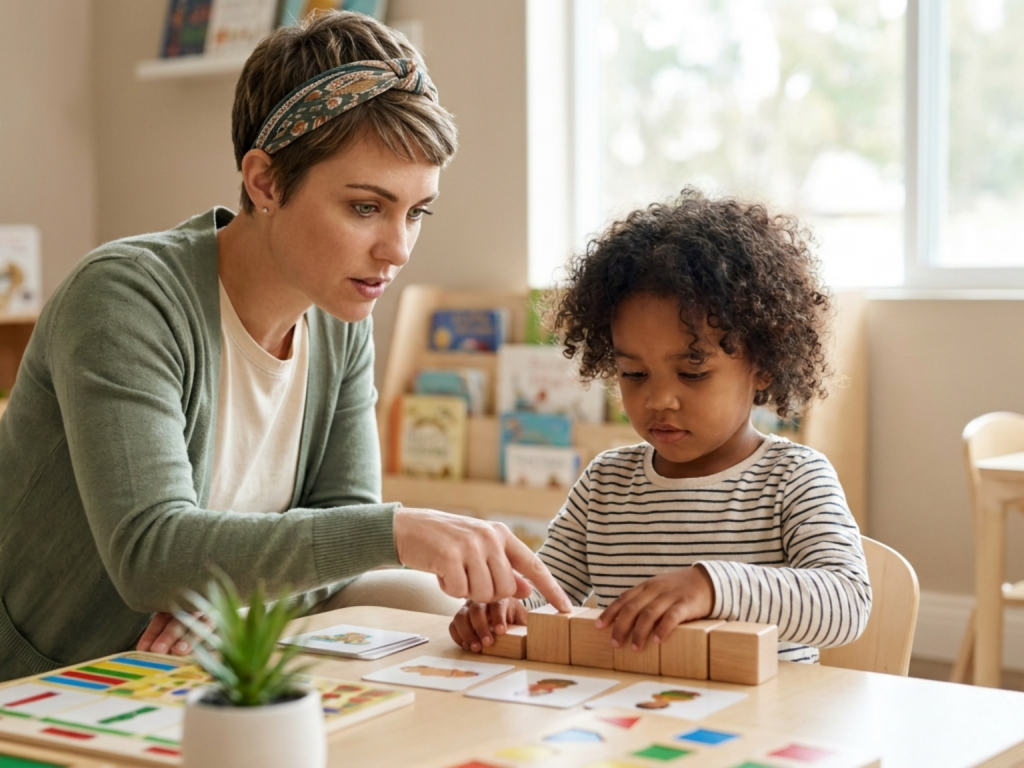
A cognitively supportive environment has several features: it is emotionally predictable, language-rich, physically safe, and flexible enough for exploration. Children benefit from adults who notice their interests and extend them. If a child is fascinated by insects, an adult might ask, “How many legs do you see?” or “Where do you think it is going?” This kind of guided participation builds attention, observation, vocabulary, and hypothesis-making. It is different from drilling facts, because it starts from the child’s curiosity.
Screen media deserves nuance. High-quality, age-appropriate media used with an engaged adult may support some learning, especially when the adult helps connect the content to real life. Passive, prolonged, or sleep-disrupting screen use is less supportive, particularly when it displaces conversation, movement, reading, and play. Families do not need perfection; they need workable routines that protect sleep, connection, and active learning.
Preschool or childcare settings can also support cognition when they provide warm relationships, predictable routines, peer interaction, developmentally appropriate challenges, and time for play. The best learning environments respect the child’s nervous system. A child who is hungry, exhausted, overstimulated, or frightened is less available for higher-level thinking.
Supporting growth without pressure
Families often ask what they should “do” to make a preschooler smarter. A more useful goal is to support curiosity, communication, and self-regulation while protecting the child’s sense of safety. Cognitive growth is optimized through repeated, responsive, ordinary interactions. Talking during meals, naming feelings, reading together, cooking, sorting laundry, building towers, singing, visiting parks, and answering questions all provide powerful learning input.
Helpful strategies include:
- Follow the child’s attention: describe what they are looking at or doing, then add one small new idea.
- Use serve-and-return interaction: respond to gestures, sounds, questions, and play themes with warm, contingent feedback.
- Make routines predictable: consistent sequences reduce cognitive load and help children practice planning.
- Offer manageable choices: “red cup or blue cup” supports autonomy and decision-making without overwhelming the child.
- Normalize effort: praise persistence, strategy, and problem-solving rather than fixed intelligence.
It is reasonable to introduce letters, numbers, and early science concepts, but preschool learning should remain active and relational. Worksheets and flashcards are not inherently harmful, yet they are usually less powerful than meaningful play and conversation. If a child resists structured tasks, that resistance may reflect fatigue, temperament, immature executive function, or a mismatch between the task and the child’s developmental stage.
Health factors and when to seek guidance
Because cognition depends on the whole child, medical and developmental factors can affect learning. Hearing differences may look like inattention or language delay. Vision problems can interfere with puzzles, books, drawing, or navigation. Sleep-disordered breathing, chronic sleep deprivation, iron deficiency, seizures, significant psychosocial stress, medication effects, and neurodevelopmental conditions can all influence attention, memory, behavior, or language. This article cannot diagnose any child, and a single behavior rarely explains the whole picture.
Consider discussing concerns with a pediatrician, family physician, health visitor, developmental-behavioral pediatrician, psychologist, speech-language pathologist, occupational therapist, or early childhood specialist if a child loses previously acquired skills, rarely uses words or gestures to communicate, does not engage in pretend play, cannot follow simple familiar directions, seems unable to hear or see well, has extreme difficulty with transitions, or struggles to participate in daily routines. Early evaluation is not a label of failure. It is a way to understand the child’s profile and match supports to their needs.
Parents and caregivers also deserve support. Worrying about development can be emotionally heavy, especially when comparisons with other children are constant. Try to observe patterns over time rather than isolated moments. Bring concrete examples to appointments: what the child understands, says, remembers, avoids, seeks, and does during everyday routines. A careful history, developmental screening, hearing and vision checks, and when indicated, more specialized assessment can clarify the next steps.
When to get professional advice
- Seek prompt medical guidance if a child loses language, motor, social, or play skills they previously had.
- Discuss concerns if speech, hearing, vision, attention, or behavior limits daily functioning.
- Do not assume delayed communication is simply stubbornness or poor motivation.
- Ask for help if sleep problems, feeding concerns, seizures, chronic illness, or stress seem to affect learning.
- If caregivers feel overwhelmed or unsafe, urgent family and mental health support is appropriate.
Tools & Assistance
- Schedule routine pediatric developmental surveillance and screening visits.
- Request hearing and vision assessment if learning or language concerns appear.
- Use shared reading, pretend play, outdoor exploration, and everyday conversation as daily learning tools.
- Keep brief notes on examples of communication, memory, play, attention, and transitions.
- Ask about early intervention or preschool developmental services if concerns persist.
FAQ
Is it normal for a preschooler to ask endless questions?
Yes. Frequent “why” and “how” questions are common and often reflect expanding language, curiosity, and causal reasoning.
Should a 4-year-old already read?
Not necessarily. Some children recognize letters or early words, but fluent reading is not expected for every preschooler. Shared reading and language play are more important than pressure.
Can play really count as cognitive learning?
Yes. Pretend play, building, sorting, drawing, and turn-taking all involve memory, planning, symbolic thought, language, and self-regulation.
When is a cognitive delay a medical concern?
Concern increases when difficulties are persistent, affect daily functioning, involve loss of skills, or occur with hearing, vision, speech, motor, sleep, or behavioral concerns. A clinician can guide evaluation.
Sources
- PMC (PubMed Central) / National Institutes of Health — Environmental opportunities facilitating cognitive development in preschool children
- Harvard University Center on the Developing Child — The Science of Early Childhood Development
- NCBI Bookshelf / National Center for Biotechnology Information — Child Development and Early Learning
Disclaimer
This article is for general educational purposes only and does not diagnose, treat, or replace care from a qualified healthcare professional. Consult a clinician for concerns about a child’s development, behavior, hearing, vision, or health.


















Please log in to leave a comment.