
Intro
Reaching and grasping are early motor activities through which babies learn about their bodies, objects, and the surrounding environment. A baby who turns toward a toy, extends an arm, opens the hand, closes the fingers, or brings an object toward the mouth is coordinating visual attention, posture, muscle activation, sensation, and motivation.
These activities do not need to resemble formal exercises. The most useful opportunities are brief, playful, and supervised, with the caregiver adapting the object, position, and pace to the baby's abilities. Progress is variable, especially among premature infants or babies with medical conditions, so observations are more informative than comparisons with another child.
Highlights
Reaching and grasping depend on integrated visual, postural, sensory, and motor control.
Simple household routines and floor-play opportunities can provide meaningful practice when safety is carefully managed.
Babies benefit from repeated chances to explore rather than pressure to perform a particular movement.
Persistent asymmetry, loss of a previously acquired skill, or marked difficulty using the hands warrants discussion with a healthcare professional.
What reaching and grasping involve
Reaching is the intentional movement of the arm and hand toward a target. Grasping is the subsequent organization of the fingers, thumb, and palm to secure that object. Although these actions appear simple, they involve anticipatory motor planning, eye-hand coordination, postural stability, muscle tone, and sensory feedback. The baby must estimate where the object is, select a movement trajectory, shape the hand, and adjust force when contact occurs.
Early movements are often broad and imprecise. A young infant may swipe at an object or accidentally make contact before gradually developing more purposeful reaching. The hand may initially close around objects using the whole palm. With experience, babies commonly begin to use the thumb and fingers more selectively, manipulate objects near the midline, and eventually attempt more refined finger control.
Reaching and grasping also support learning beyond motor skill. Handling a safe object provides information about weight, temperature, texture, shape, and movement. Visual attention may guide the hand, while tactile and proprioceptive feedback helps the baby determine whether the object has been contacted and how firmly it is being held. These linked experiences contribute to emerging fine motor skills and visual-motor integration.
How skills emerge during infancy
Development follows a broad sequence, but the timing and appearance of individual skills vary. During the early months, babies may watch their hands, bring them toward the mouth, and briefly hold an object placed in the palm. As head and trunk control improve, they can spend more time looking at and reaching toward objects while lying on the back or during supervised tummy time while awake.
Later in infancy, reaching usually becomes more accurate. A baby may extend one or both hands, grasp a toy, bring it to the mouth, shake it, bang it, or transfer it between hands. These actions reflect increasing bilateral coordination and the ability to stabilize the trunk while moving an arm. Some babies first use a raking motion with several fingers and then gradually develop a more precise pincer grasp, using the thumb and index finger to pick up small items.
Age ranges should be interpreted cautiously. A premature infant may need assessment using corrected age, depending on gestational age and local clinical guidance. A clinician may also consider the baby’s overall movement quality, muscle tone, sensory responses, communication, and ability to participate in everyday activities rather than evaluating one isolated skill.
Play activities that encourage reaching
Choose a calm, alert period when the baby is not hungry, overtired, or overwhelmed. Place one large, age-appropriate toy within easy visual range and allow time for the baby to look, orient, and initiate movement. If the toy is too far away, move it closer rather than repeatedly placing it in the hand. A pause gives the baby an opportunity to plan the action and discover the relationship between intention and movement.
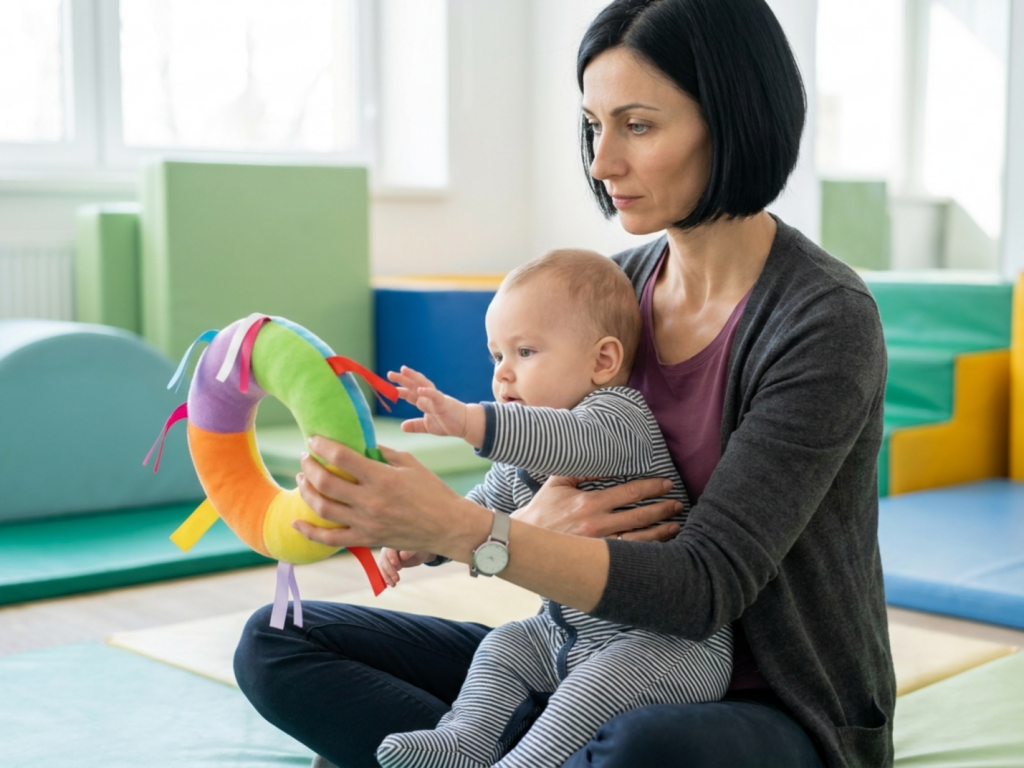
- Offer a lightweight toy with a simple shape that is easy to hold, such as a large ring or soft block.
- Position an object slightly to one side, then the other, to invite turning and reaching in both directions.
- Place a toy near the midline during supported floor play to encourage bringing the hands together.
- Slowly move a high-contrast or visually interesting object through a small arc, stopping often so the baby can attempt to follow and reach.
- Use a caregiver’s face, voice, or a familiar sound as a motivating target, while keeping the interaction relaxed.
Supported positions can be varied according to the baby’s abilities: lying on the back, lying on the side, or engaging in supervised floor play. Avoid forcing a limb into a position or repeatedly correcting the hand. Responsive interaction, including copying the baby’s sounds and pausing for their response, can make the activity more engaging without turning play into a test.
Activities for grasping and hand exploration
Once a baby can make contact with objects, offer opportunities to hold, release, rotate, and explore them. The object should be large enough to avoid choking risk, free of detachable parts, and made for the baby’s developmental stage. A soft cloth, textured teether, broad-handled rattle, or large nesting cup may provide different sensory and mechanical experiences.
Place an object in the center of the palm only when the baby is not yet reaching reliably, then allow the hand to close naturally. For a baby who is beginning to grasp, hold a second object nearby and wait to see whether they look, reach, or shift attention. This supports active participation. You can also offer two safe objects, one in each hand, and observe whether the baby brings them together, mouths them, or releases one before accepting another.
Hand-to-hand transfer is a useful later activity because it requires visual attention, grasp adjustment, and coordination between the two sides of the body. A baby may transfer an object spontaneously during exploration; caregivers can support this by presenting objects near the midline and avoiding unnecessary hand-over-hand assistance. Releasing is equally important. Placing a container or open surface nearby gives the baby a chance to let go voluntarily, although accurate placement is not expected early on.
Texture exploration should remain supervised. Offer clean, non-toxic materials and observe whether the baby appears interested, distressed, fatigued, or overloaded. Sensory processing differs between children, so a quiet object may be more suitable than a noisy or highly textured one at a particular time.
Making activities supportive and accessible
The quality of the movement opportunity matters more than the number of repetitions. Short sessions distributed across the day are generally easier for infants than a prolonged practice period. Everyday routines can become developmental opportunities: holding a washcloth during bathing, touching a caregiver’s hand during dressing, reaching toward a spoon before feeding, or grasping a soft sock during a clothing change.
Adjust the challenge systematically. If a toy is difficult to reach, bring it nearer or use a larger handle. If the baby consistently succeeds, vary the distance slightly, change the orientation, or offer an object requiring both hands. Keep the trunk supported when postural control is still emerging. Excessive support can limit active movement, while inadequate support may make reaching inefficient or tiring.
Observe the whole body rather than focusing only on the fingers. A baby may compensate for limited trunk stability by stiffening the shoulders, leaning excessively, or becoming frustrated. A change in position, a rest break, or a simpler object may restore participation. Encourage both hands over time, but do not demand equal use during every activity. Some variation is expected; persistent or pronounced asymmetry deserves professional attention.
Caregivers can record brief observations, such as which objects attract attention, whether the baby reaches with one or both hands, and how the hand releases an object. Such notes can help a pediatrician, occupational therapist, or physical therapist understand functional patterns if questions arise.
Safety and signs to discuss with a professional
All reaching and grasping activities require close, continuous supervision. Babies explore with their mouths, and an object that appears harmless can become hazardous if it is small, detachable, sharp, brittle, or capable of blocking the airway. Keep coins, button batteries, magnets, medication, food pieces that are not appropriate for the baby’s feeding stage, and small household items out of reach. Inspect toys regularly for cracks, loose parts, peeling surfaces, and long cords.
Use a stable surface and an awake adult’s attention during floor play. Do not place a baby in an unsafe elevated position to encourage reaching, and do not leave a baby unattended with a toy, even briefly. Follow current infant sleep guidance separately from play guidance: awake play positions should not be used as unsupervised sleep positions.
Consider contacting a healthcare professional if the baby consistently does not appear to notice or attempt to interact with objects, has marked difficulty opening or closing one hand, uses one side much less than the other, appears unusually stiff or floppy, or cannot maintain a position needed for play. Also seek advice after any loss of a previously acquired motor skill, a significant change following illness or injury, or persistent distress during ordinary movement.
These observations do not establish a diagnosis. They are reasons to seek individualized assessment. A pediatric clinician can review the child’s medical and developmental history and, when appropriate, arrange referral to an occupational therapist, physical therapist, or other specialist. Early guidance may identify practical adaptations and reassure families when variation is within a broad expected range.
Safety reminders
- Supervise every activity closely, especially when objects may be mouthed.
- Avoid small parts, button batteries, magnets, loose cords, and damaged toys.
- Stop when the baby is tired, distressed, or showing signs of sensory overload.
- Discuss persistent asymmetry, unusual stiffness or floppiness, or skill loss with a healthcare professional.
- Do not use play positioning as a substitute for safe, supervised sleep practices.
Tools & Assistance
- A selection of large, age-appropriate grasping toys checked regularly for damage
- A clean floor mat for supervised floor play and position changes
- A brief observation log noting hand use, visual attention, grasping, and release
- A pediatrician, occupational therapist, or physical therapist for individualized developmental guidance
FAQ
How often should I practice reaching and grasping with my baby?
Offer frequent, brief opportunities during naturally alert periods. There is no required number of repetitions; stop when the baby becomes tired, frustrated, or disengaged.
Should I place toys in my baby's hand or wait for reaching?
Both can be appropriate. Placing a safe object in the palm may support early exploration, while positioning an object within reach allows the baby to initiate the movement. Use the least assistance needed for active participation.
Is it concerning if my baby prefers one hand?
Temporary variation can occur, particularly when a baby is tired or reaching toward an object placed to one side. Consistent marked preference, reduced movement of one arm, or other movement concerns should be discussed with a pediatric clinician.
Can ordinary household objects be used for these activities?
Some large, clean, sturdy objects may be suitable under direct supervision, but purpose-designed infant items are often easier to assess for choking, breakage, and material safety. Never offer small, sharp, toxic, magnetic, or detachable items.
When should a premature baby's reaching skills be assessed?
Ask the baby's healthcare professional how corrected age should be used and when assessment is appropriate. Interpretation should include the baby's gestational age, medical history, and overall movement pattern.
Sources
- PubMed Central / NIH — Reach-to-Grasp: A Multisensory Experience
- PubMed / NIH — The preparation of reach-to-grasp movements in adults, children, and children with movement problems
- PubMed / NIH — Reaching and Grasping Movements in Parkinson's Disease
Disclaimer
This article is for general educational purposes and does not diagnose, treat, or replace advice from a qualified healthcare professional. Seek individualized medical guidance for developmental concerns or urgent safety issues.














Please log in to leave a comment.