
Intro
The first bath is one of the earliest care decisions many families face, and it is reasonable to feel uncertain about timing. For most healthy newborns, the first bath does not need to happen immediately after birth. In fact, major guidance supports waiting at least 24 hours when possible, and many clinicians also prefer to delay full immersion until the umbilical cord stump has separated.
That timing is not just tradition. Newborns lose heat quickly, and early bathing can interfere with temperature stability. A careful first bath also gives you time to learn your baby’s cues, inspect the skin, and decide whether a sponge bath is the better first step. The right answer depends on your baby’s condition, your delivery setting, and your healthcare team’s advice.
Highlights
For most healthy newborns, the first bath can wait at least 24 hours, and sometimes longer if the baby is not ready for immersion.
If the umbilical cord stump is still attached, a sponge bath is often preferred over a tub bath.
The main reasons to delay are temperature stability, skin protection, and a calmer transition for both baby and caregiver.
Babies born preterm, medically fragile, or needing special care may need a different bathing plan from the start.
The usual timing for a first bath
For many babies, the first bath is best delayed rather than rushed. The World Health Organization recommends wiping the baby dry and delaying the first bath for at least 24 hours after birth. The American Academy of Pediatrics notes that if a full day is not possible for cultural reasons, at least 6 hours is a minimum fallback, but longer is still preferable when feasible. The point of waiting is not cosmetic. Early drying and skin-to-skin contact help protect newborn temperature regulation, which is still immature in the first hours after birth.
There is also a practical reason to wait: the first day is often focused on feeding, bonding, monitoring breathing and color, and establishing warmth. A newborn who is stable but still adapting may do better with a gentle wipe-down than with immersion in water. If your baby was premature, had low birth weight, needed resuscitation, or is being monitored for another issue, the timing should be individualized by the clinical team.
Why waiting often makes sense
Newborns are vulnerable to heat loss because they have a relatively large surface area, limited body fat, and immature thermoregulation. Bathing too early can lower skin temperature and sometimes core temperature as well, especially if the room is cool or the bath lasts too long. That is why many maternity units now prioritize drying, wrapping, and skin-to-skin contact before any bath is considered.
Waiting also gives the skin its own small advantages. Vernix caseosa, the white waxy coating seen on many newborns, helps protect the skin barrier and may have antimicrobial properties. You do not need to scrub it off right away. A baby’s skin is not dirty in the adult sense, and the first bath is not a hygiene emergency. Meconium, blood, or other visible secretions can be cleaned gently, but the rest can usually wait until the baby is warm, feeding, and settled.
Sponge bath or full bath
In the first days of life, a sponge bath is often the most practical option, especially if the umbilical cord stump is still attached. Mayo Clinic guidance reflects the American Academy of Pediatrics recommendation to use sponge baths until the cord stump falls off, which may take a week or two. That approach keeps the cord area drier and avoids unnecessary handling of a healing stump.
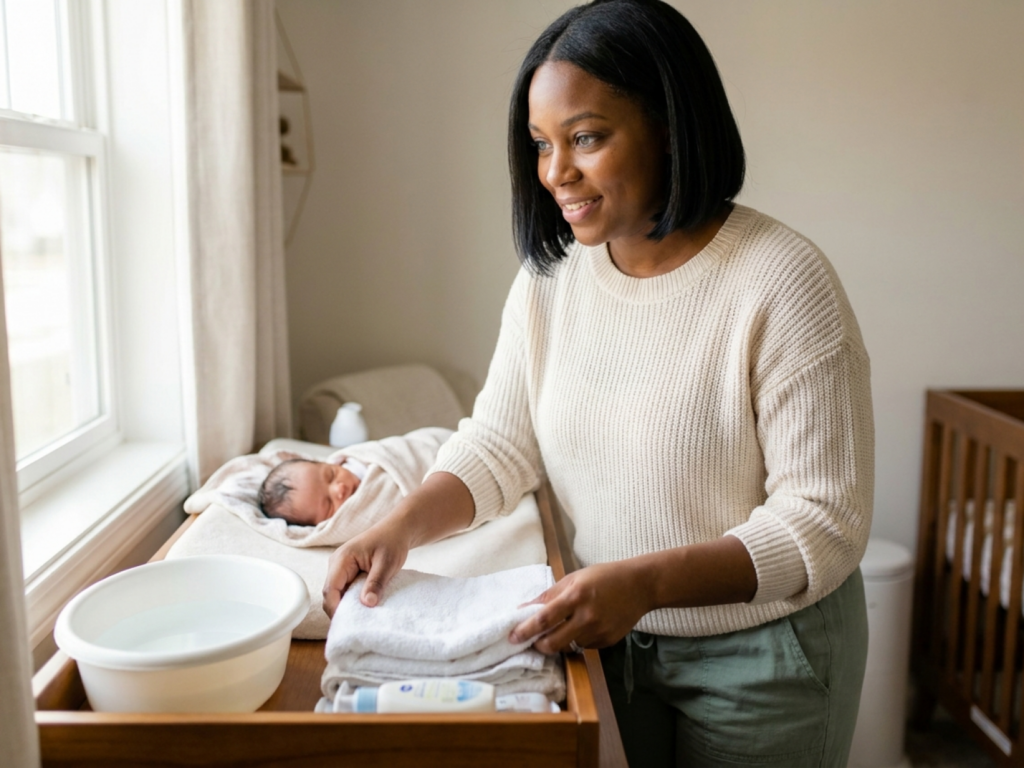
A sponge bath means washing the baby with a soft cloth or cotton pad while keeping most of the body supported on a towel or flat surface. You clean one area at a time and keep the rest covered so the baby does not cool down. A full bath, by contrast, involves more of the body in water and generally becomes more appropriate once the stump has fallen off and the baby is otherwise well. There is no advantage to forcing the transition early. In a newborn, comfort and temperature stability matter more than speed.
How to prepare for the first bath
Preparation is what makes the first bath feel calm rather than improvised. Choose a warm room without drafts, gather every item before you start, and keep the bath brief. Water should feel warm, not hot; many families use a thermometer or the elbow test, but the deeper point is to avoid scalding and avoid water that feels merely lukewarm once it is in the basin. A safe bath temperature for babies is important because infants cannot move away from discomfort as easily as older children.
Set out a towel, clean diaper, fresh clothes, a washcloth, and whatever cleanser you plan to use. Mild fragrance-free products are usually enough, and some babies do fine with plain water for the first baths. If you use soap, keep it minimal and avoid perfumed or harsh products that can irritate newborn skin. For hair, a small amount of mild baby shampoo is usually sufficient when needed, but many newborns do not need frequent shampooing at all. The goal is not a deep clean. It is a controlled, gentle routine that preserves warmth and protects the skin barrier.
Keep a hand on the baby whenever support is needed, and never leave the baby unattended in or near water. Even a small amount of water requires constant attention. If you feel rushed, stop and reset. A safer bath is worth taking longer to prepare.
A calm first-bath routine
Begin by undressing the baby only when you are ready to wash. Many parents find it easier to clean the face first, then the neck, hands, and diaper area, because those areas are easiest to manage while the baby is still warm. With a sponge bath, clean one section at a time and dry it before moving on. With a tub bath, lower the baby in slowly and support the head, neck, and body throughout.
Watch the baby’s cues closely. Shivering, mottled skin, grimacing, crying that escalates rather than settles, or color change can mean the bath should end. Dry the skin folds carefully afterward, especially around the neck, armpits, and groin, because moisture trapped in folds can irritate the skin. If the cord stump is still present, keep it dry unless your clinician has given different instructions.
For most families, the first bath is short. That is appropriate. A successful bath is not measured by how long it lasts or how much soap you use. It is measured by whether the baby stays warm, comfortable, and secure while you learn the routine.
When to ask for individualized advice
There are situations where general timing advice is not enough. Ask your pediatrician, midwife, nurse, or newborn team for specific guidance if your baby was born preterm, has a medical condition, is on a warmer or incubator plan, or had any instability after birth. Babies with jaundice, skin injury, infection concerns, or umbilical cord issues may also need a modified approach. In those cases, the first bath should fit the medical picture, not a generic schedule.
It is also reasonable to ask for help if you are unsure whether to do a sponge bath or a full bath, or if the baby seems unusually sleepy, irritable, or difficult to keep warm during care. There is no prize for improvising through uncertainty. Newborn bathing should be simple, safe, and adjusted to the baby in front of you. If your instincts say something feels off, pause and call your healthcare professional rather than trying to work it out alone.
When to delay or pause the bath
- Delay the first bath if your newborn is cold, unstable, or not yet settled after birth.
- Use caution if the umbilical cord stump is still attached; a sponge bath is often more appropriate.
- Stop the bath if the baby seems chilled, distressed, or difficult to support safely.
- Do not bathe without direct supervision and constant physical support.
- Ask a clinician before changing the routine for a preterm or medically complex newborn.
Tools & Assistance
- Pediatrician or newborn clinic
- Maternity nurse or midwife guidance
- Baby bath thermometer
- Soft washcloth and clean towel
- Fragrance-free newborn cleanser
FAQ
How long should I wait before the first baby bath?
For most healthy newborns, at least 24 hours is recommended when possible. Some guidance allows a shorter delay if cultural practice requires it, but longer is often better.
Can I bathe my baby before the umbilical cord falls off?
Yes, but sponge bathing is usually preferred until the stump separates. That keeps the area drier and reduces unnecessary handling.
Does my baby need soap for the first bath?
Not always. Many newborns do well with water alone or very mild, fragrance-free cleanser used sparingly.
What if my baby cries during the bath?
Some protest is normal, but persistent distress, shivering, or color change are reasons to stop and warm the baby. If it keeps happening, ask your clinician for guidance.
Sources
- Mayo Clinic — Baby bath basics: A parent's guide
- World Health Organization — Caring for a newborn
- HealthyChildren.org / American Academy of Pediatrics — Bathing Your Baby
Disclaimer
This article is for general information only and does not replace advice from your pediatrician, midwife, or other licensed clinician. Seek individualized guidance for preterm, ill, or medically complex newborns.














Please log in to leave a comment.