
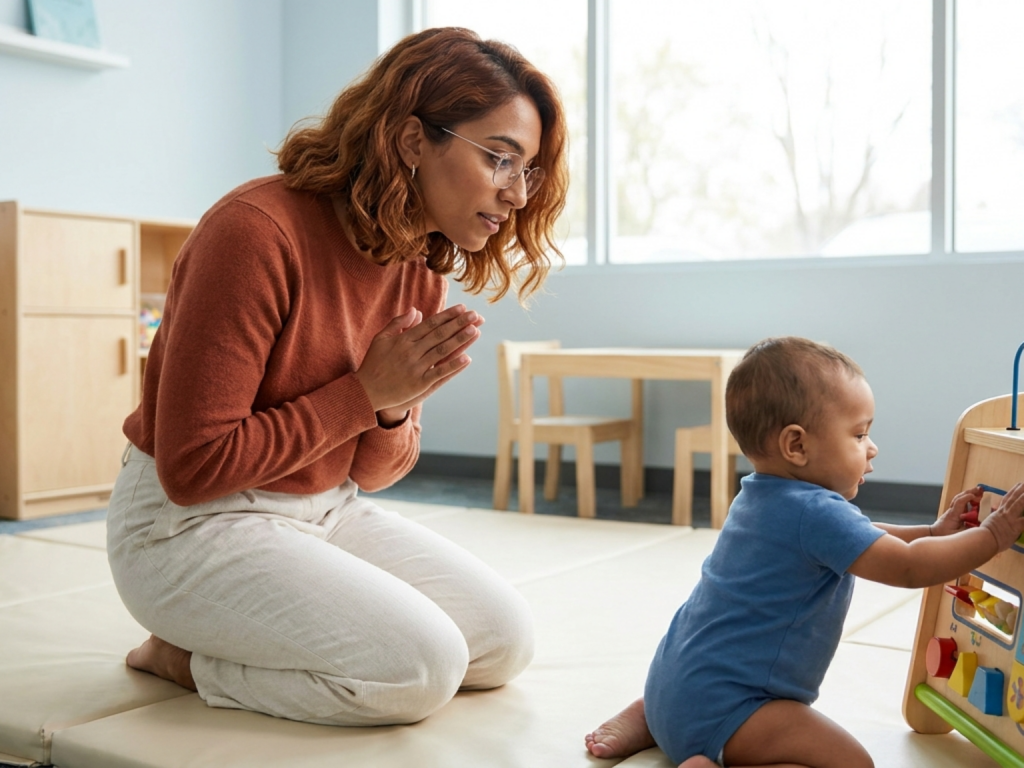
Intro
Reaching, grasping, and releasing are closely related fine motor skills that develop through the interaction of vision, posture, muscle tone, sensation, and emerging voluntary motor control. During the first year, a baby typically progresses from automatic hand movements to purposeful reaching, increasingly precise grasping, transferring objects between hands, and controlled release.
Milestones describe common developmental patterns rather than deadlines. Babies vary in the timing and quality of new skills, and children born prematurely may be assessed using corrected age for preterm infants. The most useful observations concern steady progress, opportunities to practice, and whether movements appear comfortable, purposeful, and reasonably symmetrical.
Highlights
Newborn hand movements are dominated by reflexes; purposeful reaching generally emerges as visual and motor systems become better coordinated.
Grasping usually progresses from a whole-hand palmar grasp toward a more refined pincer grasp using the thumb and index finger.
Controlled release often develops later than grasping because it requires graded muscle relaxation, attention, and postural stability.
A single late milestone is usually less informative than a broader pattern of limited progress, loss of skills, or persistent asymmetry.
What These Skills Mean
Reaching is the intentional movement of an arm and hand toward a target. Early reaching may be inaccurate or interrupted by immature trunk and shoulder control. Over time, babies learn to visually locate an object, orient the arm toward it, adjust the hand as they approach, and make contact with increasing accuracy.
Grasping is the act of securing an object with the fingers, thumb, or palm. A newborn’s grasp may be triggered by contact with the palm, whereas an older infant increasingly opens the hand in anticipation, closes it around a selected object, and modifies the grip according to size, shape, and texture.
Releasing involves letting go intentionally rather than simply losing contact. It requires coordinated inhibition of the muscles that maintain the grip. At first, an infant may drop an object accidentally; later, the baby may release it into a container, onto a surface, or into another person’s hand. These abilities are related but do not necessarily appear at the same time.
Birth to About 3 Months: Reflexes and Early Orientation
In the newborn period, the palmar grasp reflex can cause the fingers to close when the palm is touched. Hands may also remain fisted much of the time, then open briefly during relaxed or alert states. These movements are not yet evidence of deliberate object selection. Babies may bring their hands toward the mouth, wave the arms, or briefly regard their hands as visual attention and motor control begin to connect.
By approximately 2 to 3 months, many infants spend more time with the hands open and may swipe toward an interesting object. The movement is often broad, slow, and poorly calibrated. A baby may look at a toy without reaching for it, reach without making contact, or touch an object and fail to hold it. These variations are expected while shoulder stability, midline orientation, and visual tracking mature.
Positioning affects what can be observed. During supervised tummy time while awake, a baby practices head, neck, and shoulder control that later supports reaching. When the infant is calm and alert, placing a simple, lightweight object within visual range can invite attention without requiring the baby to perform on demand.
About 3 to 6 Months: Purposeful Reaching and Palmar Grasp
Between roughly 3 and 4 months, reaching becomes more visibly purposeful for many babies. The infant may extend an arm toward a toy, bring both hands together at the chest, and make repeated attempts to contact an object. Accuracy improves gradually as visual information is used to guide the arm. The baby may also reach from different positions, although success can vary with fatigue, motivation, and the amount of postural support available.
Once contact is made, a whole-hand or palmar grasp commonly predominates. The fingers wrap around the object, while the thumb may have limited opposition. Babies often hold a toy briefly, bring it to the mouth, shake it, or accidentally drop it. Dropping is not necessarily a failure of development; it reflects immature release control and the ongoing discovery of cause and effect.
From approximately 5 to 6 months, many infants can hold an object more reliably and may begin to reach with one hand while stabilizing the body with the other. They may examine objects by mouthing, turning, banging, and rubbing them. Safe, washable objects of appropriate size provide rich sensory feedback, but every item must be checked for choking, breakage, and detachable parts.
About 6 to 9 Months: Transfer, Refinement, and Intentional Release
During the second half of the first year, reaching generally becomes faster and more accurate. Many babies can pick up an object from a nearby surface, adjust the wrist and fingers during approach, and grasp objects with greater consistency. The radial side of the hand, particularly the thumb and first fingers, begins to contribute more actively than in the earlier whole-hand grasp.
Transferring an object from one hand to the other is an important sign of emerging bilateral coordination. It allows the infant to compare, rotate, and manipulate objects with both hands. Babies may also bang two objects together, hold one item while reaching for another, or use a raking motion to pull a small object closer. These actions are exploratory and do not yet represent the mature fingertip control needed for small-tool use.
Release often remains variable. A baby may let go when distracted, drop an item over the side of a chair, or release it onto a broad surface. More deliberate placement can emerge toward the later part of this range, especially when the object is released into an open container or handed toward a caregiver. The timing depends on attention, postural control, and the object’s size and weight.
About 9 to 12 Months: Pincer Grasp and Controlled Placement
From approximately 9 months onward, many infants develop a more precise grasp. The thumb and index finger begin to oppose one another, first using the sides of the fingers and later the fingertips. This pincer grasp supports picking up small pieces of food and other appropriately sized objects. Precision may appear suddenly in one situation and remain inconsistent in another because attention, surface friction, and object characteristics all influence performance.
Babies may point, poke with an index finger, use the index finger and thumb to pick up an item, and intentionally place objects down. They may hand an object to a caregiver, put items into and take them out of a container, or release a toy in response to a social game. These actions combine fine motor control with communication, imitation, problem-solving, and social attention.
Controlled release should be interpreted in context. A baby who can drop a toy into a large container may not yet be able to place a small object accurately on a narrow target. Similarly, a child may use both hands for a task but show a preferred hand intermittently. Early hand preference can fluctuate; marked, persistent use of only one hand, especially with limited use of the other, deserves professional discussion.
What Influences the Timeline
Hand skills do not develop in isolation. Trunk and shoulder stability provide a platform for the forearm and hand. Visual acuity and eye-hand coordination help the baby identify and approach a target. Muscle tone, joint mobility, tactile discrimination, and proprioception contribute to how the infant grades force and recognizes whether an object is secure. Emotional state also matters: hunger, illness, overstimulation, and fatigue can temporarily reduce reaching or grasping.
Prematurity, medical complications, vision concerns, neuromuscular conditions, and differences in sensory processing can alter the sequence or timing. For children born early, clinicians may consider corrected age for preterm infants when comparing progress with typical developmental expectations. Corrected age is only one part of assessment; a professional also considers the child’s medical history, movement quality, feeding, communication, and overall functional participation.
Developmental ranges should not be used to label a child from a single observation. A baby may be advanced in reaching but slower to release, or may demonstrate a skill at home that is absent in a busy clinical setting. Repeated observations across ordinary routines provide more meaningful information than a one-time test.
Supporting Practice Safely
Babies learn these skills through frequent, low-pressure opportunities. Place a preferred toy within easy visual reach, then vary its position slightly to encourage turning, reaching across the body, and using either hand. Offer objects with different safe textures and shapes, allowing the infant to hold, mouth, rotate, and transfer them. Floor-based play on a firm, supervised surface generally gives more freedom for movement than prolonged time in restrictive equipment.
Caregivers can model release by placing a toy into a container and pausing to let the baby imitate. Games such as passing an object back and forth, filling and emptying a large container, or dropping a toy onto a broad surface make the skill meaningful. During meals, follow local feeding guidance and use only foods and utensils that are developmentally appropriate and prepared to reduce choking risk.
Avoid forcing the fingers open, pulling an object from a tightly held hand, or repeatedly testing a skill when the baby is distressed. Practice should be embedded in responsive interaction: follow the infant’s interests, provide adequate support, and stop when signs of fatigue or frustration appear. Consult a pediatric professional before introducing activities that involve small objects, particularly when mouthing is frequent.
When to Seek Developmental Guidance
Discuss concerns with a pediatrician, child health nurse, occupational therapist, or other qualified clinician when progress seems absent, movement quality appears unusual, or a skill is lost. Examples include very limited visual attention to objects, little attempt to reach by the later part of early infancy, persistent difficulty holding objects, or inability to use the hands in increasingly purposeful ways over time.
Persistent infant movement asymmetry is also worth mentioning. Occasional preference for one side is common, especially when a toy is positioned to one side. More concerning patterns may include consistently keeping one hand fisted, rarely reaching with one arm, repeatedly ignoring one side, or showing a clear difference in strength, range, or coordination between the arms.
Urgent medical advice may be appropriate when a new loss of previously acquired hand skills occurs, weakness appears suddenly, the baby seems in pain, or there are associated changes in alertness, feeding, breathing, or general movement. A clinician can assess the infant in context and determine whether monitoring, developmental screening, vision evaluation, or therapy referral is appropriate. Early guidance is supportive and does not require waiting until a concern becomes severe.
When to Contact a Clinician
- A baby loses a previously acquired reaching, grasping, or releasing skill.
- One arm or hand is persistently much less active, weaker, or more tightly fisted than the other.
- The infant appears uncomfortable, unusually stiff, unusually floppy, or unable to move through an expected range.
- There is little purposeful interaction with objects along with concerns about vision, feeding, alertness, or overall movement.
- Any object-related activity creates a choking, ingestion, or injury risk.
Tools & Assistance
- Keep a brief dated record of new hand skills and the situations in which they occur.
- Use routine pediatric visits for developmental surveillance and screening.
- Ask a pediatrician or occupational therapist to demonstrate age-appropriate play opportunities.
- Check toys and feeding items for choking hazards, loose parts, and breakage.
- For premature infants, discuss milestone interpretation using corrected age and the child's medical history.
FAQ
When do babies start reaching for toys?
Many babies begin making purposeful reaching attempts around 3 to 4 months, although early swipes may be inaccurate. Timing varies with alertness, vision, posture, and individual development.
When does a baby develop a pincer grasp?
A pincer grasp commonly begins to emerge during the latter half of the first year, often around 9 to 12 months. It may initially use the sides of the thumb and index finger before becoming more fingertip-based.
Why does my baby grasp an object but not release it on purpose?
Grasping usually becomes reliable before controlled release. Letting go requires coordinated muscle relaxation, attention, and postural control, so accidental dropping can remain common for a period of time.
Should I worry if my baby uses one hand more than the other?
Early hand preference can change, but persistent marked asymmetry, limited use of one hand, or a consistently fisted hand should be discussed with a pediatric professional.
How can I encourage reaching and grasping?
Offer safe, lightweight objects during calm, supervised play, place them within visual reach, and allow the baby to explore at their own pace. Responsive floor play and varied textures can support practice without pressure.
Sources
- McGraw Hill Medical / AccessPediatrics — Fine Motor Development
- FPG Child Development Institute, University of North Carolina at Chapel Hill — Reach/Grasp/Release - Early Learning Progressions
- Children's Hospital of Richmond at VCU — Fine motor development: 0 to 2 years
Disclaimer
This article is for general educational purposes and does not diagnose, treat, or replace advice from a qualified healthcare professional. Seek individualized medical guidance for concerns about your baby's development or safety.















Please log in to leave a comment.